Archive for January 2010

Comic Art Friday: Yes, we do need another Hero

January 15, 2010

I’m not one for causes, generally speaking. The few that I do support, however, I support wholeheartedly. As most of our regular readers know, the fight against breast cancer is one of my causes.

The Hero Initiative is another.

Flash Gordon and Dale Arden, pencils by comics artist Ralph Reese

The Hero Initiative is a nonprofit 501(c)(3) charitable organization whose efforts benefit comic book creators in need. Although in recent years, some comic book artists and writers have managed to turn their creative endeavors into multimillion-dollar enterprises, these still-rare circumstances haven’t always existed.

For decades, comics creators worked for the most part on a freelance basis, for paltry remuneration by most standards, and without corporate healthcare or pension benefits. As a result, many of these talents hit rocky financial straits later in life when their skills were no longer in demand, and as the sorts of health challenges that become common as people grow older befell them. No safety net was in place to help.

Until 2000, when the Hero Initiative — formerly known as ACTOR (A Commitment to Our Roots) — was established.

Supported by a consortium of comics publishers — including Marvel, Image, Dark Horse, Dynamic Forces, Top Cow, and Wizard — the Hero Initiative provides financial assistance to veteran comic book writers and artists (defined as those with industry credits spanning ten years or longer) in need. The disbursement of funds is overseen by a board entirely composed of comics creators, including such legends as George Pérez, Dick Giordano, John Romita Sr., Denny O’Neil, Jim Valentino, and Roy Thomas.

Last year, the Hero Initiative began supplementing its fundraising efforts through the sale of annual memberships. I’m proud to be HERO member #115. (Stan Lee, the longtime writer, editor, and publisher of Marvel Comics, is #1.)

One of the perquisites of membership renewal is a sketch card drawn by a noted comics artist. This year, I received a sketch of Flash Gordon and Dale Arden drawn by Ralph Reese, who worked on the Flash Gordon newspaper strip in the early 1990s. Reese’s diverse credits include work on projects ranging from horror titles (for DC, Marvel, and Warren) to superheroes (THUNDER Agents) to science fiction (Magnus: Robot Fighter) to humor (National Lampoon). As related in this article from the Los Angeles Times, Reese himself has been helped by the Hero Initiative, making this sketch all the more awesome.

Times are tough, and there’s no end of worthy opportunities for whatever cash one has available to support such causes. But if you’ve enjoyed the work of comics creators over the years, and you’d like to show your appreciation in a tangible manner, the Hero Initiative is a good way to do that.

And that’s your Comic Art Friday.
Comic Art Friday: Bring down The Wall!

January 8, 2010

Our first Comic Art Friday of 2010 spotlights the first Common Elements arrival of the Teens Decade. Artist Mike Leeke actually completed this masterpiece in the closing days of ’09, but since it just landed on my doorstep earlier this week, we’ll count it as a ’10.

What better way to launch a New Year than with an action-fraught Common Elements trifecta?

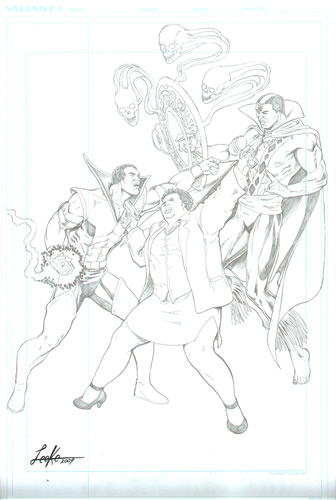
Tempest, Amanda Waller, and Brother Voodoo, pencils by comics artist Mike Leeke

On the left is Tempest, the short-lived superhero identity of Joshua Clay, a DC supporting character who’s better known by his civilian name. On the right, we have Dr. Jericho Drumm, a.k.a. Brother Voodoo, Marvel’s supreme master of the Haitian mystic arts. The pistol-packing mama in the middle is Amanda Waller, the hard-charging string-puller behind the Suicide Squad, and the White Queen within the shadowy international espionage organization known as Checkmate.

The artist wielding the pencil, Mike Leeke, enjoyed lengthy runs on Comico’s anime adaptation Robotech in the ’80s, and on numerous titles for Valiant (including X-O Manowar and H.A.R.D. Corps) during the ’90s. He’s best known, though, as one of the primary artists on the critically acclaimed Elementals, created and written by Bill Willingham, later the creator of DC/Vertigo’s popular fantasy series Fables.

As Tempest, Joshua Clay battled the forces of evil as a member of the second version of the Doom Patrol. During this period, Joshua played a key role in the concluding events of the universe-altering Crisis on Infinite Earths (he’s prominently featured on the cover of the final book of the 12-issue Crisis maxiseries). After hanging up his superhero togs, Joshua — a former U.S. Army corpsman who later graduated to full-fledged physician — becomes the Patrol’s resident sawbones and health adviser. Alas, poor Joshua was murdered by Niles Caulder, the Doom Patrol’s commander, and — understandably — hasn’t been seen much since.

A member of the ’70s-spawned wave of black superheroes, Brother Voodoo premiered in a brief miniseries in Marvel’s Strange Tales anthology — a book which at various times in its long history starred such disparate heroes as Dr. Strange, Adam Warlock, and Nick Fury, Agent of SHIELD. By trade a psychologist, Dr. Jericho Drumm picks up the mantle of his deceased brother Daniel, a houngan (voodoo priest), ultimately developing into the most powerful houngan of all time. Recently, Jericho starred in another short-lived Marvel series, in which he took over for Dr. Strange as this dimension’s Sorcerer Supreme under his new nom de guerre, Doctor Voodoo.

Amanda Waller — nicknamed “The Wall” — possesses no superpowers, yet is as formidable a figure as any hero or villain (at various times, The Wall has been viewed as both) in comics. Throughout most of her career, Amanda has served as a covert operative for either the U.S. government (as when she was the director of the Suicide Squad) or some quasi-governmental agency (as when she was White Queen in Checkmate). A master tactician and political strategist, The Wall manipulates people and situations to exercise control, often for her own ends.

By now, you’ve probably figured out the Common Element that unites these three. And no, it’s not the fact that all three are doctors (Joshua Clay is an M.D., Jericho Drumm holds a Ph.D. in psychology, and Amanda Waller owns a doctorate in political science).

Doesn’t it stand to reason that if you bring together Joshua, Jericho, and The Wall, a battle will erupt?

Of course it does.

And that’s your Comic Art Friday.

The Hawk flies in

January 6, 2010

It only took nine years — in my never-humble opinion, that’s eight years too many — but slugging outfielder Andre “The Hawk” Dawson finally gained election to the National Baseball Hall of Fame.

Dawson didn’t make the necessary total by much. To be enshrined, a candidate has to pull a minimum of 75% of the ballots submitted by members of the Baseball Writers’ Association of America (BBWAA). Dawson netted 77.9%, 15 votes above the cutoff. Last year, he fell 44 ballots shy.

I’ve no explanation why it took Dawson nearly a decade to be elected to the Hall. Anyone who saw him play recalls The Hawk as both a formidable hitter and a talented outfielder during his lengthy major league career. He suffered a good deal from injuries toward the end of his run, and he hung on as a shadow of his former self for about three years beyond the point at which he should have retired. (I can name a few dozen legends of the game who committed that latter indignity, starting with two of my favorites, Willie Mays and Willie McCovey.) But in his prime — beginning with his Rookie of the Year season in 1977 and continuing through his last year with the Chicago Cubs in 1992 — Dawson defined the phrase “money player.”

I’m thrilled that he’s in.

If I’d had a ballot this year, I’d have also voted for:

Roberto Alomar, one of the two best all-around second basemen of my lifetime (Joe Morgan was the other — Jeff Kent, an average-to-dreadful defensive player, was the best offensive player I’ve seen at the position).

Jack Morris, the American League’s best starting pitcher throughout the 1980s.

Barry Larkin, a terrific shortstop on both sides of the ball.

Lee Smith, one of the most imposing closers I’ve ever seen, and former holder of the career record for saves.

I would not have voted for Bert Blyleven, whose 400 votes left him five short of election. Blyleven will get into the Hall eventually — which, if it accomplishes nothing else, will stop his annual whining about not getting in — but he shouldn’t. Blyleven may be the most overrated pitcher of the modern era (unless that’s Don Sutton, who’s already in the Hall, and should never have been elected). His current vote total is inflated by writers who simply look at the numbers, and not at the actual quality of play. I’ve said it before, and I’ll say it every year until he finally cracks through: No one who actually saw Bert Blyleven pitch thinks he was a Hall of Fame-caliber pitcher. And if they do, they don’t know jack about baseball.

Every year, I’m stunned by the wasted votes at the bottom of the tote board. This year is no exception. I don’t know who the two writers were who voted for Ellis Burks, or the two who voted for Eric Karros, or the guys who cast solo votes for David Segui, Pat Hentgen, or Kevin Appier. These clueless people should never be allowed to vote for anything that involves baseball, ever again, period. (Burks, an outfielder who contributed two-plus excellent seasons for my beloved Giants, was a very fine player and, by all accounts, an outstanding teammate. But if he was a Hall of Famer, I’m Barry Bonds.)

Oh, and Mark McGwire? We’re not here to talk about the past.

Burj Khalifa: Arabic for “she’s a big’un”

January 4, 2010

The world’s tallest building opened today, and already they’ve changed its name.

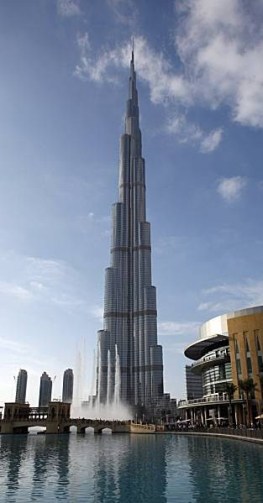
Burj Khalifa, the world's tallest structure

Known throughout its years of construction as Burj Dubai (“Dubai Tower” in Arabic), the 2,717-foot-tall behemoth is now officially Burj Khalifa (“Tower Named After the Rich Dude Who Loaned Us Money” in Arabic). The switch in nomenclature honors Sheik Khalifa bin Zayed Al Nahyan, president of the United Arab Emirates, whose infusion of petroleum cash enabled debt-ridden Dubai to complete the tower.

To give us some perspective, Burj Khalifa stands twice the height of the Empire State Building, and rises more than 50 stories higher than America’s tallest building, Willis Tower (which used to be known as Sears Tower until it was renamed last year… must be a thing with supertall buildings).

Yeah, that’s big.

The tallest building that I personally have ever been inside is the Stratosphere Tower in Las Vegas. For someone as acutely acrophobic as I am — I’m uncomfortable just climbing or descending stairs — standing on the observation deck at the Strat was one of the most terrifying experiences of my life.

So if I ever make it to Dubai — and yes, it’s on my bucket list — I’ll probably content myself with admiring the Burj from ground level.

I will, however, buy the T-shirt.