Archive for the ‘Comic Art Friday’ category

Comic Art Friday: Black (Panther) Friday

November 26, 2010

For those of you out there battling the mob scene at your local mall or big box store, I have no sympathy. Your choice, your scars and high blood pressure. I’m relaxing comfortably in my new office chair with a mug of freshly brewed coffee and a slice of leftover Thanksgiving apple pie, thank you very much. Shopping is the reason God invented Amazon.

Despite my lack of enthusiasm for the Black Friday thing, I’m brim-full of excitement about something else Black — specifically, the Black Panther, my favorite superhero of all time. (Okay, maybe he’s #1 with Spider-Man at #1A. But still.) I’m especially excited about this astounding tableau, created by one of the true modern masters of the comic art form — Steve “The Dude” Rude.
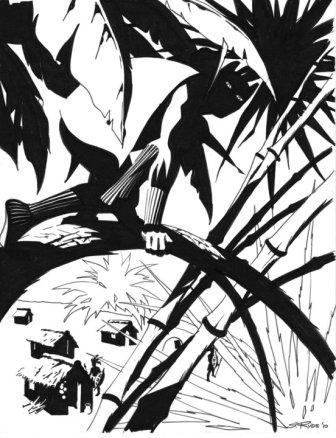
The Black Panther, pencils and inks by comics artist Steve Rude

There are artists whom I commission because I know almost exactly what they will do with the assignment, and I’m commissioning them in part for their consistency of vision. There are other artists whom I commission knowing that I have no advance clue at all what they will do with the assignment, and if I try to guess, I will be incorrect. Steve Rude falls squarely into that latter category.

Because Rude’s bold style is unabashedly influenced by the late, legendary Jack “King” Kirby, who co-created the Black Panther (pretty much every comic book artist of the past 50 years has been influenced to some degree by Kirby, but Rude more directly than most), I might have supposed that, when asked to draw the Black Panther, Rude would give me a propulsive, energetically Kirbyesque take on the character — say, something along the lines of Kirby’s iconic cover to Black Panther #7.

Instead, Steve went in the opposite direction, drawing on another of his primary influences: Alex Toth, whose mastery of shape and minimalistic linework made him a much-in-demand designer for TV animation, a medium in which clarity and simplicity are essentials. (Among the classic cartoons Toth designed are Space Ghost, The Herculoids, and Super Friends.) Rude used a Toth-like contrast of deep shadow and blinding light to create a dense, moody, atmospheric scene. I was absolutely floored when I first saw it.

Actually, the second time I saw it.
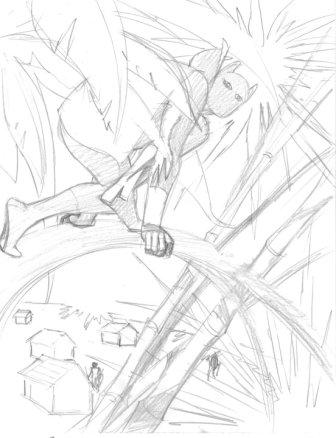
The Black Panther, rough pencil sketch by comics artist Steve Rude

My first view of the piece came by way of Steve’s preliminary sketch, at which you’re now looking. You can see how, even though all of the key shapes, lines, and spaces are present in the rough, the dramatic impact Rude will ultimately introduce through skillfully placed shadow (it’s called “spotting blacks” in comic art jargon) is not only absent, but nearly impossible to anticipate. The prelim sketch suggests a very nice drawing to come. The finished, fully inked version goes light-years beyond “very nice,” into the realm of “jaw-droppingly stupendous.”

Now that’s a Black Friday I can get behind.

And that, friend reader, is your Comic Art Friday. (Remember: Avoid mob scenes; shop online. Just a tip from your Uncle Swan.)
Comic Art Friday: You’ll not see nothing like the Mighty Quinn

November 19, 2010

For the benefit of anyone who may have strolled in late, the cornerstone of my comic art collection is a series of artworks (93, at last count) known collectively as Common Elements. Each Common Elements drawing features at least two — and on occasion, more — comic book heroes and/or heroines who share some quality (similar name, costume characteristic, superpower, etc.), but are otherwise unrelated.

Sometimes the common element is fairly obvious — Mike Grell’s Jon Sable and Silver Sable piece is one such example. But the real treat for me is coming up with a Common Elements pairing so obscure that only the most Holmesian viewer will figure it out without assistance.

Take this latest, from the supremely talented Brazilian artist Al Rio.

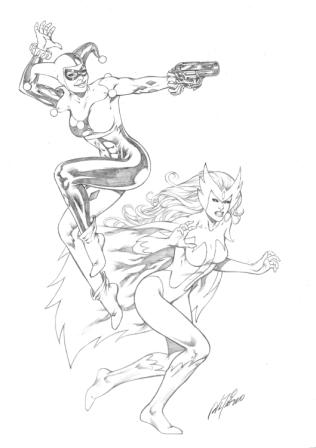
Harley Quinn and Snowbird, pencils by comics artist Al Rio

The jester with the potent-looking popgun is Dr. Harleen Quinzel, better known as Batman’s nemesis Harley Quinn. The woman wearing the winglike tiara and cape is Snowbird, a founding member of the Canadian superteam Alpha Flight, and comics’ most prominent (only?) superhero of Inuit — we used to say “Eskimo” back in the day when we were less particular about calling people what they prefer to be called — origin.

So what do a clownish villainess and a heroine from the Great White North share in common? Well, step into the Wayback Machine, my dear Sherman, and I’ll tell you a tale.

In July 1966, folk-rock superstar Bob Dylan was seriously injured in a motorcycle accident. Dylan spent most of the next year or so recovering at his home near Woodstock, New York. Toward the end of his convalescence, Dylan and his backup ensemble, Levon and The Hawks — later famous in their own right under a different name, The Band — spent about three months recording a plethora of new material in Dylan’s basement studio. The resulting recordings, together known as the Basement Tapes, floated around in bootleg form for nearly a decade before receiving an officially sanctioned label release in 1975.

One of the earliest leakages from the Basement Tapes sessions was a bouncy comedic number entitled “Quinn the Eskimo.” According to Dylan, the idea for the song came from the 1959 film The Savage Innocents, in which noted Mexican-American actor Anthony Quinn stars as an Inuit trapper accused of murder. British pop-rock sensations Manfred Mann (“sensations” is plural because Manfred Mann was the actual name of a band, of which a guy also named Manfred Mann was the leading member) recorded a worldwide hit cover of Dylan’s tune in 1968, retitled as “The Mighty Quinn” — the song’s catchy refrain goes, “Come on without / Come on within / You’ll not see nothing like the Mighty Quinn.” (Manfred Mann — the man, not the band — was born in South Africa as Manfred Lubowitz, which would not have made a very good name for a band at all.)

More than 20 years after the song had been a radio staple, actor Denzel Washington starred in the film The Mighty Quinn. In the movie, Washington’s character Xavier Quinn is not an Inuit trapper, but an American-educated police chief on a small Caribbean island. (Although, let’s be honest — it would be interesting to see Denzel play an actual Eskimo.) In one memorable scene, actress Sheryl Lee Ralph, as Xavier’s cabaret-singer ex-wife, performs a reggae remix of the Dylan song.

Given this fascinating show business success story (you were fascinated, weren’t you?), it seemed only natural to me to pair up comics’ most famous Quinn with the medium’s most famous Eskimo. Because, in the words of the song, “When Quinn the Eskimo gets here, everybody’s gonna jump for joy.”

I know I did.

And that’s your Comic Art Friday.

Comic Art Friday: Wonder Woman Day 2010

November 12, 2010

If you’ve read here often over the past six years, you know that I’m not a big holidays guy. My idea of a good holiday is something like International Talk Like a Pirate Day, which I celebrate faithfully every September 19, or National Gorilla Suit Day, which falls on January 31 each year.

Or, to the point of this post, Wonder Woman Day.

Wonder Woman, pencils by June Brigman, inks by Roy Richardson

Wonder Woman Day was inaugurated five years ago by Andy Mangels, a writer whose stock in trade is popular culture in general, and comics and comics-related media in particular. Andy teamed with Bradley Angle House, a nonprofit shelter for women and children located in Portland, Oregon, to come up with a unique event to raise funds for Bradley Angle, while simultaneously raising public awareness of the need to empower women against domestic violence. Andy’s brilliant idea was to get dozens of comic book artists to donate images of Wonder Woman — the greatest icon of female empowerment — that would then be auctioned off, both online and live at a comics shop in Portland, to support the shelter.

And Wonder Woman Day was born.

Being the avid Wonder Woman fanatic that I am, I’ve been a proud supporter of Wonder Woman Day — even though I got shut out of the auctions the past couple of years. (I have two nice pieces in my Temple of Diana from previous WWDs — one by Michael Bair, and another by Al Rio, the latter of which was later inked by Bob Almond.) When I heard that this year’s event would be the last — I don’t know the reasons, but I suspect that DC Comics’ legal department issued a cease-and-desist — I was determined to come away with another addition to my Wonder Woman gallery.

In fact, I came up with two.

The inked drawing at the top of this post is the work of one of comics’ few married artistic teams, penciler June Brigman and her husband, inker Roy Richardson. I’ve admired June’s work for quite some time — she cocreated (with writer Louise Simonson) Marvel Comics’ juvenile superteam Power Pack, and for the past 15 years she’s been the artist on the syndicated newspaper strip Brenda Starr (which she took over after the retirement of Comic Book Hall of Fame artist Ramona Fradon). When I saw that June and Roy had contributed one of their collaborations to Wonder Woman Day, I knew I had to own it.

Wonder Woman, pencils by comics artist Roger Medeiros

The pencil drawing above is by Roger Medeiros, a Brazilian artist whose work was previously unknown to me. Roer has done some licensing art for Hasbro Toys (G.I. Joe packaging), and contributed to one of the recent Dungeons and Dragons volumes. If this gorgeous drawing is representative of his talents — and trust me, Roger’s design sense and pencil technique is pristine viewed up close — this young man is going to be a star in the comics world in short order.

I’m sorry to see Wonder Woman Day go. I understand that the event will evolve into another format next year — probably into “Superheroines Day” or something similar — but I thought its connection to the most recognizable female icon in comics gave it cachet. Don’t things always suck when the attorneys get involved?

Remember this: Every day in America, thousands of women and children become victims of domestic violence. As a society, we can’t afford to turn a blind eye. We need to teach our sons that abusing those who are physically weaker is never, ever acceptable behavior, and that violence is never, ever an appropriate channel for anger. We need to teach our daughters never, ever to accept being abused, and never to fear calling for help when they need it.

And that’s your Comic Art Friday.

Comic Art Friday: Little women

October 22, 2010

The wheels of Common Elements grind slowly, but they grind exceedingly fine.

Way back in the Dark Ages — or as I like to call it, 2004 — I commissioned the very first artwork in what would come to be known as the Common Elements series (two or more comic book characters, usually unrelated, but connected by some “common element,” as you regulars here already know) from Michael Dooney. From that day to this, my Common Elements gallery has grown to include more than 90 drawings (with a couple in the works) representing the work of 70 artists.

But for whatever reason, I’d never asked Mike Dooney to create a second one.

It’s definitely not because I don’t adore Mike’s work. I’ve commissioned him more frequently than any other pencil artist. (My friend Bob Almond, who believes that every pencil drawing needs ink, holds the commission record in my collection by a long stretch. But all of Bob’s projects to date have been strictly inking work.) I know, however, that Mike usually prefers not to do multiple-character pieces. So, because I like the guy, I didn’t want to use up my allotment of special favors by going to the well too many times. But every time I’ve received a new Dooney commission in the mail, I’ve looked at it and thought, “I really need to get Mike to do another Common Elements.”

Which brings us to today’s artwork.

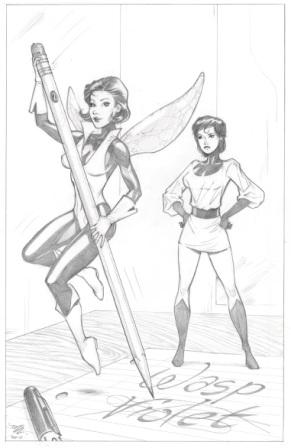
The Wasp and Shrinking Violet, pencils by comics artist Michael Dooney

Mike’s assignment for this piece was to take two of the smallest heroines in comics — the Wasp, founding member of the Avengers, and Shrinking Violet, longtime stalwart in the Legion of Super-Heroes — and bring them together in a scenario that emphasized their diminutive size. Dooney devised this clever scenario, in which the winsome Wasp (as Stan Lee used to refer to her) asserts her self-perceived superiority over her rival with a swish of her pencil.

Although Shrinking Violet is the character with the longer history (she made her debut in DC’s Legion in 1961, almost two years before the Wasp first appeared on the cover of Marvel’s Tales to Astonish #44), it’s probably fair to say that Janet Van Dyne (later Janet Pym, after she and her crimefighting comrade Henry Pym, the original Ant-Man, married) is the better known of the two. The Wasp became one of Marvel’s most prominent female heroes, in addition to one of its earliest, thanks to her role in the Avengers.

Over the years, the Wasp gained significant notoriety for her frequent costume changes. Janet, a wealthy heiress with a taste for high fashion, updated her ensemble so many times that it’s difficult to pinpoint a specific “look” for the character. I chose the outfit depicted her by Mike Dooney because it’s one of the most attractive and distinctive of her numerous styles.

Shrinking Violet (her real name is Salu Digby — I’d prefer Violet too) joined the Legion as part of its first big expansion. Such familiar Legionnaires as Sun Boy, Bouncing Boy, and Brainiac 5 came aboard at about the same time. Like the Wasp, Vi (as her colleagues often call her) has undergone several costume changes, usually as part of the Legion’s seemingly endless rebooting. Unlike the Wasp, Vi has also changed her code name from one incarnation to the next, having also operated under the guises of Atom Girl, LeViathan, and Virus, as well as just plain Violet.

Despite her name, most of Vi’s outfits over her long career have been predominantly green, not violet. (The ensemble shown here, for example, was solid green with black accents.) But that’s comics for you.

And that’s also your Comic Art Friday. (Remember: October is National Breast Cancer Awareness Month.)

Comic Art Friday: My breast art story ever

October 15, 2010

October being National Breast Cancer Awareness Month — and if you weren’t aware, you are now — I thought it would be appropriate to devote one Comic Art Friday this month to my favorite “breast story” related to my art collection.

The Scarlet Witch, pencils by comics artist Geof Isherwood

About five years ago, artist Geof Isherwood had this gorgeous pinup of Wanda Maximoff, the Scarlet Witch, posted for sale on eBay. I fell in love with the piece at first sight. There’s something magical about the expression Geof gave Wanda here that I found compelling — innocent yet wise, inviting yet inscrutable. Geof’s a master at lending his characters depth and humanity, and this depiction of one of my favorite heroes might be among the finest he’s ever drawn.

There was only one issue.

In the artwork as Geof originally drew it, he’d blessed Wanda with Power Girl-sized mammaries — what Otter in National Lampoon’s Animal House famously referred to as “major league yabbos” — barely restrained by an abbreviated bustier that left next to nothing to the imagination.

Impressive, no doubt. But…

I shot Geof an e-mail, commenting on how much I adored his latest creation. Alas, I told him, I was going to pass on putting in a bid, because Wanda’s prominently displayed endowments rendered it a trifle too risque for my collection. (My cardinal rule for evaluating female superheroine art for purchase: If I’d be reluctant to hang it where my daughter would walk past it, it’s not for me. My good friend, artist Bob Almond, thinks I’m a prude, but he loves me anyway.)

Geof, always one of the most accommodating artists I’ve ever commissioned, wrote back, “No problem — if you like it otherwise, buy it, and I’ll tweak the figure and the costume at no extra charge.”

So I did, and he did. Half a decade later, this spectacular item remains one of the true gems in my Scarlet Witch gallery.

The best part of this story is that Geof was comfortable enough with himself as an artist to make the suggested alteration. A lot of artists would simply have said, “Hey, this is how I drew it. Take it or leave it.” It wasn’t a commission, so Geof wasn’t under any obligation to change his original vision to suit my sensibilities. But he did it without complaint. I respected him even more than I did already after that. He really is a terrific guy, in addition to being an awesomely talented drawer of stuff.

Speaking of breasts (and we were)…

If you’ve got ’em, learn to examine them regularly for changes. Stay current on your mammograms, if you’re over 40. Whatever your age, open a frank, no-holds-barred dialogue with your physician about your risk factors for breast cancer.

If you don’t have ’em, half the people you know do. Encourage the women in your life to follow the above program. One in eight of those women will be a target for breast cancer at some point in her life.

Whether you have breasts or don’t, please consider making even a small donation to the breast cancer nonprofit of your choice. Every little bit helps in the fight. Let’s find a cure before we lose more of our wives, lovers, mothers, daughters, grandmothers, aunts, nieces, and friends.

Wanda and I thank you.

And that’s your Comic Art Friday.

October is National Breast Cancer Awareness Month!

Comic Art Friday: My favorite changeling

September 24, 2010

It’s no secret that I have a thing for Isis.

Isis, pencils and inks by comics artist Gene Gonzales

For those of you who missed the 1970s, The Secrets of Isis was a live-action TV program that ran on CBS Saturday mornings from 1975 to 1977. Isis ran as half of a package with Shazam!, which featured the adventures of comics’ original Captain Marvel. (I say “original” because there have been several comic book heroes and heroines named Captain Marvel, spanning 70 years of comics history. But that’s a tale for another time.)

The basic premise of Isis was reiterated in the melodramatic narration that began every episode:

“O my Queen,” said the Royal Sorcerer to Hatshepsut, “with this amulet, you and your descendants are endowed by the goddess Isis with the powers of the animals and the elements. You will soar as the falcon soars… run with the speed of gazelles… and command the elements of sky and earth.”

Three thousand years later, a young science teacher dug up this lost treasure, and found she was heir to… the secrets of Isis!

And so, unknown to even her closest friends, Rick Mason and Cindy Lee, she became a dual person: Andrea Thomas, teacher… and Isis — dedicated foe of evil, defender of the weak, champion of truth and justice!

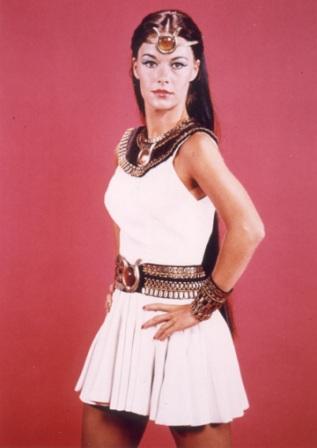
As highfalutin as all that sounds, the real attraction of The Secrets of Isis was its star, JoAnna Cameron, a charming actress who cut quite a fetching figure wearing Isis’s quasi-Egyptian miniskirt.

JoAnna Cameron as the mighty Isis

Cameron, who appeared in tons of commercials and guest-starred on several TV series and in telefilms throughout the ’70s, never had another role as prominent as Isis. By the end of the decade, she had left show business and moved on to other careers.

I’ve contributed in my own small way to keeping the legacy of Isis alive by commissioning several artworks featuring my favorite Saturday morning heroine. The drawing shown above, created by the talented and affable Gene Gonzales, is the most recent addition to my Isis gallery.

Ironically, Isis came into existence only because Filmation, the studio that produced both Shazam! and The Secrets of Isis, refused to pay DC Comics for the licensing rights to Mary Marvel, Captain Marvel’s sister and the character originally planned for the distaff half of the Shazam! TV hour.

Mary Marvel, pencils and inks by comics artist Gene Gonzales

Instead of shelling out the dough, Filmation created a new character based on the same general outline — a young woman who speaks a magical phrase (instead of “Shazam!” Andrea Thomas intoned, “O mighty Isis!”) and transforms into a superhero with powers derived from ancient mythology. DC ended up using Isis themselves, as the star of a short-lived comic series based on the TV show.

Isis, by the way, was the first female superhero to star in her own live-action program on American network television. All of the powered heroines who followed her to the small screen — from Wonder Woman and The Bionic Woman to Dark Angel and Witchblade — owe the Mighty Miniskirted One a debt of gratitude for kicking down the door.

And that’s your Comic Art Friday.

Comic Art Friday: Krypton Comet

September 17, 2010

Not too long ago, my friend Damon asked me how close I am to completing my Bombshells! project — my ongoing series of commissioned drawings featuring heroines from the Golden Age of comics (defined for the purposes of this project as any character who made her debut prior to 1960) in pinups modeled after vintage bomber nose art.

I told Damon that I’m nowhere close to the end. My Bombshells! to-do list still has another 64 heroines on it, and I probably haven’t unearthed all of the possible candidates as yet. Many of the names are obscure, but I still have a few that would be recognized by most knowledgeable comics buffs.

They don’t come more recognizable than this.

Supergirl, pencils and inks by comics artist Steve Rude

Supergirl devotee that I am, I was saving the Maid of Steel’s Bombshells! appearance for just the right artist. I don’t believe I could have made a better choice than Steve “The Dude” Rude, best known as the creator (with writer Mike Baron) of the long-running series Nexus. Rude’s retro style, influenced by such comic art legends as Jack Kirby and Alex Toth, suits Bombshells! wonderfully. His rendition of Supergirl could easily have appeared on a 1950s DC Comics cover.

The tagline used here is my inside joke to other Supergirl fans. In her earlier days, Supergirl was noteworthy for her menagerie of super-pets, including Streaky the Super-Cat and a flying Super-Horse named Comet. Rude took my idea and ran with it, depicting Kara Zor-El astride her missile just as she used to ride her beloved Comet.

I never quite understood why Supergirl would enjoy riding a flying horse when she’s perfectly capable of flying under her own power. But hey — that’s comics for you.

That’s also your Comic Art Friday.

Comic Art Friday: Imperius Rex!

August 27, 2010

I’m always tickled when a new addition to my Common Elements theme lands on my doorstep. The arrival of today’s featured artwork, however, represented a genuine coup for my signature gallery.

Hourman and Metamorpho, pencils by comics artist Ramona Fradon

Ramona Fradon, who created the above piece, was one of the first female artists — and one of the relative few, even to this day — to make her mark in the superhero comics genre. She broke into the business in the early 1950s, when the very idea of women working in mainstream comics was practically unheard of. Becoming the regular artist on Aquaman, Ms. Fradon garnered acclaim for her distinctive graceful style.

In the 1960s, after an extended maternity leave, Ms. Fradon returned to comics as the co-creator (with writer Bob Haney) of Metamorpho, the Element Man. (That’s him on the right in today’s drawing.) During the following decade, she worked extensively for DC Comics (on such series as Plastic Man, Freedom Fighters, and the comic for which many know her best today, Super Friends), and on rare occasion for Marvel (most notably, Fantastic Four #133). Then, in 1980, she transitioned into newspaper comics, taking over the art chores on the long-running strip Brenda Starr when creator Dale Messick retired. Ms. Fradon drew the intrepid reporter’s adventures for the next 15 years.

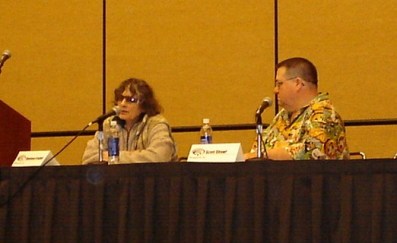
I had the honor of meeting Ms. Fradon four years ago at WonderCon, as she was about to be inducted into the Will Eisner Comic Book Hall of Fame. Here, she’s being interviewed by cartoonist Scott Shaw! (and yes, he spells it with an exclamation point).

Ramona Fradon and Scott Shaw!, WonderCon 2006

Ramona Fradon is mostly retired these days, but she’s still drawing for her fans, as the commission above attests. And as one can clearly see, her skills remain as sharp as ever, even though the artist is now well into her 80s.

As for the subjects of today’s featured item: Given the chance to commission Ms. Fradon, I wanted her to revisit the character she helped create. Metamorpho, like The Thing of the Fantastic Four, is a hero whose superpowers come at the price of a normal human appearance. Due to exposure to a radioactive meteorite, adventurer Rex Mason’s body gains the ability to transmute into any chemical element. This unique talent enables Rex to change into almost anything he can imagine — think Plastic Man on steroids. Sadly, the one change he can’t effect is making himself fully human. (I’ve never quite understood why, but that’s comics for you.)

Accompanying Metamorpho is another hero named Rex — specifically, Rex “Tick-Tock” Tyler, the original Hourman. As was the case with many superheroes of comics’ Golden Age, Tyler acquired his power from ingesting chemicals; in his case, the vitamin compound Miraclo. A dose of Miraclo gave Tyler superhuman strength and endurance, but only for the 60 minutes the effect lasted — hence the name Hourman. (Frankly, I always thought advertising one’s weakness to the world would be the most foolish move a superhero could make — sort of like Superman calling himself Captain Allergic-to-Kryptonite. If I were a supervillain, I’d figure out a way to keep Hourman confined or occupied for 61 minutes, then I’d beat the stuffing out of him.) Interestingly, as the years progressed, Tyler actually became addicted to Miraclo — one of the first examples of comics dealing with such a powerful health and social issue.

Speaking of time, I’m out of it for now.

So that, friend reader, is your Comic Art Friday.

Comic Art Friday: A flashback from the inkwell

August 20, 2010

Today’s Comic Art Friday is dedicated to the Inkwell Awards, the annual honors issued to inkers, those unsung heroes and heroines of the comic art world who transform (often rough) pencil drawings into clear, completely finished art suitable for publication.

The Inkwell Awards are the brainchild of my friend Bob Almond, an enormously talented inker perhaps best known for his lengthy stint on Marvel’s Black Panther, in collaboration with penciler Sal Velluto and writer Christopher Priest. In addition to his always exceptional artistic efforts, Bob is a tireless advocate for practitioners of his chosen craft, spending a great deal of his time and personal resources educating comics fans about the underappreciated, often misconstrued work of inking artists.

Over the years that I’ve been collecting and commissioning original comic art, I’ve learned a wealth of inking lore from Bob. And, thanks to the numerous commissioned projects he’s done for me (more than 40 at last count), my galleries sparkle with his expertly applied inks.

Given the fact that Bob and the rest of the Inkwell Awards team are currently soliciting votes for this year’s honors — an election in which you, friend reader, are cordially invited to participate — I thought this might be an excellent occasion to leap into the Wayback Machine and revisit the very first commission Bob ever inked for me.

Here’s the original pencil art, as Bob received it. If you stopped by here last week, you’ll recognize the distinctive style of Al Rio.

Superman and Supergirl to the rescue, pencils by comics artist Al Rio

This was a preliminary sketch Al created for a drawing he eventually auctioned off as a benefit for victims of the Indian Ocean tsunami that hit southern Asia on Boxing Day 2004. As the word “preliminary” suggests, and as you can see, this pencil sketch is a nicely drawn but still fairly rough outline of the idea Rio had in mind. (In fact, Al’s finished artwork bears only a passing resemblance to this initial concept. In the final product, Superman was replaced with Batman, and Supergirl gave way to a grieving mother.)

Bob Almond took this sketch and embellished it to a high gloss. He refined the figures, solidified the background elements, and added numerous details that are only hinted at — or in many instances absent altogether — in Al Rio’s pencil rough. When Bob’s work on the piece is complete, it’s no longer just a drawing. It has become a living, breathing example of finished comic art.

Superman and Supergirl, pencils by Al Rio, inks by Bob Almond

Anyone with a discerning eye can see that the inker’s contribution to the completed work extends far beyond merely tracing the penciler’s lines, as many uneducated comics fans suppose. The inker’s additions are indispensable to the art as the reader expects to experience it.

If you follow this link, you can read Mr. Almond’s own commentary about this commission, including Bob’s detailed description of the techniques and tools he employed.

Every day in the world of comic books, talented men and women practice the fine art of inking. Their toils often go unheralded, especially by comparison with those of their penciling colleagues. Still, for every Jack Kirby who has become a household name through the power of his pencil, there is a Joe Sinnott, a Frank Giacoia, or a Mike Royer inking away in the background, making those pencils look fantastic.

And yes, a Bob Almond too. (Bob’s much too young to have inked Kirby. But he certainly would have done The King proud.)

If you’re a comic art aficionado who values the abilities of inkers both historic and contemporary, please take a moment to surf over to the Inkwell Awards website and vote for your favorites. You’ll be glad you did.

And that’s your Comic Art Friday.

Comic Art Friday: Stars fell on Rio

August 13, 2010

It’s a Comic Art Friday the 13th, but you know what? I’m feeling lucky.

When I feel lucky, I turn to my signature commission theme — Common Elements, in which otherwise unrelated comic book characters who share some… well… common element meet up on the drawing table of a talented artist.

Today, Brazilian superstar Al Rio finds two star-crossed superwomen engaged in a merry chase. Leading the parade at right is Star Sapphire, the long-time nemesis-slash-paramour of Hal Jordan, best known of the numerous heroes who’ve borne the title Green Lantern. In hot pursuit at left is Stargirl, one of the youngest members of the current incarnation of comicdom’s senior superteam, the Justice Society of America.

Stargirl and Star Sapphire, pencils by comics artist Al Rio

Star Sapphire, like Carol (Ms. Marvel) Danvers and Dr. Bill (Goliath) Foster, is one of a handful of characters whose civilian identities were well established in comics before they adopted their costumed identities. In this instance, Carol Ferris had been around for three years in Green Lantern’s storyline as both the owner of the company that employed Hal Jordan as a test pilot and as Hal’s on-again, off-again girlfriend. Then, when an alien gemstone endowed Carol with Green Lantern-like powers, she took on the name Star Sapphire. Unfortunately for Hal, the influence of Carol’s power gem also turned her into a villainess — one of his primary adversaries for the rest of his career.

Courtney Whitmore, like many of the JSA’s present-day lineup, is a legacy — that is, she came into the superheroing fraternity by way of a prior connection. In Courtney’s case, her stepfather Pat Dugan enjoyed an adventuring career as Stripesy, the adult sidekick to the adolescent Star-Spangled Kid. Many years later, teenaged Courtney took up the Kid’s costume and nom de guerre. To keep Courtney from getting her inexperienced self killed, the mature Pat donned an Iron Man-like exoskeleton of robotic armor to become his stepdaughter’s partner and guardian, S.T.R.I.P.E. In time, Courtney received the cosmic staff of Jack Knight, the second Starman, and changed her code name to Stargirl in Jack’s honor.

For this Common Elements commission, I offered Al Rio three possible pairings from which he could select. I wasn’t surprised, given Mr. Rio’s predilection for attractive females, that he chose these two scintillating “stars” for his newest creation. I was, however, most pleased by the result. There’s a reason why Al is one of the pencilers most represented in my collection — that reason is on eye-catching display here.

Yes, it’s Friday the 13th, but have no fear — the stars are in alignment.

And that’s your Comic Art Friday.