Archive for the ‘Comic Art Friday’ category

Comic Art Friday: From soccer moms to Super-Moms

May 7, 2010

Today’s Comic Art Friday is dedicated to all you mothers out there. And I mean that in the nicest possible way.

It probably comes as no surprise that superhero comics aren’t exactly a bastion of motherhood. Most of the prominent female characters in the genre are, after all, presented as some fanboy’s delusion of post-pubescent hotness — a delusion that the word “mother” douses like a bucket of lake water on a campfire.

Nevertheless, we can point to a handful of comic book stars whom some tyke calls “Mom.” Let’s look at a few.

The Invisible Woman, pencils by comics artist Geof Isherwood

The best-known super-Mom in comics has to be Susan Storm Richards, a.k.a. the Invisible Woman of the Fantastic Four, drawn here by Geof Isherwood.

Sue’s firstborn child by hubby Reed Richards is a son named Franklin, who although born way back in 1968 (in Fantastic Four Annual #6, to be precise), is still portrayed in the comics as a preadolescent. Sue’s younger offspring, a daughter named Valeria (usually called simply Val), came on the scene more than three decades later in “real time,” but in the comics is generally supposed to be a few years younger than Franklin. (Val’s insanely complex backstory makes her the surviving product of what was believed to be Sue’s miscarriage in the June 1984 issue of Fantastic Four, yet she resurfaces as a fully developed child in a 1999 story arc.)

The Spider-Women (Jessica Drew and Julia Carpenter), pencils by Michael Dooney, inks by Joe Rubinstein

Julia Carpenter, the second Spider-Woman, was mainstream comics’ first “single mother” superheroine. (That’s Julia in the black costume at lower right, alongside the original Spider-Woman Jessica Drew, in this artwork penciled by Michael Dooney and inked by Joe Rubinstein.)

Julia, who joined the Marvel Universe during 1984’s Secret Wars event, is Mom to a daughter named Rachel. Julia’s responsibilities and challenges as a superhero mother have figured frequently into her storylines over the years.

Spider-Man and Mary Jane Watson-Parker, pencils by Al Rio, inks by Bob Almond

Our third and final featured mother is a character that many people won’t even realize fits the category: Mary Jane Watson-Parker, hitching a ride above with everyone’s friendly neighborhood Web-Slinger, courtesy of penciler Al Rio and inker Bob Almond.

Although in 2010 Marvel continuity Mary Jane and Peter “Spider-Man” Parker have never been married (don’t even get me started on that idiotic Brand New Day folderol), in the alternate future continuity known as MC2, MJ and Peter are married 40-somethings with a teenage daughter named May (nicknamed “Mayday”) and an infant son named Benjamin. May, who inherited her now-retired father’s arachnid powers, carries on the family legacy as the costumed crimefighter Spider-Girl.

And that’s your Comic Art Mother’s Day.
Comic Art Friday: Sittin’ on the dock of DuBay

April 30, 2010

Before we get into the meat of today’s Comic Art Friday post, let me remind you all that tomorrow (Saturday, May 1, 2010, for those who may stumble upon this missive in the distant future) is Free Comic Book Day. If you drop by your participating local comic book shop, chances are excellent that you can walk away with a free comic book, selected from an array of special editions generated by comic book publishers just for the occasion.

(If you’re polite, and your local comic shop proprietor is a decent sort, you might be able to wangle a couple or more freebies. But don’t get all greedy. And be sure to say “thank you.”)

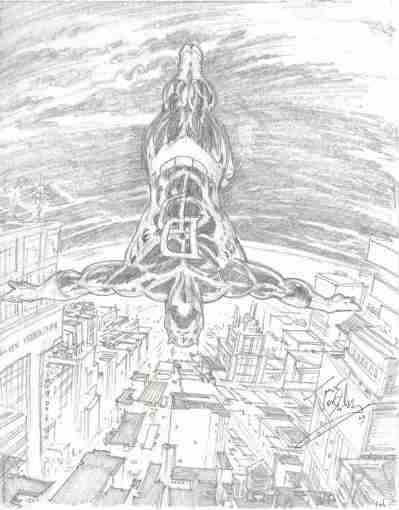
Daredevil, pencils by comics artist Trevor Von Eeden

Today’s Comic Art Friday is dedicated to the memory of Bill DuBay, a longtime comics writer, artist, and editor who passed away earlier this month following a battle with cancer. He was 62 years old.

DuBay worked for most of the major (and several minor) comics publishers during his career, but he’s best remembered for his tenure as writer-editor for Warren Publishing’s line of magazine-sized comics — Creepy, Eerie, and Vampirella, plus the reprint series featuring Will Eisner’s The Spirit — in the early 1970s. DuBay later helmed Archie Comics’ brief, unsuccessful attempt to launch a superhero line in the 1980s, and edited Western Publishing’s juvenile comics. Like many comics pros, he eventually moved on into animation, working for Marvel and FoxKids on their various TV cartoon series.

Although I was a major Vampirella fan back in the day, when I think about Bill DuBay I think first about Thriller, that mad and wonderful DC Comics series from the early ’80s. DuBay was the writer DC brought in to finish out the book’s run, after cocreator Robert Loren Fleming walked off the project after seven issues due to a plethora of editorial challenges. The series’ other cocreator, artist Trevor Von Eeden, bolted after issue #8, leaving former Warren stalwart Alex Niño to draw the last four stories written by DuBay.

To be frank, the last four issues of Thriller concocted by DuBay and Niño don’t stand up to the first seven by Fleming and Von Eeden. The eighth issue, written by DuBay from Fleming’s outline and illustrated by Von Eeden, falls somewhere in between. As weak as the conclusion of Thriller might have been, however, I’ve always been grateful to DuBay and Niño for at least attempting to resolve a storyline that (and I’m being honest here) they didn’t fully comprehend. (I’m not sure anyone other than Fleming and Von Eeden really understood Thriller completely. I’m including myself among the semi-mystified, even though I was among the series’ few loyal readers.) The run may have ended badly, but at least it ended — instead of just stopping in midstream when its creators left.

Anyway, the dramatic drawing of Daredevil at the top of this post is the work of Trevor Von Eeden. It seemed appropriate to run it today, as I’m thinking about the late Bill DuBay… who, like Matt Murdock’s Man Without Fear, was something of a daredevil who often found himself working (as on Thriller) without a net.

And that’s your Comic Art Friday.

P.S. Spread the word: Tomorrow is Free Comic Book Day!

Comic Art Friday: Phantom Lady is a “Heart Baker”

April 23, 2010

When I first conceived the Bombshells! project two years ago, I believed that I had a relatively narrow commission series ahead of me. After all, how many comic book heroines existed before 1960, the arbitrary parameter I set? Surely not that many. I jotted down the dozen or so names that came immediately to mind, and called it a day.

As it turned out, the field of potential Bombshells! proved more vast than I anticipated. Today’s featured artwork brings the series to the quarter-century mark. My going research into heroines from comics’ Golden Age has yielded enough candidates to triple that number.

So many Bombshells!, so little cash.

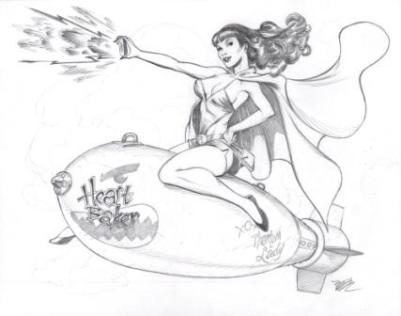
Phantom Lady, pencils by comics artist Michael Dooney

Phantom Lady appeared near the top of my original Bombshells! list. Given her stature among the most popular and influential heroines of the 1940s, I reserved her appearance for one of my favorite “good girl” artists, Michael Dooney. Mike’s third entry into the Bombshells! arena ranks with his best. (You can click the image above for a better view… and you should.)

One of the earliest costumed heroines, Phantom Lady premiered in Police Comics #1 (August 1941). After a 23-issue run in that publication, the character’s creators, the Jerry Iger Studio, moved her adventures from Quality Comics, their original publisher, to Fox Features Syndicate, where Phantom Lady headlined her own title. It was during her Fox tenure that Phantom Lady’s stories began to be illustrated by Matt Baker, the artist most closely associated with the character. Baker’s voluptuous cover depictions of Phantom Lady inspired the moniker “headlights comics” (I leave it to you, friend reader, to figure out why), and drew the ire of Congressional crusaders bent on stamping out the comics industry.

I suggested the punning tagline “Heart Baker” for Phantom Lady’s Bombshells! spotlight, to acknowledge Matt Baker’s contribution to her legend. Michael Dooney grabbed onto that idea and ran like the wind, adding his own clever touches to the piece, including the shark face and “autograph” on Phantom Lady’s bomb — two period-accurate details from the World War II era. Which makes sense, given Mike’s penchant for creating authentic bomber nose art.

By the way, the device Phantom Lady wields here is her signature “black light” projector, which she uses to blind her adversaries. That always seemed to me like overkill. If you catch my drift.

And that’s your Comic Art Friday.

Comic Art Friday: The WonderCon job

April 16, 2010

I know, I know… I’m a week late with the annual WonderCon post. It’s been busy around here. Learn to deal.

WonderCon 2010 took place at San Francisco two weekends ago, and while I didn’t count noses, it certainly appeared that neither the shift in dates (in previous years, WonderCon was in February) nor the inclement weather (it poured rain much of the weekend) hurt business any. On both Friday and Saturday — especially Saturday — Moscone Center brimmed to the gills with the sort of geeks, freaks, fanboys, fangirls, and fans of indeterminate gender (and, for that matter, species) that a comic book and fantasy media convention generally attracts.

This was an unusual con for me, for a couple of reasons. For one, I had a voiceover workshop on Friday afternoon that I was determined to attend, so my time at the con on that day was curtailed considerably. For another, I didn’t walk away with my customary windfall of newly commissioned art, scoring only one new piece for my collection.

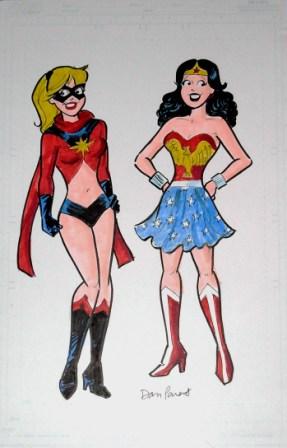
Ms. Marvel and Wonder Woman, mixed media by comics artist Dan Parent

That one piece, however, is pretty sweet.

Dan Parent — longtime artist, writer, and editor for Archie Comics — created this cute commission for my Common Elements theme. In addition to being the de facto matriarchs of their respective superhero universes, Ms. Marvel and Wonder Woman share at least one other “Common Element” — both have backgrounds in the military. Carol (Ms. Marvel) Danvers is a colonel in the U.S. Air Force, while Wonder Woman, in her assumed guise as Diana Prince, spent World War II as a U.S. Army lieutenant.

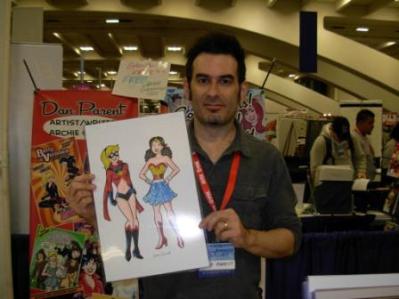
Not by coincidence, as rendered by the charming Mr. Parent, Ms. Marvel bears an uncanny resemblance to a certain Betty Cooper, while Wonder Woman looks rather strikingly like one Veronica Lodge. Below, we see the proud creator with his newest masterwork.

Dan Parent, WonderCon 2010

And yes, that’s all I got. I had decided in advance of the convention to focus my acquisition efforts on artists whose work isn’t already represented in my collection. For whatever reason, there weren’t a lot of those artists in attendance this year. I’d hoped to make a stab at Adam Hughes’s commission list, as Adam was scheduled to make his first WonderCon appearance in five years, but work-related complications forced him to cancel a couple of days before the con. So, I made the best of the circumstances.

That’s not to say that I didn’t enjoy myself thoroughly — I did. Among the highlights…

I renewed my acquaintances with a number of familiar faces in the comic art community, including Tony DeZuniga and his lovely wife Tina, Ernie Chan, Danny Bulanadi, Ron Lim, Thomas Yeates, Walt Davis, and Tom Hodges.

“Gentleman cartoonist” Keith Knight, with whom I always enjoy chatting, autographed a copy of his The Complete K Chronicles for me, as well as an anthology of his Th(ink) strips for my friend Damon.

I caught superstar artist Frank Cho in a rare unoccupied moment, and got him to autograph his latest sketchbook. I also seized the opportunity to express my appreciation for Frank’s Shanna and Jungle Girl. (Drat… I forgot to mention Liberty Meadows. I love that too, Frank.)

I rescued artist Colleen Doran‘s notebook computer, which had slipped out of her tote bag into the aisle without her knowledge. I’d love to have Colleen draw a commission for me one of these days, so I’m hoping that my act of heroic alertness will gain me sufficient favor to help persuade her into one when she has time.

One of my comic art heroes — Mark Schultz, creator of Xenozoic Tales (better known in the popular culture by the alternate title Cadillacs and Dinosaurs) — spent a good 15 minutes talking with me about his latest projects, including a single-volume collection of Xenozoic scheduled for publication this fall. Mark also signed a pair of his sketchbooks for me.

My favorite panel — as it is almost every year — was hosted by the dynamic duo of Sergio Aragonés and Mark Evanier, creators of Groo. For reasons utterly beyond comprehension, WonderCon’s organizers seem hellbent on shoving Sergio and Mark’s popular lovefest into a smaller venue every year. This time, we attendees were sitting practically in each other’s laps, and even more were turned away at the door, to Mark’s loudly expressed consternation.

In case you were wondering, one-time Bionic Woman Lindsay Wagner still looks spectacular in person. Whoever does her makeup for those Sleep Number bed commercials, in which Ms. Wagner appears positively cadaverous, ought to be horsewhipped.

My giddy middle-aged fanboy moment: Getting my copy of Supergirl #50 autographed by Supergirl herself, Helen Slater. (I managed not to drool. I think.)

Supergirl issue 50, autographed by actress Helen Slater

That’s about it from WonderCon.

And that’s your Comic Art Friday.

Comic Art Friday: Not for little boys

March 26, 2010

The Spirit, October 6, 1946, page 1, panel 1, art and script by Will Eisner

It’s one of the two most indelibly memorable introductory lines ever written for a woman in comics:

I am P’Gell… and this is NOT a story for little boys!

Over the past three Comic Art Fridays,we’ve met a collection of ladies I like to call The Spirit’s Bombshells! — the pivotal female characters from Will Eisner‘s legendary comic series of the 1940s and early 1950s, The Spirit. We’ve seen these women immortalized in pinups modeled after World War II-era bomber nose art, through the nonpareil talents of contemporary artist Darryl (Green Lantern) Banks.

Today’s spotlight falls on the fourth and final member of this unforgettable quartet, and she’s the baddest of the bunch.

P'Gell, pencils and inks by comics artist Darryl Banks

Debuting in the October 6, 1946 Spirit Sunday supplement, P’Gell represented Eisner’s take on the classic femme fatale. (We presume her to be French, as her name is a variation of Pigalle, the Parisian district notorious for its steamy nightlife.) In all of the Spirit stories in which she appears, P’Gell shows herself to be the proverbial black widow, marrying an endless string of wealthy, often powerful, usually older men, who share the knack for dying under peculiar — one might even say suspicious — circumstances. She repeatedly tries to get The Spirit in her clutches, but our stalwart hero’s heart proves to be as true-blue as his business suit.

P’Gell’s seductive persona was likely a compilation of influences. Her forebears included the Dragon Lady, the antiheroine of Milton Caniff’s popular newspaper strip Terry and the Pirates; cinematic vixens such as Mae West, Pola Negri, Greta Garbo, and Theda Bara; and the real-life courtesan turned spy, Mata Hari. P’Gell herself became an inspiration for dozens of characters — in comics and in other entertainment media — over the decades to come.

But her initial panel — languid, tantalizing, oozing with mystery, foreboding, and more than a soupçon of desire — still stands as a debut image rarely matched in the annals of comics. It wouldn’t be until 20 years later, when Mary Jane Watson burst onto the scene in Amazing Spider-Man #42 (November 1966) with a cheery “Face it, tiger… you just hit the jackpot,” that a female character would announce herself with such an iconic opening salvo.

Hey, I didn’t call P’Gell a bombshell for nothing.

I hope you’ve enjoyed this month’s review of The Spirit’s Bombshells! My thanks to Darryl Banks for contributing four sensational artworks to my theme gallery. And of course, a heartfelt salute to the legend himself, Will Eisner, for creating these four wonderful women.

Next weekend, WonderCon — the Bay Area’s annual extravaganza of comics and fantasy media of every imaginable stripe — explodes into San Francisco’s Moscone Center. I’ll preview the action with a look back at a couple of my favorite commission acquisitions from WonderCons past. See you here in seven.

And that’s your Comic Art Friday.

Comic Art Friday: Sand storm

March 19, 2010

In our most recent Comic Art Friday editions, we’ve looked at two of the four pinups that artist Darryl (Green Lantern) Banks created for my Bombshells! commission series, spotlighting the memorable women of Will Eisner’s The Spirit.

Two weeks ago, we talked about the genesis of my Spirit’s Bombshells! project, and featured Darryl’s lovely rendition of The Spirit’s true love, Ellen Dolan. Last Friday, we considered Eisner’s importance within the comics medium, and admired Darryl’s portrait of The Spirit’s frequent rival, Silk Satin.

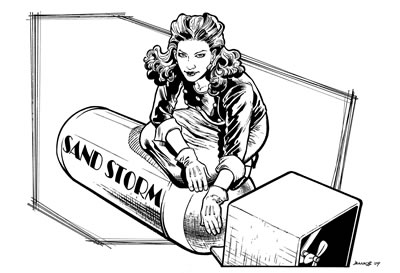
Today, while you’re checking out this sultry drawing of Sand Saref — about whom, more later — I’d like to talk a bit about how I first came to discover Will Eisner’s work in general, and The Spirit specifically.

Sand Saref, pencils and inks by comics artist Darryl Banks

I hope that most of you know that I wasn’t around during the period (1940-1952) when The Spirit‘s Sunday newspaper supplement was appearing weekly in newspapers. (Hey, I’m getting up there, but I’m not that old… yet.) My first experience with The Spirit came in 1974, when Warren Publishing began releasing reprints of the classic strips in a monthly magazine format.

At the time, my family was stationed at Clark Air Base in the Philippines. Warren magazines were a staple of the book rack at our base exchange. I was already an avid consumer of Warren’s movie fan publication Famous Monsters of Filmland, and of their line of EC Comics-inspired horror books — Creepy, Eerie, and Vampirella (issues of which I had to smuggle into the house, lest my mother find them and toss them into the trash). When The Spirit first appeared on the rack alongside the other Warren series, I assumed that it, too, contained newly published material. To my surprise, there was an entire lost world of comic book goodness that had been around for more than 30 years, and I’d known nothing about it.

The Spirit quickly became one of my new favorite magazines. I fell in love with Eisner’s art, his narrative style, his quirky characters — even, to an ambivalent degree, The Spirit’s stereotypically portrayed African-American sidekick, Ebony White, the one jarringly anachronistic and unsettling element of the older Spirit tales — and especially, his wonderfully compelling stories. Reading The Spirit was not unlike reading the absolute best of the 1960s Marvel Comics I’d grown up with, albeit with an edgier, less juvenile tone and more consistent creativity.

Those Spirit reprints sent me scrambling to the library to devour such tomes as Jules Feiffer’s The Great Comic Book Heroes, Dick Lupoff and Don Thompson’s All in Color for a Dime, and Jim Steranko’s two-volume Steranko History of Comics. It’s safe to say that reading The Spirit — and craving a deeper understanding of the era in which the series originated — drew me into the study of comic book history, an obsession that persists with me to this day.

Speaking of obsessions…

Sand Saref and Denny Colt — the boy who would grow up to become The Spirit — were childhood sweethearts. Sand’s father was a stalwart policeman, while Denny’s dad was a broken-down ex-prizefighter who hung out with underworld characters. After Officer Saref was killed by Mr. Colt’s associates during a robbery gone south, Sand became embittered and turned to crime herself, evolving into the classic “good girl gone bad.”

Sand guest-stars in a number of The Spirit’s adventures over the years, forever in the midst of malfeasance, with The Spirit compelled to end her nefarious plots. It’s clear that she still carries a torch for her old boyfriend, and to some extent, he for her. (Sand, unique among the women in The Spirit’s life, knows that The Spirit and the supposedly deceased Denny Colt are the same person.)

The Spirit’s heart now belongs to Ellen Dolan, though. (True to stereotype, you knew that Ellen was the good girl and Sand the bad because Ellen was blonde, and Sand brunette.) After all, Sand is a cold-hearted villainess. How could the straight-arrow Spirit get mixed up with a vixen like her?

How, indeed.

Next Friday, we’ll conclude this miniseries with our fourth and final Spirit’s Bombshell! Trust me… this will not be a story for little boys.

And that’s your Comic Art Friday.

Comic Art Friday: (Silk) Satin doll

March 12, 2010

Last week on Comic Art Friday, we debuted the first of artist Darryl Banks’s four Bombshells! pinups featuring the women of The Spirit, Will Eisner’s groundbreaking comic series from the 1940s and ’50s.

Here’s the second of The Spirit’s Bombshells, Sylvia “Silk” Satin.

Silk Satin, pencils and inks by comics artist Darryl Banks

Before we get to Satin’s story, though, let’s talk a little about why Eisner is such an important figure in the history of comic art. So important, in fact, that the comics industry’s annual awards — as well as its Hall of Fame — are named for him.

Eisner brought a new aesthetic to comic art: the cinematic. He was one of the earliest artists — if not indeed the very first — to see the comic panel in the same way that a film director or cinematographer looks through the movie camera’s viewfinder. In The Spirit, Eisner created a visual language for comics that launched the medium into a brave new world of crazy angles, dramatic interplay of light and shadow, and powerful closeups. The Spirit’s universe bore a striking resemblance to frames clipped from a ’40s noir detective film.

Post-Spirit, Eisner pioneered another format that has become ubiquitous today — the graphic novel. His landmark 1978 work, A Contract with God, is widely recognized as the first published comic to be identified with that descriptive phrase (although it was not the first long-form comic).

Not content simply to create these innovations, late in his career Eisner took another giant step — he told the world how he did it. His books Comics and Sequential Art (1985) and Graphic Storytelling (1996), explained how comics work as both an art form and a narrative vehicle. These two texts are essential reads for those who want to create their own comics, and those who desire a more informed appreciation of the medium.

As for Silk Satin, she enters The Spirit’s storyline in the March 1941 tale, “Introducing Silk Satin.” She presents an imposing figure — a tall, statuesque woman who generally wears her black hair cropped short, and dresses in man-tailored suits as often as she wears evening gowns. A jewel thief when she first appears, Satin (the character is generally addressed by her surname) later changes her criminal ways. Over the next decade, she would spend time as a British secret agent, a United Nations operative, and eventually an insurance investigator. Sometimes she and The Spirit were friendly collaborators; on other occasions, they worked against one another.

The Silk Satin stories generated some of the most personal moments in The Spirit’s career. In a pair of 1946 stories (“Hildie and the Kid Gang” and “Hildie and Satin”), The Spirit would help reunite Satin with her lost-lost daughter, Hildie. There were frequent hints of possible romance between The Spirit and Satin, making her the “bad girl” counterpart to “good girl” Ellen Dolan.

Next week, we’ll look at the third of these Eisner-inspired Bombshells! drawings. I’ll talk then about how I came to discover Will Eisner’s work, and how The Spirit helped me mature as a connoisseur of comics. Drop back in seven for that conversation.

And that’s your Comic Art Friday.

Comic Art Friday: To Ell’en back

March 5, 2010

The blonde on the bomb is Ellen Dolan. She’s the daughter of the police commissioner of Central City. One day, she’ll be the mayor of that dark and dangerous metropolis. And she’s sweet on a masked vigilante known only as The Spirit.

The Spirit's Bombshells: Ellen Dolan, pencils and inks by comics artist Darryl Banks

And therein lies a tale.

Ask any group of knowledgeable comics historians, “Who was the single most influential artist in mainstream comics?” and you’ll get one unanimous answer: Jack Kirby, co-creator of Captain America, the Fantastic Four, the Avengers, and the original X-Men, and sole auteur of the Fourth World cycle, among hundreds of others.

Ask the same historians, “Who was Number Two?” and the answer will be nearly as unanimous: Will Eisner.

Whereas Kirby’s creative genius ranged broadly over six decades in comics, Eisner is best known for a single creation: the long-running Sunday newspaper feature The Spirit. That’s not to say that Eisner didn’t create numerous other worthwhile projects — he certainly did; Eisner’s 1978 graphic novel A Contract with God rewrote critical thinking about comics as both literature and high art. But there’s no question that, from a pop culture perspective, The Spirit remains his most familiar brainchild.

Briefly, The Spirit revolves around the adventures of a young police detective named Denny Colt, who, after surviving a near-death encounter with some underworld types, permanently buries his former identity (literally; he takes up residence in a subterranean sanctuary hidden beneath his own tombstone) and assumes a new one — that of the masked crimefighter known only as The Spirit.

The business-suit-clad Spirit isn’t a superhero in the traditional sense. His only disguise is a domino mask; he possesses no superhuman ability (except perhaps for a remarkable knack for withstanding physical abuse); and he functions more like a consulting detective a la Sherlock Holmes than like, say, Batman. Sometimes, The Spirit serves merely as a background character in the stories in his own strip — stories which range far beyond swashbuckling derring-do to intimate, twisty, eccentric tales about the odd folks whose actions (sometimes nefarious, sometimes innocent) bring them into contact with The Spirit.

Over the course of The Spirit’s 13-year career, he encountered numerous beautiful, exotic women. In fact, most of the memorable characters in the strip — aside from The Spirit, and his police contact, irascible Commissioner Eustace P. Dolan — were female. Some appeared only for one story, and vanished as quickly as they had arrived. Four, however, recurred often enough to make a permanent mark on the series, and on The Spirit himself.

Soon after I conceived my Bombshells! theme — pinups in the style of World War II-era bomber nose art, featuring comic book heroines who debuted in the 1940s and ’50s — I hit on the idea of a special subset of Bombshells! dedicated to these four legendary women. I knew immediately the perfect artist for the project: Darryl Banks. Darryl’s most prominent contributions to comics history are his co-creation (with writer Ron Marz) of the Kyle Rayner version of Green Lantern, and his recasting (also with Marz) of the Hal Jordan version of Green Lantern as the cosmic supervillain Parallax, during an eight-year run as illustrator of the Green Lantern series.

My favorite of Darryl’s artistic efforts, though, was Millennium Comics’ 1990 miniseries Doc Savage: The Monarch of Armageddon, considered by many Doc Savage enthusiasts (including yours truly) as the most faithful comic book adaptation of the Man of Bronze. Even more specifically, I thought about a commissioned artwork Darryl drew for me a few years ago, depicting Doc and his intrepid cousin Patricia. Darryl’s take on Pat Savage had exactly the feel I wanted for my Spirit Bombshells! portraits. I was thrilled when Darryl agreed to tackle the project.

Doc Savage and Patricia Savage, pencils and inks by comics artist Darryl Banks

Ellen Dolan stars in the first of Darryl’s Spirit Bombshells! pinups. Ellen is the most consistent female presence in The Spirit’s life, and the closest to a genuine love interest in the strip. She’s a compelling character who evolves over the years, from her beginnings as an impetuous college student (and something of a stock damsel-in-distress) to a sharp-witted, capable, modern woman. As noted in our introduction, toward the end of the original series Ellen becomes mayor of Central City — not only her father’s daughter, but also his boss. And every inch The Spirit’s equal. Comics historians frequently cite Ellen as one of the earliest feminist characters in the medium.

Next Friday, we’ll look at the second of Eisner’s fetching females, and we’ll talk more about what makes The Spirit such a pivotal creation in the history of comics. Be here in seven.

And that’s your Comic Art Friday.

Comic Art Friday: Legacies

February 26, 2010

I get a kick out of dreaming up new combinations of heroes for my Common Elements commission theme. That little inward chuckle from uncovering a heretofore untapped linkage between two unrelated comics characters? Man, I love that.

Sometimes, though, my Common Elements combinations surprise even me, in that I stumble upon a second — or even a third — layer of connection bubbling just beneath the surface, sometimes long after a piece has entered my collection.

Take this one, for example.

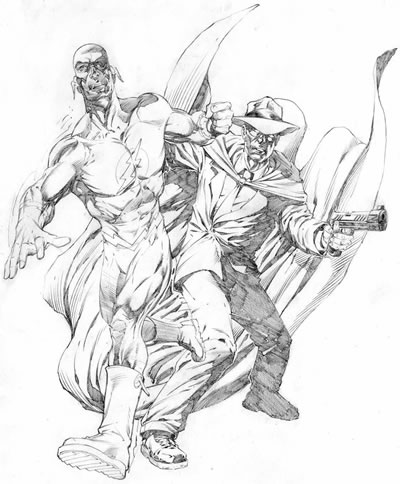
The Flash and the Crimson Avenger, pencils by comics artist Christopher Ivy

I titled this drawing by Christopher Ivy (best known as an inker, but a fine pencil artist as well) “A Study in Scarlet,” not because it has anything to do with the Sherlock Holmes chronicle by that name, but because it features two heroes dressed in red: The Flash, and the Crimson Avenger. The common element between these two stalwarts couldn’t be more obvious or prosaic. But they make an interesting combination anyway, so I went with it.

I’d had Chris’s piece in my gallery for more than a year before another commonality struck me. There’s a long tradition in comics of legacy heroes — that is, instances where one superhero takes up the mantle (and often, the costume and code name) of another who went before. This pairing (however inadvertently) pays homage to this tradition.

The Flash might be comics’ best-known example of a legacy hero. The Flash shown here — real name, Barry Allen — wasn’t the first super-speedster to wear that name. The original Flash — real name, Jason “Jay” Garrick — made his debut in Flash Comics #1, in January 1940. Like most of the costumed do-gooders of the World War II era, the first Flash vanished from the newsstands not long after the war ended. In 1956, DC Comics revived the Flash’s code name and superpower to create a new hero. Enter the second Flash.

Barry Allen died in 1986, during the event known as the Crisis on Infinite Earths. Barry’s sidekick, a young man named Wally West who ran really fast and battled evil using the moniker Kid Flash, assumed the nom de guerre and jumpsuit of his mentor, becoming the third Flash. Twenty years later, Barry’s hyperquick grandson Bart Allen briefly took over the reins of Flash-hood. Now Barry is back, alive and in costume, having become his own legacy.

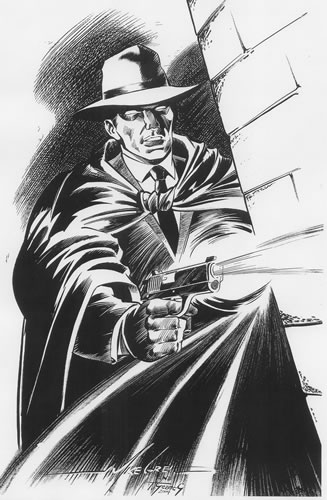
The Crimson Avenger, pencils by Mike Grell, inks by Terry Staats

The history of the Crimson Avenger boasts fewer twists than that of The Flash. Still, as was the case with the various Scarlet Speedsters, there was one way back when, another more recently, and a third of modern vintage. The first Crimson Avenger, Lee Travis, arrived on the scene in October 1938, in Detective Comics #20. (Note that date; it’ll be important later on.) In creative terms, the Avenger was a direct swipe of the then-popular radio hero, the Green Hornet, simply with a change in color scheme. Both characters were newspaper publishers who dressed up in costumes featuring masks, fedoras, and gas guns, and each fought crime in the company of his respective one-named Asian valet (the Hornet had Kato, while the Avenger had Wing).

Nearly 20 years after the first Crimson Avenger vanished from the comics pages, another appeared. The career of the second Avenger, Albert Elwood, lasted a single 1963 issue of World’s Finest Comics. From that point, the Crimson Avenger identity would lie fallow until the cusp of the new millennium. In 2000, a young woman (whose real name may or may not be Jill Carlyle, depending on the source you consult) would pick up the title — as well as the original Avenger’s twin Colt .45s — to continue the war against wickedness.

So, we’ve seen two common elements between The Flash and the Crimson Avenger. But I’ve thought of one other, which may have even greater significance than either of the previous.

I mentioned before that the Crimson Avenger made his comic book debut in October 1938. That early appearance marks the Avenger as the first masked crimefighter in comics history, beating the more highly renowned Batman to the punch by more than half a year. (Superman, the template for all costumed heroes, arrived a few months before the Crimson Avenger, but the Man of Steel didn’t wear a mask.) The Crimson Avenger’s significance as the seminal masked mystery man continues in the lore of the DC Comics universe to this day — both of DC’s primary superhero teams, the Justice League of America and the Justice Society of America, invoke the memory of the original Crimson Avenger when inducting new members into their ranks.

What does that have to do with The Flash? Well, Barry Allen’s 1956 debut in Showcase #4 is generally recognized as the launch of comics’ Silver Age, the return of superheroes to marquee status in the medium following the post-World War II drought. (As hardcore aficionados know, only five costumed crimefighters survived in continuous publication from their Golden Age premieres into the modern day — Superman, Batman, Wonder Woman, Aquaman, and Green Arrow.)

Thus, these scarlet-clad stars share unique stature as landmarks in history: The Crimson Avenger marks the advent of the Golden Age of costumed heroes, while The Flash marks their Silver Age comeback. Those of us who treasure the superhero genre owe a great debt to these two gentlemen, and to their creators.

And that’s your Comic Art Friday.

Comic Art Friday: My heroes have always been heroines

February 19, 2010

Today’s Comic Art Friday is dedicated to my birthday girls: my wife KJ and my goddaughter Shelby. As regular readers here know, KJ has been battling metastatic breast cancer for the past three years. One thing we’ve learned in these past 36 months: We don’t take birthdays — or any days — for granted.

The Invisible Woman, pencils by comics artist Geof Isherwood

In recent days, I’ve been reading Mike Madrid’s entertaining book The Supergirls, a breezy history of superheroines in comics from the Golden Age until now. Aside from the occasional pang of jealousy — this book is very much like one I had intended to write someday — I’m enjoying the author’s fresh perspective on facts I already know rather well.

In his chapter on 1960s Marvel Comics, Madrid observes something that often frustrated and puzzled me in my comics-reading youth: Marvel’s early superheroines were pretty much useless. It’s strange that a publishing concern that made at least token efforts toward progressiveness in other areas — Marvel featured African-American supporting characters (Gabriel Jones in Sgt. Fury and His Howling Commandos, Joe “Robbie” Robertson in The Amazing Spider-Man) long before the practice was fashionable, and had numerous marquee heroes of color (Black Panther, the Falcon, Luke Cage, Brother Voodoo, Black Goliath) years before DC had even one — struggled to put quality female heroes into its pages.

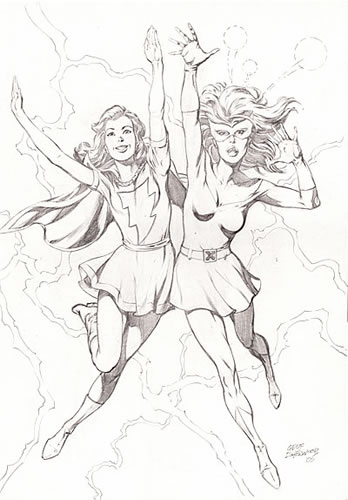
Mary Marvel and Marvel Girl, pencils by comics artist Geof Isherwood

Unlike DC’s Wonder Woman and Supergirl, whose powers were the equal of any of the men (even though they rarely got the opportunity to demonstrate this, especially in the case of Supergirl), Marvel’s heroines of the 1960s were uniformly ineffectual. The Invisible Girl (seen at the top of this post, in a pencil drawing by Geof Isherwood) turned invisible — a handy skill for a voyeur, perhaps, but not much good in a fight. The fashion-obsessed Wasp shrank to insect size and flew — again, not much help when some supervillain is bashing your brains in. The X-Men’s Marvel Girl (alongside Mary Marvel in the Common Elements commission above, also by Isherwood) could push objects around with her mind — kind of cool, but still somewhat ephemeral compared with her male counterparts’ optic blasts or ice shields. The Scarlet Witch (below — yes, that’s Isherwood yet again) could… well… we never could figure out exactly how Wanda’s powers worked. We just knew that she couldn’t kick a lot of evildoer butt using them.

The Scarlet Witch, pencils by comics artist Geof Isherwood

It wasn’t until Ms. Marvel arrived on the scene in the late ’70s that Marvel finally created a heroine with maximum power potential. And even then, they couldn’t figure out how to deploy her effectively.

To Marvel’s credit, they’ve worked at upgrading most of their legacy heroines. The Invisible Woman — Susan Storm shed the “Girl” tag decades ago — added powerful force fields to her invisible arsenal. Marvel Girl transmogrified into the world-destroying Phoenix, before coming back down to Earth under her civilian name, Dr. Jean Grey. The Scarlet Witch — as much as I detest what Marvel’s writers have done to her character in recent years — may now be one of the most formidable beings in the Marvel Universe, with the ability to warp the very fabric of reality, as witnessed by the House of M storyline of a few years ago.

And, over time, Marvel has generated a veritable plethora of outstanding female heroes, including such characters as Storm, She-Hulk, Elektra, Kitty Pryde, the Black Widow, the White Queen, Valkyrie, Monica Rambeau, Thundra, the Daughters of the Dragon, Silver Sable, and at least three versions of Spider-Woman — as well as Spider-Girl, the alternate-future teenage daughter of a now-retired Spider-Man. So… they’re trying.

Comics are still largely a man’s world, sad to tell. It’s worth noting, though, that three of the best superhero comics being published right now feature female heroes.

Wonder Woman has never been better than in her current monthly series, as written by Gail Simone and illustrated by Aaron Lopresti. After an agonizingly trite start to her present-day adventures — which worked harder at making Kara a teenage sexpot than the Maid of Steel — Supergirl has developed in new and exciting ways with (at long last!) a sensitive creative team in writer Sterling Gates and artist Jamal Igle. And Terry Moore’s independent book Echo is an absolute joy, starring a beautifully realized lead character in stories with warmth and heart.

There’s hope for the ladies yet.

And that’s your Comic Art Friday.