Archive for the ‘Comic Art Friday’ category

Comic Art Friday: Connections

February 12, 2010

This is a story about connections.

The Black Panther, pencils and inks by comics artist Brent Anderson

The other night, I was surfing cable TV’s bounty when I stumbled across Man-Thing, the ultra-low-budget cheapie thriller based on Marvel Comics’ swamp monster character, on the channel now ludicrously named Syfy. I knew of this film only by its sullied reputation, which was at least part of the reason why I’d avoided it before now. On this particular evening, however, quality offerings proved to be in scarce supply, so I thought, what the heck — let’s watch a bit of this.

Before you ask: Yes, the Man-Thing movie is as wretched as you’ve heard. (And if you’ve not heard, well, consider your life charmed.) It did, though, spawn in me a desperate craving to read an actual Man-Thing comic book. Now, I haven’t had such an item lying about the house since, oh, 1978 or thereabouts. But my desire for oozy primordial goodness was not to be denied. I had to score me some Man-Thing.

(Okay… that didn’t come out quite the way I intended. Pressing on…)

A quick online search turned up a listing of every Marvel book in which Man-Thing had ever appeared. Lo and behold, the fetid forest-dweller pulled a guest shot in Uncanny X-Men #144 (April 1981). I turned to the rack beside me and snagged my DVD-ROM archiving 40 years of X-Men comics. Into the laptop went the disc, and within moments, I was savoring the tale of the merry mutants’ battle against the villain D’Spayre, with a special appearance by none other than — you’re way ahead of me — Man-Thing.

As I perused the story, it struck me that the artwork in this particular issue was markedly different from the style I normally associate with this period in X-Men history. Specifically, it wasn’t the work of penciler John Byrne and inker Terry Austin, who drew the X-Men’s adventures for more than three years, beginning in late 1977. I vaguely recalled that Byrne had been displaced in early 1981 by the return of Dave Cockrum, who co-created the modern version of the X-Men in 1975 and drew their series until Byrne’s arrival. But this definitely wasn’t Cockrum’s work, either. Both Cockrum and Byrne (especially Byrne as inked by Austin) had, at least at this point in their respective careers, distinctive styles that would be difficult to mistake for anyone else’s.

I paged back through the PDF file to the opening splash for a look at the issue’s credits. To my surprise, I discovered that the penciler of Uncanny X-Men #144 was Brent Anderson, in what must surely have been one of his earliest published jobs.

Although Brent’s first regular series (at Marvel, in the early ’80s) was the Tarzan knockoff Ka-Zar the Savage, he became a major star later in the decade illustrating one of the most unusual comics of all time — Strikeforce: Morituri, about an X-Men-like squad of manufactured superhumans who routinely died gruesome deaths as a result of the process that gave them their powers. (Morituri is a Latin word meaning “We who are about to die.” Spring that one on your buddies sometime this week.) Today, Brent is best known as writer Kurt Busiek’s artistic collaborator on the long-running series Astro City.

As I said at the start, this is a story about connections. Brent Anderson is a local guy. In fact, he lives just a few miles away, in the town where my wife KJ worked for the past several years. He also happens to be a friend of Kathy Bottarini, the beloved proprietor of my hometown comic book shop.

Brent’s Black Panther sketch, which adorns the opening of today’s post, was commissioned at WonderCon three years ago. Brent didn’t have time to complete the drawing until the last day of the con, after I had finished my sojourn there. He graciously dropped it off at Kathy’s shop a couple of weeks later, where she kept it safe until I called for it.

See? Connections.

On that subject…

Brent’s pencils in Uncanny X-Men #144 were inked by Joe Rubinstein, who would also ink the next several issues of the series as Dave Cockrum resumed his penciling duties. Joe has probably inked just about every major character — and thousands of minor ones — published by the Big Two comics concerns during his now-legendary career, beginning in the early ’70s.

In between comics projects, Joe takes on commissioned work, including several pieces for yours truly over the last half-dozen years. The very first piece Joe ever inked for me was this lovely portrait of Lara Croft, Tomb Raider, drawn by Dan Jurgens. It’s still a personal favorite.

Lara Croft, Tomb Raider, pencils by Dan Jurgens, inks by Joe Rubinstein

And yet another connection.

Thank you, friend reader, for connecting with me today. And that’s your Comic Art Friday.
Comic Art Friday: Going batty

February 5, 2010

In an era when sexual sensationalism sells, DC Comics made a major media splash a few years ago by announcing that Batwoman — a character who’d been killed off way back in 1979 — was being revived as a lesbian.

The irony of this was that the entire reason that there had ever been a Batwoman in the first place was to “prove” that Batman and Robin weren’t gay. Go figure.

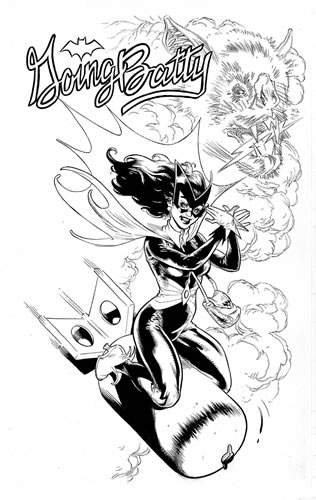
Me, I think whatever Batwoman does in the privacy of her own Batcave (okay, let’s not go there) is Batwoman’s business — much like your own, friend reader. At any rate, it’s the original 1956 version of Kathy (Batwoman) Kane — not the New Millennium version, who prefers to be known as Kate — who’s “going batty” in this Bombshells! pinup by inker extraordinaire (Deadpool, Civil War: Front Line) John Lucas.

Bombshell! Batwoman, pencils and inks by comics artist John Lucas

For those of you who may be new around these parts, Bombshells! is the second of my two comic art commission themes. This series features classic superheroines — “classic” for this purpose being arbitrarily defined as characters whose first published appearance dates prior to 1960 — in pinups styled after vintage aviation nose art.

When I commission a Bombshells! drawing, my instructions to the artist are always minimal — “a babe, a bomb, and a tagline” is generally as far as I go, beyond providing a reference picture or two of the character to be drawn. I’m perfectly delighted when I get exactly what I asked for. Every now and again, though, an artist decides to go whole hog with the project. I think it’s fair to say that “Joltin’ Johnny” dove into this one with both feet.

It’s tough to pinpoint which facet of the finished art tickles me most: Lucas’s impeccably detailed, serious-yet-whimsical drawing style; his expressive character work; his unexpected added touches — the cloud formation that turns into a bat’s head; Batwoman’s shadow-puppet bat hand gesture; the bat-shaped clasp on her shoulder bag — that bring the artwork to life. Whatever I focus on, John’s sense of fun shines through. And isn’t that what comics are supposed to be about?

Speaking of Batwoman’s shoulder bag, I’m trying to think of another superheroine who carried a purse as a standard feature of her fighting attire. I can’t come up with another.

I’ll say this for Kathy Kane — straight or gay, the woman knew how to accessorize.

And that’s your Comic Art Friday.

Comic Art Friday: A quaint and curious volume of forgotten lore

January 29, 2010

Here’s an interesting historical fact: 165 years ago today — January 29, 1845 — Edgar Allan Poe’s immortal poem The Raven was published for the first time under its author’s byline, in the New York Evening Mirror.

Considered by many — your Uncle Swan included — to be among the greatest American poetic works, The Raven is without question one of the most recognizable, most referenced, and most frequently parodied poems ever written. It made its author a literary superstar in his own time, and an influential and culturally pervasive writer to this day.

What does this have to do with comic art?

Not one doggoned thing.

Except…

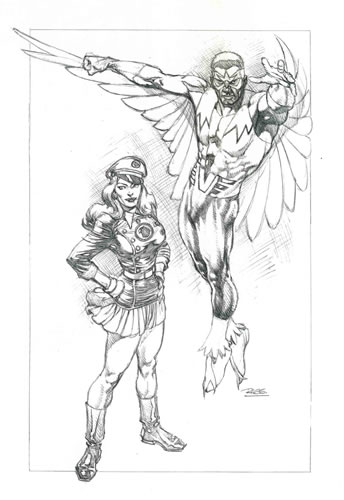
"Blackbirds of Prey," pencils by comics artist Rags Morales

It provides a ready excuse to delve into my archives and pull out this Common Elements classic. No ravens here, exactly, but a pair of fine black birds nonetheless.

That’s ace aviatrix Zinda Blake — better known as Lady Blackhawk, of the famous Blackhawk Squadron and more recently of the Birds of Prey — on the left. Her winged companion is one Samuel Wilson, familiar to most as Captain America’s longtime partner in crimefighting, the high-flying Falcon. The artist behind the pencil for this heroic pose-off is Ralph “Rags” Morales, whose work for DC Comics includes several series that fit today’s “ravenous” theme, including Hawkman, Nightwing, and Black Condor.

Speaking of Poe (and I was)…

Just 10 days ago, the legendary author’s fans celebrated the 201st anniversary of his birth. Every January 19 for the past 60 years, a mysterious black-clad figure has visited Poe’s gravesite in Baltimore in the early morning hours to perform a silent tribute: a toast with a glass of cognac, and a deposit of three roses on the writer’s tombstone. This year, for the first time in six decades, “the Toaster” — as the nameless individual has come to be known — did not appear as previously. Perhaps he (or she?) has at last joined the literary giant in the Great Beyond.

Quoth the Raven… “Nevermore.”

And that’s your Comic Art Friday.

Comic Art Friday: Tony, Tony, Tony

January 22, 2010

I’ve always been as much a student of comic book history as I am a connoisseur of comics themselves. Indeed, given the state of modern comics, I get far more enjoyment from reading about the great comics and creators of times past than from the often execrable product being churned out today.

(Don’t get me wrong: There has always been more chaff than wheat in comics. Although that’s pretty much true in any creative field. To quote Sturgeon’s Law — named for legendary science fiction writer Theodore Sturgeon, who’s credited with coining it — 90 percent of everything is crap.)

1000 Comic Books You Must Read by Tony Isabella

Right now, I’m leafing through the pages of Tony Isabella‘s excellent new book, 1000 Comic Books You Must Read. This fun, reflective volume — chock full of classic full-color cover art — lists one man’s suggestions, not necessarily of comics’ all-time best works, but rather its most seminal volumes. Although I’m only about a quarter through the book, I’m enjoying Isabella’s approach to the theme — especially his broad-based perspective that includes key issues outside the superhero genre which dominates the field today, including Western, romance, and funny animal comics.

Isabella makes a terrific choice to compile such a volume. A noted comics writer and editor who began his career at Marvel in 1972, he has for many years written the “Tony’s Tips” column for Comic Buyer’s Guide magazine, as well as a companion blog called Tony’s Online Tips. Never shy with an opinion, Isabella’s blog is one of a mere handful of comics sites I frequent.

Since I’m reading Tony’s book, I thought this might be a good time to leap back into the archives and pull out a couple of Common Elements commissions featuring characters Tony created… namely, Black Lightning and Tigra.

Elektra and Black Lightning, pencils and inks by comics artist Darryl Banks

Black Lightning — seen above with Marvel’s antiheroine Elektra, in a commissioned drawing by Darryl Banks — may be Isabella’s most famous contribution to the comics pantheon. Created by Isabella and designed by artist Trevor Von Eeden, Black Lightning was DC’s first hero of African heritage to headline his own series; not surprising, given that DC’s foot-dragging in introducing superheroes of color is the stuff of comics history. By way of comparison, by the time Black Lightning debuted in April 1977, Marvel had already given masthead status to four black heroes, beginning with the Falcon in 1971 (in Captain America and the Falcon) and followed by Luke Cage in 1972 (in Luke Cage, Hero for Hire), the Black Panther in 1973 (in Jungle Action, Featuring the Black Panther, followed by an eponymous series beginning in January 1977), and Black Goliath in 1976 (in Black Goliath — written, not coincidentally, by Tony Isabella).

In his original incarnation, Black Lightning was in civilian life a high school principal and former Olympic decathlete named Jefferson Pierce. Over time, Pierce gained sufficient status that he rose to the position of U.S. Secretary of Education (in an administration led by President Lex Luthor — not exactly a bright spot on one’s résumé). Black Lightning has served several tours of duty in the superhero team known as the Outsiders, and recently was a member of the Justice League of America for a period of time.

Tiger Girl and Tigra, pencils and inks by comics artist Greg LaRocque

Unlike Black Lightning, who sprang from whole cloth in the mind of Tony Isabella, Tigra — seen here at right, alongside Dell Comics’ Tiger Girl and friend, in a drawing by Greg LaRocque — was a preexisting character named Greer Nelson, whom Isabella and artist Don Perlin transmogrified from a rather generic Catwoman knockoff called the Cat into a “were-woman” who was half-human, half-tiger. (The “were-woman” business always confused me. If a werewolf is a man who transforms into a wolf, shouldn’t a were-woman be a man who transforms into a woman? But then, that’s why they don’t hire me to write comics. I’m too darned logical.)

Debuting in her new identity in Marvel’s Giant-Size Creatures #1 (July 1974 — and, just to be clear — it was the magazine, not Tigra, that was giant-size), Tigra soon became the featured character in another horror-flavored comic called Marvel Chillers. After a stint as a solo act, Tigra joined the Avengers, then later moved to California as a charter member of the superteam’s branch franchise, the West Coast Avengers (eventually redubbed Avengers West Coast). More recently, she has served as one of the government-licensed superheroes in the 50-State Initiative, and as leader of the underground Avengers Resistance.

If you’re interested in a fond glance back at more than 70 years of comic book history, I recommend Tony Isabella’s 1000 Comic Books You Must Read, as well as the author’s continuing blog, Tony’s Online Tips. You can tell Tony your Uncle Swan sent you.

And that’s your Comic Art Friday.
Comic Art Friday: Yes, we do need another Hero

January 15, 2010

I’m not one for causes, generally speaking. The few that I do support, however, I support wholeheartedly. As most of our regular readers know, the fight against breast cancer is one of my causes.

The Hero Initiative is another.

Flash Gordon and Dale Arden, pencils by comics artist Ralph Reese

The Hero Initiative is a nonprofit 501(c)(3) charitable organization whose efforts benefit comic book creators in need. Although in recent years, some comic book artists and writers have managed to turn their creative endeavors into multimillion-dollar enterprises, these still-rare circumstances haven’t always existed.

For decades, comics creators worked for the most part on a freelance basis, for paltry remuneration by most standards, and without corporate healthcare or pension benefits. As a result, many of these talents hit rocky financial straits later in life when their skills were no longer in demand, and as the sorts of health challenges that become common as people grow older befell them. No safety net was in place to help.

Until 2000, when the Hero Initiative — formerly known as ACTOR (A Commitment to Our Roots) — was established.

Supported by a consortium of comics publishers — including Marvel, Image, Dark Horse, Dynamic Forces, Top Cow, and Wizard — the Hero Initiative provides financial assistance to veteran comic book writers and artists (defined as those with industry credits spanning ten years or longer) in need. The disbursement of funds is overseen by a board entirely composed of comics creators, including such legends as George Pérez, Dick Giordano, John Romita Sr., Denny O’Neil, Jim Valentino, and Roy Thomas.

Last year, the Hero Initiative began supplementing its fundraising efforts through the sale of annual memberships. I’m proud to be HERO member #115. (Stan Lee, the longtime writer, editor, and publisher of Marvel Comics, is #1.)

One of the perquisites of membership renewal is a sketch card drawn by a noted comics artist. This year, I received a sketch of Flash Gordon and Dale Arden drawn by Ralph Reese, who worked on the Flash Gordon newspaper strip in the early 1990s. Reese’s diverse credits include work on projects ranging from horror titles (for DC, Marvel, and Warren) to superheroes (THUNDER Agents) to science fiction (Magnus: Robot Fighter) to humor (National Lampoon). As related in this article from the Los Angeles Times, Reese himself has been helped by the Hero Initiative, making this sketch all the more awesome.

Times are tough, and there’s no end of worthy opportunities for whatever cash one has available to support such causes. But if you’ve enjoyed the work of comics creators over the years, and you’d like to show your appreciation in a tangible manner, the Hero Initiative is a good way to do that.

And that’s your Comic Art Friday.

Comic Art Friday: Bring down The Wall!

January 8, 2010

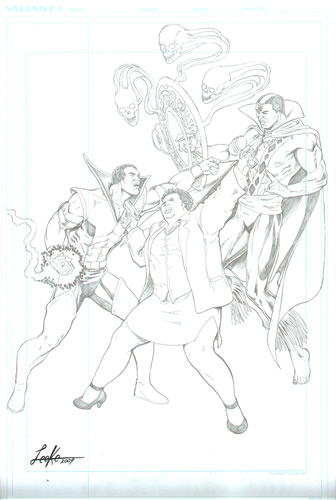
Our first Comic Art Friday of 2010 spotlights the first Common Elements arrival of the Teens Decade. Artist Mike Leeke actually completed this masterpiece in the closing days of ’09, but since it just landed on my doorstep earlier this week, we’ll count it as a ’10.

What better way to launch a New Year than with an action-fraught Common Elements trifecta?

Tempest, Amanda Waller, and Brother Voodoo, pencils by comics artist Mike Leeke

On the left is Tempest, the short-lived superhero identity of Joshua Clay, a DC supporting character who’s better known by his civilian name. On the right, we have Dr. Jericho Drumm, a.k.a. Brother Voodoo, Marvel’s supreme master of the Haitian mystic arts. The pistol-packing mama in the middle is Amanda Waller, the hard-charging string-puller behind the Suicide Squad, and the White Queen within the shadowy international espionage organization known as Checkmate.

The artist wielding the pencil, Mike Leeke, enjoyed lengthy runs on Comico’s anime adaptation Robotech in the ’80s, and on numerous titles for Valiant (including X-O Manowar and H.A.R.D. Corps) during the ’90s. He’s best known, though, as one of the primary artists on the critically acclaimed Elementals, created and written by Bill Willingham, later the creator of DC/Vertigo’s popular fantasy series Fables.

As Tempest, Joshua Clay battled the forces of evil as a member of the second version of the Doom Patrol. During this period, Joshua played a key role in the concluding events of the universe-altering Crisis on Infinite Earths (he’s prominently featured on the cover of the final book of the 12-issue Crisis maxiseries). After hanging up his superhero togs, Joshua — a former U.S. Army corpsman who later graduated to full-fledged physician — becomes the Patrol’s resident sawbones and health adviser. Alas, poor Joshua was murdered by Niles Caulder, the Doom Patrol’s commander, and — understandably — hasn’t been seen much since.

A member of the ’70s-spawned wave of black superheroes, Brother Voodoo premiered in a brief miniseries in Marvel’s Strange Tales anthology — a book which at various times in its long history starred such disparate heroes as Dr. Strange, Adam Warlock, and Nick Fury, Agent of SHIELD. By trade a psychologist, Dr. Jericho Drumm picks up the mantle of his deceased brother Daniel, a houngan (voodoo priest), ultimately developing into the most powerful houngan of all time. Recently, Jericho starred in another short-lived Marvel series, in which he took over for Dr. Strange as this dimension’s Sorcerer Supreme under his new nom de guerre, Doctor Voodoo.

Amanda Waller — nicknamed “The Wall” — possesses no superpowers, yet is as formidable a figure as any hero or villain (at various times, The Wall has been viewed as both) in comics. Throughout most of her career, Amanda has served as a covert operative for either the U.S. government (as when she was the director of the Suicide Squad) or some quasi-governmental agency (as when she was White Queen in Checkmate). A master tactician and political strategist, The Wall manipulates people and situations to exercise control, often for her own ends.

By now, you’ve probably figured out the Common Element that unites these three. And no, it’s not the fact that all three are doctors (Joshua Clay is an M.D., Jericho Drumm holds a Ph.D. in psychology, and Amanda Waller owns a doctorate in political science).

Doesn’t it stand to reason that if you bring together Joshua, Jericho, and The Wall, a battle will erupt?

Of course it does.

And that’s your Comic Art Friday.

Comic Art Friday: The best of 2009, day seven

December 31, 2009

We’ve had six stupendous days tripping backward through the cleanest and meanest commissioned illustrations that entered my comic art collection during 2009. It’s time for the final pair of drawings… and yes, they’re doozies.

(You whippersnappers will have to Google “doozy.” You’ll probably have to Google “whippersnapper,” too.)

Favorite Multi-Character Commission, Non-Theme Division:
Arak, Son of Thunder
and Valda the Iron Maiden
Pencils and inks by Tony DeZuniga

Arak, Son of Thunder and Valda the Iron Maiden, pencils and inks by Tony DeZuniga

The second of two masterpieces created at WonderCon 2009 by comics legend Tony DeZuniga, this dramatic illustration spotlights the stars of DC’s mostly forgotten 1980s mashup of Native American historical drama and sword-and-sandal fantasy, Arak, Son of Thunder. Tony drew about half of the original adventures of Arak and his lady companion, Valda the Iron Maiden. He hasn’t lost the master’s touch.

Favorite Supergirl Commission:
Pencils by Michael Dooney

Supergirl, pencils by comics artist Michael Dooney

I’ve saved one of my absolute treasures until the very end. I can’t really explain why it took so long for me to commission one of my favorite artists to draw one of my favorite heroines in my all-time favorite of her numerous costumes. Fortunately for us all, that drought ended in 2009. Mike Dooney’s take on the Maid of Steel is flat-out awesome. Spunky, too. (Spunky rocks.)

So that’s it in a seven-fragment nutshell: Comic Art Friday’s top artworks from the final year of the Aughts. With any luck, there will be more to come as we forge ahead into the Teen Decade.

May you and your loved ones enjoy a happy, healthy, and prosperous New Year in 2010.

Comic Art Friday: The best of 2009, day six

December 30, 2009

The penultimate edition of our week-long saunter through the past year of comic art collecting brings us to a pair of pieces commissioned at WonderCon 2009. Neither of these falls specifically into any of my usual themes, but they both feature fantastic renderings of characters I know and love. I couldn’t choose one over the other, so we’ll showcase both today.

Favorite Solo Commission, Non-Theme Division (tie):
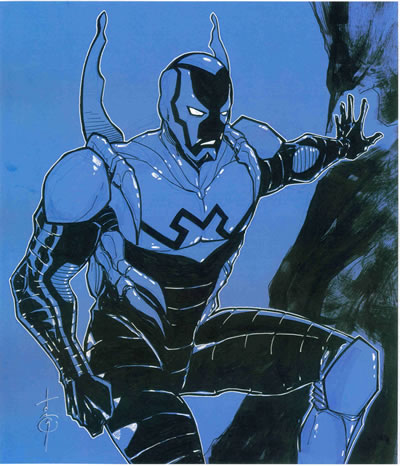
Blue Beetle

Pencils and inks by Thomas Hodges

Blue Beetle III (Jaime Reyes), pencils and inks by comics artist Thomas Hodges

I’d wanted for some time to see Star Wars artist Hodges’s take on the current Blue Beetle, mostly because I see strong similarities between Tom’s style and that of Cully Hamner, who designed Jaime Reyes’s scarab armor. Tom kicked the concept up a notch by illustrating the Beetle on bold blue art paper.

Favorite Solo Commission, Non-Theme Division (tie):
The Rocketeer

Pencils and inks by Aaron Lopresti

The Rocketeer, pencils and inks by comics artist Aaron Lopresti

Current Wonder Woman (and former Ms. Marvel) artist Lopresti wanted to apply his skills to a male character this time around, so I asked him to tackle Dave Stevens’s Rocketeer. Aaron’s iconic pinup deserves a place alongside the newly released hardcover collection of Stevens’s work.

Tomorrow, we’ll ring out the old year and look ahead to the new, with our last two splendiferous additions to 2009’s greatest and highest. You’ll want to be sure to stop by.

And that’s your sixth chapter of Comic Art Year-End, 2009.

Comic Art Friday: The best of 2009, day five

December 29, 2009

We’re heading into the home stretch of our seven-day review of the best comic art commissions we picked up during the past twelve months.

I believe that I can say without too much fear of contradiction that I’m the only collector in the comic art field who regularly commissions art featuring either Isis, star of the classic 1970s Saturday morning TV series The Secret of Isis (and later, The Shazam!/Isis Hour), or Taarna, the iconic warrior from the groundbreaking animated science fiction anthology Heavy Metal. This year, my favorite new Isis and Taarna artworks both happen to also be entries in my primary commission theme, Common Elements.

Favorite Isis Commission:
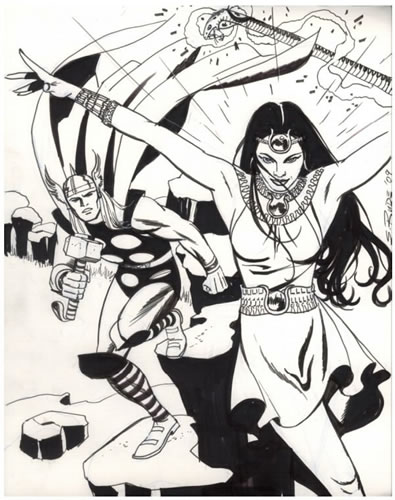
“Ye Gods!”
(costarring the mighty Thor)
Pencils and inks by Steve Rude

The mighty Isis and the mighty Thor, pencils and inks by comics artist Steve Rude

If you’re going to put together a retro heroine from the Disco Decade and a superhero cocreated and designed by Jack “King” Kirby, there’s one artist at the top of your wish list: Steve “The Dude” Rude. This amazing tableau demonstrates the reason Rude was the perfect choice for this combination.

Favorite Taarna Commission:
“One-Way Ticket to Midnight”
(costarring the original Sandman)
Pencils by Edgar Tadeo

The Sandman and Taarna, pencils by comics artist Edgar Tadeo

I had no idea what Ed Tadeo — one of the brightest talents among the new school of comics artists coming out of the Philippines — would do with the pairing of Taarna and the Golden Age hero Sandman. Ed devised an evocative scene with a hint of mystery and subtext. Then he drew the heck out of it.

In tomorrow’s post, we’ll trot out the two best single-character commissions from 2009 that don’t fit into any of my established theme categories. They’re simply two great drawings that deserve a second look. We’ll see you here in 24.

And that’s your fifth chapter of Comic Art Year-End, 2009.

Comic Art Friday: The best of 2009, day four

December 28, 2009

Thus far in our nostalgic romp through the past year’s comic art acquisitions, we’ve ogled my favorite new pieces from my two commission themes, Common Elements and Bombshells! Today, we turn our attention to our solo character galleries.

As regular visitors to my online art gallery know, I collect unique images of several beloved heroes and heroines. Alas, in 2009, most of those collections didn’t expand, as I focused my limited art-buying resources on my two primary themes. I did, however, pick up a couple of nice additions for my gallery dedicated to one of comics’ premier husband-and-wife duos, the Black Panther and Storm.

Favorite Black Panther Commission:
Alex Niño

The Black Panther, pencils and inks by Alex Nino

Alex Niño is, without question, one of the most distinctive stylists the comics industry has ever produced. He created this eye-catchingly impressionistic interpretation of the King of Wakanda at WonderCon 2009.

Favorite Storm Commission:
Bob Almond (ink finishes over rough pencils by Mark Beachum)

Storm, finished inks by Bob Almond, from a pencil rough by Mark Beachum

Bob Almond, the guy who puts the “king” in “inking,” took a rough pencil sketch that Mark Beachum included as a bonus gift with an earlier art purchase and transformed it into this powerful image of everyone’s favorite mutant weather wizard. Bob spun Storm’s costume from an idea that Geof Isherwood created for a previous Common Elements commission — an adaptation of an original concept by the legendary Barry Windsor-Smith.

More retrospective goodies tomorrow. Be here… or don’t.

And that’s your fourth chapter of Comic Art Year-End, 2009.