Archive for the ‘Comic Art Friday’ category

RIP, Dave Simons

June 10, 2009

Because I know that many of my regular readers aren’t comics fans, I usually restrict my writing about comic-related subjects to our Comic Art Fridays feature.

Today, however, I’m going to break that rule.

Comic book artist Dave Simons died last evening, after a lengthy bout with cancer. He was 54 years old.

Dave worked extensively for both Marvel and DC Comics, most prominently as an inker, but often as a penciler and cover artist also. After his comics work thinned out, he turned to the animation field, where he provided storyboards for a number of popular series.

I never had the privilege of meeting Dave, but I did correspond with him a few times. Some time back, Dave e-mailed me about possibly doing a drawing for my Common Elements commission theme. He proposed a scenario involving Marvel Comics’ Ghost Rider, the character with which Dave was most closely associated.

At the time Dave wrote to me, my art budget was tapped out. But I promised him that I would get in touch with him within the next few months, and we’d see whether we could work something out.

Earlier this year, when word began circulating about the progressive seriousness of Dave’s cancer, I got back in touch with him, and commissioned him to do the drawing we had previously discussed. We decided that Dave would draw Ghost Rider racing motorcycles with the Barbara Gordon version of Batgirl. Dave, a major motorcycle buff, seemed genuinely enthused about the project. We swapped several cordial e-mails about the details of the scenario, and comparing reference photos from which Dave would create Batgirl’s bike.

Although we did not speak of it, I was aware that Dave’s health might prohibit him from completing the commission. But I also knew from the comics grapevine that, like many comics creators, he was in tough financial shape because of his medical expenses. If the amount I paid for the commission might help him in some small way, I was glad to do it. I also know how vital it is for people with life-threatening illnesses to be able to carry on with everyday life, and to do the things they enjoy as long as they’re able. If the prospect of working on my drawing gave Dave something to look forward to, I was glad for that as well.

A couple of months ago, I exchanged notes with Dave’s art representative. At that time, Dave was feeling somewhat better, even though his long-term prognosis was not good. The doctors then were giving him six months. Dave was determined to outlast that limitation.

I was deeply saddened to hear that he did not.

Dave’s friend and biographer Daniel Best has posted a poignant and eloquent memorial to Dave on his blog. I encourage you to read it, and to learn more about this fine artist and gentleman.

I wish that I had known him better myself.

Rest in peace, Dave.

Comic Art Friday: Brush strokes with destiny

June 5, 2009

Today’s Comic Art Friday extends belated birthday wishes to longtime comic book inker Joe Rubinstein, who celebrated his 51st birthday yesterday.

Joe was the artist who took on the very first inking job I ever commissioned, back in the days when I was an art collecting newbie and terrified to let someone touch one of my pristine pencil pieces. Since then, Joe has lent his considerable talents to a dozen other pieces from my collection, always displaying the smooth line and graceful style that has been a hallmark of his comic book oeuvre since the early 1970s.

Now, let’s take a peek at Joe’s latest commission.

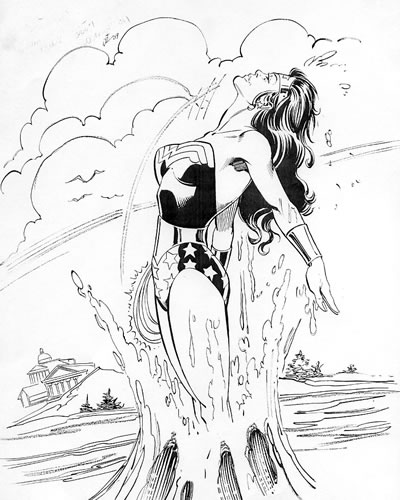
Paul Ryan, a delightful gentleman as well as a phenomenally gifted artist, drew this dynamic pencil sketch of Wonder Woman — a favorite heroine of Paul’s as she is mine — at WonderCon 2007.

I recently placed this beauty in the hands of the redoubtable Mr. Rubinstein. Below is the spectacular result.

Thanks, Joe, for yet another fine commission. Here’s hoping we’ll get to do a dozen more together.

Speaking of inkers, balloting for the Inkwell Awards is currently under way. These annual honors for comic book inkers are spearheaded by one of the best, my friend and frequent commissionee Bob Almond. If you’re an aficionado of comic art — and specifically of the underappreciated specialty of inking — please drop over to the Inkwell Awards site and cast your votes for your favorite inkers. You’ll be glad you did!

And that’s your Comic Art Friday.

[You can view previous Comic Art Friday posts here.]

Comic Art Friday: I hear red thunder

May 29, 2009

Sometimes, what makes one of my Common Elements commissions fun isn’t the mystery of the connection between the characters involved. Rather, it’s the ineffably bizarre nature of the combination itself. I just love a Common Elements scenario that makes the viewer stop and wonder, “What incredible sequence of circumstances would lead to these two characters meeting?”

Then, when the artist assigned the project absolutely rocks the execution, it’s money.

Bending the bow is Red Arrow, currently a member of the Justice League of America. Wielding the sword and shield is Red Sonja, heroine of the Hyborian Age. The talent behind the pencil is Lan Medina, best known as the artist of the fantasy series Fables.

And yes — I chortled in my joy when I saw what Lan had envisioned.

Red Arrow probably ranks right behind Dr. Henry Pym — a.k.a. Ant-Man, Giant-Man, Goliath, Yellowjacket, and just plain Doctor Pym — in the Most Superhero Identities sweepstakes. Roy Harper began his crimefighting career as Speedy, the juvenile sidekick of DC Comics’ durable bowman, Green Arrow. In addition to his adventures alongside the Emerald Archer, Speedy was also one of the longtime stalwarts (replacing founding member Aqualad) of DC’s youth brigade, the Teen Titans.

As Speedy, Roy became one of the first costumed characters in mainstream comics to struggle with drug addiction, in a landmark 1971 storyline (entitled “Snowbirds Don’t Fly”) by writer Denny O’Neil and artists Neal Adams and Dick Giordano.

The clean-and-sober, and now adult, Roy later changed his superhero name to Arsenal, apparently having recognized that “Speedy” was not a sobriquet designed to strike terror into the hearts of malfeasants. The new moniker allowed Roy to expand his weapons expertise beyond the bow and trick arrows that had been his mainstay, apparently having also recognized that as a close-quarters fighting tool, a bow leaves something to be desired.

More recently, with his stormy relationship with his mentor and surrogate father Oliver (Green Arrow) Queen resolved in positive fashion, Roy changed his nom de guerre once more, to Red Arrow. In this new guise, he joined the Justice League, where he remains a prominent member of DC’s headline team.

Given his reliance on technology, as well as his history of substance abuse, Red Arrow is one of comicdom’s most thoroughly modern heroes. How cool is it, then, to see him battling shoulder-to-shoulder with Red Sonja, a heroine of the long-distant past?

Pretty darned cool, if I say so myself. (And I just did.)

I left the design of this piece — as I nearly always do with my Common Elements commissions — entirely to the imagination of the artist. Lan Medina devised an action-packed scenario that perfectly (and rather cleverly, in my rarely humble opinion) displays the specific skills of these two amazing heroes. Lan also added a number of subtle details that underscore the contrast between ancient history (the dinosaur skeleton) and 21st century (the “Biohazard” warning seal) represented by the pair. The scene is both intricately plotted and beautifully rendered.

Best of all, the picture implies an entire tale. Wouldn’t you just love to know what led up to this moment? Where is this battle taking place? Who are the unseen adversaries? What power snatched these two heroes from their respective, far-flung time periods and deposited them in this moment? Just what the heck are Red Sonja and Red Arrow doing here?

Perhaps, someday, I’ll write that story.

For now… that’s your Comic Art Friday.

[You can view previous Comic Art Friday posts here.]

Comic Art Friday: One-way ticket to midnight

May 22, 2009

People (at least, they look like people — they might be aliens in clever disguise) ask me, “How do you come up with the ideas for your Common Elements theme?”

Since there may be folks who are just discovering us in our new WordPress digs, I’ll briefly explain what Common Elements is all about. (You old-timers can feel welcome to skip the next paragraph.)

Common Elements is an ongoing series of commissioned original artworks — 82 entries, at this writing — each of which presents a combination of comic book heroes who, though otherwise unrelated, share some feature in common. Sometimes, the “common element” is obvious — one of the earliest entries, drawn by Scott Rosema, spotlighted a match-up of Iron Man and Iron Fist. In other cases, the common element is more obscure.

Here’s one such case.

The masked gent wielding the gas gun is Wesley Dodds, comics’ first and greatest Sandman. His blade-brandishing companion is Taarna, heroine of the tentpole sequence in the classic science fiction anthology film, Heavy Metal. The artist who brought this tableau to potent life is Edgar Tadeo, who, though primarily known as an inker (on such series as Wolverine and X-Men: Worlds Apart), is a gifted penciler as well.

Although the Sandman moniker has been worn by several characters over the decades, gas-masked, fedora-sporting Wes Dodds was the original. In fact, the Dodds incarnation of Sandman ranks as one of comics’ oldest costumed superheroes, having debuted in Adventure Comics #40 (July 1939). Sandman was also one of the charter members of comics’ seminal superhero team, the Justice Society of America, when that august body first appeared in late 1940.

Like his contemporary Batman, Sandman possessed no superhuman abilities. Instead, Dodds relied on highly developed detective instincts and specialized technology — specifically, a gun that emitted gases which Sandman could use to put criminals to sleep, or compel them to tell the truth. His mask protected Wes from the effects of his own gas. (Say… I know a few people who could use a mask like that.)

A couple of years after his premiere, Sandman underwent some radical changes. He scrapped his fedora, business suit, and gas mask in favor of a more typical superhero costume — purple and yellow tights. Sandman also, like many heroes of the ’40s, took on a teenage sidekick designed to appeal to younger readers. In this instance, Wes adopted the nephew of his murdered fiancee, a boy who adopted the nom de guerre Sandy. Sandman and Sandy continued as the cover feature of Adventure until 1945.

As with most of the “mystery men” of comics’ Golden Age, Sandman disappeared from view by the late 1940s. He and his Justice Society comrades resurfaced in the pages of DC’s Justice League of America two decades later, by way of periodic team-ups between the old-school heroes and their Silver Age opposite numbers.

Over the succeeding years, several characters other than Wes Dodds have picked up the Sandman mantle. Most notably, popular fantasy writer Neil Gaiman created a version completely unrelated to the costumed heroes of the same name — Morpheus, the mythological Lord of Dreams. Gaiman’s Sandman helped launch DC’s mature-readers line, Vertigo Comics, with dark tales of the macabre.

In current continuity, Wes Dodds is deceased, and the now-adult Sandy battles evil in the reconstituted Justice Society as Sandman — complete with gas mask and fedora.

By now you may be wondering: What’s the common element shared by Wes Dodds and the silent, mysterious avenger Taarna?

As previously noted, Taarna appears in the 1981 animated film Heavy Metal. Ten years later, the rock band Metallica made a song entitled “Enter Sandman” the centerpiece of their eponymous album.

Call it heavy metal.

And that’s your Comic Art Friday.

[You can view previous Comic Art Friday posts here.]

Comic Art Friday: Union Jacks

May 15, 2009

Speaking of queens — and we were, weren’t we? I’m sure we were — it’s always struck me as a trifle peculiar that the largest country ruled by a queen calls itself the United Kingdom.

It may have something to do with those mushy peas.

At any rate…

I’ve long wanted to commission a drawing for my Common Elements theme gallery that would feature the United QueenKingdom’s two greatest superheroes. It seemed somehow inappropriate, though, to assign the project to an artist who wasn’t a son or daughter of the Sceptered Isle. Somehow, I just didn’t think the Queen would approve.

After lo, these many years, along came Mike McKone.

Although best known on these formerly colonial shores for illustrating the adventures of such quintessentially American heroes as Spider-Man and the Fantastic Four, Mike leaped at the chance (or at the very least, politely agreed) to bring together for the first time two stalwart defenders of Albion: Marvelman and Captain Britain.

Being the Yank that I am, I unthinkingly requested the commission from Mike using Marvelman’s American name — the character being known on this side of the Atlantic as Miracleman, for reasons that will become clear in a moment. Under his original nom de guerre, Marvelman has enjoyed a lengthy and storied career as a crimefighter, beginning in 1954.

The idea for Marvelman was dreamed up by Len Miller, the British publisher who at the time was reprinting the adventures of the original Captain Marvel for UK audiences. When Fawcett, the good Captain’s American publisher, was driven from the comics field due to lawsuits filed by DC Comics, the publisher of Superman, Miller hired writer Mick Anglo to reinvent the character sufficiently to avoid similar legal action, thus enabling Miller to stay in business.

Anglo’s revamped character was still a young news reporter who gained superpowers by uttering a magic word. Instead of Billy Batson’s “Shazam,” Micky Moran transformed by saying “Kimota,” or “atomic” spelled backwards phonetically. As Marvelman, Micky continued to wage war against evil until 1963. Twenty years later, legendary comics writer Alan Moore revived the character in new adventures. When American publisher Pacific Comics began reprinting the series, the hero’s name became Miracleman — a rather transparent effort to avoid incurring the wrath of a certain other comics concern already using the word “Marvel” to legally actionable effect.

Part of the impetus for Marvelman’s return was the success of another superhero, ironically published by the UK arm of Marvel Comics. Captain Britain had been launched in 1976 as the Anglophilic equivalent of Marvel’s ever-popular Captain America. The new Captain appeared in his own eponymous comics, available only in the UK, for a couple of years before making his US debut in Marvel Team-Up #65.

From that point forward, Captain Britain became a regular fixture in the Marvel Universe. In the 1980s, Cap’s cocreator, writer Chris Claremont, made him the linchpin of the X-Men spinoff series Excalibur, which featured a UK-based team of heroes including former X-Men Nightcrawler and Kitty Pryde. More recently, Cap has headlined his own title, Captain Britain and MI-13.

I couldn’t be more thrilled that Mike McKone took a few moments away from his busy Amazing Spider-Man schedule to draw today’s spotlight artwork. I understand that Mike was pretty pleased with the results himself.

And that’s your Comic Art Friday.

[You can view previous Comic Art Friday posts here.]