Archive for the ‘Comic Art Friday’ category

Comic Art Friday: A Bettie by any other name

June 20, 2014

In my online gallery at Comic Art Fans, there’s a page I call — for lack of a better term — “The Coed Room.” It’s the place where I file random artworks that feature some combination of male and female characters.

Some of the pieces in this section are group shots — the Barry Kitson Justice League sketch, for example, or my Suicide Squad commission by Geof Isherwood. Others are pairings of related characters — the Superman and Supergirl piece by Al Rio and Bob Almond fits this category, as do the two pinups starring Doc Savage and his cousin Pat, by Darryl Banks and Ernie Chan.

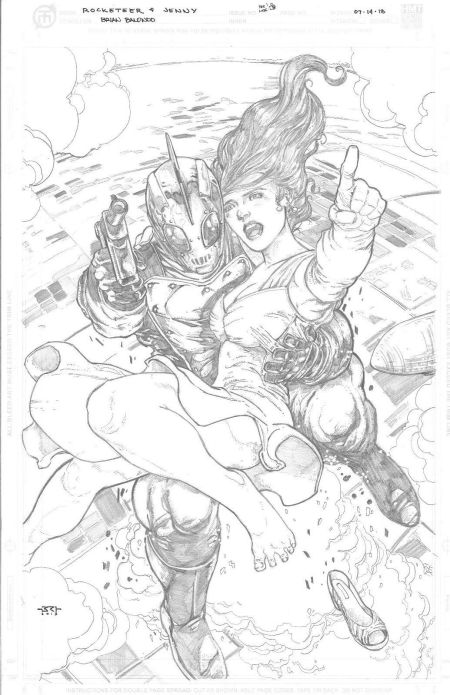
Several of the Coed Room items, however, are what I would term “couples shots” — depictions of male and female characters who have been romantically linked at some point. Here’s the latest addition to this particular category: an action scene showcasing the high-flying Rocketeer and his lovely paramour, as drawn by a talented artist from the Philippines named Brian Balondo.

The Rocketeer and Jenny Blake, pencil art by Brian Balondo

You’ll notice at the top of the page that Brian titled this piece “Rocketeer and Jenny.” If you know the history of these characters, you’ll get a chuckle out of that. Jenny Blake was the name given to the female lead in the 1991 Disney film The Rocketeer; in the movie, she’s played by Jennifer Connelly. In Dave Stevens’s original comic book stories, however, Cliff “Rocketeer” Secord’s girlfriend’s name is Betty — an homage to 1950s pinup queen Bettie Page, whose likeness Stevens used as the model (no pun intended) for the character’s appearance.

When screenwriters Danny Bilson and Paul DeMeo — now familiar to genre buffs as co-creators of such TV series as Viper and the 1990s version of The Flash — pitched the concept to Disney, they changed the name of the main female character to Jenny (and gave her a surname, Blake, which she lacked in the comics), masking the connection to the notorious star of nude postcards and bondage porn… not exactly in line with Disney’s family-friendly image. (Although I can pretty much guarantee that everyone’s family has at least one member who’s a fan of nude postcards, or bondage porn, or both.) The name change was cemented when the film went into production.

I can always tell, when The Rocketeer comes up in conversation, whether people know the character from the comics or the movie — by which name they use for the heroine.

Dave Stevens’s use of Bettie Page’s likeness in the Rocketeer comics helped spark a renewed interest in the legendary model, who by the early 1980s had largely faded from the public consciousness. In the decades since, Ms. Page (who passed away in 2008 at the age of 85) has risen to cult status far above that of her 1950s heyday. There have been two feature films about Bettie — a fictionalized production starring Gretchen Mol in the title role, as well as an award-winning documentary (the Pirate Queen and I attended a screening of the latter last year) — an infinite assortment of Bettie-inspired art (most notably by Jim Silke, creator of the Bettie Page comic series, and internationally recognized pinup artist Olivia De Berardinis), as well as a cottage industry of licensed (and, I suspect, bootleg) Bettie Page paraphernalia.

Until just a few days ago, a nationwide chain of Bettie Page clothing stores (including a location on Haight Street here in San Francisco) featured retro-styled fashions inspired by Ms. Page. As a result of litigation by the firm managing licensing for Ms. Page’s estate, the retail chain lost the right to use the Bettie Page name as well as her likeness, which formerly was splashed all over the store. The Pirate Queen owns several pre-lawsuit Bettie Page dresses and, of course, looks smashing in them.

Brian Balondo’s drawing is rather smashing as well. Although hardly as much so as the Pirate Queen.

And that’s your Comic Art Friday.

Comic Art Friday: It’s a con test

May 23, 2014

Last weekend brought us the Bay Area’s biggest annual comics-related event: Big Wow ComicFest at the San Jose Convention Center. (Of course, the Bay Area used to have an even bigger annual comics-related event called WonderCon. But don’t get me started on that.)

For me, as a comic art collector, a convention marks my best opportunity to interface one-on-one with artists and add new artworks — commissioned on the spot — to my collection. Many artists, due to their schedules for publication projects, only find time for commissions at cons. Even with those artists who regularly do commissions out of their home studios, there’s something special about being able to watch a drawing take shape in real time, and to make a personal connection with the creator as the magic happens.

Big Wow 2014 delivered on that score, and on several others. This con continues to expand and improve each year, filling the WonderCon void aptly. But even as Big Wow grows, it maintains its focus on comics and comic art — in contrast to the big daddy of cons, San Diego Comic-Con, and its smaller sibling WonderCon, whose foci have gone mass-market Hollywood in recent years. Big Wow’s comics- and comic art-friendliness can be traced directly to its owners, Steve Morger and Steve Wyatt, who are themselves fans, art collectors, and artists’ representatives.

I went into this year’s con with specific objectives, and almost without exception, I achieved them. As you scroll through the rest of this post, clicking on any of the photos will take you to a closer scan of the art depicted. Trust me — you’ll want to see these pieces in detail.
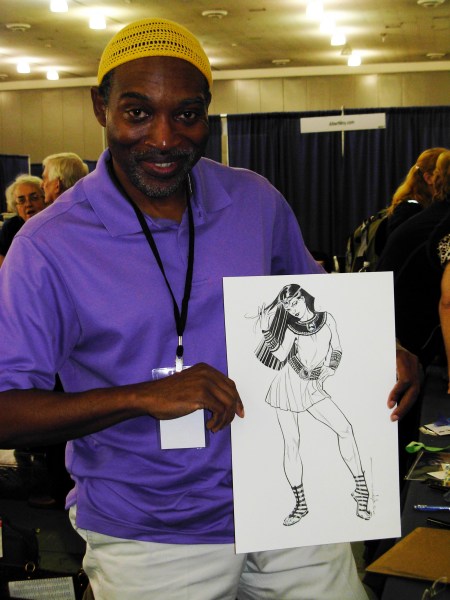
Brian Stelfreeze and Isis, Big Wow ComicFest 2014

My first priority was an Isis commission by Brian Stelfreeze, who drew Mary Marvel for me at Big Wow last year. I pitched the idea to Brian’s art representative in advance of the show, and serendipitously, Brian turns out to be almost as enthusiastic an Isis fan as I am. In fact, Brian had just recently discussed Isis with a friend during a trip to Australia. He loved the idea of doing a drawing of her — so much so that he stayed at his table working on it more than an hour after the con closed on Sunday. Here’s the proud artist with the result of his creative efforts. (You can check out a YouTube video of Brian at work on Isis, here.)
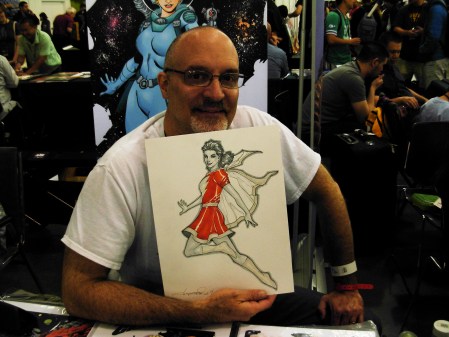
Aaron Lopresti and Mary Marvel, Big Wow ComicFest 2014

I’ve had a running joke with Aaron Lopresti about the fact that I always seem to miss getting a commission from him. At every opportunity, I dutifully add my name to Aaron’s sketch list. For four straight con seasons, I’ve fallen a slot or two shy of the goal. At last year’s Big Wow, Aaron was working on the request immediately above mine on the list as the con concluded. He told me to remind him of that the next time I saw him, and he’d be sure to take care of me. This year, Aaron was as good as his word — this lovely Mary Marvel helped take the sting out of my five-year Lopresti drought.

David Williams and Ms. Marvel, Big Wow ComicFest 2014

David “BroHawk” Williams is one of the most underrated talents in comics, in my opinion, as well as one of the nicest people I’ve met in my convention experiences. Although David wasn’t sporting his trademark hairstyle this year, he still came through with a stunning Ms. Marvel. When I showed David’s creation to a pair of fellow collectors, one said, “That should be a cover image.” The other had but one word: “Iconic.” I can’t argue with either assessment. I’ve been telling David for years that he doesn’t charge enough for his con commissions. Even though he bumped his prices up this year, I still feel as though I picked his pocket, given the labor of love he poured into this one.

Ron Lim and son, with Vixen and Black Cat, Big Wow ComicFest 2014

My Common Elements theme gallery gained two new additions — Common Elements #118 and #119, respectively. Ron Lim, one of the artists who first inspired this series, contributed a matchup of two animal-themed heroines, Vixen and the Golden Age iteration of the Black Cat. These two characters share at least a couple of other commonalities: (1) both of their alter egos are in show business (Mari “Vixen” McCabe is a model in non-costumed life; Linda “Black Cat” Turner is an actress and stunt performer); and (2) both are characters for whom I had reference images on hand and for whom I could concoct a “common element” on the fly. Seriously… I didn’t plan this one ahead of time. Sometimes, you just have to improvise. (As you can see in the photo above, Ron is already embarking on a self-cloning project that will ensure new Lim art into the next generation.)

Chris Marrinan and the three Novas, Big Wow ComicFest 2014

The second Common Elements came with much more forethought. I’ve long wanted a commission from Chris Marrinan, but it seemed as though every con passed without my having connected with him. This time, I came with a project tailor-made for Chris: a scenario starring Nova the Human Rocket (whose adventures Chris both drew and wrote in the mid-1990s), Marvel’s “other” Nova (Frankie Raye, former herald of Galactus — Frankie appears in non-powered form in the second Fantastic Four movie), and Nova Kane, girlfriend of First Comics hero E-Man. Chris did a terrific job on his “triple Nova” assignment. (Credit an assist to Ron Lim, who provided the art board on which Chris’s commission is drawn.)

Tone Rodriguez and Taarna, Big Wow ComicFest 2014

Some years back, Tone Rodriguez contributed a Wonder Woman drawing to a charity auction that I immediately fell in love with. Which means, of course, that I got outbid at the last minute and the piece went home with someone else. Turns out that artwork was a favorite of Tone’s also, as I discovered while chatting with him at Big Wow. It still rankles me that I missed out on that Wonder Woman, but I love this Taarna that Tone drew for me almost as much.

Dave Johnson and Supergirl, Big Wow ComicFest 2014

There are two prominent comics artists who could sign their work “D. Johnson” — Dave and Drew. (Neither of them actually signs that way. But they could.) Both were in attendance at Big Wow this year, and both added stellar new art to my portfolio. First up, “Reverend Dave” Johnson — he’s an ordained Methodist minister — channels the 1970s in his Supergirl drawing.

Lady Blackhawk, pencils and inks by Drew Edward Johnson

Next, Drew Johnson imbues his Lady Blackhawk pinup with heroic flair. Somehow, I missed getting a picture of Drew with his artwork. My only excuse is that I picked it up first thing on the morning of the con’s second day, and I probably hadn’t had sufficient coffee. Please be advised that Drew is a fine-looking specimen of a human being, and the absence of his photo is not in any way intended to reflect otherwise. Mea culpa.

Steve Mannion and the Golden Age Valkyrie, Big Wow ComicFest 2014

I’m a huge fan of Steve Mannion‘s work. He’s that rare comics artist whose distinctive style can’t be mistaken for anyone else’s — when you see a Mannion, you know instantly that Steve drew it. This gorgeous pinup of the Golden Age Valkyrie (aviator hero Airboy’s sometime-nemesis, sometime-ally) will always be special to me for a reason beyond its inherent beauty: Steve drew it on his wedding day. He and his longtime partner Una were married elsewhere in the convention hall mere minutes before I snapped this photograph.

Cat Staggs and Black Cat, Big Wow ComicFest 2014

When I saw this drawing of the modern Black Cat by artist Cat Staggs, I couldn’t resist the opportunity to add a “Cat by Cat” to my collection. Cat — the artist, not the comics character — does some absolutely beautiful work, much of it for the various Star Wars comics. One of these days, I’m going to persuade her to draw a Common Elements piece.

As hard as it is to imagine, Big Wow 2014 offered several highlights even above and beyond all of the fantastic art I acquired.

Darick Robertson with his 2006 Common Elements commission, Big Wow 2014

Eight years ago, Darick Robertson drew the 42nd installment of Common Elements during a signing at the Comic Book Box, the fine retail shop owned by my friend (and current Eisner Awards judge) Kathy Bottarini. (You can view a YouTube video of Darick at work on the piece, here.) I thought it would be fun to get a photo of Darick with his creation all this time later. When he saw the piece, Darick immediately recalled it, and the circumstances in which he had drawn it. Neither he nor the art have changed one bit in eight years. Nor have I. (Ahem.)

Frank Cho painting Emma Frost, Big Wow 2014

I took some time to watch Frank Cho paint (above) and Brent Anderson ink (below), in live art demonstrations.

Brent Anderson inking Batman, Big Wow ComicFest 2014

The Pirate Queen (who accompanied me on Day Two) and I met one of our favorite comics creators, Terry Moore, and his wife and publisher Robyn. Terry graciously autographed both volumes of my Strangers in Paradise Omnibus (I spared him the chore of signing all 30 issues of Echo) and the Pirate Queen’s Rachel Rising trades.

I got my Xenozoic compilation volume signed by Mark Schultz. Sadly, I can only afford Mark’s incredible artwork when it’s published in book form.

Throughout the two days, I visited with several other artists I’ve met at previous cons, many of whose works are represented in my collection.

I also met in person for the first time several fellow collectors whom I know from various online forums. It’s always good to put faces and voices to names.

All in all, Big Wow 2014 offered all the excitement that its name implied. I’m already looking forward to next year!

And that’s your Comic Art Friday.
Comic Art Friday: The ineffable WHY

May 9, 2014

Saturn Girl, pencils by comics artist Paul Abrams

It’s always the most difficult question to answer…

WHY?

And yet, it’s the question that shapes so many of our thoughts, impulses, and actions. Even when we don’t know the answer.

On my iPad, I use a news aggregator called Zite. (I probably won’t be using it for much longer, because a couple of months ago, Zite was purchased by its competitor Flipboard, which will probably extinguish its new acquisition sometime in the near future.)

Here’s how Zite works: It serves up a smorgasbord of links to articles from around the Internet – articles it believes you will want to read, based on your stated interests. For each article that appears, you have the option of giving a “thumbs up,” meaning “show me more articles like this,” or “thumbs down,” which of course means the opposite. The aggregator internalizes that information, and adjusts its future selections according to what you’ve indicated that you liked or didn’t like.

On the whole, Zite performs this function relatively well – which is, of course, why a competitor bought it. But there’s an inherent weakness in its processing…

Zite never knows WHY.

Let’s take a random article from my current Zite feed: “Apple Reportedly Acquiring Beats for $3.2 Billion.” Now suppose I gave this article a “thumbs up.” Zite, in its uniquely algorithmic way, would think, “Aha! He likes this! Let’s send him more stuff just like it!”

But how does it know what to send? It has no idea why I “liked” this particular article.

Here’s a list of some of the hypothetical reasons I might have given this a “thumbs up,” just off the top of my head:

  •  I’m an Apple stockholder, so I’m materially interested in news about the company.
  • I use Beats headphones, so I want to know whether the events described in this article will impact my ability to keep buying and using this product.
  • I’m a fan of Dr. Dre, the co-founder of Beats, so I like knowing what the good Doctor is up to.
  • I’m a gadgetoholic, and I devour anything tech related.
  • I’m a professional musician, so the future of streaming media directly impacts my livelihood. (One of the reasons it’s thought that Apple wanted to buy Beats is because Apple covets Beats’s new streaming music service.)
  • I like the site The Next Web, where this article is published.
  • Josh Ong, the author of the article, was a college buddy of mine, so I want to read everything he writes.

These are but a few of the possible reasons I might flag this article positively. I could probably come up with a dozen more if I kept pondering the matter. But the point is that Zite has no way of knowing which of these – or which several of them, or perhaps even none of them – is my real reason. (None of the above is true for me, incidentally. Okay, I might be a bit of a gadgetoholic. But not enough to care about Beats.)

Now, based on its interpretation of my feedback, Zite might show me more articles about Apple, about Beats headphones, about technology, about Dr. Dre, about streaming media, published by The Next Web, or written by the author of this article.

Or it might send me articles that meet any or all of these criteria, since it doesn’t really know which answer is correct, and it wants to cover all possible bases.

Which could mean that, instead of me getting more content that I want to read, I could conceivably be overwhelmed by a tsunami of content that doesn’t address my real interests.

All because Zite doesn’t know WHY.

This is the same issue that continually befouls Facebook’s ridiculous attempts to manage what posts – and what advertising – I as a Facebook user see. If I “like” something, Facebook’s algorithms will decide to show me more of what I “like.” But since Facebook hasn’t a clue WHY I “liked” that item, it could be making horrendously incorrect assumptions about my preferences, and therefore choosing to present content that I don’t care to see, while at the same time hiding from me content that would genuinely interest me, had I the opportunity to view it.

Which is, by the way, what almost always happens.

All because Facebook doesn’t know WHY.

This problem isn’t limited to our online apps and tools. We encounter this same roadblock in all manner of human interaction. Every moment we’re around other people – in the real world or in cyberspace – we take note of the words they speak or write, and the actions they manifest, and make judgments based thereon. But because we have such a hard time evaluating WHY people say what they say and do what they do, we often misjudge each other.

Complicating the problem is this…

We don’t always know WHY, even when the subject is ourselves.

I’m reminded of a story a friend once told. When he and his younger brother were preteens, their father severely chastised the younger brother for jumping up and down on his bed – risking his own safety and the structural integrity of the bed. The father made it clear that harsh punishment would ensue if the younger brother got caught jumping on the bed again.

Moments after the father left the room, the younger brother resumed his trampoline act. “Didn’t you hear what Dad just said? He’s gonna tan your hide!” whispered my panicked friend. “Why are you doing what he just told you not to do?”

The brother continued pogoing for a minute. Then, without stopping, he replied in mid-bounce, “I don’t know.”

We’ve all been that younger brother.

Inquiring minds want to know: What does any of this have to do with comic art?

Perhaps not much.

But then, there’s this.

When I post a piece of art from my collection here, or when you peruse my online galleries if you’re so inclined, you might make any number of assumptions based on that piece or group of pieces. You might theorize several reasons why I commissioned or purchased that artwork – could be the subject; could be the artist; could be that the scenario depicted holds some personal meaning for me; could be all of the above; could be any number of things.

Unless I tell you, you’ll never know for sure WHY.

Sometimes, I might not know WHY myself.

As for today’s featured artwork: That’s Saturn Girl, from the Legion of Super-Heroes, as drawn by the talented Paul Abrams.

No big WHY here… I just kind of like it.

And that’s your Comic Art Friday.
Comic Art Friday: The art of “YES! AND…”

April 11, 2014

I’m taking a 10-week workshop on improvisational acting at the American Conservatory Theater. It’s an opportunity to expand my actor’s toolbox –learning to be more spontaneous and less patterned in my approach. Thus far, it’s been fun, enlightening, and a bit scary — in a beneficial way — as well.

One of the key tenets of improv is the acceptance of offers or gifts. No matter what the idea or inspiration your acting partner presents to you (that’s an “offer”), you receive it enthusiastically — you always say “YES!” to whatever the other actor throws at you. More than that, you have to take the offer one step further, adding something of your own to it. So, it’s more than merely saying “YES!” to your partner’s idea, it’s saying “YES! AND… here’s another idea to go along with that.” With each actor continually saying “YES! AND…,” the scene grows and builds, and takes on a life of its own. (Saying “NO!” either overtly, or through subconscious resistance to the offer, stonewalls the creative process.) In a nutshell, that’s what improv is — constantly accepting offers and adding something new, which in turn earns a “YES! AND…” from the next actor.

Comic art, it occurs to me, is a lot like improvisational acting.

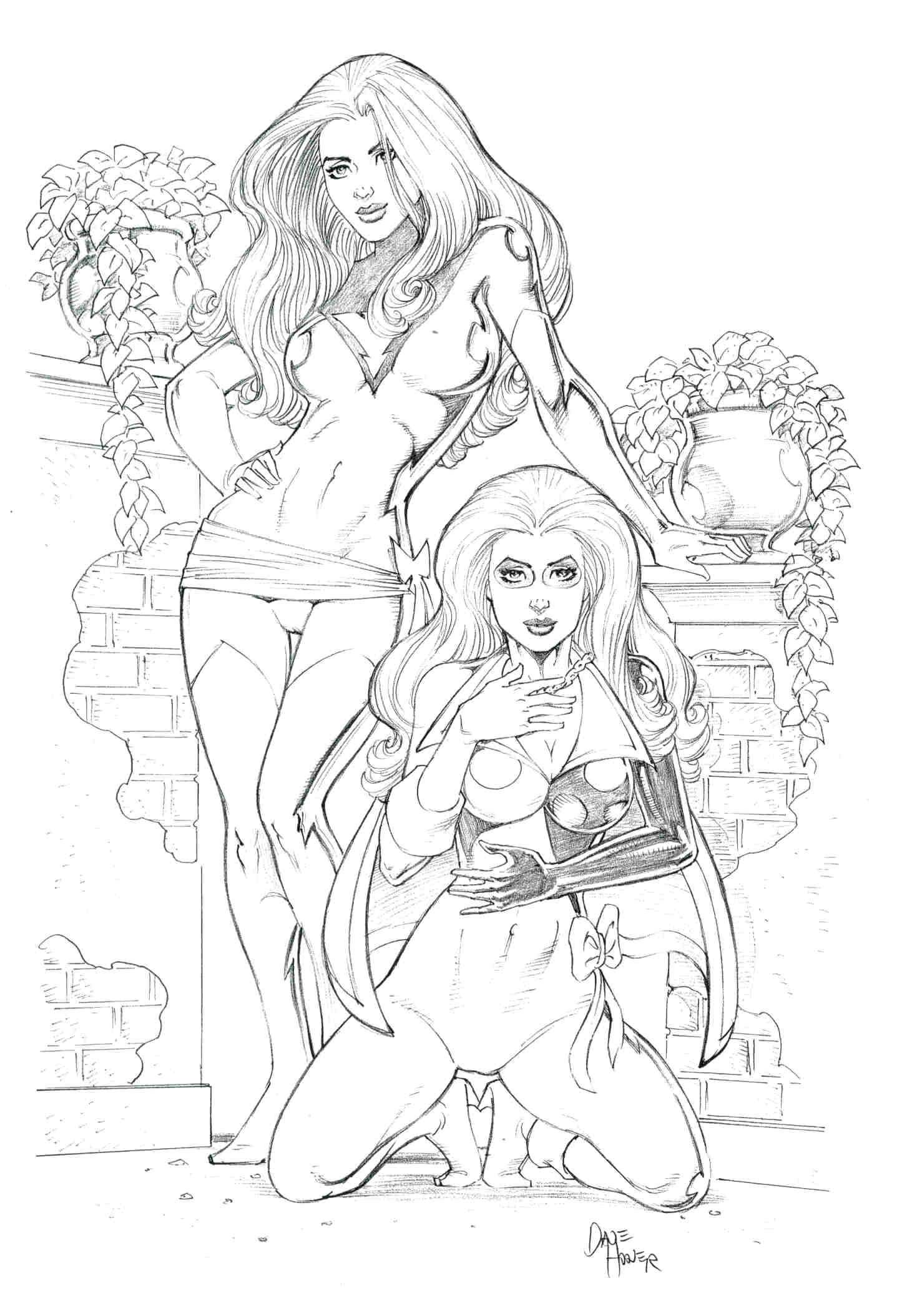
Phoenix and Looker, pencil art by Dave Hoover

In a published comic, several artists contribute to the creation of what the reader sees on the printed page: the writer, who conceives the story and composes the dialogue and captions; the penciler, who draws the panels and the action that takes place within them; the inker, who refines the pencil art and finishes it in ink; the colorist, who colors the art; and the letterer, who drafts the words as they appear on the page. (Of course, some or all of these functions may be performed by the same individual. There might also be some overlap — for example, the writer and penciler may collaborate to a greater or lesser degree on the design of the page. But for the sake of our discussion, let’s suppose that each is a different person.)

If you think about it, this development process is a series of “YES! AND…” situations. The writer gives an offer or gift to the penciler in the form of a script. (If the writer is working “Marvel Method,” the script at this point may be little more than a plot outline. Or, if there’s a full script involved, the writer may verbally diagram the content of each panel.) The penciler takes the script and says “YES! AND…” adds pictures to visualize the story. The penciled pages go next to the inker, who says “YES! AND…” embellishes what the penciler has drawn. The colorist and letterer “YES! AND…” the inked art with their respective additions in turn. The end result is a composition of words, lines, colors, and letters that reflects each artist’s unique contribution, but is likely far different from what any one of them might have envisioned alone.

The same principle applies in commissioned art, although usually with fewer parties involved. The client gives an idea to the artist, who in this case will certainly serve as penciler, but may — depending on the agreement — also add inking, coloring, and perhaps even lettering. The artist says “YES! AND…” to the client’s concept, and adds the visuals. Other artists might be commissioned to add ink or color or lettering to the original pencil art as well, bringing even more “YES! AND…” into the mix.

I find this endlessly fascinating. As a collector, I’m the first offer-maker. The “YES! AND…” of the pencil artist takes my offer in directions I might never have anticipated. Sometimes, I’ll pass a penciled commission on to an inker, whose “YES! AND…” imbues the art with yet other unexpected dimensions.

Consider the series of images in this post.

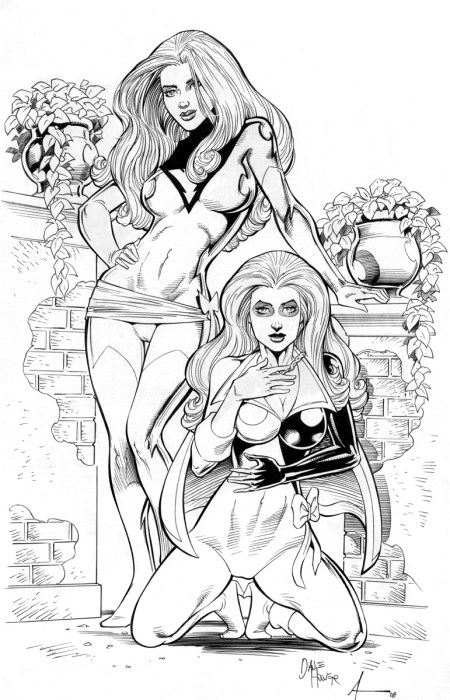
Phoenix and Looker, pencils by Dave Hoover, inks by Bob Almond

I gave pencil artist Dave Hoover (who, sad to say, has since passed) an offer: What if Phoenix (a.k.a. Jean Grey) from the X-Men and Looker (a.k.a. Emily Briggs) from the Outsiders — two heroines with telekinetic powers who each underwent transformative changes at one point — got together to hang out?

Dave said, “YES! AND… what if they met in an old courtyard with painted brick walls, and potted plants as decoration? And what if they posed with Emily kneeling, and Jean standing hipshot behind her?” So, he drew that.

Then inker Bob Almond said, “YES! AND… what if the light on the courtyard fell from this angle, making the shadows cast by the women and the objects fall this way? And what if the wall was textured like this, and the characters’ costumes were textured like this?” Then he inked the piece to show all of that.

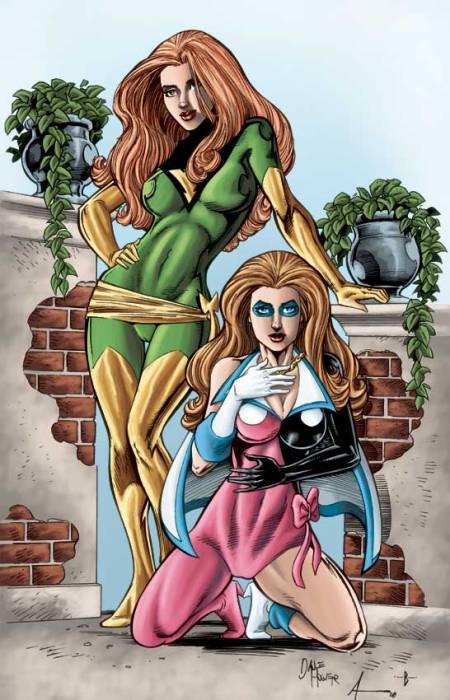
And then colorist Blake Wilkie (whose involvement was yet another “YES! AND…” on Bob Almond’s part) said, “YES! AND… what if the walls were painted this color, and beneath the paint the bricks were this color, and the plants and pots were these colors, and the light had this kind of effect on everything?” When he finished working his magic, all of that happened.

Phoenix and Looker, pencils by Dave Hoover, inks by Bob Almond, colors by Blake Wilkie

To all of which I said, “YES! AND… that looks pretty darned awesome.” Because it did.

Sometimes, when I page through my art collection, I find myself wishing that I could draw as wonderfully as the artists I’ve commissioned. But then I realize that, if I did all of the drawing myself, then everything on each page would be mine — every concept, every character, every figure, every line. Every artwork would be exactly what arose from my own thoughts and talents — nothing more.

It’s far more interesting to me simply to make the initial offer, and let others surprise me with their special brand of “YES! AND…”

“YES! AND…” that’s your Comic Art Friday.

Comic Art Friday: One mask is never enough

April 4, 2014

I’ve been pumping out these Comic Art Friday posts for so long — nearly a decade now — that it’s easy to lose track of when I featured certain pieces from my collection. Today’s premiere of the new film Captain America: The Winter Soldier inspired me to dig back into the archives for these two artworks by Bob Layton that I last showcased together seven years ago.

Heck, iPhones were just barely a thing then.

These two Layton creations stand apart in my Common Elements commission theme because they remain, to date, the only paired pieces in that theme that feature the same two characters — albeit under different guises and in different costumes, and matched together because of entirely different commonalities. In both works, we see the familiar characters Steve Rogers and Michael Jon Carter. Beyond that, things get a teeny bit weird.

Booster Gold and Captain America, pencils and inks by Bob Layton

In this first piece, we see Steve and Michael in their best-known identities — Captain America and Booster Gold, respectively. The title I’ve given this one — “Out of Time” — suggests one common element shared by these heroes: both are men who find themselves in a time-period not their own. Cap, of course, is the hero from the past, having been frozen in suspended animation from World War II until the modern day. Booster comes to the present timeline from the distant future; specifically, the 25th century. Part of the appeal of each character is watching his adaptation to his new temporal location.

Supernova and Nomad, pencils and inks by Bob Layton

The second piece once again presents Steve and Michael, only this time in costumes each wore only briefly. The erstwhile Booster Gold assumed the pseudonym Supernova during the events of DC Comics’ weekly publication, 52. (2006-2007). Steve Rogers, saddened by the political turmoil of the early-to-middle 1970s, temporarily abandoned his role as Captain America, taking on the nationally ambiguous title Nomad for several months (as chronicled in Captain America and the Falcon, issues 180-184). Thus, I’ve titled this drawing “By Any Other Name” to highlight the fact that its subjects were better known by… well… other names.

Needless to say — but I’ll go ahead and say it anyway — Bob Layton did some stellar work on both of these pieces, which he completed in June and October 2007. For me, Layton is one of the quintessential Marvel inkers of the late 1970s through the 1980s, most notably for his two lengthy runs on Iron Man during that period. You can see here that he’s also an outstanding penciler. Bob went on to pivotal roles in three comics publishers that he co-founded: Valiant, Acclaim, and Future Comics. Most recently, he’s been involved with several film projects as a writer and producer.

These two artworks remind me that none of us are just one person. We are each several differing personalities, or at least facets of personality,wrestling for control of a common body. I don’t mean that in a pathological sense. It’s simply that we’re all more than a single identifier can describe. Inside every Steve Rogers, there resides both a Captain America and a Nomad. Inside every Michael Carter, there lives both a Booster Gold and a Supernova. Every Jean Grey is both a Marvel Girl and a Phoenix. Every Janet Van Dyne Pym owns several dozen Wasp costumes, but is always uniquely herself no matter which outfit she wears.

If you ask me who I am, I’m many things. Professionally, I’m a writer, a voice actor, and a  public speaker. Personally, I’m both a husband and a widower; both a father and a bastard child; an American, and an ethnically diverse citizen of the greater Planet Earth. I’m a Jeopardy! champion, a pop culture geek, a sports fanatic, and a collector of comic art.

And even that multifaceted list is merely the tip of the all-too-human iceberg that is me. You have a myriad list yourself, I’ll imagine.

All of which keeps life –and ourselves — in continuous reevaluation and evolution.

And that’s your Comic Art Friday.

Comic Art Friday: Why ad men don’t write comics

March 28, 2014

I never think in advance about what one of my Common Elements artworks will look like when I commission it. As I’ve written on other occasions, much of the fun for me is the surprise of seeing how an artist decided to use the characters I assigned.

In the case of today’s spotlight piece, however, I did have one thought: How will Dheeraj Verma make NFL SuperPro not look lame?

Because NFL SuperPro just might be the lamest superhero in the history of comics.

At the very least, he’s in the top three.

Wildcat and NFL SuperPro, pencils by comics artist Dheeraj Verma

Sir Alec Issigonis, the man responsible for the British car we know today as the Mini, once said, “A camel looks like a horse that was planned by a committee.” NFL SuperPro looks like a superheroic camel dreamed up by a sports marketing firm. And not a top-shelf sports marketing firm — a midlevel agency trying to get in good with the biggest dog in American professional sports, the National Football League.

You can almost imagine the conversation…

“Wouldn’t it be awesome if, like, a football player became a superhero?”

“Yeah, but not just a football player… like, the literal embodiment of the NFL.”

“Dude, I think you’re onto something! And what if this NFL superhero had, like, his own Marvel comic book? Y’know, with Spider-Man or Wolverine or whoever guest-starring?”

[Pregnant pause]

“Make the phone call.”

I don’t know for sure that’s how it went down, but I’m probably not all that far off.

Now, I know what you’re thinking. If NFL SuperPro is so completely ridiculous, why are you using him in a Common Elements commission?

Because, friend reader, that’s the magic of Common Elements. The element of surprise. Bringing together characters you’d never expect to see in the same frame — perhaps even a character or two that you’d ever expect to see, period.

And because, hey — the very idea that Marvel actually published nine issues of a comic book about NFL SuperPro makes me chuckle. I mean, what could be sillier? MLB Bat-Man? NHL Iceman? Luke Cage as a literal cage match fighter? (Wait… I actually like that one.)

For an example of a professional-athlete-turned-costumed-crusader done right — or at least, less wrong — there’s Wildcat. Although he’s a perennial C-lister, Wildcat holds a place alongside some of the longest-running superheroes in comics. He first appeared in July 1942’s Sensation Comics #1 — the very same issue made famous as the debut of Wonder Woman. If nothing else, Wildcat stands the test of time.

When he’s not running around dressed like a ginormous black cat, Ted Grant is a retired heavyweight boxing champion and expert martial artist. (Because if you’re a superhero, and don’t have superhuman abilities, martial arts expertise is de rigeur.) A longtime member of the Justice Society of America — formerly the alternate-Earth version of the Justice League, now more like a mentorship program in which older heroes show younger crimebusters the ropes — Ted has helped train several up-and-comers, most notably the current iteration of Black Canary.

At various times, Ted has also shared the Wildcat identity with junior heroes. A young woman named Yolanda Montez became Wildcat for a while in the 1980s. Later, Ted’s long-estranged son Tom Bronson morphs into a werecat (I kid you not) and joins his dad in the JSA, both of them calling themselves Wildcat. Tom eventually opts to be known as “Tomcat” instead, which is both less confusing and more comical at the same time.

It’s a good thing that artist Verma chose to depict these two athlete-avengers as fighting on the same side. Should there ever be a battle between Wildcat and NFL SuperPro, Wildcat will kick SuperPro’s hindquarters nine ways from Sunday.

Why?

Because NFL SuperPro is lame.

And that’s your Comic Art Friday.

Comic Art Friday: Getting to the bottom of things

March 21, 2014

It’s often noted — and correctly so — that superhero costumes as depicted on the comic book page rarely work if translated exactly to a live-action medium.

Even though some fans howled when director Bryan Singer completely retooled those characters’ iconic outfits for the first X-Men film, it was without question the right choice. Yellow-and-blue spandex just isn’t a good look in live action, while black leather pretty much always looks awesome.

In the same way, most of the Marvel Studios-produced films (in contrast to X-Men, which is a Fox property) have tweaked the heroes’ haberdashery in ways that make perfect sense — Thor, Iron Man, and especially Captain America look quite different on camera than in print, but remain instantly recognizable even as they adopt more realistic colors and materials. Seriously, did anyone really need to see a purple-clad Hawkeye sporting a harlequin mask in The Avengers? Didn’t think so.

Here’s a more subtle example of that principle.

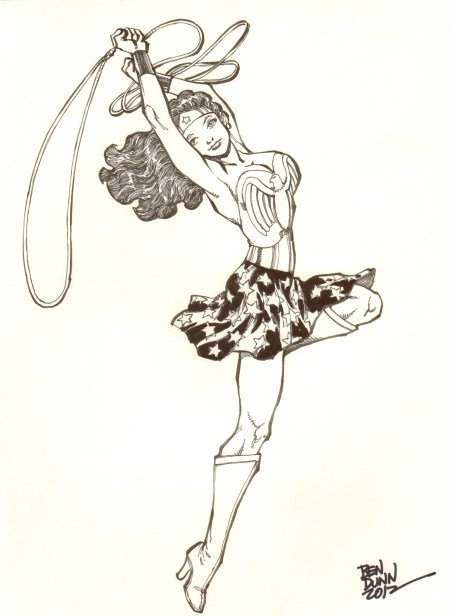
Wonder Woman, pencils and inks by Ben Dunn

I’ve always been fond of superheroine costume designs that incorporate a skirt. To my eye, a skirt reflects grace and ease of movement. Artist Ben Dunn, best known as the creator of Ninja High School, illustrates that quality to perfection in this drawing of Wonder Woman.

But now, try to imagine this costume being worn by a real-life Diana. Every time she flew, she’d be offering a display of her nether regions — or at the very least, her underwear, assuming that Amazons wear underwear — to friend and foe below. Not exactly what “in her satin tights, fighting for our rights” is supposed to imply.

That’s a good part of the reason why I’ve always liked Supergirl’s costume from the mid-1970s, seen here in a lovely drawing by Michael Dooney of Teenage Mutant Ninja Turtles fame.

Supergirl, pencils by comics artist Michael Dooney

Yes, to the 21st century viewer, Kara’s hot pants appear dated. They are, however, practical from both the visual and combat perspectives. She can move in them with complete freedom, while keeping her business out of everyone’s noses, so to speak.

(Before you argue that long pants would be even more practical in battle, I will remind you that Supergirl is Kryptonian, and therefore invulnerable. Unlike a human heroine, her legs do not require protection from the elements, or from an opponent’s weaponry. Wonder Woman’s current powers also include invulnerability — her original skill set did not, hence her bullet-deflecting bracelets — which is among several reasons why her recent experiment with full-leg trousers simply didn’t make sense.)

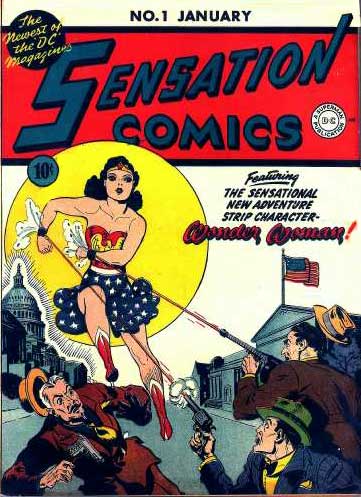
A lot of folks mistakenly believe that Wonder Woman’s original costume, recalled most famously from H. G. Peter’s cover art for Sensation Comics #1, included a star-spangled skirt.

Sensation Comics no. 1, art by H. G. Peter

It’s hard to tell in this particular drawing, but in fact, the lower half of this costume is a voluminous pair of culottes — what we often call “skorts” in today’s fashion parlance. They combined the visual appeal of a flowing skirt with reduced potential for inadvertent overexposure.

Either Peter got tired of drawing the culottes or the All-American Comics editorial staff dictated against them, because a very brief (no pun intended) time later, they evolved into the form-fitting bicycle-style shorts that Wonder Woman wore throughout the remainder of the Golden Age and into the 1950s — also a fine practical option.

Aesthetically, though, you’ve got to admit that Diana really rocks a good skirt.

Maybe another time we can address the bustier.

And that’s your Comic Art Friday.
Comic Art Friday: Canary in fishnets

March 7, 2014

Here’s a little something that I’ve owned for a couple of years now, but that somehow has never found its way into a Comic Art Friday post before today.

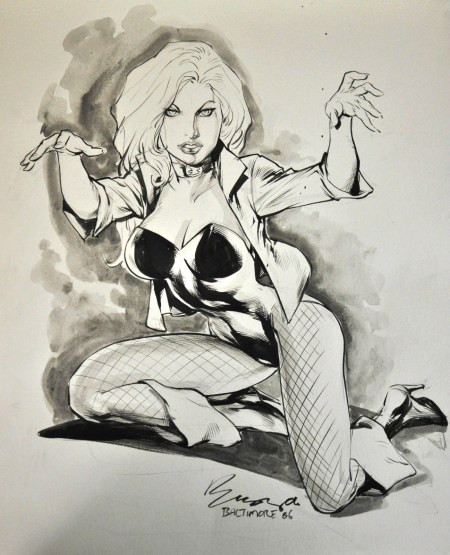
Black Canary, pencils and inks by the comics artist known as Buzz

It’s Black Canary, one of the most venerable comic book superheroines, as rendered by the perspicacious Aldrin Aw, better known to the comics world by the nom de plume Buzz. (If you think about it for a moment, you’ll figure it out.) I acquired this artwork second-hand via an eBay auction, so even though Buzz annotated it “Baltimore ’06,” you may rest assured that I was nowhere near Baltimore in ’06. Therefore, whatever might have gone down there then, I cannot be held responsible.

Black Canary fascinates me, if for no other reason than that she has survived an incredibly long career in comics — she first appeared in Flash Comics #86 in 1947 — without being a particularly interesting or remarkable character. I don’t mean that at all unkindly; as I’ve noted, I’m a fan. It’s just that in any group, someone has to represent the average, the median, the merely competent. When it comes to superheroines, Black Canary falls into that broad central swath.

In her initial incarnation, Black Canary was nothing more than a carbon copy of another popular Golden Age heroine, Harvey Comics’ Black Cat. The two characters had obviously connected code names, wore similar costumes, had similar talents (both were martial arts experts who rode motorcycles), and were frequently drawn by the same artist, the great Lee Elias. As time progressed, the Canary gained a few points of distinction. In 1948, she became the second female member, after Wonder Woman, of the Justice Society of America; the Canary’s Silver Age incarnation would likewise follow Diana into the Justice League in 1969. Also in the Silver Age, the Canary gained a superpower — the Canary Cry, an ultrasonic scream that wreaked havoc on her opponents. (Although it didn’t induce psychedelic hallucinations in its victims, like that of Daredevil’s nemesis Angar the Screamer. Cool though that would have been.)

For the past several decades, Black Canary has been romantically linked to Green Arrow, probably because one way to make two rather nondescript characters stronger is to pair them up. (Again, I don’t mean that as an insult. Green Arrow has always been among my favorite DC heroes. But seriously… he’s a guy who shoots arrows.) The two have been coupled — sometimes married, sometimes not — since the early 1970s. Their stormy relationship has proven to be one of comics’ most enduring love stories, and is a significant part of both characters’ charm.

And speaking of charms…

Can we talk about fishnet stockings for just a moment?

Fishnets have been an identifying hallmark of Black Canary’s costume since her origin. I’m not sure exactly why that is; they hardly seem a practical addition to one’s battle attire. (The Canary’s predecessor and template, the Black Cat, wore buccaneer boots identical to Canary’s, but no hose or tights.) I can only think of one other superheroine who has worn fishnets with any degree of regularity, and that’s Zatanna — for whom it makes sense, because her costume is basically what she wears in her civilian career as a stage magician. (Dr. Strange’s companion Clea wears patterned tights that can, depending on the artist who’s drawing them, look somewhat like fishnets. But they aren’t.)

I’ve always thought the Canary’s fishnets just seemed odd and out of place. The leather jacket and boots I understand — she rides a motorcycle, after all. But why would a top-flight expert in hand-to-hand combat opt for pantyhose from Frederick’s of Hollywood? It boggles the mind. Fishnets seem particularly ill-chosen for a character on a bike. You might want to think about some sturdy trousers there, Ms. Lance. Thighs can be delicate equipment.

For the record, I don’t much care for the look of stockings — fishnet or otherwise — on women in real life, either. I’m probably in the minority here. It’s a taste thing.

I do know that many artists dislike drawing Black Canary specifically because they hate sketching in all those tiny crosshatched lines on her stockings. Several times over the years, I’ve been wandering through Artists’ Alley at a comics convention when a patron requested a drawing of Black Canary, and watched as the artist’s eyes rolled back into (usually his) head. In fact, I recall one occasion where an artist — whom I won’t mention by name, because I like the guy and don’t want to make him sound like a jerk, which he definitely is not — stared pointedly at the customer and grumbled in a weary tone, “Black Canary? Really? Can I just draw her from the waist up?”

One other peculiar note about Black Canary: She is — or at least was, in her original incarnation — one of the most prominent avatars of Clark Kent Syndrome aside from Superman himself. I refer, of course, to the fact that Superman goes about his heroic business with his face unmasked, and yet somehow when he dons Clark Kent’s spectacles, no one recognizes that he’s Superman. (I once read an article that suggested that the Kent protocol works because every nonsuper person in the DC Universe is a complete idiot. There may be some validity to this theory.)

Black Canary’s case was even more extreme. A natural brunette, she disguised herself for crimefighting duty not by covering her face, but by putting on a blonde wig. Just imagine if Tina Turner or Dolly Parton had been superheroines. No one would have ever sussed out their identities. Come to think of it, I’m not entirely certain that Tina Turner isn’t a superhero. More thought required.

For what it’s worth, I think the current iteration of Black Canary is actually blonde 100% of the time. Or as blonde as most blondes are in American culture, anyway. At any rate, I believe she’s wig-free.

And that’s your Comic Art Friday.

Comic Art Friday: Hey, I know that guy!

February 21, 2014

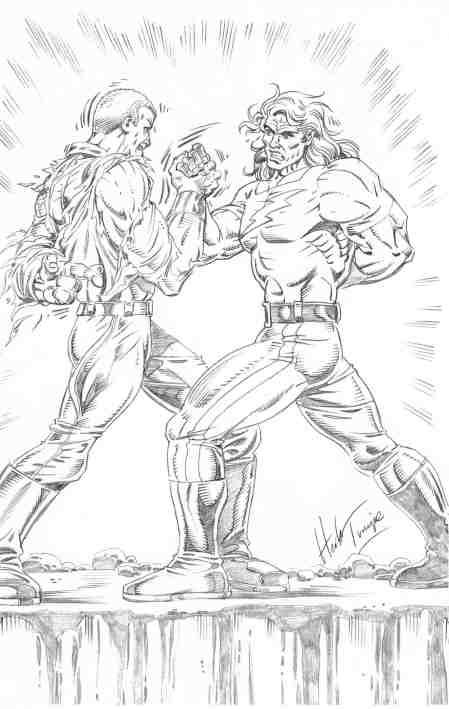
Doc Savage and Doc Samson, pencils by Herb Trimpe

I don’t remember how many years I’d been reading comics before I could distinguish the work of one artist from another. Given that I started reading comics as a first-grader, I’m guessing that recognition took quite a while. But by the time I was thinking about comics critically — say, around age nine or ten — I could readily spot certain artists with distinctive styles, and could form preferences for one creator’s work over another’s.

Part of the reason I gravitated more closely to Marvel comics in those formative years was the fact that Marvel gave its artists more individual license than did DC. For the most part, DC’s 1960s comics all looked similar — almost as though they were drawn by the same (supremely busy) hand. The company imposed a strict house style to which all of its artists were required to adhere. DC editorial wanted Superman to always look exactly like the established model of Superman, whether he was being drawn by Curt Swan in Action Comics, Kurt Schaffenberger in Lois Lane, or Dick Dillin in Justice League of America. (There’s an infamous story about how, when the legendary Jack Kirby moved from Marvel to DC in the early 1970s and took over the Jimmy Olsen comic, DC editorial had another artist, Al Plastino, redraw all of the heads on Kirby’s Superman figures to conform to house style.)

At Marvel, the concept of “house style” was practically nonexistent. Even though Kirby’s powerful action scenes set the standard, none of the other Marvel artists were forced to ape the King precisely. In fact, the three artists who formed Marvel’s core talent in the mid-’60s — Kirby, Steve Ditko, and John Romita Sr. — all drew quite differently from one another. Kirby’s art was muscular, propulsive, in-your-face bold; Ditko’s was stiff, quirky, and often fantastical; Romita’s sleek, prettified approach reflected his many years drawing romance comics.

As Marvel grew into the next decade, the company continued to add artists to its stable whose work immediately stood out from everyone else’s. From a young age, I could identify the splayed hands, twisted posture, and bizarre up-the-nostrils facial perspective of Gil Kane; the statuesque, graceful, almost neoclassical anatomy of John Buscema; the fine lines and haunted eyes of Jim Starlin’s characters; the intricate detail of Barry Windsor-Smith. Ditko’s Spider-Man looked nothing like Romita’s or Ross Andru’s or Kane’s, or any of the others who followed him (not to mention Kirby, who — at the risk of speaking sacrilege — couldn’t draw Spidey very well at all), and Marvel seemed okay with that.

Among the first artists whose work I could pick out of a lineup was Herb Trimpe, who throughout the late ’60s and early ’70s was the regular penciler on The Incredible Hulk. Trimpe’s style had a unique, almost Ditko-esque angularity, particularly when it came to faces, that no one else possessed. His Hulk more or less became the template for the character. Much as when I close my eyes and think “Batman,” I envision the Caped Crusader as drawn by Neal Adams or Jim Aparo, or when I think “Iron Man,” I see George Tuska’s or Bob Layton’s, the definitive image of the Hulk in my mind will always be Herb Trimpe’s.

The 2005 Common Elements commission by Trimpe seen at the top of this post was one of my earliest “big scores” as a collector, in terms of commissioning an artist of whom I’d been a fan since childhood and whom I regarded as a “big name.” Even now, I don’t think I have another commission by an artist whose work goes back as far in my memory. I’ve been fortunate to commission several other artists I enjoyed in my youth, but probably none earlier than Trimpe.

At the time of this commission, I thought it would be fun to have Herb draw Doc Samson, a Hulk supporting character he co-created with writer-editor Roy Thomas. (Why not the Hulk? you ask. Because everyone asks Herb to draw the Hulk, I reply.) Of course, the natural Common Elements pairing would be another Doc — Savage, of pulp, comics, and kitschy ’70s film renown. Herb threw me for a loop, though, when he asked me what I wanted the characters to be doing in the drawing. As longtime Comic Art Friday readers know, I prefer to allow artists I commission to dream up their own scenarios, figuring that their ideas will almost invariably be superior to my own. But, since Herb asked, I suggested the arm-wrestling bit.

This remains one of just a couple of Common Elements pieces in which I had any input into the scenario design, beyond selecting the characters and artist. The only others that come to mind are Bob Budiansky’s Ghost Rider / Batgirl matchup, and Gene Gonzales’s “Catfight of the Bands.” Even in those pieces, everything beyond the one-phrase concepts “motorcycle race” and “battle of the bands” came from the imaginations of the respective artists, not from me.

That’s probably for the best.

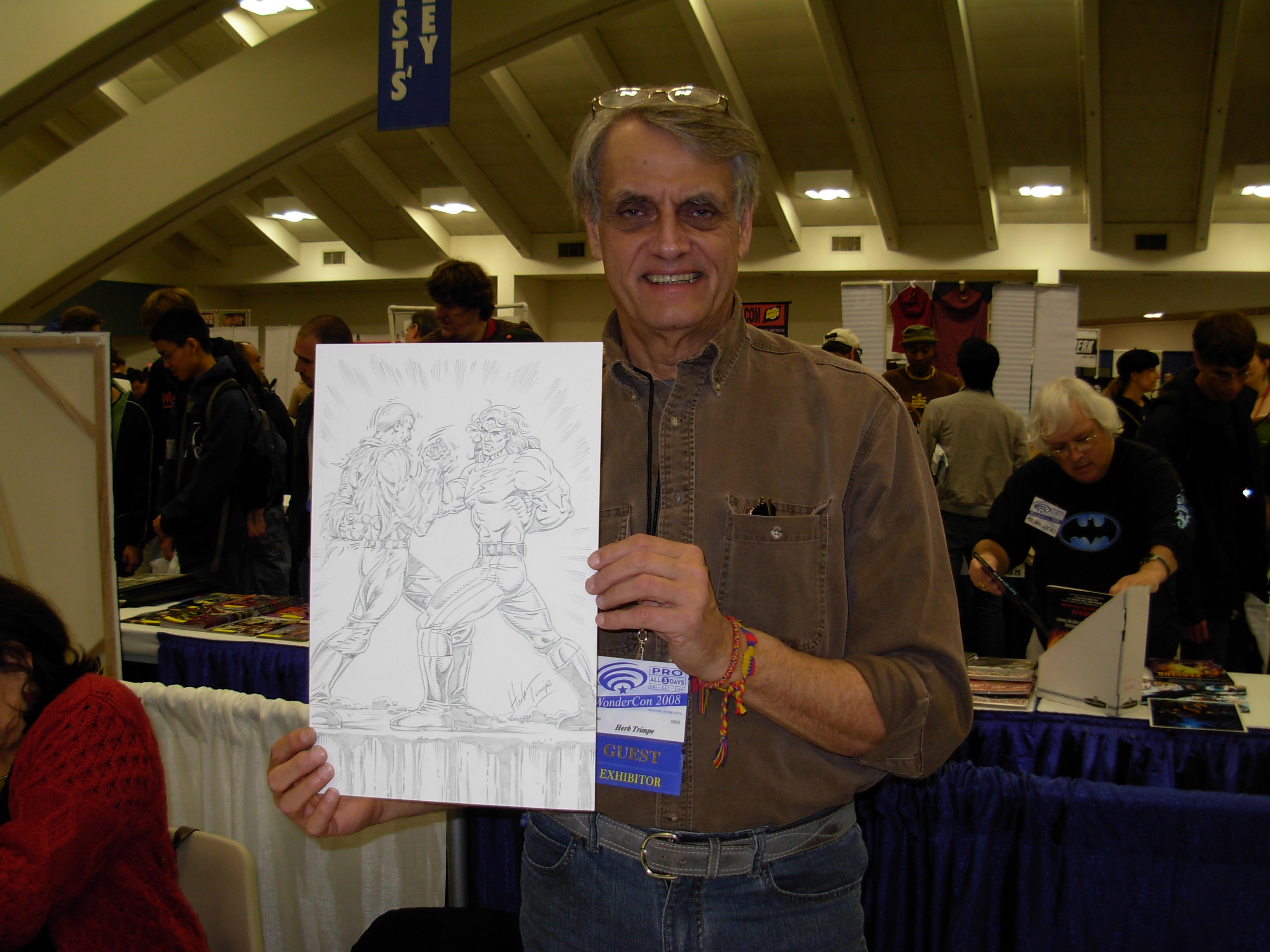
Some three years after this commission was completed, I connected in person with Herb at a local comics convention. It was a rare treat to be able to thank him, face to face, both for this particular artwork and for all of his creations that I’ve enjoyed over the years. Herb even posed with his masterpiece for this photo.

Herb Trimpe and his Common Elements commission, WonderCon 2008; photo by Michael Rankins

There’s an interesting sidelight to the Herb Trimpe story. Herb worked for Marvel for a phenomenally long time, spanning the mid-1960s into the 1990s. Late in his Marvel tenure, his drawing style changed rather drastically, reflecting the line-intensive approach favored by then-popular artists such as Todd McFarlane, Jim Lee, and Rob Liefeld. Opinions differ as to whether Trimpe evolved his style on his own, as artists frequently do — think of Picasso’s many “periods,” for example; or, to choose a comics-related parallel, the stark switch in Bill Sienkiewicz’s style away from its early Neal Adams influences to something bordering on abstract — or whether he was pressured by Marvel editorial to stop drawing “old school” and come up with a more “up to date” look.

I don’t know which is true; perhaps the reality contains an element of both. As you can see in the drawing featured here, Herb’s recent approach is an amalgam of classic Trimpe and his latter-period comics work.

That, too, is probably for the best.

And that’s your Comic Art Friday.
Comic Art Friday: Hello, young lovers!

February 14, 2014

Let’s be honest: This whole Valentine’s Day business is kind of silly.

It’s a holiday so bogus that even the Roman Catholic Church — an organization that never passes up an opportunity to invent a holiday — took it off its official calendar way back in ’69. (I hear you snickering. Stop.) For the most part, Valentine’s Day continues to be perpetuated primarily by commercial interests — the See’s Candies, Vermont Teddy Bears, FTD Florists, and Hallmark Cards of the world.

But hey… it’s about love. Who doesn’t support love, am I right?

So, in honor of romance on this Valentine’s Day, let’s root through the galleries and cull out a few great images of loving couples from the comics.

The Scarlet Witch and the Vision, pencils by Frank Brunner, inks by Geof Isherwood

Probably my favorite superhero love story of all time is that of Wanda Maximoff, the Scarlet Witch, and the android Avenger known as the Vision. This unlikely pairing — the passionate Wanda and the cool, distant Vision — made for some terrific storytelling during the Bronze Age. Here, Geof Isherwood — one of the industry’s most underrated artists, in my opinion — takes a rough preliminary sketch by the legendary Frank Brunner and transforms it into a dynamic work of finished art.

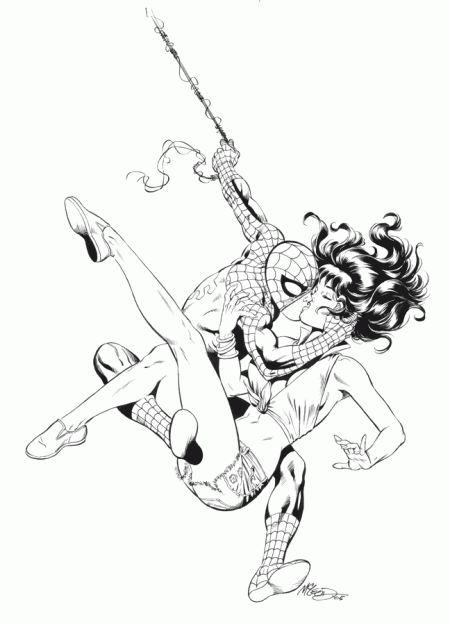
Spider-Man and Mary Jane, pencils and inks by Bob McLeod

Among the best romantic matchups of superhero and civilian was the longstanding marriage of Peter Parker, your friendly neighborhood Spider-Man, and vivacious Mary Jane Watson (eventually Watson-Parker). I know a lot of fans preferred Peter with Gwen Stacy, but Gwen always seemed kind of dull to me. (The icy blondes typically are, unless you’re Alfred Hitchcock.) MJ was the kind of girl who would keep life interesting… which is why Peter married her, I think. I commissioned this beautifully drawn piece from New Mutants co-creator Bob McLeod.

Superman and Wonder Woman, pencils by Mike Wieringo, inks by Richard Case

The Superman-Wonder Woman romance was never really a thing in the actual comics until relatively recently. I’m still not sure that it works, but I do love this drawing — penciled by the late, much-missed Mike Wieringo, and inked by Richard Case.

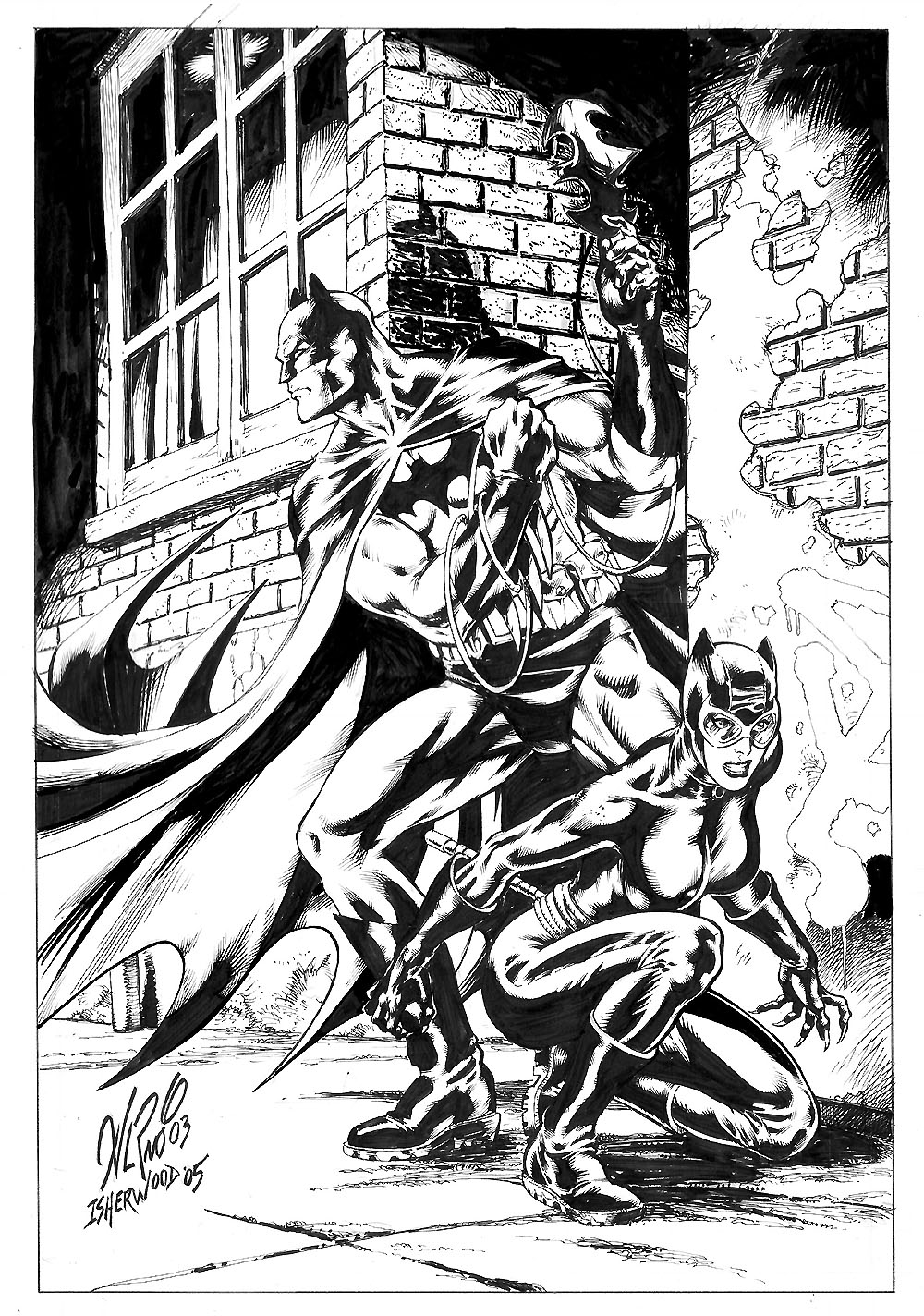
Batman and Catwoman, pencils by Al Rio, inks by Geof Isherwood

Batman and Catwoman can’t decide whether they want to be a couple or not. At various times during the past several decades, their relationship has ranged all over the spectrum. Still, there’s probably not another pairing in comics with more raw intensity than Selina and Bruce. They’re captured here in a working moment by another monumental talent we lost too soon — Al Rio, with inks by Geof Isherwood.

Green Lantern John Stewart and Hawkgirl, pencils and inks by Wilson Tortosa

The love affair of Green Lantern John Stewart and Hawkgirl originated in the DC Animated Universe, by way of the Justice League TV series. So far as I know, this relationship hasn’t crossed over to the comics page in a major way. For me, though, it remains one of the highlights of the DCAU lexicon. Wielding the pencil and pen here is artist Wilson “Wunan” Tortosa.

Dynamo and Iron Maiden, pencils by Geof Isherwood

You’d have to be as ancient as I am to recall the days when the THUNDER Agents made their first foray into the spinner racks. Dynamo, the sometimes lunk-headed leader of the THUNDER crew, had an ongoing love-hate relationship with the villainous Iron Maiden (no relation to the heavy metal band of the same name). The duo gets wrapped up in a fighting clinch — or a passionate embrace; you be the judge — in this gorgeous tonal-pencil creation by Geof Isherwood.

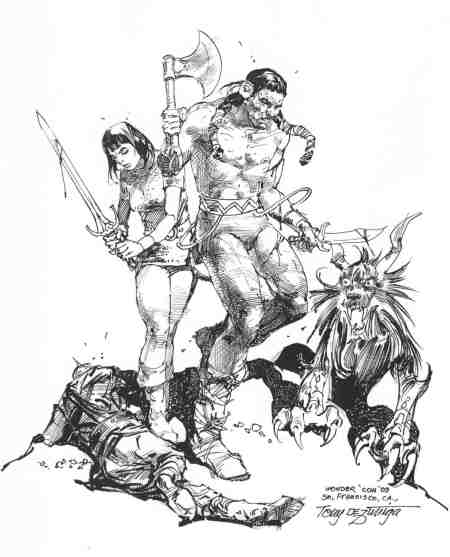
Arak and Valda, pencils and inks by Tony DeZuniga

Speaking of thunder, the last time I visited with the great Tony DeZuniga before his passing, he drew this powerful scenario starring Arak, Son of Thunder, and his paramour and comrade-in-arms Valda the Iron Maiden (no relation to the preceding). The couple that slays together, stays together. (Words to live by, right there.)

Friend reader, I hope that wherever you find yourself today, you’ll take a moment to let those you love — romantically, familially, platonically, or otherwise — know that they’re special to you. To quote an old Don Henley tune, there’s just not enough love in the world. So get on that, will you, please?

Here’s my personal Valentine shout-out to the two ladies in my life: my beloved Pirate Queen, and my pride and joy, The Daughter. I love you both — in your own unique ways, of course — truly, madly, and deeply.

And that’s your Comic Art Valentine’s Day.