Archive for the ‘Hero of the Day’ category

Comic Art Friday: Even an android can fly

June 17, 2016

Listing all of the comic book stories that left a lasting impression on the nascent Uncle Swan would prove an impossible task. But one of the tales from my youth that I recall most vividly, and that still resonates with me today, nearly half a century later, is the two-part introduction of the Vision in Avengers #57-58 (October-November 1968).

Part of that resonance is the iconic cover image from Avengers #57, drawn by the legendary John Buscema:

Avengers #57 (October 1968), cover art by John Buscema

Another part is this equally iconic image that concludes Avengers #58, as the android Vision sheds tears of humble joy at being welcomed into membership among Earth’s Mightiest Heroes:

From Avengers #58 (November 1968), art by John Buscema and George Roussos

Mostly, I think, the Vision appealed to me because here was a character whose identity was defined by his alienness. As a young person, I always felt “different.” Being biracial, I looked different from other kids, no matter what group of classmates I found myself in. (Even though my adoptive parents withheld the nature of my genetic heritage from me for many years, I always knew there had to be a reason for my ethnically ambiguous appearance.) Because I was usually — all right, pretty much always — the most intelligent kid in every class, I was often regarded as a curiosity by fellow students and teachers alike. Plus, my most obsessive interests were subjects of niche appeal — comics, for example.

The synthetic being Vision embodied all of those weirdnesses I felt. He looked, spoke, and even thought differently from his Avengers counterparts. He struggled to find acceptance among other heroes who couldn’t totally grok him — not necessarily because the other Avengers didn’t accept him, but more because he could never quite accept himself as one of them. When, some time later, he embarked upon a romantic connection with Wanda Maximoff — the superheroine known as the Scarlet Witch — their affair served as a metaphor for every loving relationship that challenged then-existing societal norms, whether interracial, interfaith, or gay/lesbian/queer.

I related to the Vision. Man, did I relate.

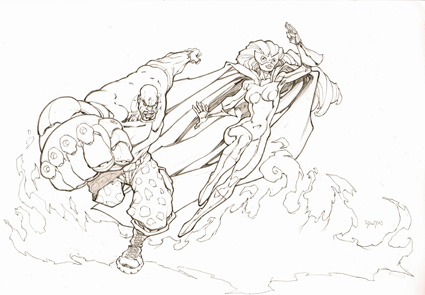
All of those thoughts flooded back to me as I welcomed the Vision, at long last, into the annals of my Common Elements theme. Michael L. Peters, an artist with a style as unique as the Vision himself, depicts the ethereal Avenger in an encounter with comics’ other well-known android superhero, Red Tornado.

Vision and Red Tornado, pencils and inks by Michael L. Peters

Michael’s previous Common Elements entry, featuring Adam Strange and the Rocketeer, hung for many years in the living room at the old Casa de Swan. I have no earthly idea why it took more than a decade for me to commission another piece from him, but I’m certain that the next one won’t be quite that long in the making. (If you dig Michael’s work, he’s always accepting commissions. You’ll find all the details at his website.)

And that’s your Comic Art Friday.

Comic Art Friday: Uncaged in Vegas

June 10, 2016

If you know me well at all, then you know this: I loves me some Las Vegas.

Which might seem a trifle odd if you do indeed know me, because then you also know that I’m not much of a gambler (I enjoy playing poker and blackjack, but I enjoy them as games, not as vehicles for fiscal risk-taking) and I’m definitely not a partier (in any sense of the word), while Vegas is more or less the universal nexus for both activities. But I am a huge fan of over-the-top glitz and kitsch, particularly when it comes to decor and architecture (we should discuss my googie obsession sometime), and Vegas is the universal nexus for all of that as well.

It’s also one of the greatest people-observing venues on the planet. Every time I go to Las Vegas, I see something I’ve never seen before and would never have thought I’d see. That’s not always a good thing, but it’s usually interesting.

Interesting also is this Vegas-themed Common Elements commission by veteran comics artist Larry Stroman, who has illustrated such series as Marvel’s Alien Legion and X-Men.

Luke Cage, Power Man and Ghost Rider, pencils and inks by Larry Stroman

The idea for a Sin City setting for this piece came from Larry’s art representative, Jerry Livengood at Serendipity Art Sales. Jerry’s suggestion made perfect sense, given that the connection between our heroes, Luke Cage and Ghost Rider, is the actor Nicolas Cage, who famously chose his professional surname in honor of the comics’ Power Man, and also portrayed a version of Ghost Rider in two (execrable, in this critic’s opinion) films. Cage also starred in a pair of movies with “Vegas” in their titles: the cult comedy Honeymoon in Vegas (fondly remembered for its sequence involving skydiving Elvis Presley impersonators) and Leaving Las Vegas, the 1995 drama for which Cage won the Best Actor Oscar. (My fingers feel all weird typing “Cage” and “Best Actor Oscar” in the same sentence. But you can look it up.)

Cage and Ghost Rider each makes his second Common Elements appearance here. I’m a little bit surprised, frankly, to see that Cage hasn’t shown up in the series more often, given that he was a favorite of mine during my comics-reading youth. In fact, I can vividly recall the first time I saw him, in the summer of 1972. My family had stopped in the midst of a cross-country journey — we had just returned from two years in Greece, and were on our way to California — to visit relatives in Kokomo, Indiana. On a trip to the grocery store, I paused — as was my wont — to check out the spinner rack where the comic books resided. And there, resplendent in his open-chested yellow shirt and chain-link belt, was the man himself, on the cover of Luke Cage, Hero For Hire #1. I had never seen a black superhero with his own self-titled comic before. (Marvel was still a year away from installing the Black Panther as lead feature in Jungle Action, which even then was not quite the same thing. Because… Jungle Action? Seriously?)

These days, Luke Cage has burst out into the cultural mainstream, courtesy of his co-starring role in Marvel’s hit Netflix series, Jessica Jones. Played by actor Mike Colter, Cage made a powerful impression as Jessica’s off-and-on love interest and fellow crimebuster. Colter will again assume the role in Cage’s upcoming eponymous series this fall, as well as 2017’s The Defenders, which will band together all of Marvel’s Netflix stars — Cage, Jessica, Daredevil, and the yet-to-be-seen Iron Fist.

I don’t know whether there’s ever been a comics storyline in which Cage took on Bright Light City. But if there hasn’t, doggone it, someone needs to write that.

And that’s your Comic Art Friday. Viva Las Vegas!

Comic Art Friday: Sisters are doin’ it for themselves

June 3, 2016

The tricky part of developing my Common Elements themed commissions is rarely the concepts themselves. My brain just naturally takes the bizarre twists and turns that uncovers previously unseen linkages between otherwise unconnected comic book characters.

No, the difficulty often lies in finding the right artist for each concept — particularly when the concept screams out for an artist of specific style, or personal background.

Take today’s featured artwork. I came up with the idea of bringing these three ladies together several years ago. Let’s introduce them, from left to right:

Gogo Yubari, Nico Minoru, and Vixen, pencils by Adriana Melo

Gogo Yubari, the schoolgirl-bodyguard-assassin played by Chiaki Kuriyama in Quentin Tarantino’s Kill Bill, Volume 1. When Gogo first appears on camera, Beatrix Kiddo, a.k.a. The Bride (QT’s muse Uma Thurman), introduces her with this ominous observation: “Gogo may be young, but what she lacks in age, she makes up for in madness.” The Bride’s battle with Gogo and her meteor hammer (a chain with a spiked ball on either end) is one of the highlights of the movie. (If you have to ask why a character from a Tarantino film is being lumped in with comic book characters, you haven’t seen enough Tarantino films.)

Nico Minoru, sorceress leader of the team of superpowered youths known as The Runaways. Nico, who for a while went by the superhero sobriquet Sister Grimm (no relation), inherited the ability to wield magic from her villainous parents. In the Runaways, Nico partners with other offspring of evil metahumans to help right the wrongs done by the preceding generation.

Vixen, longtime member of various Justice League permutations, and before that, of Suicide Squad. The first black superheroine in the DC Comics canon, Vixen’s a longtime personal favorite of mine. She possesses the power to tap into a mysterious force called the Red, through which she can utilize the abilities of any animal on Earth. Her code name comes from the fox-headed Tantu totem she wears.

Okay, so you’re thinking, three butt-kicking women you wouldn’t want to trifle with — but what’s their common element? Those of you old enough to remember the popular culture of the 1970s and ’80s will recall these three all-female rock bands: The Go-Go’s (yes, I know; never use an apostrophe to create a plural noun — but that’s how they spell it), hitmakers behind such classics as “Our Lips Are Sealed” and “We Got the Beat”; The Runaways, the “Queens of Noise” who introduced the world to future Rock and Roll Hall of Fame inductee Joan Jett; and Vixen, the glam-metal rockers best known for their 1988 hit “Edge of a Broken Heart.”

The perceptive among you now understand the challenge I faced with this Common Elements concept: I couldn’t very well assign a piece featuring three female characters who share names with all-female rock bands to a male artist. That just wouldn’t do. But it also wouldn’t do to assign it to a female artist just because she was female. It had to be someone whose drawing style fit with the bold, tough, take-no-prisoners attitudes and attributes of the trio being depicted. And for the longest time, I couldn’t come up with an artist who seemed right for the role.

Then one day, Adriana Melo‘s commission list opened up.

Clouds parted. Trumpets blared. Angels sang. I knew I’d found the perfect artist at last.

Adriana is no stranger to drawing powerful women in action. She’s been, at various times, the regular artist on Birds of Prey and Rose and Thorn for DC, Witchblade for Top Cow/Image, and Ms. Marvel for… well… the other guys. I’d have been hard-pressed to come up with a talent better matched to this concept — and her finished creation proves it.

And that’s your Comic Art Friday.

Comic Art Friday: The Jackie Robinson of comics

April 15, 2016

Allow me to begin today’s festivities by wishing you a happy Jackie Robinson Day.

In the event that you’re not a baseball aficionado — in which case, I might think somewhat less of you, but we can still be friends — I’ll explain that April 15 marks the anniversary of Jackie Robinson’s first appearance with the Brooklyn Dodgers in 1947, becoming the game’s first black player since baseball banned participation by African Americans in the late 1880s. The integration of the national pastime led not only to revolutionary change in the sporting world, but in society as a whole. No less a civil rights champion than Dr. Martin Luther King, Jr. credited baseball’s black pioneers with “making my job easy” by demonstrating that people of color could work successfully alongside their white counterparts, and even excel, when provided opportunity.

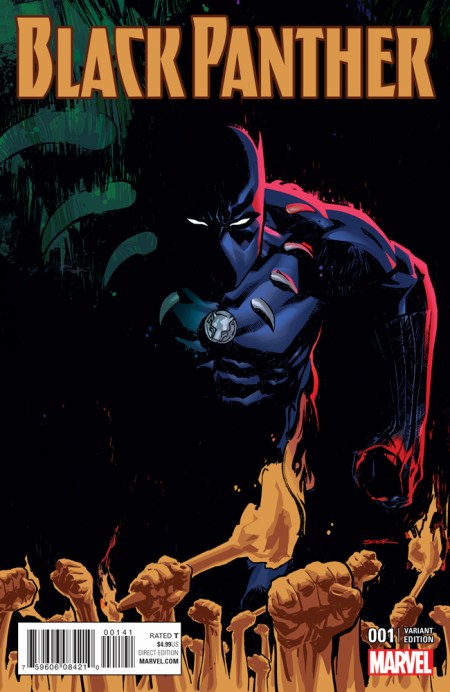
Variant cover for Black Panther #1 (2016 series), original art by Ryan Sook

It seems appropriate, then, to celebrate Jackie Robinson’s historic accomplishment with an artwork featuring the Black Panther, whose advent in Fantastic Four #52 (July 1966) represented to mainstream comics what Robinson’s arrival did to baseball. It’s Ryan Sook’s variant cover for Black Panther #1, the first issue of the new Marvel series that hit the stands last week. I acquired the original black-and-white ink art from Ryan last month at Silicon Valley Comic Con. I don’t usually have much interest in buying published covers or pages — my collection largely consists of commissioned pieces, as regular readers can attest — but I couldn’t pass up the chance to own this amazing cover. Thanks, Ryan! (You can see the published version, in full color, below.)

These are good days to be a Black Panther fan, which I’ve been since he began appearing regularly in The Avengers in 1968. Not only are we getting a fresh run of Panther stories in the comics — with scripts by award-winning author and social commentator Ta-Nehesi Coates, and art by the incredible Brian Stelfreeze — but T’Challa is also poised to make his big-screen debut next month in Captain America: Civil War. Portraying the Panther is actor Chadwick Boseman, who coincidentally also played Jackie Robinson in the film 42. Boseman will continue the role in a Black Panther solo film scheduled for release in July 2018. You’d best believe I’ll be among the first in line to see that one.

Black Panther #1 (2016 series), Ryan Sook variant cover

It’s worth mentioning that while the Panther was the first black superhero in mainstream comics, he wasn’t the first character of African descent to star in his own title. In December 1965, Dell Comics — best known for its licensed comics based on popular TV shows — published Lobo, a Western adventure featuring an African American gunfighter as its titular protagonist. The series, created by writer D.J. Arneson and artist Tony Tallarico, lasted only two issues. Not until Luke Cage, Hero For Hire arrived in June 1972 would a black superhero headline his own book. (The Black Panther took over the lead feature in Marvel’s Jungle Action comic beginning in July 1973. He moved to his own eponymous series in January 1977.)

I still remember the first time I stood in front of the spinner rack at the local supermarket and saw the Black Panther on the cover of a comic book. My younger self could scarcely have envisioned the day when the Panther would stand at the brink of multimedia superstardom, as he does today.

As I said earlier… good days indeed, for us T’Challa fans.

And that’s your Comic Art Friday.

Comic Art Friday: Frankenheimer’s castle

February 5, 2016

People who know that I’m a film buff sometimes ask me, “What’s your favorite movie?” Which is, of course, an impossible question to answer. I love many movies for many reasons, and they’re not interchangeable. How does one compare a favorite horror film (Psycho) to a favorite comedy (Blazing Saddles), or the appeal of two markedly different fantasy films (say, The Princess Bride vs. Heavy Metal)? Do I love Die Hard more or less than Double Indemnity? Streets of Fire more or less than Enter the Dragon?

You see the problem.

Anyway…

One night I happened to be parked in front of the television watching yet another of my favorite films, John Frankenheimer’s brilliant crime drama, Ronin. It’s a great piece of entertainment, combining a twisty plot; crackling dialogue; understated performances by a fine cast (including Robert DeNiro’s last truly stellar acting job before he dove headlong into self-parody, apparently permanently); and one of cinema’s all-time great car chase sequences. (Although it has his signature style all over it, many people don’t realize that Ronin was scripted by David Mamet, using the pseudonym Richard Weisz.) It’s also that rare film in which Sean Bean appears but does not die, although he does get booted from the story a third of the way in.

As I was viewing Ronin for the umpteenth time, a thought flashed to mind: “Isn’t there a superhero named Ronin?” Another thought quickly followed the first: “Didn’t Frankenheimer also direct The Birdman of Alcatraz and The Iceman Cometh? Birdman and Iceman are superheroes, too.”

And that’s how Common Elements concepts are born.

Iceman, Birdman, and Ronin, pencils by Val Semeiks

Ronin the superhero — as distinct from Ronin the movie — has actually been embodied by several different characters in the Marvel Comics universe, including Clint Barton (the Avenger better known as Hawkeye) and Eric Brooks (better known as Blade, the vampire hunter). Shown here is the original Ronin, Maya Lopez, who herself is probably more familiar to comics readers under her subsequent costumed identity, Echo. Maya is both one of the more prominent Latina heroines in superhero comics, and one of the genre’s few deaf characters.

Iceman — a.k.a. Robert “Bobby” Drake — is one of the founding members of the X-Men, going all the way back to the debut of the franchise in 1963. Historically, Bobby was the youngest in the original lineup, and was often portrayed by Marvel writers as somewhat immature and impulsive. More recently, Iceman gained publicity for coming out as gay — a revelation questioned by some readers as a retcon, given that Bobby has been romantically involved with numerous female characters over the course of his X-career.

Birdman will be familiar to those of a certain age (ahem…) as star of the fondly remembered 1960s animated TV series, Birdman and the Galaxy Trio. Designed by legendary comics artist Alex Toth (also responsible for such characters as Space Ghost and the Herculoids), Birdman is actually Ray Randall, a normal guy who receives an array of superhuman abilities from the Egyptian sun god Ra. He can fly using the powerful wings that erupt from his back, and can also fire beams of solar energy from his hands. Because his gifts derive from the sun, Birdman frequently found himself in dilemmas where the lack of sunlight robbed him of his powers temporarily. He was accompanied on his adventures by a pet eagle named Avenger.

Younger readers know Birdman from his comedic retooling in the late 1990s. In the Cartoon Network series Harvey Birdman, Attorney at Law, the former superhero is presented as a rather dimwitted defense lawyer, whose client list includes a diverse collection of his fellow Hanna-Barbera characters. Avenger is nowhere to be found in this adaptation, likely due to embarrassment.

Today’s featured artwork — #123 in my Common Elements theme — springs from the potent pencil of veteran comics artist Val Semeiks. This marks Val’s third foray into the world of Common Elements. As is true of both of his previous efforts, this one rocks.

And that’s your Comic Art Friday.

Comic Art Friday: A thousand points of light

January 29, 2016

Let’s get straight to the particulars of today’s featured artwork, officially #114 (of, currently, 127) in my Common Elements commission series, shall we?

Orion_Andromeda_Sharpe

On the left is Orion, one of the key players in Jack Kirby’s Fourth World mythos. On the right, that’s Laurel Gand, better known as Andromeda, of the Legion of Super-Heroes. The artist wielding the pencil is Kevin Sharpe — Kevin has drawn dozens of comics for most of the main publishers, but is probably most familiar for his work on G.I. Joe for Image Comics and Army of Darkness for Dynamite Entertainment.

The more astute among you will have recognized that the “common element” uniting our two mighty heroes is the fact that each is named after a constellation — more specifically, a constellation containing a noteworthy nebula. The Orion Nebula (officially Messier 42) is one of the brighter objects of its kind in the night sky, and is clearly visible to the naked eye as the middle “star” in Orion’s “sword.” The Andromeda Nebula (Messier 31), more accurately referred to as the Andromeda Galaxy, is one of our Milky Way galaxy’s closest neighbors in the universe. (“Close” being relative, when discussing cosmic distances.)

As for our own two superpowered stars…

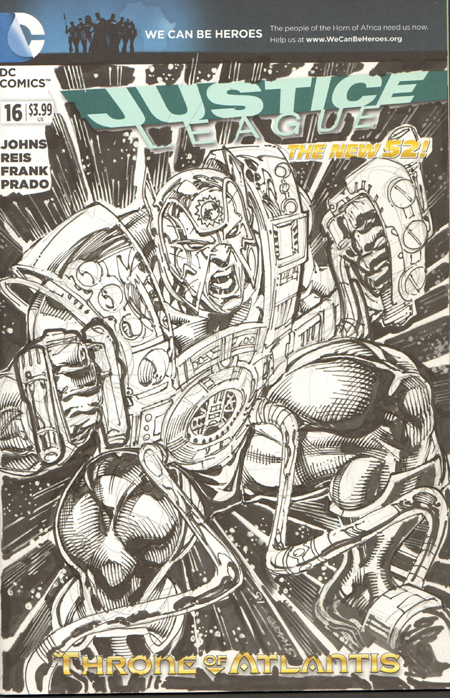
Orion first appeared in New Gods #1 (February 1971). He’s the son of DC’s ultimate villain Darkseid — coming soon to a movie screen near you — but was raised as the adopted child of Darkseid’s opposite number, Izaya the Highfather, as part of a peacemaking infant-swap. (The Highfather’s son, Scott Free, is in turn raised by Darkseid, eventually rebelling against his foster dad and becoming the heroic Mister Miracle.) Under the Highfather’s tutelage, Orion learns to (mostly) control the darker nature he inherited from his natural forebear and conduct himself in a more noble manner. He is often seen zipping about the cosmos in his Astro-Harness, as illustrated here in a sketch cover drawing, also by Kevin Sharpe.

Orion_Sharpe

To be honest, I was never a huge fan of the Fourth World saga. For me, it quickly devolved into a morass of Kirby’s unchecked worst impulses, with way too much weird and crazy simply for the sake of weird craziness. Kirby was a brilliant artist, a dynamic creator of characters and concepts, and one of the greatest visual storytellers who ever put a pencil to paper, but as a writer… yikes. He desperately needed collaborators to edit and wordsmith his scripts. And no one ever should have let the King compose dialogue. Ever. (This might sound like sacrilege to some, but I’m just keeping it 100%. Your Kirby mileage may vary.)

It’s no accident, then, that New Gods was my least favorite of the Fourth World books, because it was the core of the mythos and as such, the place where Kirby most surrendered to his unfettered imagination and purplest prose. I much preferred the two series that tied more closely into the familiar DC superhero universe — Superman’s Pal Jimmy Olsen (where Kirby first began introducing his Fourth World saga when he moved to DC from Marvel) and Mister Miracle. The fourth book in the line, Forever People, could be fun but was impossible to take seriously — Kirby putting words into the mouths of space hippies read just as badly as that phrase sounds.

Orion, though, like almost every character Kirby ever designed, looks awesome.

Andromeda_Sharpe

Andromeda was something of a Jenny-come-lately to the original Legion of Super-Heroes roster. When Supergirl famously died during Crisis on Infinite Earths, DC decided to replace her in the Legion with a character as similar to Kara Zor-El as possible. Thus, Andromeda — another blonde with an almost identical array of powers — was born. Laurel Gand (as did her Legion predecessor Mon-El) hailed from Daxam, a planet colonized by Kryptonians centuries earlier. Unlike her counterpart from Krypton, Andromeda had a vulnerability to lead, with potentially fatal complications arising from lead exposure.

To my mind, Andromeda epitomizes one of the ongoing weaknesses of DC’s editorial philosophy: namely, cloning its top-line characters over and over again. By the Andromeda came along, DC already had one alternate Supergirl in Power Girl, she of the imposing bosom and keyholed costume. Then again, killing the original Supergirl in the first place was a silly stunt that never should have happened.

But I have to admit — Andromeda, though not designed by Jack Kirby, looks awesome.

And that’s your Comic Art Friday.

Comic Art Friday: Royal Air Force

January 22, 2016

People often ask me, “Where do you come up with all of these ideas for Common Elements commissions?” The truth is that concepts strike me in the most random ways. I’ve literally been driving in the car or watching some non-comic-related program on television when out of the blue comes the thought, “Hey, what if I put [Hero X] and [Heroine Y] together?” Whenever I get one of these ideas, it immediately goes onto the list of Common Elements concepts that I’ve been maintaining for over a decade now, to await its turn to be drawn.

The genesis of today’s featured artwork ties into my other commission theme, Bombshells!, which showcases classic comics heroines (by my arbitrary fiat, a character has to have made her first appearance in or before 1960 to qualify as a Bombshell!) in pinups modeled after vintage aircraft nose art. One day, while brainstorming Bombshells! ideas, it hit me that there was at least one superheroine who shared her code name with a British fighter plane: Spitfire, who first appeared in the 1970s Marvel series The Invaders. Spitfire is too recent a character to use in a Bombshells! commission, but I soon thought of another character who also has a British military aircraft code name: Gauntlet, from the Avengers Initiative storyline of a few years ago.

And just like that, a Common Elements concept is born.

Gauntlet_Spitfire_Bowden

For the benefit of the non-airplane buffs in the audience, here’s a touch of background. The Gauntlet was an open-cockpit biplane used by the Royal Air Force in the 1930s, although a handful were still flying during World War II. The better-known Spitfire came along in the late 1930s, and was an RAF staple well into the 1950s. The Spitfire is notable as the only British fighter whose production run predated, spanned, and continued for years after WWII.

As for our fighter plane namesakes, Spitfire (a.k.a. Lady Jacqueline Falsworth Crichton) gained superhuman speed and healing ability from the combination of a vampire bite and a subsequent blood transfusion from an android — specifically, the original Human Torch. (I know. It sounds crazy. I don’t make this stuff up.) Jacqueline’s father James was the original Union Jack; her brother Brian later took up the mantle. (Writer Roy Thomas had initially planned for Jacqueline to become the second Union Jack, but he and artist Frank Robbins decided that Union Jack’s flag-patterned outfit looked awkward on a female figure. So they created a new identity for Jacqueline, with a simpler costume design.) Spitfire joined the Invaders — a WWII-era superteam led by Captain America, the Sub-Mariner, and the aforementioned Torch — and a was a key member throughout the series’ 1970s run.

Gauntlet (a.k.a. Joseph Green) turned up following Marvel’s Civil War storyline (coming soon in modified form to a cineplex near you) as a training officer for rookie superheroes. A former Army drill sergeant, he has a massive prosthetic of alien origin permanently attached to his right hand and arm. This robotic appendage provides Green with super-strength and enables him to project a “hand” made of pure energy with powers of its own. (I know. It sounds crazy. I don’t make this stuff up.)

Bringing together our two champions is UK-based comics artist Mike Bowden. I thought it appropriate that a Common Elements starring characters named after British aircraft should be drawn by a British artist. So far as I know, there has never been an RAF plane called the Bowden. But perhaps there should be.

And that’s your Comic Art Friday.

Comic Art Friday: Always be yourself, unless you can be Mary Marvel

January 15, 2016

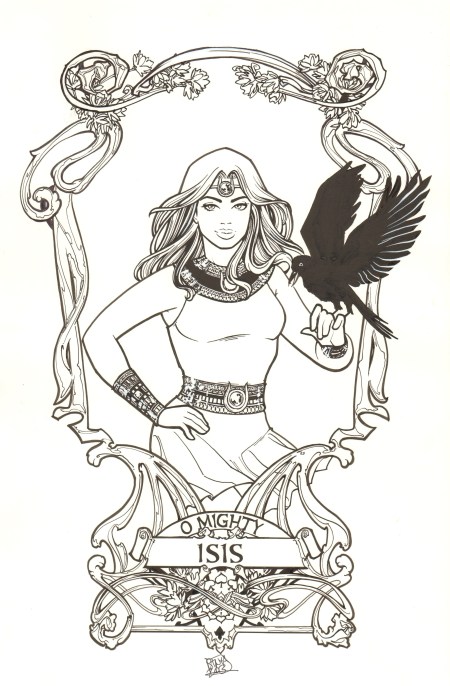
A couple of years ago, I met a talented Canadian artist named Sanya Anwar at a local comics convention. Sanya created this gorgeous Art Nouveau-inspired portrait of one of my favorite heroines: Isis, star of the 1970s TV series The Secrets of Isis. (I probably just landed on some national security watchlist for typing the name “Isis.” You people need to chill.)

Isis_Anwar

At the time Sanya drew the Isis piece, we talked about her doing a companion piece featuring Mary Marvel, the inspiration for the Isis character. Sanya and I revisited that conversation last spring at Big Wow ComicFest. It took a few months for Sanya to work the project into her hectic schedule, but in the end, this beautiful rendition resulted.

Mary Marvel, pencils and inks by Sanya Anwar

Since I first discovered the Marvel Family characters in the early ’70s, I’ve always found the concept of Mary Marvel intriguing. Unlike her brother, the original Captain Marvel, Mary’s accessing the powers of various mythological beings doesn’t transform her into a different person (or, at least, persona — for decades, comics writers couldn’t decide whether Billy Batson and Captain Marvel were separate entities, or just differently aged versions of the same individual). When Mary says “Shazam!” she doesn’t grow older or muscle up. She’s the same sunny-spirited teenager whether she’s Mary Batson or Mary Marvel. The latter just has more amazing abilities.

Which always raised the question in my mind: If you could be Mary Marvel and still be fully and completely Mary Batson, why would you ever not be Mary Marvel? What would be the reason for changing back into your non-powered self, and spending most of your life that way? If I had the option of being Just Plain Me or Superhuman Me, I would opt for Superhuman Me all the time.

The lesson is: Always be yourself.

Unless you can be Mary Marvel.

Then, always be Mary Marvel. (Or Isis. That works, too.)

And that’s your Comic Art Friday.
Comic Art Friday: All my Hexes live in Texas

January 8, 2016

It occurred to me this morning that I didn’t post a single Comic Art Friday in 2015. For a guy who rarely missed a weekly art post for several years, that’s more than a smidgen embarrassing. I will endeavor to do better in 2016. In fact, with today’s post, I already have.

There’s a long and not always cheerful story behind today’s featured artwork, the 127th entry in my Common Elements commission series.

(For the benefit of those joining us for the first time — or old-timers who’ve simply forgotten, because of my slacker posting habits of the past year — Common Elements is a series of commissioned artworks depicting comics characters who are in most cases unrelated, but who share some unifying feature. The “common element” may be obvious — similar names or superpowers, for example. Sometimes, the connection is so obscure that it requires detailed explanation. Ultimately, the point of Common Elements is to showcase characters that might never be seen together anywhere else, for the pure joy of novelty.)

The Scarlet Witch and Jonah Hex, pencils and inks by Pete Woods

I originally planned this matchup of Western antihero Jonah Hex and longtime Avenger Scarlet Witch (whose probability-altering powers have historically been referred to as “hexes”) to be drawn by legendary comics artist Tony DeZuniga, who co-created Jonah Hex with writer John Albano. Tony was a frequent guest at Bay Area comics conventions, where I got to know him and his wife Tina over the years. The last time I saw Tony in person, I’d mentioned the idea to him, and he and I agreed that I would commission him to draw it the next time our paths crossed at a con.

As sad misfortune would have it, that next meeting never occurred. Tony passed away in May 2012 due to complications from a stroke he suffered about a month earlier.

When I heard the news of Tony’s passing, I resolved to give the assignment to Tony’s good friend and fellow artist Ernie Chan, also a regular at our local cons, and a brilliant artist who’d drawn several pieces for me previously. But less than a week after Tony’s death, Ernie also passed. The world had lost two talented creators, and I’d lost a pair of friendly acquaintances.

As for this Common Elements concept, I shelved it, hoping that eventually an artist would come along who would do something truly special with the idea.

Fast forward three and a half years. Pete Woods, an artist whose work I’ve admired since the DC Comics miniseries Amazons Attack in 2007, opened his commission list briefly in late 2015. I immediately thought of the Hex/Wanda pairing, and knew that Pete’s unique style would be perfect for it. Pete must have agreed, because he accepted the project, then proceeded to nail every aspect like a carpenter on amphetamines. All of the creative notions packed into this drawing — from Hex on horseback, to the Witch’s period-styled costume, to the inquisitive reptile observing the scene — came entirely from Pete’s imagination and pen.

The one item that didn’t come from either Pete or myself is the title: “All My Hexes Live in Texas.” Credit for that clever pun goes to my fellow comic art collector Joshua “Doc” McCoy. Well played, sir.

I still wonder what Tony DeZuniga or Ernie Chan would have drawn, given the same two-character assignment. But I’m convinced that both artists — who were always eager to see the fruit of others’ talents (whenever he saw me with my art portfolio wandering Artists’ Alley, Tony’s second question after “How you been?” was always “What did you get?”) — would have admired the amazingly conceived and rendered scene that Pete Woods crafted.

And that’s your Comic Art Friday.
Comic Art Friday: No love for the Valkyrie

November 14, 2014

Those of us who follow comics news — and, more specifically, news of appearances by comics characters in other media, i.e., film and television — have heard quite a bit in recent weeks about the increasing profile of female superheroes in the live-action universes of Marvel and DC.

Wonder Woman finally received the green light for her own solo film, following on the heels of her debut in the upcoming Batman v. Superman: Dawn of Justice.

Carol Danvers, the former Ms. Marvel turned newest Captain Marvel, is now slated to headline a movie as well.

The Scarlet Witch will be joining the Black Widow on the roster of Earth’s Mightiest Heroes in next summer’s Avengers sequel, Age of Ultron.

The TV series Marvel’s Agents of SHIELD recently introduced Bobbie Morse, better known as the heroine Mockingbird, to its cast of characters (although I don’t believe she’s actually been referred to by that code name on the show).

And Jessica Jones (who once used the superhero handle Jewel, and is best known as star of Marvel’s private detective saga, Alias) has been tapped to star in one of Marvel’s impending Netflix programs, culminating in the team epic, The Defenders.

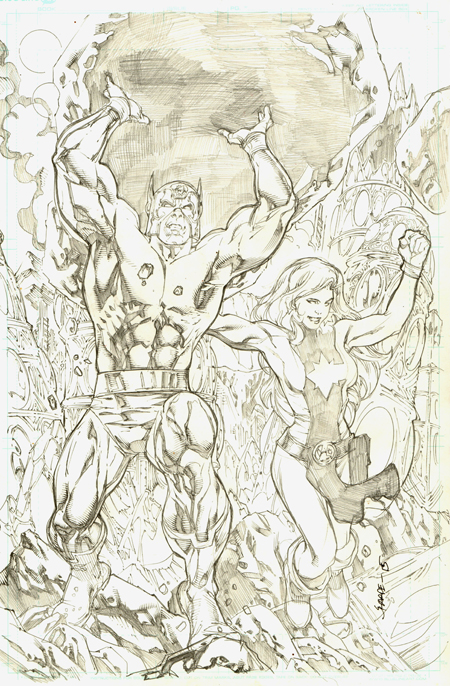
Speaking of the Defenders, there’s at least one key name missing from all of this chatter: The Valkyrie, longtime stalwart in the Defenders superteam, and one of Marvel’s most recognizable (to comics geeks, anyway) heroines.

Valkyrie, pencils and inks by comics artist Leo Matos

To me, Valkyrie is a no-brainer for the silver screen. She’s a powerful visual — a badass blonde in Viking garb who slings a wicked sword and spear. She even rides a winged horse, named Aragorn. Who wouldn’t want to see that in IMAX?

And Val isn’t just a pretty face. She’s a warrior to the stone core, who takes neither guff from nor back seat to any man (not unlike the Lady Sif, who’s already been portrayed in both of the Thor theatrical films, and has guest-starred on the SHIELD TV series). She’s exactly the kind of strong female image the audience is clamoring for, and that the studios keep promising, without much actual delivery to date.

So far, however, Marvel Studios isn’t showing the love. There are no plans, so far as has been reported, for Val to make an appearance in any of the company’s movie or television properties. That’s a missed opportunity, in my opinion.

Here’s hoping that Valkyrie gets her day on camera sometime soon.

It’s what America wants.

And that’s your Comic Art Friday.