Archive for the ‘SwanStuff’ category

Comic Art Friday: You’re Thor? I’m tho Thor I can’t write an ethay

September 20, 2013

The truth can now be told: I’ve never much liked Thor.

Steel vs. Thor, pencils by Trevor Von Eeden, inks by Joe Rubinstein

I actually think the concept of Thor — lightning-wielding proto-Viking with a flying hammer — is pretty awesome. The character himself? Not so much.

I want to like Thor. He’s a pillar of the Marvel Universe, an original Avenger, wears a wicked costume, and talks as though he wandered in from an improvisational Shakespeare road company. His adventures have been drawn by some of the greatest artists in comics history: Jack Kirby, John Buscema, Keith Pollard, and Walt Simonson, to name just a few. What’s not to like?

But from the dawn of my comics-reading days until now, Thor has always left me kind of cold.

Thor, pencils by Geof Isherwood, inks by Bob Almond

For me, Thor doesn’t work very well as a superhero. A superhero is a rather narrowly specific kind of fantasy character, a creature of modern urban mythology. Thor, who’s more or less a port-over from ancient Norse legend given a comic book twist, feels awkwardly shoehorned into superherodom. He’s too powerful to waste his time beating up Earthbound bad guys — which, let’s be frank, is also one of the main problems with the prototypical superhero, Superman — and yet, that’s mainly what superheroes do. It’s no accident that Thor’s best storylines place him outside the terrestrial realm and give him a more cosmic scope. But since he’s not a true spacefaring quasi-science-fictional character, like, say, Adam Strange or the various Green Lanterns, that doesn’t suit Thor very well either. So, he kind of floats in between, neither fish nor fowl.

We see this problem play out in Joss Whedon’s Avengers movie. Of all the titular heroes, Thor’s by far the least interesting — and, despite his familial connection to the villain of the piece, the one whose presence adds the least to the story. Which is saying something, considering how brutally that film treats Hawkeye, a character for whom I have a fair amount of affection. At least Hawkeye’s narrative, clumsy as it is, has some semblance of an arc.

Thor’s supporting cast can be fun. I’ve always had a soft spot for the Warriors Three, the triumvirate of bickering adventurers who occasionally pal around with the big guy. And Thor’s half-brother Loki makes a decent villain, as his enjoyable appearances in the first Thor and Avengers films attest. There’s at least a modicum of potential in the whole Asgardian thing.

Just not for me, I guess.

Thor, pencils and inks by Bob McLeod

To his credit, though, Thor does make for some appealing pictures.

At the top of this post is a Common Elements scenario pitting the Thunder God against another hammer-slinging hero, Steel. Penciler Trevor Von Eeden said that he wanted to comment on the relative merits of the two characters. I believe it’s clear whom Trevor favors in this duel. Veteran inker Joe Rubinstein contributed the finishes.

Next up, penciler Geof Isherwood and inker Bob Almond team up to present old Winghead in all his Mjolnir-gripping glory.

Lastly, Bob McLeod gives us a classic rendering of the Asgardian wunderkind.

Ah, Thor. I wish we could be better pals. Unfortunately, that would require you to be less lame. No Dr. Don Blake reference intended.

And that’s your Comic Art Friday.

Comic Art Friday: O Captain, my Captain!

September 13, 2013

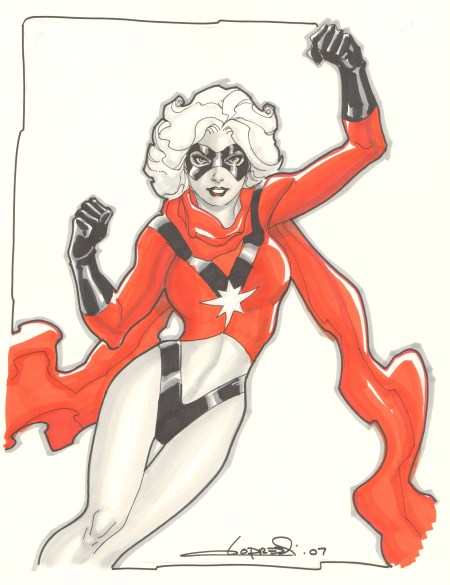
Ms. Marvel, pencils and inks by Aaron Lopresti

In the entertainment world, rumors are a dime a dozen. With the advent of social media, that value has plummeted to, say, about a dime per quadrillion.

Still, I was intrigued to note earlier this week the rumor that actress Katee Sackhoff — best known to genre fans as Starbuck on the reimagined Battlestar Galactica, and currently costarring on A&E’s modern-day Western-slash-police-drama Longmire — is being touted for a film role as one of my favorite superheroines, Ms. Marvel.

Except… okay… she’s not Ms. Marvel any more. She’s Captain Marvel now.

But not the guy in the red union suit with the lightning bolt on the chest. Then again, he’s not Captain Marvel any more.

I’ll explain.

Marvels vs. Marvels, pencils by Luke McDonnell

The original Captain Marvel first appeared in Fawcett Publications’ Whiz Comics #1 way back in February 1940. Enormously popular from the get-go — comics featuring Captain Marvel routinely outsold those starring Superman — the Big Red Cheese (as he was lovingly nicknamed) spawned an entire family of spinoff characters, including his sister Mary Marvel, his protege Captain Marvel Jr., and numerous Lieutenant Marvels. The publishing concern today known as DC Comics — National at the time — took Fawcett to court, arguing that Captain Marvel was a ripoff of their Man of Steel. (Never mind that Superman was himself, in some respects, a ripoff of Doc Savage and other characters who preceded him. But that’s an essay for another day.)

After years of legal wrangling, National/DC forced Fawcett to stop publishing the adventures of Captain Marvel and his cohorts, effectively pushing Fawcett out of the comics business. By the early 1970s, DC had won all rights to the Fawcett characters, and began putting out their own Marvel Family comics.

Only they couldn’t use “Captain Marvel” in the title of any of those books.

Why? Because in the intervening period when Captain Marvel lay fallow, the entity today known as Marvel Comics (who’d operated under various names, including Timely and Atlas, before settling on Marvel in the early 1960s) had created a new character named Captain Marvel, thus seizing claim to the then-inactive trademark. Marvel’s hero, unrelated to the Fawcett character other than in name, was a former soldier from a distant planet who embarked on a series of increasingly cosmic exploits. The real-world upshot meant that as long as Marvel kept a comic in active publication (that is, within a three-year window) with “Captain Marvel” in the title, DC couldn’t use that trademarked phrase in marketing any of its comics. Thus, DC resorted to “SHAZAM!” — their Captain Marvel’s transformational magic word — as the umbrella title for books featuring Cap and company.

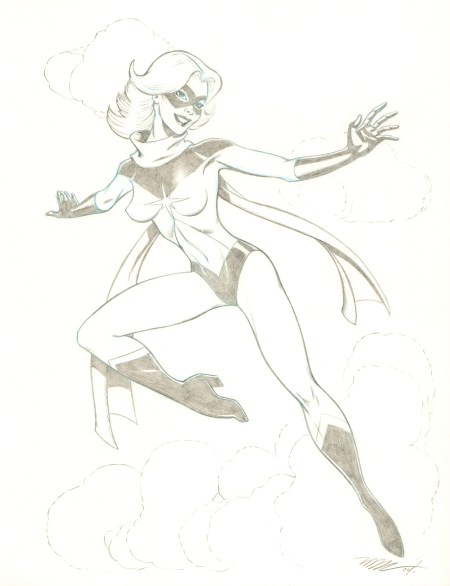
Ms. Marvel, pencils by Michael Dooney

In 1977, Marvel debuted Ms. Marvel, a distaff version of their Captain Marvel. (As both audience-expanding and trademark-grabbing moves, Marvel generated a host of female spinoffs during this period, including Spider-Woman and She-Hulk.) Ms. Marvel was the freshly superpowered incarnation of Carol Danvers, a supporting character who had floated around in the Marvel Universe background for several years prior. An officer in the U.S. Air Force, Carol’s new abilities (mainly super-strength, invulnerability, and flight) and costumed identity made her essentially Marvel’s equivalent to DC’s Wonder Woman, another powerhouse who likewise had a military career in her past.

Following the cancellation of her eponymous series after a two-year run, Carol (who flirted briefly with other codenames, including Binary and Warbird, but always returned to calling herself Ms. Marvel) moved on to a stint in the Avengers and occasional guest appearances in other Marvel books. She didn’t regain her own title until 2006, when writer Brian Reed and a revolving door of artists (Roberto de la Torre and Aaron Lopresti notched the longest tenures on the series) chronicled Ms. Marvel’s adventures until the book folded after four years. Last year, Carol ditched her longtime nom de guerre in favor of Captain Marvel (a name that had bounced around between a couple of different characters over the previous two decades), and began a new self-titled series under that banner.

Meanwhile, back at DC, the original Captain Marvel — who, as noted above, had headlined a variety of books with “SHAZAM!” in the title since the ’70s — finally gave up on the marketing nightmare a couple of years ago, and changed his own codename to Shazam (the name by which many readers called the character anyway, given the cover designation).

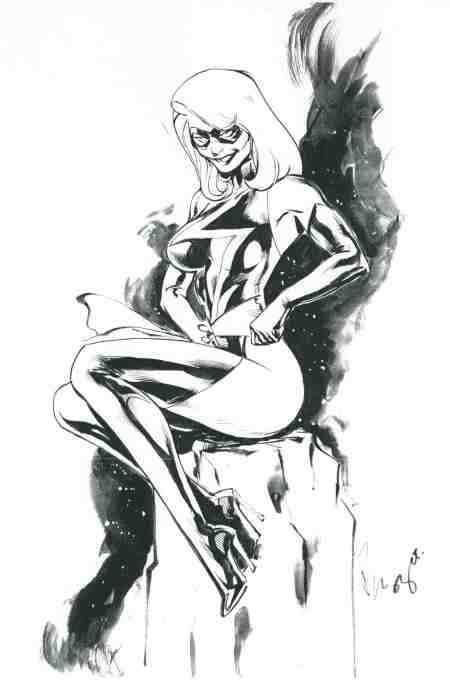
Ms. Marvel, pencils and inks by the comics artist Buzz

I’ve always really liked Ms. Marvel — I haven’t quite gotten the hang of calling her “Captain” yet — because from the time of her debut, she represented the kind of heroine that Marvel hadn’t had previously; an immensely powerful fighter who could battle mano a mano with any villain in the Marvel Universe. Plus, having grown up in a Air Force family, I felt a special connection to Carol due to her history in that service.

She remains one of my all-time favorites. I’d love to see her on the big screen someday. Katee Sackhoff, who exudes a kind of scrappy toughness, wouldn’t be a bad choice to portray her.

Of course, given how many decades I’ve been waiting for a Wonder Woman motion picture, I’m not holding my breath.

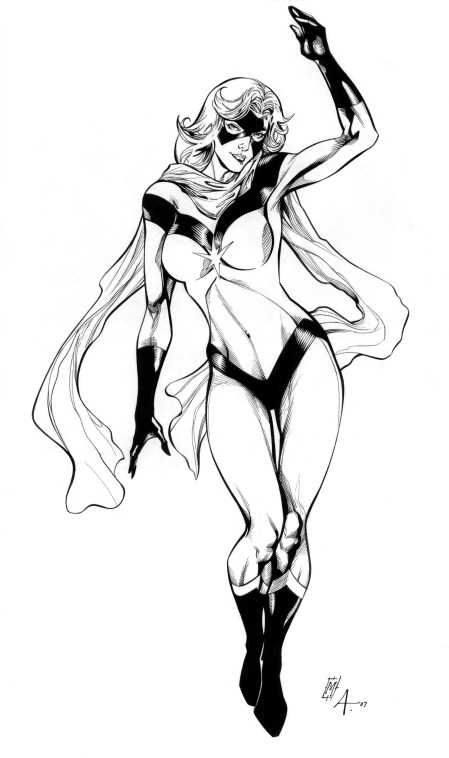
Ms. Marvel, pencils by Matthew Clark, inks by Bob Almond

A few notes on the art we’re presenting today, starting at the top of this post:

Ms. Marvel in her original (and still my favorite) costume by Aaron Lopresti, who at the time this piece was drawn (at WonderCon 2007) was the regular penciler on the Ms. Marvel comic.

A battle of the two Marvel Families, penciled by Luke McDonnell (JLA, Suicide Squad). On the left, from top to bottom: Mary Marvel; the original Captain Marvel; Captain Marvel Jr. On the right: Marvel’s first Captain Marvel (Mar-Vell of the Kree); Ms. Marvel; Marvel’s second Captain Marvel (Monica Rambeau).

Ms. Marvel, again in her original costume, penciled by Michael Dooney (Teenage Mutant Ninja Turtles). This piece was my very first Ms. Marvel commission, and also the first of my many commissions from Dooney.

Ms. Marvel in her second and longest-tenured costume (which I refer to snarkily as the Warbird Swimsuit), in beautiful brushed ink by the comics artist known as Buzz. (Buzz was supposed to draw Carol in her original costume, but forgot. I love this piece anyway… in spite of the Warbird Swimsuit.)

And back to the original — see how much better that looks? — with pencils by Matthew Clark (Adventures of Superman) and inks by Bob Almond (Black Panther, Infinity Gauntlet).

Finally, below: Ms. Marvel in battle against the sometime-villainous, sometime-heroic Moonstone; pencils by Scott Rosema (Space Ghost), inks again by Bob Almond.

And that’s your Comic Art Friday.

Ms. Marvel and Moonstone, pencils by Scott Rosema, inks by Bob Almond

Comic Art Friday: The universal me

September 6, 2013

The Thing and Sabra, pencils and inks by comics artist Rich Buckler

L’shana tovah and Happy New Year to all of my Jewish friends! (I will presume that you know who you are.) May the year 5774 bring you and everyone you love much good, and none ill.

In celebration of Rosh Hashanah, today’s Comic Art Friday features artworks starring the four most prominent superheroes of the Hebrew persuasion. At the top of this post, you’ll encounter Ben “The Thing” Grimm and Ruth “Sabra” Bat-Seraph, drawn by longtime Marvel Comics stalwart Rich Buckler. Further down, you’ll see Denny “The Spirit” Colt and Kitty “Shadowcat” Pryde, rendered by the artist known as Briz (a.k.a. Brian Douglas Ahern).

Someone asked me several years ago why I always post messages to Facebook and Twitter wishing folks well on Jewish holidays, given that I’m not Jewish. The best answer I can come up with is found in the lyrics of one of my favorite popular songs from the 1990s, Marc Cohn’s “Walking in Memphis”:

Muriel plays piano
Every Friday at the Hollywood
And they brought me down to see her
And they asked me if I would
Do a little number
And I sang with all my might
She said, “Tell me, are you a Christian, child?”
And I said, “Ma’am, I am tonight!”

The point being, here’s a Jewish musician singing Christian gospel music in a blues club… and why not?

The Spirit and Shadowcat, pencils and inks by Brian Douglas Ahern ("Briz")

Which is the frame of reference from which I come. I’m not Jewish, but I have a lot of friends who are — in fact, I’m sure that I probably have friends who are Jewish whose religion/heritage is unknown to me — so why would I not wish them well when they’re celebrating? It may not be my holiday, but it is theirs, and they’re my friends and I want them to be happy. That doesn’t seem all that difficult to understand — at least, not to me.

Incidentally, the same principle applies to my friends who identify as some denominational brand of Christian. I’m a Christian, but I don’t celebrate religious holidays as part of my faith practice. That doesn’t mean I can’t wish my friends whose religious practice does include holidays like Christmas and Easter much happiness as they celebrate. (And yes, I do celebrate Christmas — and, to a lesser degree, Easter — in a secular manner. I just don’t acknowledge December 25 as the “birthday” of Jesus, or attach any religious significance to the date.)

Although I don’t always apply this principle perfectly — mostly because it’s a lot of work to keep track of who might be celebrating what this week, and I’m sure I miss somebody’s Festivus Maximus or whatever — but I do apply it as universally as is practical. I tell my ethnically Asian friends “Gong Hei Fat Choi” at the Chinese New Year, even though I’m not ethnically Asian. I wish my female friends well on International Women’s Day and Women’s Equality Day, even though I’m demonstrably not a woman. I salute my friends who identify as LGBT during Pride Week, even though I’m pretty much a 0 on the Kinsey scale.

And why not? It doesn’t have to be my holiday for me to want you to enjoy it if it’s yours.

I believe a key reason why we have so much division among people — both generally, and in American culture specifically — is our tendency to separate ourselves from those we perceive as “different” or “other.” Now, there’s great value in finding and bonding with people with whom we share commonalities. I treasure the bonds I’ve made with folks whose beliefs or vocation or interests or hobbies mirror my own. I think it’s vital, however, to also connect with people who differ from me, so that I don’t end up living in a bland, homogenous world.

I’m glad that, even though I’m a nondenominational Christian, I have friends who identify with other varieties of Christian practice, and friends who are Jewish, and Buddhist, and Muslim, and Wiccan, and atheist. (And yes, I really do have friends who fit each of those labels, and more besides.) I’m glad that, even though I’m genetically biracial and identify primarily as African-American, I have friends who reflect every shade in the melanin spectrum, from inky to pasty and all of the various browns and pinks and goldens in between. I’m glad that even though I test out as more or less left of center politically, I have friends who range from left-wing socialist/anarchist pinko to right-wing reactionary whacko (and I use those terms advisedly). And I’m glad that even though, as previously noted, I’m unrepentantly hetero and monogamous, I have friends who are openly gay and lesbian and bi and trans and poly (and, I imagine, others who aren’t out to me).

I’m glad why? Because I love them all, and I learn from them all. And because my world would be less rich and glorious without them all.

And by “them,” I mean “you.”

So, yes. L’shana tovah to my Jewish friends today. And happy whatever your thing is, when your thing comes around. I’ll try to remember. (If I forget, it doesn’t mean I don’t love you. It just means I forgot. Or didn’t know. I’ll try to do better.)

And that’s your Rosh Hashanah Comic Art Friday.

Comic Art Friday: I wish I knew how it would feel to be free

August 30, 2013

This past Wednesday marked the 50th anniversary of Dr. Martin Luther King Jr.’s “I Have a Dream” speech, delivered on the steps of the Lincoln Memorial during the August 1963 March on Washington for Jobs and Freedom.

Thinking about that historic event put me in mind of a classic song, “I Wish I Knew How It Would Feel to Be Free.” Written in 1954 by jazz pianist Billy Taylor, the song was first recorded by Taylor in November 1963, just three months after Dr. King’s speech. Although dozens of artists have covered it since then — including a version by British pop singer Sharlene Hector that appeared in a Coca-Cola commercial a few years back — the best-known rendition of “I Wish I Knew” is the 1967 recording by the legendary Nina Simone.

As I sit here with Ms. Simone’s magnificent, inimitable voice resounding through my headphones, kindly take a moment to read and reflect on these lyrics, composed by Taylor and songwriting partner Dick Dallas.

I wish I knew how it would feel to be free.
I wish I could break all the chains holding me.
I wish I could say all the things that I should say —
Say ’em loud, say ’em clear, for the whole round world to hear.

I wish I could share all the love that’s in my heart —
Remove all the bars that keep us apart.
I wish you could know what it means to be me.
Then you’d see and agree that everyone should be free.

I wish I could give all I’m longing to give.
I wish I could live like I’m longing to live.
I wish that I could do all the things that I can do —
Though I’m way overdue, I’d be starting anew.

I wish I could be like a bird in the sky —
How sweet it would be if I found I could fly!
Oh, I’d soar to the sun and look down at the sea
And I’d sing ’cause I’d know how it feels to be free.

Like Dr. King — and like Billy Taylor, and Nina Simone — I long for the day when every person on earth can truly be free… free to be themselves, free to enjoy the wonders and blessings of life, free from hunger and want and pain and fear, free to be loved and accepted and embraced for their own individual uniqueness without reservation or qualification.

I don’t know that that dream will be fulfilled in my lifetime, or The Daughter’s lifetime, or even in this old round world’s lifetime.

But it sure would be sweet, wouldn’t it?

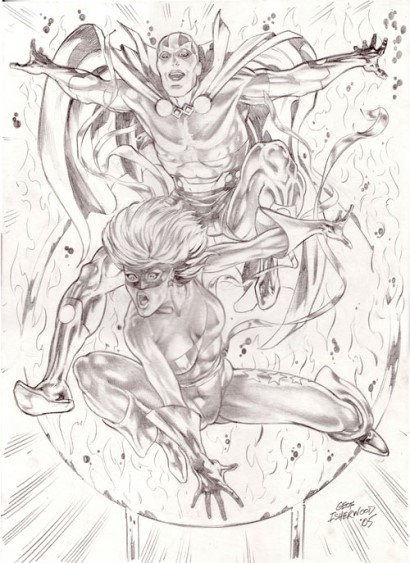
Free Spirit and Mister Miracle, pencils by comics artist Geof Isherwood

The Common Elements entry pictured above is entitled “Breaking Free,” mostly because it features Mister Miracle (whose real name is Scott Free) and Free Spirit, who was Captain America’s sidekick for a brief time in the mid-1990s. (Her real name is Cathy Webster, in case you’re keeping track.) Artist Geof Isherwood masterfully expresses the character’s feelings of liberation and joy in this gorgeous drawing. Every time I look at it, I feel just a little bit more as though I might know what it’s like to be free. That makes me smile.

And that’s your Comic Art Friday.

TCONA 3: Most of my pursuits are trivial

August 16, 2013

I just flew in from Las Vegas, and boy, is my brain tired.

Actually, the Pirate Queen and I flew back from Bright Light City two days ago, and I’m mostly not tired any more. I’d headed to Vegas last weekend for the third annual Trivia Championships of North America — henceforth, TCONA, or I’ll be typing all day. The Pirate Queen joined me on Sunday following the festivities, and we spent a blissful three days checking out the sights and sounds of one of my favorite vacation destinations.

But let’s talk TCONA.

What began two summers ago as a largely informal gathering of game show champions, Quiz Bowl veterans, and pub quiz mavens has ballooned in this third installment into a real live media event. Not only were crews from two nationally televised game shows — NBC’s Million Second Quiz, and The Chase, GSN’s new Stateside version of the UK hit — on site to conduct in-person auditions, but the stars of both the US and UK editions of The Chase also participated in several of the weekend’s competitions. The Experts, easily the best weekly quiz program on YouTube, taped four episodes before a live audience. And of course, there was in attendance the usual assortment of trivia geeks from all over the continent, and beyond. (I met at least one fellow who’d come all the way from Sweden. Or maybe Norway. Somewhere in Scandinavia, anyway.)

A summary of one attendee’s highlights follows.

The weekend commenced on Friday morning with a multi-part written quiz. This opening salvo serves not only to start the neurons firing, but also to provide an initial gauge of one’s level among the competitors. My first thought after completing the test was that I should have ingested more coffee before we began. I was relatively pleased, once the scores were published later that day, to discover that I hadn’t fared as poorly as I feared, and in fact, I’d outpointed several folks whose names are far better known in the trivia world than my own. With another triple latte in my system, I might have performed even better.

One of TCONA’s primary individual events is 5×5, a buzzer battle whose gameplay bears distant similarity to a certain television quiz program with which I am intimately acquainted. Despite the aforementioned acquaintance, I never seem to do very well at 5×5, and this year’s contest was no exception. I lost my first match thanks to a foolishly aggressive final wager — I was leading up to that point — on a question about Celebrity Apprentice, a program with which I am clearly not as intimately acquainted as I thought. I was never a factor in my second game, and thus lost any hope of advancing to further rounds.

I had high expectations for myself in another individual event, LearnedLeague Live. At TCONA 1, I won my first round against seven other competitors, despite never having played the game before. Last year, I held my own at an eight-player table that included several seasoned LearnedLeague veterans; I didn’t win the table, but I felt that I acquitted myself decently. This year, I made the critical error of playing at a table featuring two of the greatest (and two of my favorite) players in Jeopardy! history, Jerome Vered and Dan Melia. Note to self: Next year, instead of sitting with people you like, sit with people you might stand a chance of beating. Assuming there are any.

For the main team event, Quiz Bowl, I reconnected with two other members of last TCONA’s silver-medal-winning squad for a run at fresh hardware. Our team captain, Dave Legler, who once bagged $1.7 million on the game show Twenty-One, recruited as our fourth player a trivia host from Chicago, Jeremy Cahnmann. Combine that with our not-so-secret weapon, Jonathan Hess, a soft-spoken grad student from South Carolina who knows more arcane information than I’ve forgotten — and I’ve forgotten a lot over the years — and little old me (you remember that I’ve won eight games on that TV quiz show with the Canadian ex-pat, right?), and we liked our chances going in. We galloped off to a tremendous start, going undefeated in our first three games and winning our four-team bracket. Then, in our first elimination match, we ran into a tough crew led by Anne Hegerty, one of the “chasers” on the original British version of The Chase. As coincidence would have it, the game commenced with a battery of Anglocentric material that Anne leaped all over like a wolf attacking a Porterhouse. Our side rallied, though, making up ground furiously as the game progressed, only to lose in the end by the value of a single question. It was a hard loss to stomach… but there’s always next year.

Luckily for me, redemption came in the other team event, the Pub Quiz Mashup. Another Jeopardy! Ultimate Tournament of Champions veteran, Dr. Shane Whitlock, invited me to team up with him and his charming bride. We added three other players to fill our roster, which Shane dubbed (in the time-honored pub quiz tradition of quirky team names) “Natalie Portmanteau.” After seven often-hilarious rounds of play, we walked away with the silver medal. Except… well… we didn’t exactly. An apparent scoring error, uncovered between the end of the event and the medal presentation the following day, resulted in our being bumped from second place to third. So we got the bronze medal instead of the silver. I don’t care — it started out silver, and I’m sticking to that. It’ll always be silver to me.

Having the two hottest new game shows in television making their first TCONA appearances generated considerable buzz. Both Mark “The Beast” Labbett, the “chaser” on the US version of The Chase, and the show’s producer came in for Q&A sessions. (Not only is Mark a smart fellow, he’s also ginormous. They don’t call him The Beast for nothing.) Quite a few folks auditioned for Million Second Quiz; it’ll be interesting to watch the show and see how many people I know who made the final cut.

Speaking of game shows, if you aren’t already watching The Experts every Monday (or whenever you choose — it’s on YouTube, so tune in when it suits you, but the new eps post on Mondays), you should be, doggone it. Produced by my Jeopardy! colleague Alan Bailey, it’s consistently as entertaining a 20 minutes as you’ll spend. Alan and his crew shot four new games on Saturday night, including an all-star slugfest between The Chase‘s Anne Hegerty (whose subject specialty was Terry Pratchett’s Discworld) and Jeopardy! superstars Brad Rutter and Roger Craig (experts on Mad Men and Prince, respectively). All four games offered action, suspense, brain-shredding trivia superiority by the contestants, and abundant joviality for all. I won’t spoil the outcomes for you — you’ll just have to hie yourself over to YouTube when the new shows post, and check them out for yourself.

There were, as usual, plenty of ancillary events in and around all of the above. Quiz hosts and trivia producers from all over North America bring their favorite material and stage impromptu games throughout the weekend, which anyone can drop into and play. TCONA is also the home of the World Championship of Kno’dgeball, an amusing yet bizarre hybrid of trivia and dodgeball. (Your Uncle Swan declines participation in the latter, preferring not to combine mental challenge with risk of bodily injury. But the Kno’dgeballers do seem to enjoy themselves.)

Of course, TCONA’s most memorable highlights are always the connections and reconnections with my fellow trivia mavens. TCONA is the one place each year where I run into some of the many amazing people I’ve met via Jeopardy! — Bob Harris, Roger Craig, Brad Rutter, Steve Chernicoff, Dan Melia, Shane Whitlock, Alan Bailey, Jerome Vered, and I’m probably forgetting others, for which I’ll apologize in advance. (Yes, all of those people are as intelligent as they appear on TV. More, even.) It’s also a chance to meet up again with my Quiz Bowl teammates Dave and Jonathan, as well as many other new acquaintances I’ve made over these past three events, including such quiz show stars as Who Wants to Be a Millionaire winners Ed Toutant and Joe Trela, whose exploits I’ve admired from the other side of the tube. It was fun to put faces to many of the names with whom I compete in LearnedLeague — I think at least half of Rundle A West, my current LL bracket, was in attendance this year, several of whom I met for the first time.

Kudos to the TCONA team for lining up an infinitely superior venue this time out. The Tropicana met the event’s needs as well as anyone could have hoped after the horrors of Circus Circus last year. The Trop’s not perfect — in particular, its dining options are limited, especially in the budget-friendly/quick-service areas (there’s neither a buffet nor a true food court). Still, it’s an easy stroll across the street to the MGM Grand, New York New York, or the tram-connected Excalibur/Luxor/Mandalay Bay trio, so ample eating choices are right nearby. On the positive side, the conference center is easily accessible, and eminently convenient if you’re staying in the Trop’s Club Tower — basically, step off the elevator and you’re there. I couldn’t have been more satisfied with my room, which was large, well-appointed, clean, and comfortable. The in-room high-speed wifi worked splendidly. (Don’t get me started about the execrable Internet access situation I encountered when I moved over to Excalibur after the convention ended.) And, if you like to while away your free time and dollars in the casino, I found the Trop’s blackjack dealers as friendly and helpful as any I’ve encountered anywhere in Vegas.

Speaking of the Trop, TCONA shared the hotel’s weekend hospitality with another niche convention: the National Pole Dancing Championships. (Yes, that’s a thing. I kid you not.) I can assure you that, for the most part, you’d have had scant difficulty determining which guests were there for the trivia, and which for the pole dancing. Let’s just say that, were you to draw a Venn diagram depicting quiz nerds and pole dancers, there would be precious little overlap between the two sets. Maybe none.

Before I departed, I registered in advance for TCONA 4. You could join me in Vegas (probably at the Trop, but that’s yet to be negotiated) next August 8-10. But I’ll warn you: You’d better bring your A game.

Comic Art Friday: Superheroines’ day off

July 26, 2013

I’ve written on other occasions about how my philosophy as a comic art collector — and specifically, a collector of commissions and other unpublished drawings, as opposed to pages from published comics — differs from many others. I tend not to sweat the details.

For example, most of the time, I’m not persnickety about whether an artist gets a character’s “look” exactly right, so long as it’s recognizable. That approach isn’t all that different from the prevailing wisdom at the Big Two these days, where artists are given much greater license to tweak characters’ appearance to suit their own creative sensibilities. No one much cares these days how large the eye holes in Spider-Man’s mask are, or whether Captain America’s shirt is made of chain mail, scale mail, or just plain fabric. We’ve come a long way from the days when house styles were so rigid that when Jack Kirby — the man who pretty much defined how superhero comics should be drawn — switched from Marvel to DC, the DC editorial staff would have another artist (usually Al Plastino) redraw the heads on Kirby’s Superman figures, because Kirby’s Kal-El veered too far off-model.

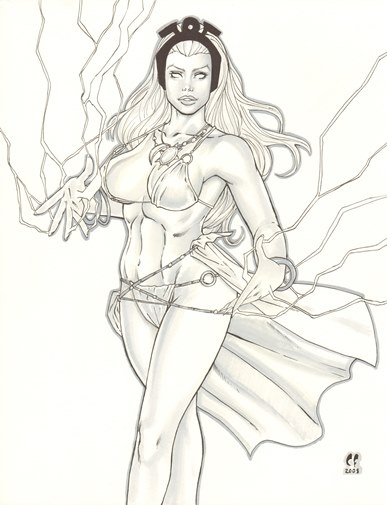
So I don’t mind too much when an artist decides to take a fresh approach to a character. I’m certain that in the comics, Storm has never worn an outfit precisely like the one Christopher Foulkes designed here. But you know what? I’m okay with that. Maybe it’s her day off.

Storm, pencils and inks by comics artist Christopher Foulkes

In fact, I like the idea of superheroes taking a break from the daily grind of world-saving now and again. They’re only human — or mutant, or android, or refugees from other planets — right?

I had that very notion in mind when I commissioned this drawing of Mary Marvel from artist Charles Hall. I thought it would be interesting to see what Mary would do when she arrived home after a long, strenuous day of beating up villains. Wouldn’t it make sense that she’d want to kick those boots off and collapse on the floor?

Mary Marvel, pencils by comics artist Charles Hall

Perhaps my favorite image of a superhero at rest is this Wonder Woman scene by Peter Krause, who’s probably best known for his work on DC’s Power of Shazam. Here, mighty Diana sheds her confining bustier (seriously, how comfortable can that thing be?) and boots for the comfort of a tank top and bare feet, as she dangles her toes in the cool water of a lake on a warm summer day.

Wonder Woman, pencils by comics artist Peter Krause

Tomorrow, she’ll be back duking it out with the forces of evil. Today, she’s all about the R&R.

I hope your weekend affords you a bit of the same.

And that’s your Comic Art Friday.

Comic Art Friday: I am my art collection, and my art collection is me

July 19, 2013

The Great Comic Art Inventory of 2013 is finished.

When I say “finished,” that’s a slight overstatement. Not every entry in the database is 100% complete. There’s a small group of pieces — mostly items I bought via eBay between late 2007-early 2008 and mid-2010 — for which I still need to research and input purchase prices. (That information resides on my current PC’s immediate predecessor, so I’ll have to go to that computer to look it up.)

Comet and Vixen, pencils by comics artist Luke McDonnell

Aside from that, though, I’ve accomplished what I set out to do. There’s a unique entry for every piece of comic art in my collection (with the exception of 20 published pages from Millennium Comics’ Doc Savage, Man of Bronze: The Monarch of Armageddon #1, which I considered a single item). I’ve recorded the artist(s) and character(s) pertaining to each piece, as well as the item’s size, medium, purchase price or commission fee, and other pertinent details. For the first time in several years, I can tell at a glance exactly how many artworks I own, and can easily access all of the information about each work that I’d ever care to know. In many cases, more than I’ll ever care to know.

This inventory proved far more than a mere data-compiling exercise. To do the project justice, I required myself to connect, visually and physically, with every single item. I handled each piece — touched it, measured it (even those whose dimensions seemed obvious at first glance), looked at it up close and in person — often, for the first time in years. I saw each piece with fresh eyes. I was stunned by how emotional the experience was. It’s ineffably different holding an artwork in your hands — or at least, seeing the physical work — than observing a digital image on a screen. When you can really examine every pencil or pen line or brush stroke, you climb into the mind of the artist in a way that is otherwise impossible.

It’s a humbling reminder of why art is such an essential element of humanity.

Spider-Woman, pencils by comics artist Thomas Fleming

Not long ago, the Pirate Queen and I went to San Francisco’s DeYoung Museum to see Johannes Vermeer’s Girl with a Pearl Earring, currently touring the U.S. and Japan. I’ve seen this painting dozens of times in photographs. I’ve even watched the film that presents a fictional account of its creation. But viewing Vermeer’s actual canvas in person was altogether different, and powerful. Tears welled in my eyes as I stood before it, and saw the nuances that no reproduction can fully capture. In a gallery crowded with strangers, I felt for a moment utterly alone with the artist’s creative force, preserved in a painting nearly 350 years old.

I don’t own anything that approaches that Vermeer; no offense intended to any of the artists whose work I do possess. But as I paged through and pondered the hundreds of drawings in my collection, mostly late at night in the quiet of my living room, I felt many reactions equally potent. At times, I found myself enveloped in magical rapture. At others, I laughed out loud. In still other moments, my mind raced into the panel to invent an entire story based on the single scene that my eyes took in.

Daredevil, pencils by Michelangelo Almeida, inks by Bob Almond

And then, there were memories, and personal connections. More than half my collection consists of artworks I commissioned — pieces that exist only because I hired artists to draw them. Each of these carries a back story of how it came to be — correspondence, dialogue, and in a few cases, lasting friendships made. I’ve been fortunate, in that most of my commission experiences have been positive. I’ve not, unlike many of my collecting compatriots, had scenarios where an artist took money for a commission and never delivered the art, or had to be hounded for years before finally coming through. (I’ve had to chase a commission here and there, but rarely for more than a few months.) I’ve rarely had a commission result in a piece of art that I actively disliked. (There have been a couple, but looking at them again after the initial disappointment has faded into history, in most cases I appreciate them better now.)

I thought quite a bit about artists who’ve passed on since I commissioned them, or since I purchased their art. I’m grateful for the several pieces I own by Dan Adkins. I’m grateful for the many works — some commissioned, others not — by the amazingly talented Al Rio, and wish I had commissioned him even more. I’m glad I commissioned so many pieces from Ernie Chan and Tony DeZuniga, and I dearly miss chatting with them both at conventions. I discovered a lovely handwritten note that Jim Mooney — whose career as a comic book artist spanned more than a half-century — sent me when I bought a drawing from him. There’s a nice image by the once-ubiquitous George Tuska in one portfolio. I’m still sad that Dave Simons, a delightful man, never had a chance to complete the commission he started for me, though I love the Common Elements that Dave’s longtime collaborator Bob Budiansky created in his memory. And I still wish I had back the other drawing by Mike Wieringo that I sold mere months before his sudden, untimely death, to go with the one Ringo original I’ve held onto.

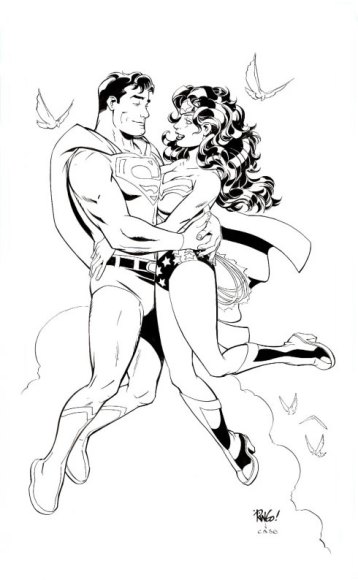
Superman and Wonder Woman, pencils by Mike Wieringo, inks by Richard Case

More than a few pieces in my collection were impulse buys — things I saw (usually on eBay) and thought, “Wouldn’t it be cool to have that?” Some of these purchases, in retrospect, might not have been wise investments. But there are others that, years down the road, make me ecstatic that I pulled that trigger. And the fact of the matter is that every preexisting piece I’ve bought somehow resonated with me in the moment — something about the image motivated me to spend money on it. It’s interesting to reflect upon what that resonance was, and to consider whether it still exists, or has faded with time.

Equally intriguing, there’s the realization that my art collection is uniquely reflective of me. No one else would have commissioned all the works I’ve commissioned, or purchased the exact combination of other pieces that I’ve compiled. There’s no other theme collection quite like Common Elements. Although there are any number of nose art-inspired pinups, no one else has an aggregation of them referencing Golden Age superheroines, certainly not in the specific manner that Bombshells! does. No other collector, to my knowledge, collects images of both Taarna, the silent avenger from the film Heavy Metal, and Isis, from the ’70s Saturday morning TV series. Other collections of Wonder Woman, Supergirl, Storm, Mary Marvel, and the Scarlet Witch exist, but I don’t know of another collection with a focus on all five. And none combine the above with a Black Panther gallery, or a group of images of male-female couples or teams.

Bombshell! Moon Girl, pencils by comics artist Michael Dooney

No one else would have done this — built this specific collection, exactly this way. No one else could.

Therefore, when you look into my portfolios or online galleries, you look into me.

That’s amazing — and more than a little frightening — to think about.

And that’s your Comic Art Friday.

Comic Art Friday: There’s no “I” in “Superteam”

June 28, 2013

I’ve commented a few times recently about the inventory I’m conducting. I’m roughly a third of the way through the process: Common Elements and the book dedicated to Supergirl art are completely done, as is the book in which I keep miscellaneous odd-sized pieces that don’t fit well into the 14″ x 17″ Itoya Profolios I use for storage. At the moment, I’m halfway into the Bombshells! theme group, and will probably work on the Wonder Woman portfolio next.

Two Fridays ago, we considered a piece I rediscovered as I delved through that miscellaneous stack. Here’s another I’d forgotten was in there.

Justice League preliminary pencil sketch by Barry Kitson

It’s a preliminary sketch by Barry Kitson, the British superstar who first made his mark in the UK on Judge Dredd. On this side of the Pond, Kitson’s pencils have elevated numerous properties for both major comics publishers, including noteworthy runs on Marvel’s Amazing Spider-Man and The Order, and DC’s Teen Titans, Legion of Super-Heroes, Batman: Shadow of the Bat, and Adventures of Superman.

When I bought this sketch a few years back — and still more recently, when I stumbled upon it again — I had no idea why Kitson had drawn it. Thanks to another collector who posts to Comic Art Fans, however, I now know that it was a preliminary study for a mini-poster Kitson created for the late, more-or-less-lamented Wizard Magazine to promote DC’s then-upcoming JLA: Year One series, which Barry penciled. I found this image of the finished piece online, so you can see how it turned out once fully penciled, inked, and colored.
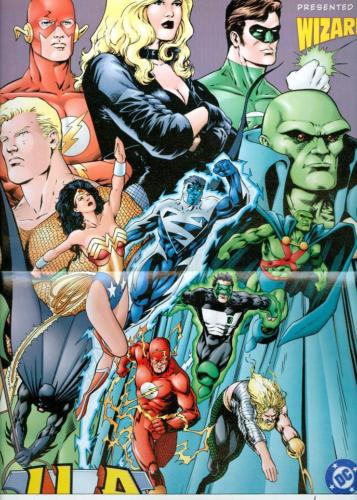
JLA: Year One mini-poster by Barry Kitson, published in Wizard Magazine

I still don’t know who “Pete” is, to whom Kitson inscribed the prelim. Based only on the note, I’m guessing that “Pete” was a collector who bought some of Kitson’s JLA: Year One pages, and Kitson included the sketch as a bonus. Unfortunately, I didn’t record the identity of the person from whom I bought the piece, and given that I’ve slept several hundred times since then, I no longer remember. Somehow, I don’t think that person’s name was Pete, but I could be wrong.

On the other hand, I remember quite well why I wanted the item in the first place, aside from the obvious fact that I don’t own anything else by Barry Kitson. My favorite comic series have always been supergroup and team-up books. I always felt I was getting more for my money when multiple heroes and/or heroines appeared on the cover of a comic. Thus, I gravitated toward books offering that benefit.

Which leads me into a bit of Listology…

Uncle Swan’s Top 12 Favorite Superhero Teams of All Time

12. Metal Men. This unusual bunch consisted of six sentient robots invented by the brilliant scientist Will Magnus. Each robot was constructed primarily from a different chemical element, and manifested the unique properties of — and personality traits suggested by — his or her constituent metal. Gold, the team leader, was brave and noble, and could stretch his robot body into any imaginable shape. Iron was strong, both in physical power and in attitude. Lead was dense, literally and figuratively. Tin was weak and emotionally unstable. Mercury was — wait for it — mercurial. Platinum, usually called Tina, was a beautiful female robot with a passionate crush on her creator Dr. Magnus. (More recent reboots added a second female member, the sharp-tongued Copper.) The Metal Men’s adventures played as much for comedy as for drama, which was probably why I enjoyed them so much back in the day.

11. The Champions. Remember when you were a kid, and you had access to a self-service soda fountain? There was always the temptation to mix all the different flavors together in one cup, just to see what it tasted like. If you did that same thing with superheroes, you’d get the Champions. In the mid-1970s, Marvel writer Tony Isabella had the idea of putting together a bunch of second-tier characters who had nothing in common, just to see what would happen. Thus, we had Angel and Iceman from the original X-Men lineup, teamed with the demigod Hercules, the demonic motorcyclist Ghost Rider, and the Russian spy turned superheroine Black Widow. Yeah, that made no sense at all. And ultimately, it didn’t work — the Champions folded after just 17 issues. They were fun while they lasted, though.

10. New Warriors. Despite the name, there was never an “Old Warriors” or “Original Warriors” team. Which begs the question, Why not simply call this group “Warriors”? I dunno. Maybe they wanted to distinguish themselves from the street gang in Walter Hill’s classic movie, or from my favorite basketball team. And how long can you call yourselves “New Warriors” before you stop being “new”? Whatever the case, the New Warriors came together as a band of rebellious young heroes under the leadership of high-tech urban ninja Night Thrasher. Founding members included human rocket Nova, flame-wielding Firestar, aquatic Namorita, energetic Speedball, and Marvel Boy, who quickly realized how lame his code name sounded and started calling himself Justice instead. Today, the New Warriors are best known as the catalysts for Marvel’s epic Civil War crossover event.

9. Heroes for Hire. As is typical of Marvel’s superteams, the all-about-the-Benjamins Heroes for Hire have undergone more lineup changes than you can shake a no-prize at. Originally, the team consisted of Luke Cage, a.k.a. Power Man, and his martial artist pal Iron Fist. The Daughters of the Dragon — Misty Knight and Colleen Wing — often worked alongside the duo. Over the decades, the ever-shifting roster has mostly centered around Misty as de facto leader — sometimes in partnership with Colleen, but lately without — with support from a variety of morally ambiguous types, including most frequently the mercenary Paladin. Shang-Chi (Master of Kung Fu), the Black Cat, Silver Sable, and the Punisher are among the more prominent characters who’ve wandered onto and off the team at various times. Always an entertaining assemblage.

8. Suicide Squad. Similarly to Heroes for Hire, Suicide Squad has served as a focal point around which to gather some of DC’s more questionably heroic characters. As originally conceived, the Squad consisted mostly of former supervillains who agree to serve as covert government agents in exchange for clemency. At the head of the organization is the powerful and ambitious Amanda “The Wall” Waller, who manipulates the team to further her own shadowy objectives. In addition to out-and-out baddies as Deadshot and Captain Boomerang, the Squad also enlisted more typically heroic members, including Bronze Tiger, Nightshade, and Vixen. A noteworthy event in the Squad’s early history involved the death of its field leader, Rick Flag.

7. Legion of Super-Heroes. My comics-reading friends and I often referred to these far-future Superhero Scouts as “the Legion of Stupid Heroes,” for their propensity toward juvenile code names (male members were typically designated as “Boy,” “Lad,” or “Kid,” while females were “Girl,” “Lass,” or some similarly ridiculous feminine identifier) and ludicrous powers (illustrated most notoriously by Bouncing Boy, who was basically a human Spaldeen, and Matter-Eater Lad, who… well… I’m killing brain cells just thinking about him). But I loved the Legion in spite of their silliness, because their adventures were fun, their youthful enthusiasm and camaraderie were endearing, and you could tell that the writers didn’t take the whole business too seriously. Hey, remember that? When superheroes didn’t always have to be so depressingly serious? Man, I miss those days.

6. Justice League of America. DC’s all-star super-squad raised the bar for all who would follow their 1960 debut. I still like the expanded original lineup the best: Superman, Batman, Wonder Woman, Green Lantern Hal Jordan, the Flash, Aquaman, Martian Manhunter, plus early additions Green Arrow, Hawkman, and the Atom. Basically, all the major superhero food groups are covered right there. (Don’t get me started on the proliferation of random spinoffs — Justice League International, Justice League Detroit, Justice League Dark, Justice League of Their Own… okay, I made that last one up. But you get the idea.) The JLA always seemed a bit superfluous — if you have Superman, Batman, and Wonder Woman, do you really need any of the others? — and its stories worked best when the Triumvirate were marginalized or absent altogether. Still, I have to give them credit for being the first superteam of the Silver Age and beyond. Which brings us to the original superhero conglomerate…

5. Justice Society of America. From the day I first discovered the JSA, I liked them better than their modern-day counterparts. For one thing, the original constituent characters are just so weird and loopy in that retro sort of way that you can’t help but dig them. I mean, come on — Hourman? A superhero whose powers run out in an hour? Who advertises that weakness to every villain he faces by making it HIS NAME? How do you not love that guy? Put him alongside the Spectre (a reanimated corpse who loves killing people in bizarre ways), the Sandman (“I’ll put you to sleep with my gas gun!”), the original Atom (who had no powers at all, aside from a heavy-duty case of Short Man Syndrome), and Doctor Fate (basically, Mandrake the Magician with a cool helmet), and you’ve got a recipe for comic greatness. The JSA’s present-day incarnation, with its ginormous cast featuring such stalwarts as Power Girl and the current Mister Terrific alongside holdover founders such as the original Flash and Green Lantern Alan Scott, has been fun too.

4. The Defenders. Billed as Marvel’s “non-team,” the defenders started with an unbeatable three-star core: the Hulk, Namor the Sub-Mariner, and Doctor Strange. The big three were soon joined by the cosmically powered Silver Surfer, plus a motley array of supporting players — most notably Valkyrie, Nighthawk, and Hellcat — who eventually came to dominate the stories. Unlike the aforementioned Champions, a cut-and-paste crew that never quite gelled, the Defenders’ nonsensical admixture of heroes pretty much always worked, even as the roster evolved to include such ill-fitting pieces as the Gargoyle and Damian Hellstrom, the Son of Satan. The former Justice League creative team of writers Keith Giffen and J.M. DeMatteis and artist Kevin Maguire reconvened the first four Defenders for a hilarious seriocomic miniseries in the mid-2000s.

3. X-Men. I still have a soft spot for the original roster: Angel, Cyclops, Beast (pre-blue fur), Iceman, and Marvel Girl (the not-yet-Phoenix Jean Grey), plus the wheelchair-bound Professor Charles Xavier. The first tears I ever shed over a comic book came with “The Death of Professor X” in Uncanny X-Men #42 (March 1968). I remember how sad I was when Marvel relegated the team to reprint stories for several years in the early 1970s. However, I remember with equal vividness seeing the cover of Giant-Size X-Men #1 on the comic rack at Subic Bay Naval Base in 1975, and being introduced to the second-generation team starring Wolverine, Storm, Nightcrawler, Colossus, and former villain Banshee alongside returnee Cyclops. The early issues of the revived run, written by Chris Claremont and drawn first by Dave Cockrum, then by John Byrne, remain among my favorite comics of all time. (I’ve enjoyed the various animated series and live-action films, too, though not as much as those amazing comics.)

2. The Fantastic Four. A squabbling family of superheroes — super-intelligent, emotionally distant dad; romantic but exasperated mom; brash kid brother; and gruff-but-lovable uncle — unlike anything that preceded them. The first comic book I can recall reading was a hand-me-down copy of Fantastic Four Annual #3. I was immediately addicted, as though the ink on the pages was suffused with crack cocaine. And it was the FF (quickly followed by Spider-Man) who sealed that addiction. They seemed so much like real people — unlike most heroes in juvenile fiction of the time, they fought and argued and teased and lovingly poked fun at each other, all while saving the world from galactic menaces. I wanted to be Reed Richards more than I wanted to be any other comic book hero until the arrival of the Black Panther: he was a super-genius with an insufferable ego and an answer for everything (hmm… know thyself?), who saddled himself with the lamest code name in comics (“Mister Fantastic”? Really?) and got stuck with the least useful superpower on the team.

1. The Avengers. For me, the Avengers really came to life once the founding lineup — Iron Man, Thor, Ant-Man (who soon changed code names to the more impressive Giant-Man), and the Wasp, plus the Hulk, who took off after the first issue — dissolved. Captain America, thawed from his icy suspended animation in Avengers #4 and granted “founding member” status in the Hulk’s stead, was tasked with rebuilding the team from scratch, and made what seemed like incomprehensible choices for “Earth’s Mightiest Heroes”: Hawkeye, Quicksilver, and the Scarlet Witch, all reformed villains. The new mix of quirky, often conflicting personalities gave the stories more emotional heft. With the return of ex-Ant/Giant-Man Hank Pym (now called Goliath, and eventually Yellowjacket) and the Wasp, and the additions of Hercules, the android Vision (who married the Scarlet Witch) and the Black Panther, the Avengers developed into a premier team. The roster would change almost constantly from then on — I think practically every hero and heroine in the Marvel Universe has been an Avenger at some point or other — but the tradition was now firmly established.

And that, superteam members, is your Comic Art Friday.
A is for Eighth (phonetically, anyway)

June 18, 2013

Until the 57th season of LearnedLeague concluded yesterday evening, it hadn’t occurred to me that I had completely neglected to update here, not only about the season just ended, but the outcome of the previous season as well. Permit me herewith to remedy these omissions.

In LL56 — my debut season as a LLama (that is, a member of LearnedLeague) — I managed to narrowly win my rookie Rundle (read: bracket) with a record of 21-3-1. By finishing in the top three, I earned advancement for the next season to a “B” level Rundle, the second highest division aside from Championship level. Imagine my surprise, then, to discover that I had instead been bumped all the way up to Rundle A West, the top tier in my region. Apparently, a Rookie Rundle winner can qualify for a “battlefield promotion” to “A” level given an arcane combination of scoring and circumstances, and my first-season stats met the necessary criteria.

Thus, I was thrown into one of the toughest groupings in the entire League for LL57. To give you an idea of just how tough, this season’s A West competitors included at least six Jeopardy! Tournament of Champions veterans (including four of my colleagues from the Ultimate Tournament of Champions in 2005), a million-dollar winner from Who Wants to Be a Millionaire, several high finishers in the World Quizzing Championships, and a guy who writes trivia questions for a living.

In a word… yikes.

Needless to say, I did not match sheer-beginner’s-luck success from the prior season. I spent most of the 25-game run languishing at or slightly below the middle of the pack — falling as far as 20th on Match Day 17 — before rallying to win my final three games to finish in 8th place. The last game of the season could easily have gone the other way, as my opponent and I both got four of the day’s six questions correct. I just happened to assign defensive points in a fortuitous (read: blindly lucky) manner, eking out a one-point victory. If I’d lost the match, I’d have ended up 14th. My final record: A far more down-to-earth 11-9-5.

Here were the questions from the concluding match of LL57.

  • Question 1: Give the last name of the man who was a pioneer in the development of sound effect techniques used in the production of motion pictures — and after whom the art of post-production sound effect creation is now named.
  • Question 2: Bob Wills and Milton Brown, with their bands The Lightcrust Doughboys, Bob Wills and His Texas Playboys, and Milton Brown and His Musical Brownies, were pioneers in a musical style, a subgenre of country music, that is known today by what name? It was born in the Texas-Oklahoma region in the 1920s, was popularized in a second wave in California in the late 1940s, and reintroduced in the 1970s in bands such as Asleep at the Wheel.
  • Question 3: What was the name of the official proclamation, issued in April of 1598 by King Henry IV, which granted historic concessions to the Protestant Huguenots of France?
  • Question 4: Which is the only element in the halogen group on the periodic table which presents as a liquid at room temperature and pressure?
  • Question 5: Kaizen (“continuous improvement”), Genchi Genbutsu (“go and see yourself”), and Nemawashi (“laying behind-the-scenes groundwork”) are among the management principles first made famous by what manufacturer?
  • Question 6: What is the best-known and most critically acclaimed novel written in the English language centered on the subject of hebephilia (it’s fourth on Modern Library’s list of the 100 best English-language novels of the 20th century)?

Got your answers ready?

Are you sure?

Okay, then. Here come the correct responses.

Answer 1. As an actor, there’s no way I’d better miss this one. The talented people who create ambient sound effects in movies and television — everything from footsteps to rustling leaves and shattering glass — are known as Foley artists. FOLEY is the last name of the fellow who pioneered the art form. (For bonus points, his first name was Jack.)

Answer 2. I’d never heard of Milton Brown and His Musical Brownies, much less the Lightcrust Doughboys. Heck, I might have thought the latter was the house band at the Pillsbury Bake-Off. I did, however, know that Bob Wills is considered the father of WESTERN SWING. (Hey, the fact that I detest country music doesn’t mean I’ve never heard of it. I nearly ran an entire category about Willie Nelson on Jeopardy! back in the day.)

Answer 3. I had no clue on this one. The minutiae of European history has never been my strongest suit. And apparently, there was no such item as the Magna Huguenota, which is the facetious answer I submitted. My opponent, on the other hand, scored three huge points for knowing all about the EDICT OF NANTES.

Answer 4. This is one of those little science factoids that pops up in trivia quizzes fairly frequently. BROMINE is the lone member of the halogen group that’s liquid at normal room temperatures and pressures. If you can remember the five halogens in periodic table order from top to bottom, it helps: the top two (chlorine and fluorine) are gasses, so they rise; the bottom two (iodine and astatine) are solids, so they sink; bromine is liquid, so it floats in the middle. If that gets you points at your next pub quiz night, you’re welcome.

Answer 5. I thought about this long and hard, and still muffed it. As soon as I submitted my answers, I remembered the movie Gung Ho, about a Japanese company that takes over a vacated automobile plant in the U.S. Had I flashed on that sooner, I might have gotten my brain around to TOYOTA. Or I might have said Nissan or Mitsubishi, and still been wrong. For the record, I put down Sony — that was the Most Common Wrong Answer, so at least I wasn’t alone.

Answer 6. It probably helps if you know that hebephilia is the sexual fetish for children at the age of pubescence (say, 11 to 14 years old — as distinguished from pedophilia, the fetish for prepubescent children, or ephebophilia, the fetish for postpuberty adolescents). It would also help if you’d been in my English literature class at San Francisco State, in which we studied Vladimir Nabokov’s LOLITA. Or maybe you just like The Police.

LearnedLeague Season 58 begins on August 19. I’ll be back in A West for that one.

Let’s hope I survive.

Comic Art Friday: Off the cliff

June 14, 2013

In last week’s Comic Art Friday post, I noted several theme commission collectors whose galleries continue to inspire my own efforts. With today’s featured artwork, I’m reaching back to one of the first theme collections of which I ever took serious notice.

Tesla Strong, pencils, inks, and markers by comics artist Phil Noto

Walt Parrish is revered in comic art collecting circles as “The Cliff Guy.” As you look at Phil Noto‘s drawing of Tesla Strong (daughter of Tom Strong, hero of Alan Moore and Chris Sprouse’s eponymous series for America’s Best Comics), which moved from Walt’s collection to mine about three years ago, you can appreciate where the nickname came from. Walt’s theme was “comics characters on a cliff.” That’s it — simple, elegant, evocative. His online galleries once held hundreds of artworks, from rough sketches to elaborately finished pieces, built around that concept.

Artists always seemed particularly inspired by the “Cliffs” theme, perhaps because it challenged them to come up with some unique way to depict a character on a cliff. So they played around with perspectives, angles, and poses. Characters stood on cliffs, fell off cliffs, dangled from cliffs, or even looked up at cliffs. Quite a number of the “Cliffs” drawings were intensely dramatic. Almost as many were humorous. All were unique.

About three years ago, Walt sold a large portion of his art collection. At the same time, he took down all the images from his “The Cliff Guy” website. His remaining galleries at Comic Art Fans, last updated in December 2010, showcase a smattering of pieces marked as “Art I Used to Have.” I don’t know whether Walt stopped collecting altogether, or if he merely decided to downsize his holdings and forgo a public presence for the remainder. I certainly don’t know his reasons for doing whatever he did, and it would be unfair for me to speculate.

All I know is, I miss the Cliffs.

I’m glad to own a reminder of Walt’s terrific theme. But I have to admit — it makes me more than a trifle sad to look at it, thinking of the once-inspiring collection whence it came.

Tesla seems sad, too.

At the moment, I’m engaged in a massive project: a comprehensive inventory and catalog of my comic art collection. It’s a ton of work, but it’s also been great fun, as I reconnect “up close and personal” with every single piece of art I own. I’m forced to recall how I acquired each item — both those I’ve commissioned, and the many others I’ve purchased that existed before they came my way — and the reasons for each acquisition. I’ve rediscovered a few pieces I’d completely forgotten that I owned — today’s feature being one example. I’ve certainly encountered some that made me question my judgment at the time of purchase. For the most part, I’ve experienced profound joy at seeing these creations again, at holding the paper in my hands and admiring each pencil line, pen mark, and brush stroke. The scans you see here never reveal the complete extent of the artist’s mastery. Only when observing the physical artwork directly can you truly drink in all of the magic.

Yet, with all of the laughter and wonder I draw from this exercise, there’s a darker undercurrent. I ask myself whether the day will come when these images no longer impart any pleasure to me, and I will find myself with endless stacks of paper that afford no value, tangible or intangible. Will there come a time when my galleries lie empty, save for a sorrowful sampling of “Art I Used to Have”?

I thought I might have reached that point three years ago, when KJ died. (For the benefit of any newcomers in the crowd, my first wife — referred to herein as KJ — passed away in 2010 at the far-too-young age of 44, following a 10-year battle with breast cancer.) To say that KJ tolerated my art collection is to understate the mystery that said collection — and my obsession with it — presented for her. Never having been a comics reader, she felt neither attraction nor attachment to images of fictional characters in outlandish costumes, and never really comprehended why I felt both. She certainly distressed at times over the fiscal investment that fueled my predilection. Yet, she graciously (or at the very least, mostly silently) went along as I filled ever-increasing numbers of portfolios and frames with superheroes and superheroines, with little more than a head shake and heavy sigh.

Amid the crushing, debilitating sadness that accompanied KJ’s final months, and the aftermath of her passing, I often asked myself whether she was right.

Indeed, I contemplated at more than one juncture selling off the entire lot that would sell, and destroying the rest in a bonfire. I thought perhaps that would be a fitting tribute, given her disdain for all of it. I could not see, at times, that even I would ever find happiness in these admittedly temporal, juvenile pictures again.

But eventually, the darkness parted.

And I stepped back from the cliff.

I have always been, and fear that I always will be, an insular creature. That I have lived so much in the fields of my own imagination stems largely from childhood circumstances that I’ll sketch in the briefest terms — I grew up an adoptive child, and an only child, in a family that moved constantly (my dad was career Air Force) and loved sparingly. Always a highly intelligent (I could show you the test scores) yet socially awkward kid, my closest friends were often the characters in fantasy novels and stories I read, in science fiction films and TV shows I watched — and especially, in my omnipresent comic books.

These heroes and heroines became an essential, inextricable component of my inner self. They gave the childhood and adolescent me the power to soar, to strive, to subdue, and to survive.

I’m an infinitely more complete person as an adult. These days, I read precious little fantasy literature, even comics. (Most comics being published today aren’t being written for me, anyway.) But the images in my comic art collection are like talismans, of times when I treasured the company of superheroes. I still see my would-be self in these characters. Just as I now see my daughter in, say, Tesla Strong.

These days, I just enjoy the pictures. I feel a tickle of nostalgic happiness when I look at every drawing in my collection, especially the ones I’ve commissioned. So I guess I’ll keep looking, at least for the time being.

Sure, I know they’re just fantasy. But also I remember all the times when they kept me off the cliff.

And to some extent, they still do. Even now.

Thanks, superheroes.

And that’s your Comic Art Friday.