Archive for the ‘SwanStuff’ category

Comic Art Friday: Tony DeZuniga needs your help!

April 27, 2012

I was deeply saddened recently to hear of the dire health circumstances faced by one of my favorite comics artists of all time: the legendary Tony DeZuniga, co-creator of the DC Comics characters Jonah Hex (don’t blame Tony for the abominable movie) and Black Orchid.

Black Orchid and Poison Ivy, pencils by comics artist Tony DeZuniga

Tony suffered a stroke earlier this month in his native Philippines, since which time he has been hospitalized and breathing via a ventilator. He has at least partial paralysis, as well as other complications that frequently accompany a major stroke. Fortunately, the latest report from Tony’s wife Tina indicates that he is starting to show improvement, and may be disconnected from the ventilator with the next few days.

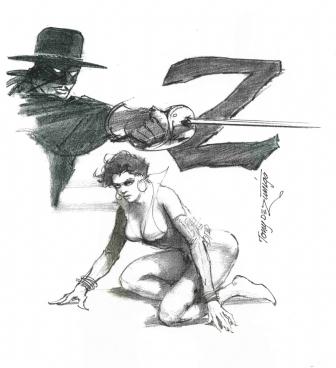
Zorro and Vixen, pencils by comics artist Tony DeZuniga

It’s hard to overstate the impact that Tony had on the comics industry, despite not being a household name on the level of Stan Lee or Jack Kirby. Tony was the first artist from the Philippines to be hired by either of the Big Two comics publishers. Rather than simply being satisfied with his own success, Tony facilitated the debut of numerous other Filipino artists into the American comics mainstream by persuading DC’s then-editor-in-chief Carmine Infantino to undertake a recruiting trip to the Philippines. As a result of Tony’s efforts, American comics readers enjoyed the work of such talents as Ernie Chan, Alex Nino, Alfredo Alcala, Nestor Redondo, Gerry Talaoc, Romeo Tanghal, and many others.

Taarna, pencils by comics artist Tony DeZuniga

Having had the chance to get to know Tony and Tina DeZuniga at comics conventions over the past several years, I can attest to their generosity and kindness firsthand. You’re looking at a few of the amazing artworks that I’ve commissioned from Tony, demonstrating the level of creative brilliance he maintained before his recent setbacks. The greatest testimony to Tony’s genius is the fact that it’s his pieces other artists always admire when I break out my portfolio at a con. Hardly a con weekend goes by that another artist doesn’t ask to “see what Tony drew.”

Black Panther, pencils by comics artist Tony DeZuniga

Like most freelance artists, Tony doesn’t have health insurance to offset his medical expenses. Superstar artist Neal Adams and others are spearheading a fundraising drive for Tony and Tina. I understand that the DeZunigas are also receiving assistance from the Hero Initiative, the nonprofit charitable organization that helps comics creators in need. (I’ve been a proud member of the Hero Initiative since I first learned about it. Anyone who grew up loving comics, as I did, should consider supporting this group that does so much good for the folks whose talents enlightened our childhoods.)

Arak and Valda, pencils by comics artist Tony DeZuniga

Like dozens of other comics fans and industry insiders, I’ve contributed what I could share. If you’d like to chip in, you can direct funds to Tony’s PayPal account: tonydezuniga@yahoo.com. The account is managed by Tony’s daughter, Cheryll Lim. Whatever amount you can offer will help, and will be sincerely appreciated by the DeZuniga family. (I received two lovely notes from Tina thanking me for my gift.) I know that times are tough for a lot of folks these days, but if you have a few uncommitted simoleons that you can donate, please be assured that Tony is well deserving of whatever help you can give.

And that’s your Comic Art Friday.

Comic Art Friday: Skulduggery

April 20, 2012

I know we just did a riff on Cloak and Dagger not too long ago, but you know how it is in comics — the same tropes keep popping up again and again.

Spy Smasher and Cloak and Dagger, pencils by comics artist Eric Koda

In this Common Elements tableau drawn by the talented Eric Koda, our hero and heroine find themselves confronted by Spy Smasher, a classic stalwart from that thrilling Golden Age of yesteryear. (For those of you who are new here, Common Elements is my series of original commissioned artworks, bringing together unrelated comics characters who share some feature in, well, common.)

Although he’s fallen into relative obscurity now, Spy Smasher was quite a popular hero back in the day — popular enough that Republic Pictures produced a well-received film serial featuring the character. Spy Smasher made his debut in Fawcett Publications’ Whiz Comics #2, the very same issue which presented the premiere of an even more popular hero: the original Captain Marvel.

Like the good Captain, Spy Smasher sprang from the collective imaginations of writer Bill Parker and artist C.C. Beck. Unlike the Captain, Spy Smasher possessed no superhuman or magical abilities. He was simply a skilled investigator named Alan Armstrong, who employed a variety of high-tech tools to track down and thwart covert enemies of the United States of America. (His trademark weapon was a fantastical vehicle called the Gyrosub, which combined the features of a submarine, an airplane, and a car.) You might think of Spy Smasher as a less-bizarre Batman, with a slightly narrower career focus. During the post-World War II years, Spy Smasher changed his code name to Crime Smasher, and broadened his attack to include nefarious ne’er-do-wells of every stripe, not just spies.

When DC Comics bought the rights to the former Fawcett characters in the early 1970s, Spy Smasher began popping up occasionally in stories featuring Earth-S, the alternate Earth where the Fawcett heroes resided before the Crisis on Infinite Earths maxiseries merged all of the Multiverse worlds into one. His most prominent appearances came in the Captain Marvel series, The Power of Shazam. This series depicted Alan Armstrong as a retired hero who befriended Billy and Mary Batson, the alter egos of Captain Marvel and Mary Marvel, respectively.

Because modern comics publishers can never leave well enough alone, there’s now a modernized version of Spy Smasher running around in the DC Universe. The latest edition is a young woman named Katarina Armstrong — I’m not certain, but I’m guessing that she’s Alan’s granddaughter — whose creator, writer Gail Simone, describes her as a sort of female Jack Bauer, the antiterrorist operative portrayed by Kiefer Sutherland in the late, great TV series 24. Katarina mostly hangs out with the distaff crimefighting team Birds of Prey.

Back at last to our featured artwork. It’s easy to understand how a guy who’s looking for spies everywhere might be thrown off by the nomenclature of a team calling themselves Cloak and Dagger. He may, however, be in over his head in this instance. I love Eric Koda’s figure work in this drawing, as well as the personalities with which he imbues his characters.

And that’s your Comic Art Friday.

Comic Art Friday: Children of the atom

March 23, 2012

I’ll get to the subject at hand momentarily, but first, I’m going to vent just a tad. (If you wish to avoid my angst-ridden screed, feel welcome to scroll down to the big picture, and start reading beneath it.)

Usually, around this time of year, I spend a joyous and fun-filled weekend at WonderCon, here in San Francisco. As many of you know, Comic-Con International — presenters of both WonderCon and the industry’s biggest annual event, San Diego Comic-Con — moved WonderCon 2012 from the Moscone Center (which is currently undergoing renovation) to Anaheim Convention Center, 400 miles to the south. I have been vocal, both online and in person among my comics-aficionado associates, in contending that this move was (a) unnecessary, as there are other facilities in the Bay Area to which WonderCon could have been relocated for one year; and (b) permanent, because the real reason CCI moved the con to Anaheim in the first place is to get the event into a larger, more lucrative media market — especially one closer to the hub of the motion picture/television/video gaming industry, toward which CCI’s events have become increasingly geared.

I’ve told anyone who’d listen over the past several months since the move was announced that I believe CCI will keep WonderCon in SoCal from here on out. I’ve heard nothing from CCI’s leadership that contradicts that view. In fact, the rather vague assertions of CCI’s spokespeople to the effect that, “Well, we’d like to keep WonderCon in San Francisco, but gee, we don’t know what’s going to happen…” have only served to reinforce my perspective.

So, earlier this week, when the popular comics news blog The Beat published its latest article promoting the CCI party line, I dropped in the following comment:

Believe the misdirection ploy (“It’s everyone else’s fault”) if you choose. The bottom line is that this is about money, pure and simple. [CCI head David] Glanzer and his crew think there’s more money in relocating WonderCon to SoCal. Every other excuse is a canard.

Maybe they’re right. But SoCal already has SDCC. Now, thanks to abject greed, it has our Bay Area con, too.

If Glanzer was sincere about keeping WonderCon in the Bay Area, there were and are several alternatives.

And, if he were sincere now, all it would take is an unequivocal statement: “WonderCon will be held in the Bay Area in 2013, and in the foreseeable future. If the Moscone Center doesn’t work out, we’ll stage it at another Bay Area venue. Period. End of conversation.”

But he won’t. He’s too busy counting those SoCal dollars.

I guess the thousands I’ve spent at WonderCon over the years — along with the millions spent by countless other Bay Area and Northern California fans — just don’t smell as sweet.

Having apparently offended the delicate sensibilities of The Beat‘s editor-in-chief, Heidi MacDonald, I was promptly placed on moderation and told that my comments were “insulting.” Never mind, of course, whether they’re accurate.

I recognize that CCI is a major advertiser on The Beat — you can’t go to the site without seeing a huge banner ad for CCI’s upcoming events. So, I understand that Heidi’s simply protecting that revenue stream, as well as her sources for information and stories from within the CCI organization. I totally get it.

But if you still think this isn’t about money, take note of what happens when you try to speak truth to power.

Now that I have that out of my system, let’s look at today’s featured artwork, shall we?
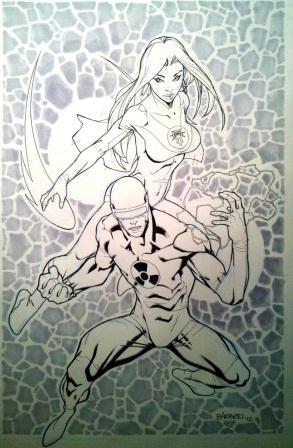
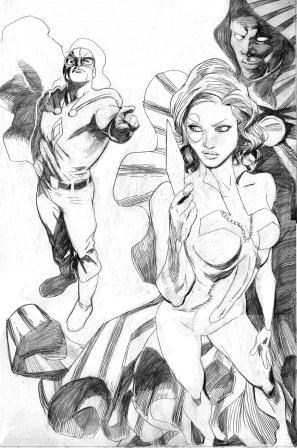
Atom Eve and Doctor Solar, pencils and inks by comics artist Carlo Barberi

When we think of comics today — to be more narrowly specific, superhero comics — we’re often thinking in terms of the Big Two publishers of such fare: Marvel Comics (now an arm of the Walt Disney Company) and DC Comics (owned for the past few decades by Warner Bros., a division of Time Warner). Several other entities — including Image, Dark Horse, and Dynamic Entertainment — also put out superhero and related science fiction and fantasy comics, but with a far smaller footprint in the marketplace.

Although DC and Marvel have dominated the field since the early 1960s (both companies, of course, trace their histories back much further in time than that, all the way to the late 1930s), they’ve always had competitors, even as they do at present. In fact, when I was a comics-reading kid in the mid-to-late 1960s, I regularly picked up books published by Charlton, Tower, Dell, and Western Publishing (which issued its comics under the Gold Key imprint), among others. All of these minor (relatively speaking) players have faded from the scene over time, but many of their characters live on in the memories of fans — and occasionally, in licensed revivals by publishers active in the business today.

Which brings us to Doctor Solar. (That’s him sporting the wicked-looking visor in the drawing above. Credit the talented Carlo Barberi with the pencils and inks.)

Doctor Solar, Man of the Atom, first published in 1962, was one of Western/Gold Key’s more successful superhero ventures. Its lead character, Dr. Raymond Solar (a name born for superhero-dom), was a nuclear physicist who gained his superpowers from a reactor meltdown. (Radiation-spawned abilities were all the rage in the early 1960s — see Spider-Man, the Fantastic Four, and the Hulk, to name but a few.) The newly irradiated Solar could transform himself into all kinds of energy at will, as well as fly, teleport, and generate powerful energy bursts. All of which made him a formidable opponent, as you might imagine. Oddly enough, considering his name, Doctor Solar’s powers had nothing to do with the sun, which doubtless led to the clarifying subtitle “Man of the Atom.”

Solar’s adventures ran in his own comic until 1969, right about the time Gold Key was beginning to phase itself out of the original action-adventure genre (most of the company’s output was licensed comics based on TV series and cartoons). In the 1990s, Jim Shooter’s upstart Valiant Comics picked up the character and revamped him — the good doctor’s true identity was now Phil Seleski, and he demonstrated significantly enhanced power over the previous iteration (the new Solar could travel through time, and was apparently immortal) — for a run that lasted about as long as Valiant itself… which is to say, not all that long. Valiant’s successor, Acclaim Comics, continued the feature. Finally, Dark Horse brought back Doctor Solar for another brief run just a few years ago. Who knows? He may pop up yet again, given time.

Accompanying the Man of the Atom in this Common Elements tableau is Atom Eve, the on-again, off-again girlfriend of the teenage superhero Invincible. Created by writer Robert Kirkman — perhaps best known as the auteur responsible for The Walking Dead — and original Invincible penciler Cory Walker, Samantha Eve Wilkins possesses the power to manipulate matter at the atomic level, which basically means she can change anything into anything else. (Her powers don’t work on living creatures, though, so the people around Eve are safe from being transmogrified into toads or furniture.) She can also use her abilities to alter the density of the air around her, enabling her to fly.

If you’re not already familiar with Invincible, I recommend it as one of the more enjoyable reads in present-day comics. It also features one of the few successful superhero universes outside of the Big Two. Kirkman has been cranking out Invincible on a more or less regular basis since 2003 — artist Ryan Ottley (who frequently signs his work “Wya,” infant-speak for “Ryan”) having replaced Walker eight issues into the run — and shows no sign of stopping anytime soon. Although the series occasionally overindulges in graphic violence (what do you expect from the Walking Dead guy?), at its core Invincible retains a good deal of the rollicking fun that characterized Silver Age Marvel, albeit with a razor-sharp modern sensibility. If the Big Two’s product isn’t floating your boat these days, or even if you’re just looking for something a little fresher and hipper in your superhero reading, give Invincible a try.

That’s a totally free recommendation, by the way. My opinion is never for sale to the highest bidder.

And that’s your Comic Art Friday.
Comic Art Friday: Ty and Tandy, sitting in a tree

March 2, 2012

Somehow, when I posted the art I picked up at WonderCon last spring, I absent-mindedly missed a piece. (What can I say? Senior moment.)

Well… better late than never.

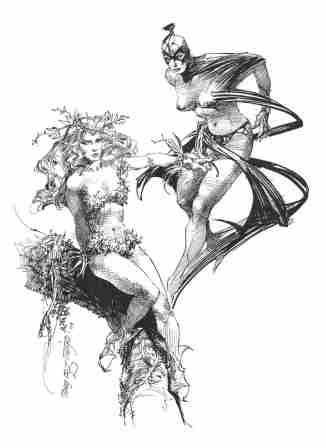
Cloak and Dagger, marker sketch by comics artist Ian D. Walker

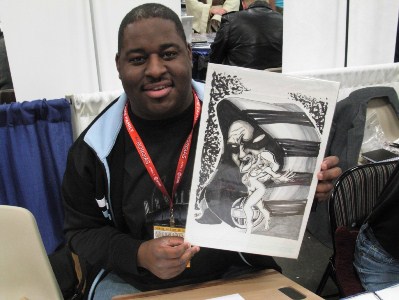
This nifty sketch (and yes, I am old enough to still say “nifty”) of Marvel’s Cloak and Dagger came my way courtesy of Ian D. Walker, a talented local artist whose work was unknown to me before this drawing caught my attention. I have no idea what the D. in Ian D. Walker stands for, but I’m thinking it might be “Darned good.”

Cloak and Dagger first showed up in a Spider-Man story in the early 1980s (Peter Parker, The Spectacular Spider-Man #64, March 1982, to be precise). Originally, Ty Johnson and Tandy Bowen were just a couple of teenage runaways from opposite sides of the tracks, until forced injections of a synthetic opiate unleashed their superhuman powers. Ty became Cloak, who can create an opening into a “dark dimension” — an opening through which he can teleport himself and his allies, or banish his enemies. Tandy became Dagger, who generates (wait for it…) daggers made of luminous energy. As representatives of darkness and light respectively, Cloak and Dagger enjoy a symbiotic relationship — Tandy’s ability to create light feeds Ty’s craving for it.

As superhero teams go, Cloak and Dagger have always been an intriguing one, even though Marvel’s repeated efforts to kick them up to a higher profile have mostly been met with underwhelming enthusiasm on the part of the comics-buying public. A couple of years ago, Marvel announced that a Cloak and Dagger TV series was being developed for the ABC Family cable channel, but so far, nothing tangible (pun intended) has come of that.

In the meantime, there’s a Common Elements commission in the works featuring the duo. You’ll see it in a future post here, once it’s ready for public view.

For now, that’s your Comic Art Friday.

Oh, wait… one more thing.

Ian D. Walker with Cloak and Dagger sketch, at WonderCon 2011

If you check out Ian Walker’s website (not-so-subtle hint) and you like his work, shoot him a line and order up a commission. I’m sure Ian would be delighted to hook you up with some funk of your own. (You can tell him your Uncle Swan sent you.)

Comic Art Fans: Did someone call for a Doctor?

February 24, 2012

In recent years, many (indeed, too many) of my longtime comics-artist heroes have shuffled off this mortal coil, never to draw again. The advance of age and ill health has deprived us of many of the greats — Gene Colan, Jim Aparo, Jim Mooney, Dick Giordano, Dave Simons… the list goes sadly on.

Others have left us suddenly, at the height of their powers, and far too soon — Mike Wieringo and Al Rio come immediately to mind.

Still others have retired from commission work, and are thus no longer available to create new treasures for their fans.

Too often, I find myself ruing missed chances to commission these legendary talents. That fact has made me acutely aware of opportunities to connect with my favorites while I can.

When fellow comic art collector Michael Dunne announced the retirement of Frank Brunner some time back, I found myself again kicking myself for not getting a commission from Frank sooner. Luckily for me, Michael passed along a comment I made to him describing the Common Elements scenario I’d have obtained from Frank if I’d acted in time. Frank was intrigued enough by the concept that, though still enjoying his retirement, he accepted my commission.

Am I ever grateful that he did!

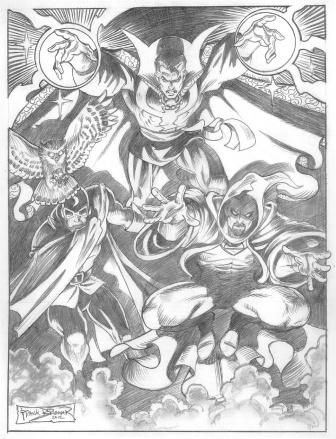
Doctor Strange, Doctor Mid-Nite, and Doctor Druid, pencils by comics artist Frank Brunner

Frank designed and drew this power-packed scene depicting his old friend Doctor Strange — whose series Frank drew and co-scripted for a fondly remembered run in the mid-1970s —  alongside colleagues Doctor Mid-Nite and Doctor Druid. Frank also came up with the title of this Common Elements entry, which was so much more clever than the one I’d devised that I’m refraining from mentioning the latter out of sheer embarrassment. (As always, you can click the image above for an enlarged view.)

Both Doctor Strange and Doctor Mid-Nite make their second Common Elements appearances in this masterpiece. The Sorcerer Supreme previously joined the party alongside the Green Lama in James Ritchey III’s Tibetan-themed tableau, while the original sightless superhero duked it out with fellow blind crusader Daredevil in a stunning creation penciled by Ron Wilson and inked by Bob Almond. You can check out both pieces by following the links to my Comic Art Fans gallery.

The newcomer, Doctor Druid, is by far the least well-known of these three physician crimebusters, but he comes equipped with a rather interesting history. He’s one of a handful of Marvel Comics characters (a handful that also includes Captain America and Prince Namor the Sub-Mariner) whose career predates what we traditionally think of as the Marvel Age of Comics, beginning with Fantastic Four #1 (November 1961). He’s also among an even smaller handful of modern Marvel characters (the only other I can think of right off is the giant dragon called Fin Fang Foom) who were co-created by Stan Lee and Jack Kirby before the FF went to press.

Originally called Doctor Droom (eventually renamed to avoid confusion with Marvel’s later, but far more famous, supervillain Doctor Doom), Druid is a psychiatrist turned mystic warrior against the supernatural forces of evil. He briefly joined the Avengers in the 1980s, and later led another hero team, the Secret Defenders. Marvel has killed Doctor Druid off a time or two, but you can always count on him coming back, because (a) no one ever stays dead in comics, and (b) you can’t keep a good Druid down.

My sincerest thanks to Michael Dunne for facilitating my introduction to the great Mr. Brunner, and to Frank himself for adding a page to my theme gallery that won’t be topped for some time. If ever.

And that’s your Comic Art Friday.
Comic Art Friday: Two hawks, no doves

February 17, 2012

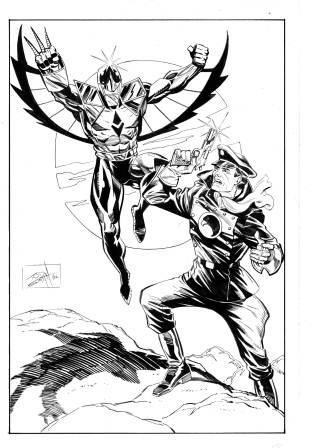
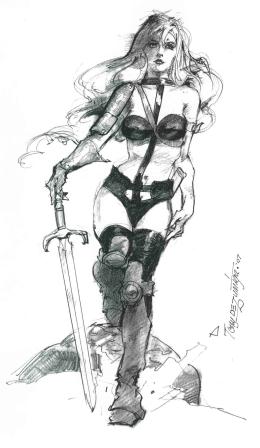
Darkhawk and Blackhawk, pencils and inks by comics artist Tod Smith

For my birthday a couple of months back, the Pirate Queen gave me a fistful of cash to put toward new art commissions. That’s what you get for the guy who has… well, not everything, but pretty close.

Wanting to stretch my windfall as far as possible, I turned to fellow collector Damon Owens for counsel. Damon, in addition to boasting a collection that makes me weep every time I compare it with my own, is a master at discovering artists who offer budget-friendly commission rates. Damon responded to my inquiry with a list of artists with whom he’d enjoyed positive commission experiences recently.

At the top of the list was Tod Smith, a name I recognized from his lengthy stint drawing Marvel’s Darkhawk series in the early 1990s. Immediately I thought, Who better than Tod to execute a Common Elements pairing of Darkhawk and the high-flying aviator hero known as Blackhawk?

No one better, as it turns out.

I’ve always had a fondness for teenage superheroes. In the ’90s, Darkhawk represented Marvel’s latest contribution to that long-standing comics tradition. Young Christopher Powell discovered a high-tech amulet that enabled him to switch spatial location with an animated suit of superpowered armor, with which Chris shared a telepathic bond. (If that sounds suspiciously like a pseudoscientific riff on Captain Marvel… well, I didn’t say it was the most original concept ever.) When Chris reclaimed his place in the universe after a fight, the Darkhawk suit beamed to an alien spacecraft, where any damage it incurred was repaired.

In addition to battling evildoers on his own, Chris and his android alter ego hung out on occasion with a team of fellow juvenile crimebusters, the New Warriors. If I recall correctly, Darkhawk was also a member of the Avengers — or was it Avengers West Coast? — for a brief period. (Then again, who hasn’t been in the Avengers?) He was also befriended by Spider-Man, Marvel’s best-known take on the teenage hero theme (although Spidey had long since matured into adulthood by the time he met Darkhawk).

Blackhawk holds the distinction of being one of a handful of characters to leap from the comic book page into other media. At the peak of his popularity during comics’ Golden Age in the 1940s, Blackhawk starred in his own radio drama, as well as a film serial. Pretty impressive, for a guy who’s basically just a fighter pilot in a fancy outfit.

In his original incarnation, Blackhawk was the leader of an international squadron, whose members were portrayed as a colorful collection of ethnic stereotypes. The writers could never quite agree on whether Blackhawk himself was American, or Polish, or an American of Polish heritage (the character was identified as each of the above at various points in his career). After World War II, the squad busied itself combating various non-military threats. During the 1960s, in a misguided attempt to keep the characters relevant, DC temporarily transformed Blackhawk and the boys into superpowered heroes, with such lame code names as “M’sieu Machine” and “Dr. Hands.” (Yikes.) In the most recent reboot of DC continuity (a.k.a. “The New 52”), the Blackhawks have been reinvented as a crack modern-day commando unit (think GI Joe). Me, I still prefer the original.

Tod Smith — who, in his post-Darkhawk career, probably is best known as the longtime artist of the Elvira: Mistress of the Dark comic book — seemed to get a kick out of being reunited with his old friend Darkhawk after a couple of decades. I love it when a plan comes together.

And that’s your Comic Art Friday.


My funny Valentine

February 9, 2012

For those of you who’ve expressed an interest in my burgeoning voice acting career, here’s a little something I voiced recently.

It’s a promotional video for a Bay Area men’s chorus that delivers Singing Valentines. NIA Creative, an awesome marketing and production company, produced the project.

Fun stuff…

…and if you decide to purchase a Singing Valentine for your beloved, please tell ’em your Uncle Swan sent you.

Comic Art Friday: RIP, Al Rio (1962-2012)

February 3, 2012

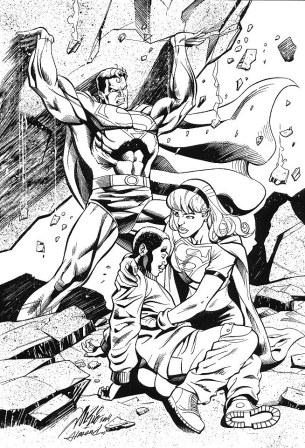
Superman and Supergirl, pencils by Al Rio, inks by Bob Almond

I was shocked and saddened on Tuesday morning — as were many of my fellow comics fans and comic art aficionados — to receive the news that artist and former Disney animator Al Rio had passed away in his native Brazil, the result of an apparent suicide.

Wonder Woman, pencils by Al Rio, inks by Geof Isherwood

Those of you who have followed Comic Art Fridays over the years know how greatly I appreciated Al Rio’s art. He is among the most well-represented artists in my collection; I own 15 of his original works — six of which I commissioned personally, plus several I’ve had inked by other artists. I’ve also enjoyed receiving the lovely postcards Al made available to his fans every holiday season. Al’s art representative, Terry Maltos, has always been one of my favorite vendors with whom to transact business. More than once, Terry has given me a price break on a purchase, or thrown in a little something extra in gratitude for my frequent custom.

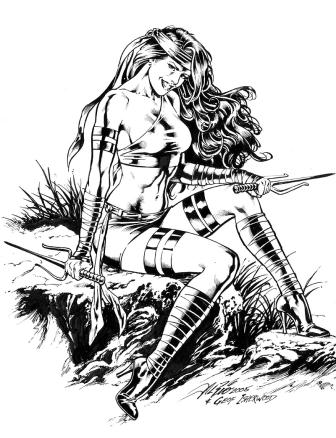
Elektra, pencils by Al Rio, inks by Geof Isherwood

Al first came to prominence when he followed J. Scott Campbell as the regular artist on Wildstorm’s Gen13 and DV8. Although many people saw him as a Campbell clone, particularly in his early comics projects, his style continued to evolve. He worked on a variety of series for both of the major comics publishers and numerous second-tier labels — everything from Spider-Man and Captain America to Grimm Fairy Tales.

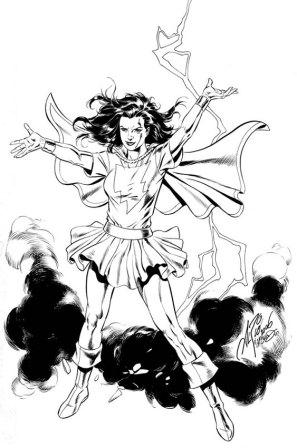
Mary Marvel, pencils by Al Rio, inks by Bob McLeod

As you can see from the pieces I’ve chosen for this memorial post, Al drew some of the most beautiful women in comics. Because of this, he was sometimes dismissed as “just a cheesecake artist.” That’s a bit like saying that Michelangelo, Titian, and Rubens weren’t great artists because they painted a lot of naked people. Without question, Al knew his way around the feminine form, but he could also draw heroes and backgrounds with the best in the business, and his sequential work shows that beyond his pinup talents, he was a brilliant storyteller. I was especially fond of his work on Marvel’s Heroes for Hire and White Tiger a couple of years back.

Batman and Catwoman, pencils by Al Rio, inks by Geof Isherwood

Since I didn’t know Al personally, I can’t really say much about him in that regard. I’ve always heard  him described as a nice man who extended extraordinary kindness to his fans and to other artists, and who frequently donated art in support of charitable causes. In fact, his Superman and Supergirl piece — seen at the top of this post — began as a preliminary sketch for a drawing Al created in support of victims of the 2004 Indian Ocean tsunami.

Wanda, the Scarlet Witch, pencils by comics artist Al Rio

You can see my entire gallery of Al Rio’s art by following this link. Please go take a look at the beauty and dynamic range of this talented creator’s gifts.

Spider-Man and Mary Jane, pencils by Al Rio, inks by Bob Almond

Al Rio was 49 years old. He leaves behind a wife, three children, countless friends, and a legion of fans who admired his unique abilities.

Supergirl, pencils by Al Rio, inks by Joe Rubinstein

And that, sadly, is your Comic Art Friday.

Comic Art Friday: Somebody scream!

January 20, 2012

You ever have one of those days when you just wanna scream?

Tyroc and Songbird have those all the time.

Tyroc and Songbird, pencils by comics artist Peter Vale

A hypersonic scream seems like such a bizarre superpower that it’s actually rather amazing how many comic book characters possess it. In addition to the subjects of the dazzling panel above — commissioned from the pencil of Brazilian artist Peter Vale, whose work has graced such series as Superman, She-Hulk, and X-Men Forever — I can think of several others off the top of my head: Banshee, Silver Banshee (no relation), Angar the Screamer, and at least one version of Black Canary.

Of course, Tyroc had ample reason to scream. The creation of writer Cary Bates and artist Mike Grell, Tyroc’s 1976 debut in Legion of Super-Heroes marked one of the earliest introductions of a black superhero into the DC Comics pantheon. Both Grell and longtime Legion scribe Jim Shooter had lobbied to add a black character to the Legion for several years previously, but DC’s notoriously conservative editorial staff had prevented them from doing so. When DC management finally greenlighted a Legionnaire of African descent, “they did it in the worst way possible,” according to Shooter. Tyroc was assigned a lame superpower, a code name straight out of a blaxploitation film, a racially insensitive origin (a descendant of a black isolationist sect, Tyroc carved a niche as the Marcus Garvey of comics), a stereotypical “angry black man” persona (his debut story was entitled “The Hero Who Hated the Legion”), and (courtesy of Grell, who designed it in protest of everything else he didn’t like about DC’s vision for the character) one of the most ludicrous costumes of the time period — “somewhere between Elvis’s Las Vegas costume and something you would imagine a pimp on the street corner wearing,” as Grell bluntly described it.

Unfortunately (or fortunately, depending on your point of view), Tyroc’s tenure in the Legion proved relatively brief. He resurfaced only on rare occasion in the Legion’s periodic rebootings over the next several decades. Although I haven’t sampled the current version of the Legion, I understand that Tyroc is back as a full-fledged member. Hopefully, with a more competent tailor.

Songbird began her career on the wrong side of justice. Originally code-named Screaming Mimi, she debuted as a member of the Grapplers, a cadre of female wrestlers turned supervillains. Mimi and her cohorts battled Ben Grimm — a.k.a. The Thing — in a couple of fondly remembered issues of Marvel Two-in-One. After a subsequent stint in another team of criminals, the Masters of Evil, Mimi joined yet a third sinister enterprise, the Thunderbolts, and adopted her new fighting identity as Songbird. Over time, the Thunderbolts transitioned from bad guys to underground heroes, and they remain on the straight and narrow (more or less) to this day.

And that’s your Comic Art Friday.

Comic Art Friday: Heavenly creatures

January 13, 2012

We’re not fully two weeks into 2012, and already it’s been an exciting art year at the new Casa de Swan.

Here’s the first of several reasons why.

Halo and Angel, pencils and inks by comics artist Sean Chen

I frequently discuss with other comic art collectors our approaches to our theme commissions. Many of my fellow hobbyists present elaborately detailed scenarios to the artists they commission, to ensure that the end result matches the collector’s vision. I know of at least one collector who actually writes a script for each piece he commissions.

There’s nothing at all wrong with that approach. In fact, it greatly appeals to the obsessive control freak in me. Over the years, however, I’ve developed a far more laissez-faire tactic toward my commissioning. I generally prefer to simply give the artist reference images of the character(s) to be drawn, then stand back and turn the artist loose.

This works well on a number of fronts:

  • Since I don’t know in advance what the artist will draw, there’s an element of anticipation and mystery while I wait for the commission to be completed.
  • It eliminates back-and-forth argument with the artist: “No, that’s not what I wanted; do it this way.”
  • Creative people in general — and I consider myself one — dislike having their imaginative impulses constrained by someone else’s vision. (Imagine a patron standing over Picasso’s shoulder and kibitzing, “Shouldn’t her eyes be on opposite sides of her head? Why is everything blue? That looks like my five-year-old nephew painted it.”) Allowing the artist more freedom usually means that he or she enjoys the creative process more, which in turn means that he or she feels more inspired toward excellent work.
  • I’m not a visual thinker, so inventing pictures in my head doesn’t come easily to me. Artists being visual thinkers means that the pictures they dream up will invariably be better than my clumsy attempts.

The artwork above, drawn by the insanely talented Sean Chen — best known for his work on such comics as Iron Man and Wolverine — illustrates the advantages of my commission philosophy. (As always, you can click on the image — or on this link — for a larger, more detailed view. Go ahead. You know you want to.)

When I assigned Sean the Common Elements pairing of Angel (from Marvel’s original X-Men lineup) and Halo (from DC’s Batman and the Outsiders), I had no clue how he would utilize these two characters. In fact, our initial discussion about a possible layout revolved around a completely different scenario. Thus, when I first saw this beautifully executed riff on Michelangelo’s The Creation of Adam, I was blown away. It would never have occurred to me to suggest this concept. Furthermore, had I gone into the project with a tightly defined idea already in mind, Sean might never have presented this one.

Best of all, Sean had fun coming up with this scenario and bringing it to fruition, so both artist and patron love the result. I like it when the artists I commission are happy.

Again, there wouldn’t have been anything wrong with taking a more hands-on approach to this commission. I’d have still gotten a terrific piece of art from Sean had I instructed him exactly what to draw.

But I wouldn’t have gotten this.

And that’s your Comic Art Friday.