Collectors of comic art fall generally into two camps. Some collect published art — the original pencil and ink drawings from which comic books are printed. Others collect unpublished art, which encompasses drawings commissioned directly from an artist, drawings created by artists specifically for sale to fans, and convention sketches, which are essentially fast-turnaround commissions drawn at comic book conventions. Many collectors have both published and unpublished comic art in their galleries, but most specialize in one or the other.
As you know if you’ve been a Comic Art Friday for any length of time — whether in this location or at our prior address — my collection is almost entirely composed of the unpublished variety. The lion’s share of my holdings are pieces that I’ve commissioned myself, either directly from the artist or through a representative. My two signature theme collections, Common Elements and Bombshells!, both consist — in their entirety — of art that was drawn specifically at my request.
Why did I choose the path I follow? I’d be disingenuous if I didn’t acknowledge the economic factor. Published art, especially pages drawn by well-known artists or featuring iconic images of popular characters, can be quite expensive — classic cover art and full-page splash panels frequently run into four figures, and the truly great pieces fetch more than that.
There’s also an aesthetic issue. Because comics are a sequential narrative medium, a panel page in isolation doesn’t often hold much appeal for me. It’s a little like reading only one page of a comic book — without the rest of the story, it doesn’t make much sense.
That’s just my perspective, of course. And I do in fact drool over the collections of fellow hobbyists who’ve amassed impressive galleries of published work.
The real reasons I prefer commissioned art, though, are visceral. I relish the charge that comes with seeing, for the first time, an image that never existed before I commissioned it. And, I enjoy the satisfaction of looking through my portfolios at art that’s unique — nothing exactly like any of my commissioned pieces exists anywhere else.
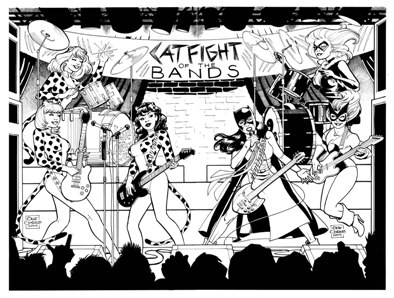
Today’s featured artwork pretty well encompasses all of the joys of commission collecting in one incredible package.
The concept of a “battle of the bands” between Josie and the Pussycats and a trio of feline-themed females from the more serious end of the comics spectrum — DC’s Catwoman, Marvel’s modern-day Black Cat, and the original Black Cat from the Harvey Comics title of the 1940s — first occurred to me years ago, in one of those flashes of wild imagination that have spawned most of my Common Elements ideas. Originally, I’d thought about a three-artist scenario — a penciler with Archie Comics experience to draw the Josie half of the piece, a traditional superhero artist to draw the opposite half, and an inker to detail the entire page and give it a unified finish.
Then, some time ago, comics artist and commercial illustrator Gene Gonzales posted a Josie and the Pussycats sketch to his daily art blog. I liked his approach to these characters, so my mental wheels began turning. Gene has done several previous commissions for me, including one for Common Elements and three for my Bombshells! theme, so I knew that he could handle the superheroines as well. Plus, because Gene inks his own pencils, he could tie the completed piece together with style.

I proposed the idea to Gene. He embraced the scenario with gusto. Almost immediately, he sketched out a thumbnail showing how he might approach the concept. I loved his choices, and suggested a few minor tweaks. Gene was open to my ideas, and before long, we had a commission in the works.
That’s how magic gets made.
Some time later, Gene showed me the rough pencil art for his “Catfight of the Bands.” Gene noted that, because he would be inking the piece himself, he would add much of the detail as the art evolved from pencils to inks. I could already see, though, how much fun his vision of the scene would entail. (No pun intended.)

If you’re wondering why Gene signed the art twice, this piece is what’s called in the trade a double-page spread. Although intended for display as a single composition, it’s drawn on two separate pages of comic art board. Gene designed the image so that no character overlaps the center division. Thus, the half featuring the Pussycats is complete in itself, as is the half starring the rival band that Gene dubbed 9 Lives. In the unlikely event that I ever store this piece in a portfolio, each piece can occupy its own sleeve and still look like a complete picture.
Over our next two Comic Art Friday installments, we’ll take a closer look at each of our tuneful tigresses.
For now, that’s your Comic Art Friday.
If you’re interested in seeing the process that goes into creating a comic art commission, comics artist John Beatty recently produced a webcast, during which he partially inked a new Common Elements commission. Follow the link to view the replay of John’s webcast.
 SwanShadow Thinks Out Loud
Recent Comments