Archive for the ‘Celebritiana’ category

Comic Art Friday: The Jackie Robinson of comics

April 15, 2016

Allow me to begin today’s festivities by wishing you a happy Jackie Robinson Day.

In the event that you’re not a baseball aficionado — in which case, I might think somewhat less of you, but we can still be friends — I’ll explain that April 15 marks the anniversary of Jackie Robinson’s first appearance with the Brooklyn Dodgers in 1947, becoming the game’s first black player since baseball banned participation by African Americans in the late 1880s. The integration of the national pastime led not only to revolutionary change in the sporting world, but in society as a whole. No less a civil rights champion than Dr. Martin Luther King, Jr. credited baseball’s black pioneers with “making my job easy” by demonstrating that people of color could work successfully alongside their white counterparts, and even excel, when provided opportunity.

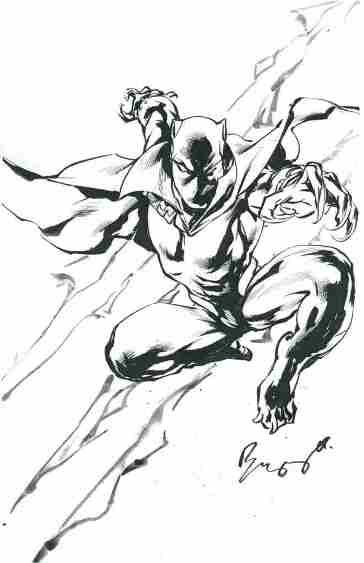
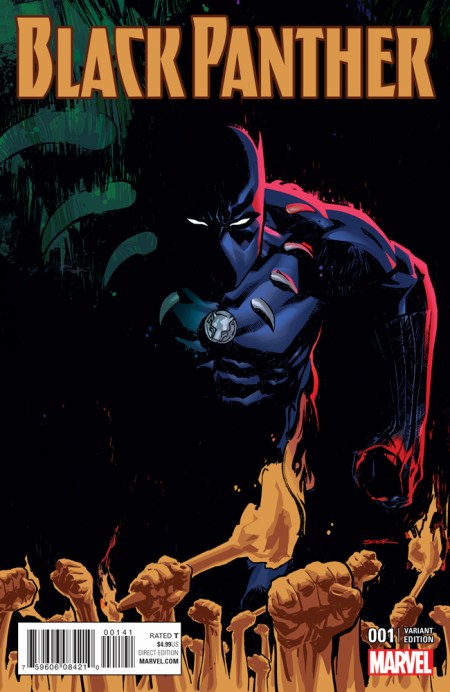
Variant cover for Black Panther #1 (2016 series), original art by Ryan Sook

It seems appropriate, then, to celebrate Jackie Robinson’s historic accomplishment with an artwork featuring the Black Panther, whose advent in Fantastic Four #52 (July 1966) represented to mainstream comics what Robinson’s arrival did to baseball. It’s Ryan Sook’s variant cover for Black Panther #1, the first issue of the new Marvel series that hit the stands last week. I acquired the original black-and-white ink art from Ryan last month at Silicon Valley Comic Con. I don’t usually have much interest in buying published covers or pages — my collection largely consists of commissioned pieces, as regular readers can attest — but I couldn’t pass up the chance to own this amazing cover. Thanks, Ryan! (You can see the published version, in full color, below.)

These are good days to be a Black Panther fan, which I’ve been since he began appearing regularly in The Avengers in 1968. Not only are we getting a fresh run of Panther stories in the comics — with scripts by award-winning author and social commentator Ta-Nehesi Coates, and art by the incredible Brian Stelfreeze — but T’Challa is also poised to make his big-screen debut next month in Captain America: Civil War. Portraying the Panther is actor Chadwick Boseman, who coincidentally also played Jackie Robinson in the film 42. Boseman will continue the role in a Black Panther solo film scheduled for release in July 2018. You’d best believe I’ll be among the first in line to see that one.

Black Panther #1 (2016 series), Ryan Sook variant cover

It’s worth mentioning that while the Panther was the first black superhero in mainstream comics, he wasn’t the first character of African descent to star in his own title. In December 1965, Dell Comics — best known for its licensed comics based on popular TV shows — published Lobo, a Western adventure featuring an African American gunfighter as its titular protagonist. The series, created by writer D.J. Arneson and artist Tony Tallarico, lasted only two issues. Not until Luke Cage, Hero For Hire arrived in June 1972 would a black superhero headline his own book. (The Black Panther took over the lead feature in Marvel’s Jungle Action comic beginning in July 1973. He moved to his own eponymous series in January 1977.)

I still remember the first time I stood in front of the spinner rack at the local supermarket and saw the Black Panther on the cover of a comic book. My younger self could scarcely have envisioned the day when the Panther would stand at the brink of multimedia superstardom, as he does today.

As I said earlier… good days indeed, for us T’Challa fans.

And that’s your Comic Art Friday.

Comic Art Friday: You don’t have to be a star, baby, to be in my show

November 7, 2014

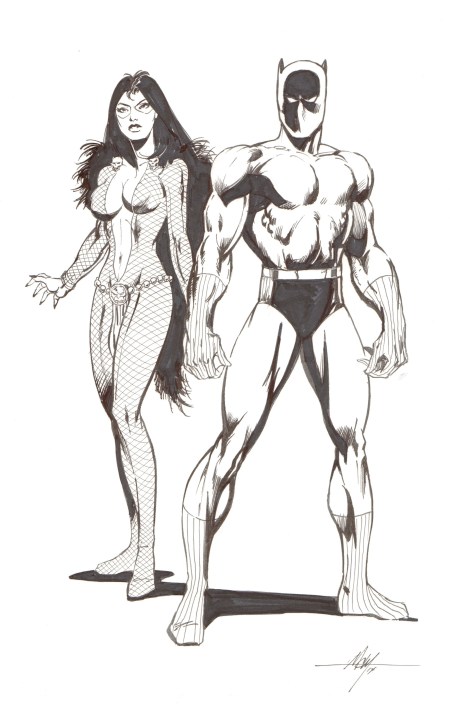
Gamora and the Black Panther, pencils and inks by MC Wyman

Those of you who have followed the development of my Common Elements commission theme know that I maintain a lengthy to-do list of Common Elements concepts. (And for those of you who are new: Common Elements is a series of themed original artworks, each of which brings together otherwise unrelated comics characters who share some aspect in… wait for it… common.)

Some of these concepts have been on my list for years, awaiting assignment to artists who will bring them to fruition. In fact, there are still a handful of unused ideas that date back to the start of Common Elements, nearly a decade ago.

The concept illustrated in today’s artwork by former Marvel Comics stalwart MC Wyman has been collecting dust for a few years now. Back in February 2011, the Black Panther took over the lead role in the monthly series that had belonged to Daredevil, a.k.a. “The Man Without Fear.” Retitled Black Panther: The Man Without Fear, the series continued — using the existing Daredevil issue numbers, beginning with #513 — for the better part of a year. Then, with issue #523.1 (November 2011, and no, the “.1” is not a typo), the series was again retitled, this time becoming Black Panther: The Most Dangerous Man Alive. The book carried on under its new moniker through issue #529, when the run concluded.

At the time the “Most Dangerous Man” title surfaced, it occurred to me that there was already a Marvel character with a similar tagline. Gamora, an interstellar assassin who first turned up in Jim Starlin’s Warlock series in the mid-1970s, then reappeared as a key player in the Infinity Watch/War/Crusade saga in the early 1990s, had long been known as “The Most Dangerous Woman in the Universe.” Recalling that fact, I made an entry in my Common Elements log entitled “Most Dangerous,” that would match the two characters who now had borne that description.

Little did I know that in just a couple of years, Gamora would become a major movie star as one of the leads in Marvel’s cinematic blockbuster, Guardians of the Galaxy. When the film was announced, I didn’t even know that the Guardians in question were not the team I associated with that name from my comics-reading youth.

I’ll explain. Back in 1969, the Guardians of the Galaxy debuted in Marvel Super-Heroes #18. This team of weirdly mismatched, far-future space rangers was co-created by writer Arnold Drake, who had a penchant for off-kilter characters. (Drake was also responsible for DC Comics’ Deadman and Doom Patrol.) The original Guardians crew consisted of Vance Astro, an Earthman who’d spent a millennium in suspended animation; Charlie-27, a being from Jupiter whose stout, powerful physique reflected his home planet’s intense gravity; Martinex, who hailed from Pluto and whose body was formed out of crystal; and Yondu, a bow-slinging soldier of fortune from Alpha Centauri. The foursome eventually added a fifth member, a mysterious mutant who went by the name Starhawk.

Like many of the peculiar super-teams Marvel cooked up during the Bronze Age (the Champions, anyone?), the Guardians popped up mostly as guest stars in other teams’ ongoing series (in particular, the Avengers and the Defenders) in and around brief runs in their own stories. They pretty much disappeared once the wild and wacky ’70s ended. Marvel resurrected the Guardians for a while in the early 1990s — because no property ever goes away permanently in comics — then once again allowed them to fade from view.

In 2008, Marvel restarted the Guardians, this time with a new collection of characters, including Gamora. Although I was aware that there was a new Guardians series on the market, I never read an issue, and was unaware that the team had been completely reimagined until news of the film began leaking out. And I was as surprised as anyone — except, obviously, the folks at Marvel Studios — when the Guardians movie exploded into theaters as a massive hit. Who’d’a thunk that a flick about a talking raccoon and a sentient tree would make megamillions?

Now, the once-obscure Gamora is a household name, thanks to the Guardians film. Even better, my longtime favorite Black Panther is finally getting his own big-screen presence, with a guest-starring role in the third Avengers movie to be released in 2016, and headlining his own motion picture in 2017. Chadwick Boseman, brilliant as baseball pioneer Jackie Robinson in 42, seems like a near-perfect choice to bring T’Challa of Wakanda to life. I can hardly wait until the aforementioned titles hit the silver screens in my neighborhood.

Until then, we have this pairing of the Most Dangerous Man and Woman Alive… two unlikely cinematic stars.

Ain’t Hollywood grand?

And that’s your Comic Art Friday.

Comic Art Friday: Invasion Force!

July 25, 2014

Writers of fiction frequently get asked, “Where do you get your ideas?” The obvious answer is, “From my brain, duh.” Most writers not named Harlan Ellison are too polite to respond quite that bluntly.

Since I don’t write much fiction, this question is usually directed toward my Common Elements commission artworks: “Where do you get the ideas for all those bizarre matchups?” To which I reply…

From my brain. Duh. (Take that, Harlan Ellison.)

In humbler truth, I don’t always know where my Common Elements concepts originate. Usually, it’s a random thought, triggered by some equally random event or factoid. But then, if you know me in real life, you understand that’s just me. My brain is constantly kicking out random ideas, some of which spew forth from my lips or keyboard entirely without filter.

The others sometimes end up as Common Elements commissions.

The Fourth Doctor, Cyborg, and Blue Beetle, pencils and inks by Ibrahim Moustafa

The concept behind today’s featured artwork languished on my to-do list for several years, so the impetus for it has long since swirled down the drain of my vanishing memory. I think I might have been watching a TV documentary about the British Invasion of the early 196os when the concept just sort of fell together, as things in my brain often do. Whatever the genesis, that singular era in popular music history spawned this grouping of the Fourth Doctor (because Tom Baker will always be The Doctor to me), Cyborg, and the third incarnation of the Blue Beetle, a.k.a. Jaime Reyes.

You know…

A Be(a)tle, a Stone (Victor, Cyborg’s real identity), and a (Doctor) Who.

***drops mic***

Credit to artist Ibrahim Moustafa, co-creator (with writer Christopher Sebela) of the Eisner-nominated digital comic series High Crimes, for bringing my whacked-out notion to life. A special thanks to my fellow collector Jerry Livengood at Serendipity Art Sales for managing a smooth commission experience.

And that’s your Comic Art Friday.

Comic Art Friday: A Bettie by any other name

June 20, 2014

In my online gallery at Comic Art Fans, there’s a page I call — for lack of a better term — “The Coed Room.” It’s the place where I file random artworks that feature some combination of male and female characters.

Some of the pieces in this section are group shots — the Barry Kitson Justice League sketch, for example, or my Suicide Squad commission by Geof Isherwood. Others are pairings of related characters — the Superman and Supergirl piece by Al Rio and Bob Almond fits this category, as do the two pinups starring Doc Savage and his cousin Pat, by Darryl Banks and Ernie Chan.

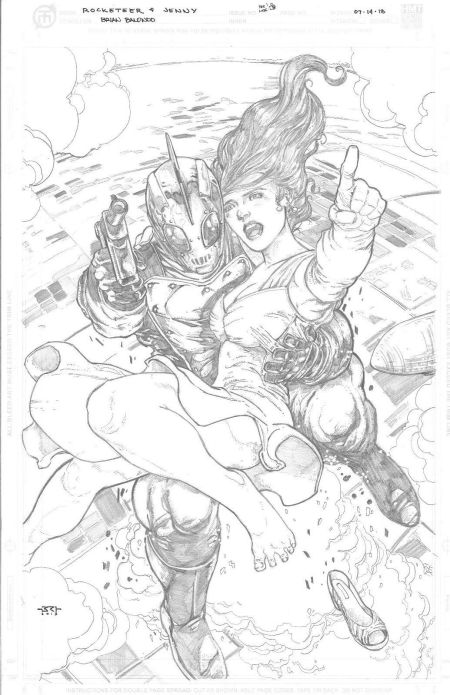
Several of the Coed Room items, however, are what I would term “couples shots” — depictions of male and female characters who have been romantically linked at some point. Here’s the latest addition to this particular category: an action scene showcasing the high-flying Rocketeer and his lovely paramour, as drawn by a talented artist from the Philippines named Brian Balondo.

The Rocketeer and Jenny Blake, pencil art by Brian Balondo

You’ll notice at the top of the page that Brian titled this piece “Rocketeer and Jenny.” If you know the history of these characters, you’ll get a chuckle out of that. Jenny Blake was the name given to the female lead in the 1991 Disney film The Rocketeer; in the movie, she’s played by Jennifer Connelly. In Dave Stevens’s original comic book stories, however, Cliff “Rocketeer” Secord’s girlfriend’s name is Betty — an homage to 1950s pinup queen Bettie Page, whose likeness Stevens used as the model (no pun intended) for the character’s appearance.

When screenwriters Danny Bilson and Paul DeMeo — now familiar to genre buffs as co-creators of such TV series as Viper and the 1990s version of The Flash — pitched the concept to Disney, they changed the name of the main female character to Jenny (and gave her a surname, Blake, which she lacked in the comics), masking the connection to the notorious star of nude postcards and bondage porn… not exactly in line with Disney’s family-friendly image. (Although I can pretty much guarantee that everyone’s family has at least one member who’s a fan of nude postcards, or bondage porn, or both.) The name change was cemented when the film went into production.

I can always tell, when The Rocketeer comes up in conversation, whether people know the character from the comics or the movie — by which name they use for the heroine.

Dave Stevens’s use of Bettie Page’s likeness in the Rocketeer comics helped spark a renewed interest in the legendary model, who by the early 1980s had largely faded from the public consciousness. In the decades since, Ms. Page (who passed away in 2008 at the age of 85) has risen to cult status far above that of her 1950s heyday. There have been two feature films about Bettie — a fictionalized production starring Gretchen Mol in the title role, as well as an award-winning documentary (the Pirate Queen and I attended a screening of the latter last year) — an infinite assortment of Bettie-inspired art (most notably by Jim Silke, creator of the Bettie Page comic series, and internationally recognized pinup artist Olivia De Berardinis), as well as a cottage industry of licensed (and, I suspect, bootleg) Bettie Page paraphernalia.

Until just a few days ago, a nationwide chain of Bettie Page clothing stores (including a location on Haight Street here in San Francisco) featured retro-styled fashions inspired by Ms. Page. As a result of litigation by the firm managing licensing for Ms. Page’s estate, the retail chain lost the right to use the Bettie Page name as well as her likeness, which formerly was splashed all over the store. The Pirate Queen owns several pre-lawsuit Bettie Page dresses and, of course, looks smashing in them.

Brian Balondo’s drawing is rather smashing as well. Although hardly as much so as the Pirate Queen.

And that’s your Comic Art Friday.

Comic Art Friday: It’s hard out here for a superheroine

December 13, 2013

In case you missed it, the upcoming Batman/Superman feature film just added a Wonder Woman.

Gal Gadot, the new face of Wonder Woman

Warner Brothers has cast Israeli actress and model Gal Gadot — that’s her, right above — as mighty Diana, warrior princess of Themyscira. No one knows yet whether Wonder Woman’s role in the movie will be major or tangential. One supposes that the publicity splash over Gadot’s hiring suggests that she’ll contribute something more than a cameo, but that’s purely speculation.

I don’t have a strong opinion about Gadot’s casting one way or the other. So far as I’m aware, I’ve never seen the erstwhile Miss Israel perform on film — she’s costarred in the three most recent iterations of the Fast and Furious franchise, but after sampling the inaugural F&F I never had any hankering for further helpings. I’m told that she can act a little. I’m willing to extend the benefit of the doubt there. From the photos and video clips I’ve checked out, Ms. Gadot looks a fair bit leaner than I’d envision Wonder Woman, but six weeks in the gym before filming could easily fix that. At five-foot-ten, she’s more than tall enough. (Heck, if Tom Cruise, who’s a few inches shorter than I am, can effectively play the towering Jack Reacher on the silver screen, a 5’10” actress certainly qualifies as Wonder Woman.)

Plus, Gadot served two years in the Israeli Defense Forces, and is an expert on military weaponry. You’re not going to hear me question whether she’s tough enough to play a superhero.

I do appreciate the fact that Warner cast someone of eastern Mediterranean ethnicity, with physical features to match, as the (presumably more or less Grecian) Amazon, rather than Hollywood’s stock northern European type. If I imagine Gadot’s headshot with Diana’s trademark ruby-starred tiara Photoshopped in, I can certainly see the face of Wonder Woman there. She definitely looks closer to my personal impression of Queen Hippolyta’s daughter than did the now-iconic Lynda Carter (who, yes, I know, is not the usual stereotype either — she’s partly of Latina heritage). At least, from the neck up.

But here’s the thing.

Why does Wonder Woman have to be a walk-on in someone else’s movie?

Why doesn’t Wonder Woman — the most prominent female superhero in comics for more than 70 years — rate her own motion picture?

Wonder Woman, pencils by Iago Maia

If you ask the folks at DC/Warner, Wonder Woman is one-third of their “Trinity,” their top tier of characters. Since 1978, the other two members of the DC Trinity — Superman and Batman — have headlined 13 theatrical motion picture releases between them, plus numerous animated TV series and telefilms. Since the cancellation of the mid-1970s Wonder Woman live-action TV program, the Amazing Amazon has appeared in the various Justice League animated series (as one character among a veritable horde of super-doers), a stand-alone animated direct-to-DVD project, and one embarrassing and ill-fated live-action TV pilot (starring Adrienne Palicki, late of Friday Night Lights) that did not result in a series. Despite rumors here and there — including a persistent one involving fan favorite writer-director-producer Joss Whedon — there’s never been a Wonder Woman movie.

And now, she’s relegated to supporting duty in a big-budget Batman/Superman team-up flick.

That’s just pitiful.

Heck, even the Hal Jordan version of Green Lantern got his own terrible movie. And Hal Jordan is lame. (Except in Green Lantern: The Animated Series, which was awesome, and never should have been cancelled.)

Which brings me to the similarly sorry case of Ms. Marvel, who’s the closest thing Marvel Comics has to a Wonder Woman archetype.

Marvel has enjoyed a spate of success in recent years producing its own movies (now as an arm of the Disney entertainment megaconglomerate), churning out one blockbuster after another featuring top-shelf heroes Iron Man, Captain America, and Thor, plus their in-house supergroup, The Avengers. [Comics-to-film cognoscenti know that the ongoing Spider-Man (Sony) and X-Men (Fox) movie franchises, as well as the soon-to-be-rebooted Fantastic Four (also Fox) are the licensed product of other studios.] Marvel currently produces the live-action series Agents of SHIELD for ABC television, and has theatrical Ant-Man and Guardians of the Galaxy features in the works. The House of Ideas recently announced that it will, over the next few years, generate four additional series to be distributed via Netflix, starring Daredevil, Luke Cage, Jessica Jones, and Iron Fist, plus a miniseries featuring another superteam, The Defenders.

So where’s the love for Ms. Marvel?

Ms. Marvel, pencils by Carlos Silva

Not long ago in the comics, Marvel started a new ongoing series about Carol Danvers — who’s been Ms. Marvel for 35 years — redubbing her Captain Marvel. I know that Marvel editorial viewed this as a promotion, but I did not. Marvel has already had a long-running character named Captain Marvel. Actually, they’ve had a few; most recognizably Mar-Vell, a former soldier of the alien Kree civilization; Mar-Vell’s son, Genis-Vell, who assumed his father’s mantle after Mar-Vell’s death; and Monica Rambeau, whose tenure as Captain Marvel bridged the years between Father-Vell and Son-Vell. There have been at least three more Captain Marvels in the Marvel Universe, but you get the idea. (This of course says nothing about the original Captain Marvel, who’s still alive and kicking over at DC, but now calls himself Shazam. That’s a whole other story.)

Although she falls somewhere in the line of the Kree Captains Marvel (her powers derive from an explosion that infused her with Kree DNA), Carol’s Ms. Marvel identity has existed for the most part independently of that franchise. I would wager that there are plenty of comics fans who didn’t even know that Ms. Marvel had anything at all to do with Marvel’s Captain Marvel, so distinct an entity has she become in her own right. Foisting the Captain Marvel nom de guerre on Carol lessens her, in my opinion, to being just another knockoff of a male superhero, when over the past several decades she had evolved into far, far more than that.

And, like Wonder Woman, she still can’t get a movie deal.

Which I think sucks, quite frankly.

Both of these great heroines and role models deserve better, as do their fans. Your Uncle Swan included.

And that’s your Comic Art Friday.

Comic Art Friday: A real-life superhero passes

December 6, 2013

In respectful acknowledgment of the passing of former South African president Nelson Mandela — one of the towering figures in human events in my lifetime — today I’m sharing a few choice images from my Black Panther gallery, interspersed with selected quotes from a real-life African-born superhero.

To be free is not merely to cast off one’s chains, but to live in a way that respects and enhances the freedom of others.

Black Panther, pencils and inks by Buzz

There is no passion to be found playing small – in settling for a life that is less than the one you are capable of living.

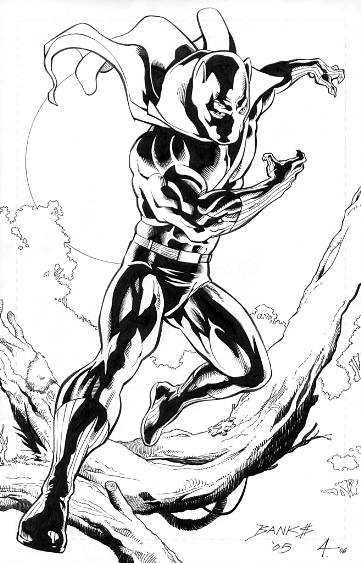
Black Panther, pencils by Darryl Banks, inks by Bob Almond

A fundamental concern for others in our individual and community lives would go a long way in making the world the better place we so passionately dreamt of.

Black Panther, pencils by Paul Boudreaux

I learned that courage was not the absence of fear, but the triumph over it. The brave man is not he who does not feel afraid, but he who conquers that fear.

Black Panther, pencils and inks by Steve Rude

We must use time wisely, and forever realize that the time is always ripe to do right.

Black Panther and Storm, pencils by Ron Adrian, inks by Bob Almond

A good head and a good heart are always a formidable combination.

Black Panther, pencils and inks by Geof Isherwood

Rest in peace, Mr. Mandela.

And that’s your Comic Art Friday.

TCONA 3: Most of my pursuits are trivial

August 16, 2013

I just flew in from Las Vegas, and boy, is my brain tired.

Actually, the Pirate Queen and I flew back from Bright Light City two days ago, and I’m mostly not tired any more. I’d headed to Vegas last weekend for the third annual Trivia Championships of North America — henceforth, TCONA, or I’ll be typing all day. The Pirate Queen joined me on Sunday following the festivities, and we spent a blissful three days checking out the sights and sounds of one of my favorite vacation destinations.

But let’s talk TCONA.

What began two summers ago as a largely informal gathering of game show champions, Quiz Bowl veterans, and pub quiz mavens has ballooned in this third installment into a real live media event. Not only were crews from two nationally televised game shows — NBC’s Million Second Quiz, and The Chase, GSN’s new Stateside version of the UK hit — on site to conduct in-person auditions, but the stars of both the US and UK editions of The Chase also participated in several of the weekend’s competitions. The Experts, easily the best weekly quiz program on YouTube, taped four episodes before a live audience. And of course, there was in attendance the usual assortment of trivia geeks from all over the continent, and beyond. (I met at least one fellow who’d come all the way from Sweden. Or maybe Norway. Somewhere in Scandinavia, anyway.)

A summary of one attendee’s highlights follows.

The weekend commenced on Friday morning with a multi-part written quiz. This opening salvo serves not only to start the neurons firing, but also to provide an initial gauge of one’s level among the competitors. My first thought after completing the test was that I should have ingested more coffee before we began. I was relatively pleased, once the scores were published later that day, to discover that I hadn’t fared as poorly as I feared, and in fact, I’d outpointed several folks whose names are far better known in the trivia world than my own. With another triple latte in my system, I might have performed even better.

One of TCONA’s primary individual events is 5×5, a buzzer battle whose gameplay bears distant similarity to a certain television quiz program with which I am intimately acquainted. Despite the aforementioned acquaintance, I never seem to do very well at 5×5, and this year’s contest was no exception. I lost my first match thanks to a foolishly aggressive final wager — I was leading up to that point — on a question about Celebrity Apprentice, a program with which I am clearly not as intimately acquainted as I thought. I was never a factor in my second game, and thus lost any hope of advancing to further rounds.

I had high expectations for myself in another individual event, LearnedLeague Live. At TCONA 1, I won my first round against seven other competitors, despite never having played the game before. Last year, I held my own at an eight-player table that included several seasoned LearnedLeague veterans; I didn’t win the table, but I felt that I acquitted myself decently. This year, I made the critical error of playing at a table featuring two of the greatest (and two of my favorite) players in Jeopardy! history, Jerome Vered and Dan Melia. Note to self: Next year, instead of sitting with people you like, sit with people you might stand a chance of beating. Assuming there are any.

For the main team event, Quiz Bowl, I reconnected with two other members of last TCONA’s silver-medal-winning squad for a run at fresh hardware. Our team captain, Dave Legler, who once bagged $1.7 million on the game show Twenty-One, recruited as our fourth player a trivia host from Chicago, Jeremy Cahnmann. Combine that with our not-so-secret weapon, Jonathan Hess, a soft-spoken grad student from South Carolina who knows more arcane information than I’ve forgotten — and I’ve forgotten a lot over the years — and little old me (you remember that I’ve won eight games on that TV quiz show with the Canadian ex-pat, right?), and we liked our chances going in. We galloped off to a tremendous start, going undefeated in our first three games and winning our four-team bracket. Then, in our first elimination match, we ran into a tough crew led by Anne Hegerty, one of the “chasers” on the original British version of The Chase. As coincidence would have it, the game commenced with a battery of Anglocentric material that Anne leaped all over like a wolf attacking a Porterhouse. Our side rallied, though, making up ground furiously as the game progressed, only to lose in the end by the value of a single question. It was a hard loss to stomach… but there’s always next year.

Luckily for me, redemption came in the other team event, the Pub Quiz Mashup. Another Jeopardy! Ultimate Tournament of Champions veteran, Dr. Shane Whitlock, invited me to team up with him and his charming bride. We added three other players to fill our roster, which Shane dubbed (in the time-honored pub quiz tradition of quirky team names) “Natalie Portmanteau.” After seven often-hilarious rounds of play, we walked away with the silver medal. Except… well… we didn’t exactly. An apparent scoring error, uncovered between the end of the event and the medal presentation the following day, resulted in our being bumped from second place to third. So we got the bronze medal instead of the silver. I don’t care — it started out silver, and I’m sticking to that. It’ll always be silver to me.

Having the two hottest new game shows in television making their first TCONA appearances generated considerable buzz. Both Mark “The Beast” Labbett, the “chaser” on the US version of The Chase, and the show’s producer came in for Q&A sessions. (Not only is Mark a smart fellow, he’s also ginormous. They don’t call him The Beast for nothing.) Quite a few folks auditioned for Million Second Quiz; it’ll be interesting to watch the show and see how many people I know who made the final cut.

Speaking of game shows, if you aren’t already watching The Experts every Monday (or whenever you choose — it’s on YouTube, so tune in when it suits you, but the new eps post on Mondays), you should be, doggone it. Produced by my Jeopardy! colleague Alan Bailey, it’s consistently as entertaining a 20 minutes as you’ll spend. Alan and his crew shot four new games on Saturday night, including an all-star slugfest between The Chase‘s Anne Hegerty (whose subject specialty was Terry Pratchett’s Discworld) and Jeopardy! superstars Brad Rutter and Roger Craig (experts on Mad Men and Prince, respectively). All four games offered action, suspense, brain-shredding trivia superiority by the contestants, and abundant joviality for all. I won’t spoil the outcomes for you — you’ll just have to hie yourself over to YouTube when the new shows post, and check them out for yourself.

There were, as usual, plenty of ancillary events in and around all of the above. Quiz hosts and trivia producers from all over North America bring their favorite material and stage impromptu games throughout the weekend, which anyone can drop into and play. TCONA is also the home of the World Championship of Kno’dgeball, an amusing yet bizarre hybrid of trivia and dodgeball. (Your Uncle Swan declines participation in the latter, preferring not to combine mental challenge with risk of bodily injury. But the Kno’dgeballers do seem to enjoy themselves.)

Of course, TCONA’s most memorable highlights are always the connections and reconnections with my fellow trivia mavens. TCONA is the one place each year where I run into some of the many amazing people I’ve met via Jeopardy! — Bob Harris, Roger Craig, Brad Rutter, Steve Chernicoff, Dan Melia, Shane Whitlock, Alan Bailey, Jerome Vered, and I’m probably forgetting others, for which I’ll apologize in advance. (Yes, all of those people are as intelligent as they appear on TV. More, even.) It’s also a chance to meet up again with my Quiz Bowl teammates Dave and Jonathan, as well as many other new acquaintances I’ve made over these past three events, including such quiz show stars as Who Wants to Be a Millionaire winners Ed Toutant and Joe Trela, whose exploits I’ve admired from the other side of the tube. It was fun to put faces to many of the names with whom I compete in LearnedLeague — I think at least half of Rundle A West, my current LL bracket, was in attendance this year, several of whom I met for the first time.

Kudos to the TCONA team for lining up an infinitely superior venue this time out. The Tropicana met the event’s needs as well as anyone could have hoped after the horrors of Circus Circus last year. The Trop’s not perfect — in particular, its dining options are limited, especially in the budget-friendly/quick-service areas (there’s neither a buffet nor a true food court). Still, it’s an easy stroll across the street to the MGM Grand, New York New York, or the tram-connected Excalibur/Luxor/Mandalay Bay trio, so ample eating choices are right nearby. On the positive side, the conference center is easily accessible, and eminently convenient if you’re staying in the Trop’s Club Tower — basically, step off the elevator and you’re there. I couldn’t have been more satisfied with my room, which was large, well-appointed, clean, and comfortable. The in-room high-speed wifi worked splendidly. (Don’t get me started about the execrable Internet access situation I encountered when I moved over to Excalibur after the convention ended.) And, if you like to while away your free time and dollars in the casino, I found the Trop’s blackjack dealers as friendly and helpful as any I’ve encountered anywhere in Vegas.

Speaking of the Trop, TCONA shared the hotel’s weekend hospitality with another niche convention: the National Pole Dancing Championships. (Yes, that’s a thing. I kid you not.) I can assure you that, for the most part, you’d have had scant difficulty determining which guests were there for the trivia, and which for the pole dancing. Let’s just say that, were you to draw a Venn diagram depicting quiz nerds and pole dancers, there would be precious little overlap between the two sets. Maybe none.

Before I departed, I registered in advance for TCONA 4. You could join me in Vegas (probably at the Trop, but that’s yet to be negotiated) next August 8-10. But I’ll warn you: You’d better bring your A game.

The perfect Cain

June 14, 2012

Over at ESPN.com — a site owned by a network that typically can’t be bothered to cover the Giants because, after all, we don’t have real sports out here on the Left Coast — David Schoenfield just asked the question, “Did Matt Cain throw the greatest game ever?”

Well, let’s see…

Matt Cain's perfect game: June 13, 2012

No hits.

No walks.

No baserunners.

27 up, 27 down.

14 strikeouts, tying the record for the most ever in a perfect game… a record set by Sandy Koufax, who for five seasons may have been the greatest pitcher ever.

A feat accomplished only 22 times in the 130-plus years of baseball history.

Yes, Mr. Schoenfield…

I believe he did.

You go, Matty. We’re glad you’re on our side.

A final sting from the Scorpions

June 11, 2012

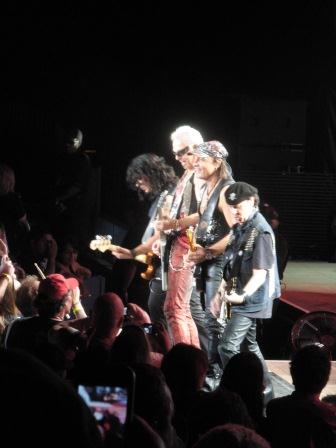
The Scorpions: Klaus Meine, Matthias Jabs, Rudolf Schenker, and Paweł Maciwoda

Let’s get this on the table right now: I wouldn’t describe myself as a huge Scorpions fan. (We’ll leave the issue of whether I would ever describe myself as a “huge” anything for another time.)

Back in my radio days, I always thought of the Scorpions as “that German metal band with the weirdly misogynistic album covers” — i.e., the Scorps’ 1979 release Lovedrive, which depicted a woman with bubblegum stuck to her exposed breast. And, to be bluntly honest, too many of the Scorpions’ lyrics sounded like they were written by someone for whom English wasn’t a primary language… which, come to think of it, is true. I dug a few of their hits — “The Zoo” is a fun, chugging rocker with a catchy hook, “Wind of Change” is as solid a power ballad as the genre allows, and come on, who doesn’t bang his or her head to “Rock You Like a Hurricane”? — but not enough to land the group on my list of top-rated acts. Liked ’em, didn’t love ’em.

When the Pirate Queen mentioned a few months back that one of her favorite bands from the ’80s was coming to town, however, I rallied to the cause.

And so it was that last Saturday evening we made our way down to Mountain View’s Shoreline Amphitheatre — or as I prefer to call it, Le Grande Brassiere — to check out the Scorpions on their final pre-retirement tour. (Considering that Scorpions lead singer Klaus Meine turned 64 last month, and the band’s founder and guitarist Rudolf Schenker will join him at that age in August… yeah, it’s probably about time to hang ’em up.) The Pirate Queen had been ill for several days with a nasty cold, but as she put it, “Either you or I would have to be on our death bed for me to miss the Scorpions… and if it were you, I’d see if someone could watch you for a few hours.” (She was kidding. I think.)

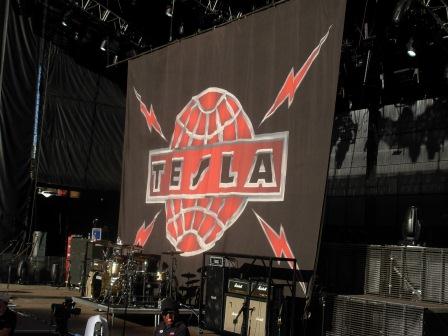
The show kicked off with Tesla, the hard-rocking Sacramento quintet who’d opened for the Scorpions on their 2004 U.S. tour. (I gleaned this factoid from the back of a passing T-shirt.)

Tesla: Let's get uncoiled.

A talented act who’ve knocked around the circuit for nearly 30 years, Tesla’s repertoire boasts a total of two hit records — a power ballad with the astoundingly original title “Love Song,” which climbed into the Billboard Top 10 back in 1989, and a cover of the Five Man Electrical Band’s 1960s classic, “Signs.” The band served up their duo of familiar tunes, surrounded by plenty of perfectly serviceable filler, during an entertaining hour-long set.

Tesla guitarist Frank Hannon

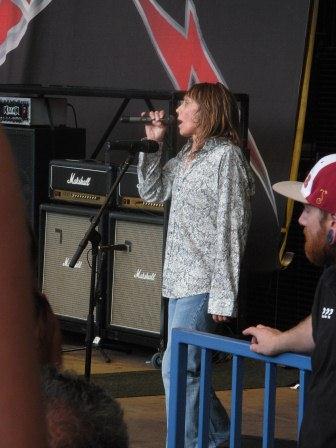
To Tesla’s credit, their performance held my interest throughout, even though I couldn’t have named more than the aforementioned two songs. Lead singer Jeff Keith probably had better voice back in the day than he displayed on this particular night, but his cigarettes-and-whiskey rasp was more than enough to do the job. (I don’t know whether Keith either smokes or drinks, but if he doesn’t, he might as well. He already sounds as though he’s pounding down a fifth of Jack Daniel’s and two packs of Marlboros daily.) I was highly impressed with Tesla’s guitar combination of Frank Hannon — who worked much of his fretboard magic on a double-necked Gibson — and Dave Rude; I’d gladly pay to hear these two gents rip it up anytime.

I’ll award Tesla’s Saturday show two-and-a-half tailfeathers on the Uncle Swan scale of a possible five. They get docked a half for Jeff Keith’s wearing of the ugliest shirt I’ve seen on a rock concert stage in 35 years.

Tesla lead vocalist Jeff Keith: Dude, what's up with that shirt?

When the Scorpions took the stage (after nearly an hour of technical set-up), I could tell immediately that we were in for a fun evening. From the thunderous opening riff of “Sting in the Tail,” the title track of the band’s final all-original studio album, the Deutschland destroyers grabbed the audience by the throat and never let up.

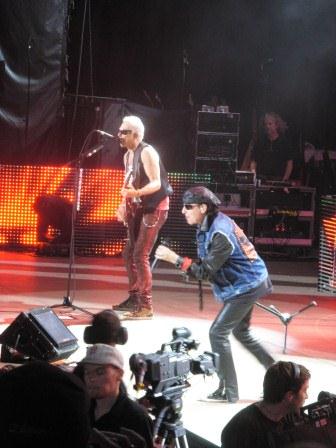
Scorpions Rudolf Schenker and Klaus Meine

Klaus Meine displayed a remarkably powerful voice for a man of his advanced years — I’m sure that a couple of the high notes soared a half-tone or so higher in decades past, but all in all, the diminutive vocalist (who reminded me of the late Ronnie James Dio, another powerhouse instrument packed into an impossibly tiny frame) sounded about as incredible as he did on any of the Scorpions’ albums.

Scorpions lead vocalist Klaus Meine: He looks bigger on screen.

Meine’s vocals surfed above a sonic tsunami generated by one of the tightest — and unquestionably loudest — ensembles I’ve seen in a while. The Scorpions have always boasted a guitar tandem among the best in rock, starting from the band’s origins, when rhythm guitarist Rudolf Schenker played alongside his brother Michael, one of the most capable artists in the history of the instrument, to Uli Jon Roth, who replaced Michael on the Scorpions’ early albums and helped create the band’s signature sound. Rudolf hasn’t lost a step that my ears could detect, and lead guitarist Matthias Jabs — who joined the band in the late ’70s, just before the hits started coming — continues his dominant presence as the Scorpions’ melodic engineer. (It’s no accident that the Scorpions transitioned from metal legends to mainstream rock superstars when Jabs entered the fray.) Among the fastest fretmen in the game, Jabs blasted out one scorching cascade after another before taking the spotlight near the end of the set for a blistering extended solo (dubbed “Six String Sting” on the setlist) that would have made many of his fellow guitarists lay down their weapons in homage.

Scorpions lead guitarist Matthias Jabs: He be jabbin'.

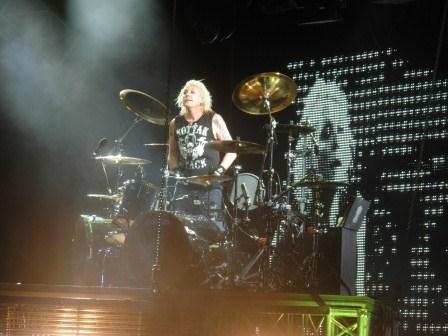
Not to be outdone, drummer James Kottak kept the fire burning all night, combining powerhouse bass drum kicks with flashy stickwork across his kit, perched on a moveable riser that at times towered 20 feet above his colleagues. The lone American in the band, Kottak also added background vocals on several numbers while never missing a beat. His “Kottak Attack” solo featured his own customized music video — starring the drummer himself in a surrealistic parody of several of the Scorpions’ album covers — that brought down the house.

Scorpions drummer James Kottak: Attacking.

The Scorpions’ farewell tour setlist compiles most of their chart-making hits, including “Send Me an Angel,” “Holiday,” “Tease Me Please Me,” my favorite “The Zoo,” and the set-closing “Big City Nights,” while adding a sprinkling of more recent works, such as “Raised on Rock” and “The Best is Yet to Come.” (Interestingly, the show contained not a single number from their first five albums, a.k.a. the pre-Matthias Jabs years.) The band saved three of its biggest crowd-pleasers — “Still Loving You,” “No One Like You,” and of course, “Rock You Like a Hurricane” — for the no-surprises encore.

Scorpions: One final sting before retirement.

Uncle Swan gives the Scorpions a well-earned four tailfeathers out of five, and wishes them well in retirement. Assuming, of course, that they actually retire. Old rock bands never seem to truly go away, even when it’s time… just ask the Rolling Stones.

One final question, though… are there really scorpions in Germany?

You can still rock in America, even if you need a rocking chair

October 6, 2011

Way back in America’s bicentennial year (1976, for those of you who are either too young to recall or lousy at math), Jethro Tull recorded a concept album entitled Too Old to Rock and Roll; Too Young to Die. The record’s theme reinforced the notion that rock music is a young person’s game. (Remember The Who’s “My Generation” — “Hope I die before I get old”?)

Last evening, the Pirate Queen and I — along with several thousand fellow members of our chronological demographic — spent four blissful hours testing that theory, as ’80s rock fossils Night Ranger, Foreigner, and Journey cut loose with the hits at Sleep Train Pavilion in Concord.

The last time I attended a show at the aforementioned venue, it was a cold, stormy night almost exactly 20 years ago, when KJ and I huddled on the lawn in a pouring rain to hear local favorites Huey Lewis and the News. (Rock historians will recall that as the night music impresario Bill Graham died in a helicopter crash, on his way home from that very concert.) I don’t even think Sleep Train, the furniture chain that’s now the name sponsor of what used to be called simply Concord Pavilion, even existed then. I know this for sure — the long uphill trek from the parking lot to the amphitheater seemed less steep and distant when I was in my late 30s.

By the time we found our seats at ten minutes before the scheduled showtime, opening act Night Ranger had already taken the stage. (Apparently they neglected to make allowances for their now slower-moving target audience.) Still, we managed to hear 95% of a sharp-edged set that included the band’s most familiar tunes — “When You Close Your Eyes,” “Sing Me Away,” “Don’t Tell Me You Love Me,” and prom-night legend “Sister Christian.” The band also busted out a credible cover of Damn Yankees’ “Coming of Age,” a nod to the band bassist and singer Jack Blades co-founded while on hiatus from Night Ranger in the early 1990s. The set concluded with “(You Can Still) Rock in America,” complete with flags and red-white-and-blue graphics.

Of the evening’s three acts, Night Ranger most resembled the lineup most famous under the name. All three of the band’s founding members — Blades, drummer/vocalist Kelly Keagy, and lead guitarist Brad Gillis — were on stage, and in top form. Keagy even stepped out from behind his kit for the opening of “Sister Christian” (which he wrote for his younger sister). Blades remains the energetic frontman he’s always been, and Gillis’s powerful riffs found a worthy match in those of relative newcomer Joel Hoekstra.

Night Ranger’s kickoff performance earned an enthusiastic three-and-a-half tailfeathers out of a possible five from your Uncle Swan, even though I’ve never really been a huge fan of the band. The Pirate Queen’s assessment was more subdued — “too rock and roll for me,” she opined as the stage was being reset for Foreigner. (Yes, “too rock and roll” sounds oxymoronic to me, too.)

When Foreigner launched into their set with “Double Vision,” I whispered to the Pirate Queen, “There’s not a single member of the Foreigner I remember on stage.” (“I wish you hadn’t told me that,” came the terse reply.) Indeed, the only original member who’s still with the band — guitarist Mick Jones — has missed much of the group’s current tour due to health problems, leaving what basically amounts to a flashy cover band performing under the Foreigner logo.

Not that Faux-reigner doesn’t put on one heck of a show — they certainly do. Former Hurricane lead singer Kelly Hansen represents a total departure in both vocal quality and stage presence from Foreigner’s original vocalist Lou Gramm (to my sensibilities, Hansen both looks and sounds a lot like Aerosmith’s Steven Tyler), but that’s not necessarily a bad thing. While he trades Gramm’s sweet tenor for a husky heavy-metal growl, Hansen’s a lot more fun to watch than the relatively laid-back Gramm ever was. (He also deftly handled a technical glitch when his wireless microphone went dead during the opening verse of “Head Games.” He probably thought someone was playing… oh, you’ll figure it out.) Hansen’s favorite foil, multi-instrumentalist and Tom Jones doppelganger Thom Gimbel, seemed to have a blast bouncing from rhythm guitar to saxophone (mostly notably for a ripping solo on “Urgent”). Mick Jones’s stand-in on lead guitar, Bruce Watson (formerly of Rod Stewart’s backup band), did a nice job handling the familiar Foreigner repertoire.

And familiar it was. I don’t think there was a single number in the entire Foreigner set that’s not still in heavy rotation on classic-rock radio stations everywhere. From “Cold As Ice” and “Dirty White Boy” to “Feels Like the First Time” and “Hot Blooded,” the Foreigner soundalikes tore through hit after hit in fine style. The only weak points came with the lush ballads “Waiting for a Girl Like You” and “I Want to Know What Love Is,” which simply aren’t well suited to Hansen’s vocal style, or vice versa. As is the band’s custom, they brought on a local choir — in this case, from a Concord high school — to back up the latter song. The kids were… well… cute.

The band saved my all-time favorite Foreigner number for the encore: “Juke Box Hero.” Hansen was back in his element for this crowd-pleasing crusher, which left the audience shouting for more — despite the cheesy computer graphics that looked like they’d been cribbed from an ancient Commodore 64 video game.

Uncle Swan gave Kelly Hansen and Faux-reigner a solid four tailfeathers out of a possible five for their rousingly entertaining set. The Pirate Queen enjoyed them too, despite the disappointing lack of original Foreigner personnel.

After waiting in interminable lines for the restrooms, we were ready for the night’s headliner. Journey grabbed the audience from jump street with the pounding, soaring “Separate Ways.” I was especially curious to hear how the band’s current lead singer, Arnel Pineda, would sound live. Any doubts I might have harbored vanished during the opening number.

Pineda, the Philippine native famously hired after guitarist Neal Schon discovered him singing Journey covers on YouTube — is the real deal. His phrasing isn’t as nuanced as that of Journey’s legendary former vocalist, Steve Perry (probably because English is Arnel’s second language), but Pineda has the same power and pure clarion tone. He’s also a nonstop dynamo on stage — running, dancing, leaping. I couldn’t believe the guy is in his mid-40s. I’m only five years older, and if I cavorted like Arnel for just two songs, I’d need a good night’s sleep and half a bottle of ibuprofen.

Schon blazed through his trademark solos in rare form. I’d swear he’s a tighter player now than when I last saw Journey live 30 years ago. Keyboardist, singer, and occasional guitarist Jonathan Cain and veteran bassist Ross Valory held down their roles as musical backbone and elder statesmen flawlessly. The band’s secret weapon is drummer Deen Castronovo, who’s played with everyone from Ozzy Osbourne to Steve Vai. Castronovo brings a heavy-metal thunder to Journey’s pop-rock sound, lending their concert sound more punch and depth than I remembered.

I liked that Journey surrounded the expected hits — “Lights,” “Wheel in the Sky,” “Faithfully,” “Open Arms” — with some of their lesser-known songs from the band’s classic period, specifically “Stone in Love,” “Only the Young,” and “La Do Da.” I was okay with them salting in a couple of numbers from their new album (“City of Hope,” the first single from Eclipse, is a pretty decent song that compares favorably with the band’s vintage material), because you’ve always gotta be promoting. I longed for a few old favorites — “Anytime,” “Just the Same Way,” “Line of Fire,” and “Who’s Crying Now?” in particular — but by the time Journey plowed into its roof-raising two-song encore (“Any Way You Want It” and the inevitable “Don’t Stop Believin'”), I’d forgotten that I’d missed anything.

Journey scores a whopping four and one-half tailfeathers out of five for kicking it old school, but with Arnel Pineda’s fresh energy. (Uncle Swan docks Neal Schon half a tailfeather for that whole Michaele Salahi business. Y’know, just for the tacky factor.) The Pirate Queen proclaimed the entire show the best concert she’s seen in years, outside of Madonna. It’s tough to argue with Madonna.

Not all of the music from three decades ago holds up today — listen to any Kim Carnes lately? — but the arena rock of Night Ranger, Foreigner, and Journey still brings joy to my middle-aged ears. We had a great time reliving the glory days with this trio of iconic ensembles. It was well worth the interminable hike to and from the Sleep Train Pavilion parking lot, and a night of short sleep.

You can, in fact, still rock in America. Even if your lead singer is from the Philippines.