Archive for the ‘Celebritiana’ category

Comic Art Friday: The chauffeur’s daughters

March 4, 2011

I’ll be honest — sometimes, the only reason for a new Common Elements commission is that the idea made me grin from ear to ear when I thought of it.

Well, not literally from ear to ear in that Julia Roberts / Cameron Diaz sort of way. My mouth is not that enormous. More like from mid-cheek to mid-cheek.

First, the art. (As always, you can click the image for a better view.)

Sabrina the Teenage Witch and Fairchild, pencils and inks by comics artist Mike DeCarlo

Comics veteran Mike DeCarlo, who has drawn and/or inked everything from Spider-Man to The Simpsons during his quarter-century-plus in the industry, teams Sabrina, the Teenage Witch — star of comics, animation, and live-action TV, and responsible for extending the acting career of Melissa Joan Hart well beyond her teens (and, some might opine, beyond the limits of her talent) — with Caitlin Fairchild, leader of the youthful superhero team Gen13, who’s often known simply by her surname.

Next, the concept.

As an aficionado of old-school Hollywood, one of my favorite classic films is Sabrina. (That’s Billy Wilder’s 1954 original, starring Humphrey Bogart, William Holden, and a luminous Audrey Hepburn in the title role, not the tepid 1995 remake with Harrison Ford, Greg Kinnear, and Julia Ormond, directed by Sydney Pollack.)

Bogie and Holden portray two wealthy brothers — David, a good-for-nothing playboy (Holden), and Linus, who’s older and more serious (Bogart) — competing for the affections of a young woman (Hepburn) who happens to be the daughter of their family’s chauffeur. It’s sort of a reverse spin on Cyrano de Bergerac, with Linus working to sabotage the budding romance between his brother and the chauffeur’s daughter in order to score a huge business deal with the family of another woman, to whom David is engaged. And of course, Linus ends up falling in love with the girl himself. (Who wouldn’t? It’s Audrey Hepburn, for crying out loud.)

Okay, you’re thinking — that explains Sabrina. But what’s the Fairchild connection? If you’ve seen the movie, you know: the character Sabrina’s last name is Fairchild.

That makes me smile. Doesn’t it you?

And that’s your Comic Art Friday.

No Justice for the Maestro

February 22, 2011

I could hardly be more shocked and stunned than I was earlier today, when I read the news of the sudden death of Dwayne McDuffie.

Dwayne McDuffie leads an animation panel, WonderCon 2008

If the name is unfamiliar to you, then I’ll assume that you’re not a fan of either comic books or animation, or if you are, you don’t pay much attention to the names in the credits of either. McDuffie was a prolific writer and editor of comics who became an equally prolific writer, story editor, and producer of animation, primarily for television.

In the former realm, McDuffie created one of the most unique series in the history of comics: Damage Control, which spotlighted the exploits of a company that cleaned up cities after superhero fights. He also co-founded Milestone Media, an entire comics line that focused on bringing greater diversity to the medium, both on the page and behind the scenes. From Milestone’s publications came Static, the young electricity-wielding hero who later went on to star in the long-running and popular animated TV series, Static Shock.

McDuffie’s contributions to animation didn’t end with Static Shock. He served as story editor and producer on the Justice League franchise, as well as on the various iterations of Ben 10. He recently wrote the script for Warner/DC’s latest direct-to-DVD project, All-Star Superman, which debuted in stores — ironically enough — today.

As successful as he became in animation, McDuffie never completely abandoned printed comics. A few years ago, he wrote an outstanding miniseries for Marvel entitled Beyond!, and a well-regarded run on Fantastic Four. More recently, he breathed fresh life into DC’s tentpole series, Justice League of America.

Unlike many creators, McDuffie maintained a close connection to the readers and viewers who consumed his product. His personal website hosted a thriving online discussion forum, in which McDuffie himself (nicknamed by his fans “The Maestro”) actively participated. Never shy of expressing his opinions — and he had strong opinions about everything — McDuffie in correspondence was much like the characters whose adventures he wrote: witty, thoughtful, and more than a little tough. He gave no quarter, but he had a deft way of disagreeing vehemently with opponents without resorting to ad hominem attacks.

I had the privilege of meeting McDuffie briefly at WonderCon in 2008, following a panel featuring himself and several other top animation writers. (I took the above photo during that panel.) Although I didn’t muster the gumption to mention it to him in person, it was one of my career goals as a voice actor to snag a role in one of the series McDuffie wrote. As recently as a week ago, I’ve participated in workshops where McDuffie scripts served as the fodder for honing my acting chops. I deeply regret that I will never have the opportunity to work with him professionally.

McDuffie spoke and wrote much about the uphill struggle of being an African-American creator in a mainstream comics industry often frustratingly closed to diverse talents and storylines. His founding of Milestone Media represented his best effort at giving other people of color the opportunities that he, like few other creators of his background, had been afforded, and expanding the palette of characters about whom great comics tales could be spun. And yet, McDuffie would have been the first to correct anyone who referred to him as a “great black comics writer” — he was just a darned great writer, period.

A darned great writer, gone far too soon.

Dwayne McDuffie leaves behind his wife, his mother, a monumental legacy of work, and a numberless legion of colleagues and fans who appreciated his character as much as his creative genius. He was a singular talent in two discrete media, and successful in both.

He was just 49 years old — almost exactly two months younger than I. His birthday was yesterday.

Rest in peace, Maestro.

RIP, Donnie the K

January 18, 2011

This will only mean something to you if you were listening to pop-rock music in the 1960s and ’70s, or watched TV programs of similar vintage revolving around said music.

Don Kirshner is gone.

Kirshner — or Donnie the K, as I like to call him — started out as a Tin Pan Alley music publisher, whose stable included numerous legendary songwriting duos, from Goffin and King to Sedaka and Greenfield. But he became a household name in the ’60s as the impresario behind prefabricated-for-television pop groups such as The Monkees and The Archies.

In the ’70s, Kirshner’s eponymous record label signed the progressive-rock band Kansas, unleashing a string of hits including “Carry On Wayward Son” and “Dust in the Wind.”

That same decade, Kirshner began producing and hosting the late-night TV music series, Don Kirshner’s Rock Concert. Donnie the K’s eerily awkward on-camera presence made him the butt of numerous jokes — including an infamous Saturday Night Live sketch starring Paul Shaffer, who later starred in a sitcom produced by Kirshner called A Year at the Top — and proved the venerable maxim that record producers should be neither seen nor heard. Still, the show ran for a decade, and featured pretty much every big-name act in pop music at one time or another.

As a kid who loved the songs of The Monkees and The Archies (“Sugar Sugar” was one of the first mainstream pop records I ever owned), and later as a teenager who was a major-league Kansas fanatic (I celebrated my 19th birthday at a Kansas concert at San Francisco’s Cow Palace), Don Kirshner contributed mightily to the soundtrack of my youth — even though he never sang or played a note. (For which, if his musical talents matched his abilities as a master of ceremonies, the universe should be eternally grateful.)

They also entertain who only sit and write checks.

And don’t call me Shirley

November 29, 2010

When I heard last evening that Leslie Nielsen had died at the age of 84, I immediately thought — as I presume most people did — of the comedic roles he played during the last three decades of his acting career, beginning with Airplane! and continuing most notably with the TV series Police Squad! and the Naked Gun movies it spawned.

Often lost in that thought, however, is that Nielsen’s first comedy successes resulted from his not previously having been viewed as a comic actor. It’s a marvelous study in contrast — which is, after all, the very essence of comedy.

What made Airplane! funny was the absurdity of seeing actors whose screen images were stereotypically strait-laced — Nielsen, Lloyd Bridges, Robert Stack, Peter Graves, George Kennedy — doing and saying outlandish things. Think about the classic scene where Graves’s airline pilot makes homosexually suggestive remarks to a young boy: “Have you ever been in the cockpit of an airplane before? Have you ever seen a grown man naked? Have you ever been in a Turkish prison? Do you like movies about gladiators?” It’s shockingly funny, because at that point we mostly knew Peter Graves as the humorless secret agent Jim Phelps from Mission: Impossible. Did Graves ever utter a funny line in the entire run of that series? Did he ever even crack a smile? I don’t think so. Thus, when he makes these outrageous comments in Airplane!, it’s hilarious because, well, we didn’t know Peter Graves had that in him.

Now imagine, say, Will Ferrell in that same Peter Graves role. (Yes, I know Will Ferrell was in junior high school when Airplane! was made. Just go with me here.) It wouldn’t be as funny, because we expect outrageous comments from the mouth of Will Ferrell. The jokes would be the same, and Ferrell’s take on them might be more inherently humorous, but the impact of contrast would be lacking.

When Airplane! appeared, most people knew Leslie Nielsen — if indeed they knew him at all — as the sober-sided space captain in Forbidden Planet, or the equally somber ocean liner captain in The Poseidon Adventure, or the daring but dull Revolutionary War hero Francis Marion in the Disney miniseries The Swamp Fox. He was not an actor one expected to hear tossing off deadpan one-liners like the one in the headline of this post. Nielsen’s stiff-upper-lipped persona (as well as a previously untapped gift of timing) made him the perfect contrast for humor — a contrast he milked to great financial reward for the next 30 years.

Unfortunately — at least in my view — Nielsen didn’t know when to quit. In the aftermath of his first Naked Gun bonanza, he cranked out more than a dozen execrable films showcasing his newfound penchant for deadpan comedy, each of which proved more rancid than its predecessor. It’s one thing to find a fresh horse to ride; it’s entirely another to keep beating that horse long after it’s expired. Had Nielsen contented himself with the two movies that made his reputation, plus the TV series that inspired the second of those two movies, he’d be remembered as an unqualified comic genius. As it is, our fond memories of those noteworthy roles are muted by the likes of Repossessed, 2001: A Space Travesty, and Scary Movies 3 and 4.

If you like science fiction, and have never seen Forbidden Planet, you owe it to yourself to check it out on cable (it turns up periodically on the classic movie channels) or DVD. It’s one of the very few films from the bug-eyed monster era of sci-fi flicks that still holds up well today. (It’s more or less a retelling of Shakespeare’s The Tempest, in space opera dress.) Nielsen is effective in stolid action hero mode, Walter Pidgeon gnaws scenery as a brilliant but mad scientist, and Anne Francis — later the star of TV’s first female-lead detective series, Honey West — fills out a miniskirted space dress with aplomb.

Thanks for the good times, Mr. Nielsen. And remember… when you’re offered a choice between steak and fish for dinner, always choose the lasagna.

Descent into the Pitt

November 23, 2010

Sad news for genre film fans today: Ingrid Pitt, one of the leading ladies of horror movies during the 1970s, has died — this time, for real — at the age of 73.

Ingrid Pitt, horror superstar

Pitt became a cult star by way of her appearances in Hammer Films’ The Vampire Lovers and Countess Dracula, The House That Dripped Blood from Amicus Productions (generally thought of as “Hammer Lite”), and the seminal psychological thriller, The Wicker Man (the original 1973 classic, not the insipid Nicolas Cage remake).

What many aficionados didn’t realize at the time was that the Polish-born Pitt — née Ingoushka Petrov — was a World War II concentration camp survivor, the daughter of a Jewish mother and a German father. I’m thinking that after enduring the atrocities of Nazi barbarism, facing vampires and other fictional monsters must have been a piece of strudel.

Despite her horror pedigree, Pitt assayed numerous film and TV roles outside the genre, often to positive reviews. She frequently played villainous women who got their fatal comeuppances in the final act. Not content with her onscreen work, Pitt also became a successful writer, penning a dozen or so books, plus reams of magazine and online articles, columns, and stories.

I was a major Hammer horror geek back in my misspent youth. I retain many fond memories of Ingrid Pitt… although in my heart of hearts, I was always a Barbara Shelley man.

Rest in peace, Countess Dracula.

I have a power ring; I’m just wearing it as a belt

November 17, 2010

Once again, I get robbed.

This year, People Magazine passes me over for its annual Sexiest Man Alive honor in favor of Ryan Reynolds, whose chief claims to fame include (a) portraying comic book superhero Green Lantern (the Hal Jordan Green Lantern, for those of you sufficiently comics-savvy to know that the title of Green Lantern applies to literally dozens of characters in the DC Comics universe) in the upcoming motion picture; and (b) being Mr. Scarlett Johansson.

Okay, so I’m not an alien-tech-equipped superhero, and frankly, I don’t think Ms. Johansson is my type. (Nor, doubtless, I hers.) But just once, you’d think People Magazine could show a little love to those millions of portly middle-aged gentlemen whose sexiness derives, not from matinee-idol looks which, let’s be honest, will need to be propped up with surgery and Botox in a decade or so, but from that most potent of sexual engines: the brain.

Experience and cunning trump chiseled cheekbones and washboard abdominals any time, ladies. Just sayin’.

Can I get a witness?

An SI cover I’ve waited 35 years to see

November 2, 2010

At long last, I can scratch one huge item off my bucket list…

Sports Illustrated: SF Giants Win the World Series

The San Francisco Giants are the champions of the world.

To Big Time Timmy Jim, who won four games in the postseason and flat-out locked the Texas Rangers down over eight innings to notch Game 5;

To Edgar Renteria, the shortstop we all thought was washed up, but who discovered the Fountain of Youth in the playoffs and crushed the home run that won the Series;

To the best pitching staff in baseball — starters The Freak, The Shotgun, JSanch, MadBum, and Z-Man, plus relievers BWeez, J-Lo, The Surge, Crazy J, Jairo, Willie Mo, Rockin’ Ramon, Runz, and Ray;

To the undisputed Rookie of the Year, Buster Posey;

To Huff Daddy, The Boss, and Pat the Bat, guys the Giants picked up off the scrap heap and the waiver wire and revitalized their careers;

To Andres the Giant, Fab Freddy, and Magic Juan, coming through in the clutch with timely offense and sparkling defense;

To Panda, Little Mike, Ishi, Eli, Nate the Great, and A-Row, doing their thing and contributing;

To The Big Giant Head and his coaching staff — Rags, Wotus, Bam-Bam, Bobby, Flan, and Gardy — who pushed the team to excel every day;

To the Giants’ ownership group and front office staff, who signed the contracts and wrote the checks;

To the guys behind the scenes — clubhouse men Murph and Harvey, the training and conditioning team, the non-roster coaches and special assistants like Shawon, J.T., and Will the Thrill;

To the Giants Hall of Famers who never got there — The Say Hey Kid, Stretch, Cha-Cha, and The Spitter — but who keep reminding us what it means to be a Giant;

To the world’s greatest broadcasting corps — The Big Kahuna, Kuip, Kruk, Flem, Papa, Erwin, and Tito — who called every pitch and every swing;

To every last Giants fan everywhere, who’s stuck it out through any part of the past five decades of frustration…

Thank you. And good night.

Orange October: Electric Boogaloo!

October 23, 2010

A wise man once said that one picture is worth a thousand words.

2010 National League Champions: Your San Francisco Giants!

Yeah… that says it all.

Congratulations to my Giants! Special kudos to:

  • Cody “The Boss” Ross, who was named Most Valuable Player of the National League Championship Series;
  • “Magic” Juan Uribe, who hit the big home run in the eighth inning, giving the Giants a lead they would never relinquish;
  • Brian “The Beard” Wilson, who slammed the door on the Phillies by getting the final five outs, including a Statue of Liberty strikeout of Ryan Howard to end the game and the series;
  • Bruce “The Big Giant Head” Bochy, who pulled all of the right strings;
  • and Brian “Sabes” Sabean, who picked up guys like Ross, Pat “The Bat” Burrell, and clutch reliever Javier “J-Lo” Lopez when the Giants needed extra help down the stretch.

On to the World Series!

Comic Art Friday: My favorite changeling

September 24, 2010

It’s no secret that I have a thing for Isis.

Isis, pencils and inks by comics artist Gene Gonzales

For those of you who missed the 1970s, The Secrets of Isis was a live-action TV program that ran on CBS Saturday mornings from 1975 to 1977. Isis ran as half of a package with Shazam!, which featured the adventures of comics’ original Captain Marvel. (I say “original” because there have been several comic book heroes and heroines named Captain Marvel, spanning 70 years of comics history. But that’s a tale for another time.)

The basic premise of Isis was reiterated in the melodramatic narration that began every episode:

“O my Queen,” said the Royal Sorcerer to Hatshepsut, “with this amulet, you and your descendants are endowed by the goddess Isis with the powers of the animals and the elements. You will soar as the falcon soars… run with the speed of gazelles… and command the elements of sky and earth.”

Three thousand years later, a young science teacher dug up this lost treasure, and found she was heir to… the secrets of Isis!

And so, unknown to even her closest friends, Rick Mason and Cindy Lee, she became a dual person: Andrea Thomas, teacher… and Isis — dedicated foe of evil, defender of the weak, champion of truth and justice!

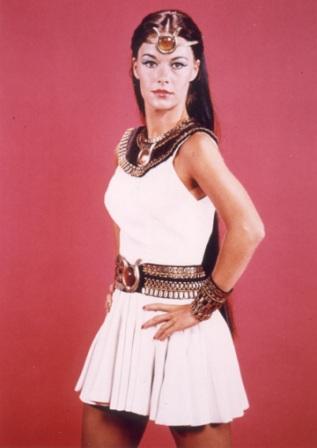
As highfalutin as all that sounds, the real attraction of The Secrets of Isis was its star, JoAnna Cameron, a charming actress who cut quite a fetching figure wearing Isis’s quasi-Egyptian miniskirt.

JoAnna Cameron as the mighty Isis

Cameron, who appeared in tons of commercials and guest-starred on several TV series and in telefilms throughout the ’70s, never had another role as prominent as Isis. By the end of the decade, she had left show business and moved on to other careers.

I’ve contributed in my own small way to keeping the legacy of Isis alive by commissioning several artworks featuring my favorite Saturday morning heroine. The drawing shown above, created by the talented and affable Gene Gonzales, is the most recent addition to my Isis gallery.

Ironically, Isis came into existence only because Filmation, the studio that produced both Shazam! and The Secrets of Isis, refused to pay DC Comics for the licensing rights to Mary Marvel, Captain Marvel’s sister and the character originally planned for the distaff half of the Shazam! TV hour.

Mary Marvel, pencils and inks by comics artist Gene Gonzales

Instead of shelling out the dough, Filmation created a new character based on the same general outline — a young woman who speaks a magical phrase (instead of “Shazam!” Andrea Thomas intoned, “O mighty Isis!”) and transforms into a superhero with powers derived from ancient mythology. DC ended up using Isis themselves, as the star of a short-lived comic series based on the TV show.

Isis, by the way, was the first female superhero to star in her own live-action program on American network television. All of the powered heroines who followed her to the small screen — from Wonder Woman and The Bionic Woman to Dark Angel and Witchblade — owe the Mighty Miniskirted One a debt of gratitude for kicking down the door.

And that’s your Comic Art Friday.
Can I get some “Free Bird” up in here?

September 20, 2010

Leonard Skinner, the high school gym teacher from whom the seminal Southern rock band Lynyrd Skynyrd borrowed its name, has passed away at the age of 77.

Skinner spawned the group’s peculiarly (mis)spelled moniker during a conflict with several long-haired male students at Robert E. Lee High, the Jacksonville, Florida school where he taught in the early 1960s. The students, irked at Skinner’s mockery of their flowing manly tresses, displayed their outrage by forming a band and naming it after Skinner. (Which leads one to wonder why more rock bands aren’t named after high school gym teachers. Not to mention mothers, neighborhood bullies, and ex-wives.)

What strikes me as ironic about Skinner’s passing is the fact that he survived almost all of the key members of the band that parodied his name.

Lead vocalist Ronnie Van Zant, guitarist Steve Gaines, and backup singer Cassie Gaines were killed in an infamous 1977 plane crash.

Guitarist Allen Collins was seriously injured in an automobile accident in 1986, and died of complications from his injuries in 1990.

Bassist Leon Wilkeson died of chronic liver disease in 2001, at the age of 49.

Keyboard player Billy Powell died of a heart attack in 2009.

Guitarist and vocalist Hughie Thomasson, who joined a latter-day incarnation of Lynyrd Skynyrd after a long career as the leader of another influential Southern rock band, the Outlaws, died of an apparent heart attack in 2007.

I guess Mr. Skinner got the last laugh.

There is, apparently, no truth to the rumor that the current edition of Skynyrd, which retains guitarist Gary Rossington as the “sole survivor” from the original membership, is planning to release an album entitled Lynyrd Skynyrd Is Dead (And Most of Us Have Been For Some Time).