Archive for the ‘Cinemania’ category

Comic Art Friday: Top Ten from the Temple of Diana

June 23, 2017

Yes, I know this Wonder Woman tribute post is a few weeks overdue. I had intended to do something to coincide with the premiere of the film (which I loved, incidentally), but just didn’t get to it until now.

Wonder Woman has been one of my favorite comic book heroes for nearly half a century. She has also been a cornerstone of my comic art gallery since I began collecting in earnest 13 years ago. I own more artworks featuring Diana of Themyscira than of any other character — more than 60 pieces, at current count, which is twice as many as the second leading character in my collection (Supergirl). Aside from my Common Elements theme, Wonder Woman art represents the largest single segment of my collecting hobby.

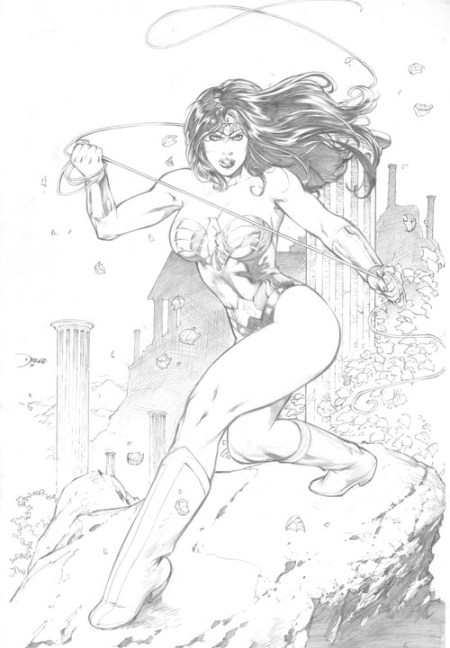
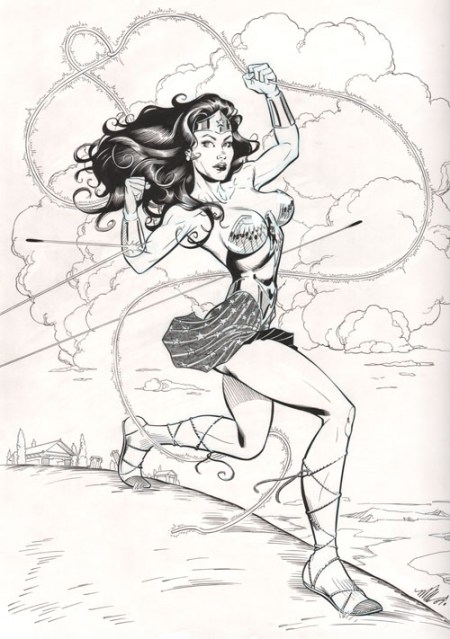
Choosing among my Dianas proved no easy task, but here are my ten favorite (at least today) Wonder Woman images, listed alphabetically by penciler.

Diego Bernard

WonderWoman_Bernard

As classic as it gets — powerful, graceful, beautiful. When I close my eyes and think “Wonder Woman,” she looks pretty much like this.

Michael Dooney (Bob Almond, inks)

WonderWoman_DooneyAlmond

Michael Dooney is a pinup artist par excellence. His stylish take on Diana — with a couple of costume suggestions from your Uncle Swan — demonstrates that.

Adam Hughes

WonderWoman_Hughes

If I can only own one Adam Hughes original — and to date, that’s been the way that circumstances and budget have worked out — it might as well be his deft take on Diana. Hughes is most widely renowned for his rendering of the feminine form, but it’s the eyes that make this one.

James E. Lyle (Buzz Setzer, colors)

WonderWoman_LyleSetzer

I love seeing a unique take on a familiar character. James E. Lyle (“Doodle” to his friends) creates a winner here.

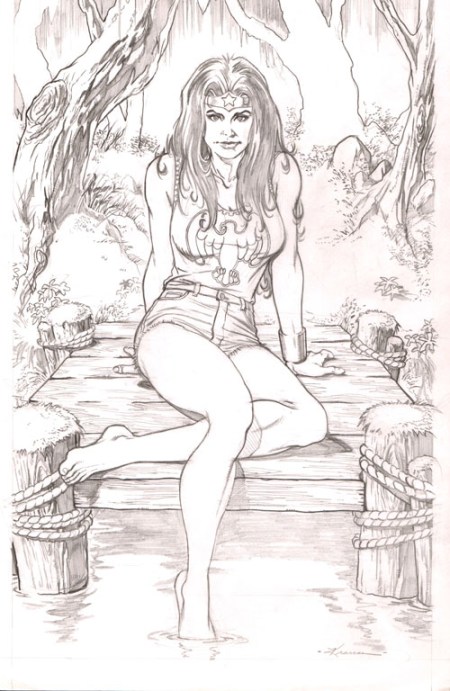
Peter Krause

WonderWoman_Krause

I refer to this picture as “Diana’s Day Off.” I love the idea of her just relaxing by a lake, dipping her toes into the cool water, and letting someone else battle evil for a day.

Geof Isherwood

WonderWoman_Isherwood

Geof Isherwood is one of the most underrated artists in the business, period. His approach to Diana here is simultaneously classic, ultra-modern, and just a tiny bit off-center… in a good way.

Alan Patrick (Bob Almond, inks)

WonderWoman_PatrickAlmond

A perfect setting for our Amazon warrior — a battle that might be taking place in ancient Greece a couple of millennia ago. Alan Patrick’s composition is outright stunning.

Jason Michael Paz (Geof Isherwood, inks)

WonderWoman_PazIsherwood

I often post this piece online to honor one of our traditional servicepersons’ holidays, Memorial Day or Veterans Day. Wonder Woman leads the charge into battle as only she can.

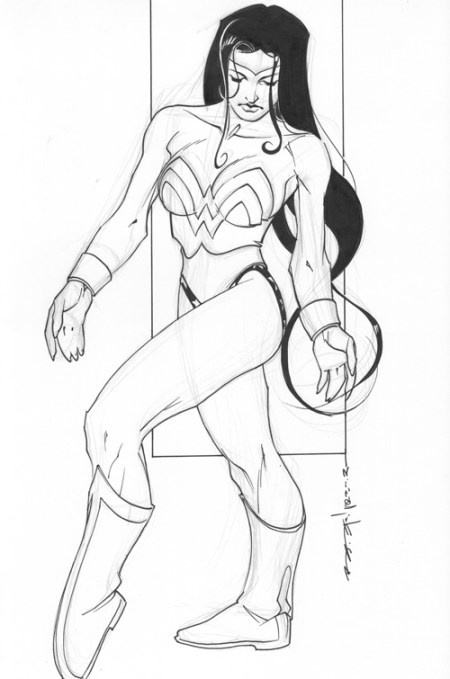
Brian Stelfreeze

WonderWoman_Stelfreeze

Few artists can convey as much with just a few perfectly placed lines as can Brian Stelfreeze. And his acting — the expressions on his faces, the body language of his figures — never fails to be anything but powerful.

Al Rio (Geof Isherwood, inks)

WonderWoman_RioIsherwood

The first Wonder Woman piece I ever personally commissioned. The particulars of Diana’s costume were my suggestion. Everything else you see here sprang from the imagination of the now departed and deeply missed Al Rio. What a phenomenal talent the comic art world lost when he left us.

Let’s add one honorable mention. I don’t fully embrace the notion of a Wonder Woman / Superman romance for several reasons, but this piece is just so darned cute, it almost makes me a believer. Sadly, it’s the only original artwork I own by the late Mike Wieringo, whose work I absolutely love.

Mike Wieringo (Richard Case, inks)

WonderWoman_Superman_WieringoCase

If you’re interested in checking out my Temple of Diana in its entirety, pop on over to my gallery at Comic Art Fans. There, you can see every Wonder Woman artwork I own, along with a bunch of other amazing art that happens not to feature the Themysciran Princess.

And that’s your Wonder Woman Art Friday.


Comic Art Friday: Quoth the Raven: “Nevermore!”

May 19, 2017

As much as I enjoy concocting convoluted connections between otherwise unrelated characters for my Common Elements commission series, quite often the simpler and more obvious matchups produce equally fine results.

Case in point: this pairing of long-time X-Men nemesis Mystique (real name: Raven Darkhölme) and Raven from the Teen Titans, drawn by veteran comic artist Ron Randall.

Mystique_Raven_Randall

The later films in Fox’s X-Men series cast Mystique as a member of the heroic superteam, which in my opinion doesn’t serve the character well. I’m perfectly cool with versions of comics characters in live-action media diverging somewhat from their comic-book counterparts — I think Marvel Studios has, for the most part, done a decent job of tweaking characters to fit the needs of its big-budget blockbuster movies — but I just don’t think Mystique works as a heroine. She’s much more compelling as a villain.

(And yes, I understand why Fox took the turn they did. When Mystique was recast from C-lister Rebecca Romijn to Oscar-winning superstar Jennifer Lawrence, Fox made Mystique a “good guy” because J-Law’s Millennial fans won’t pay to see her playing a “bad guy.” Such are the realities of Hollywood.)

In addition to switching sides mid-series, the movie Mystique also lost one of the key distinctions that made her backstory unique. In the comics, the ancient and ageless Mystique is the birth mother of the X-Man Nightcrawler, and the foster mother of another X-Man, Rogue. Because Mystique begins the cinematic narrative as a young girl, she doesn’t have these familial connections. Again, I understand why the changes happened, but I think the comics character’s history is much more interesting.

Speaking of interesting histories, Raven comes equipped with one — she’s the spawn of the dimension-hopping demon Trigon and a human woman named Angela Roth, who later calls herself Arella. As a teenager, Raven joins the Teen Titans to combat her father and ultimately defeat him. Her hybrid parentage endows Raven with a variety of superhuman powers, ranging from empathic sensitivity to the ability to cast a “soul-self” — a sort of astral projection — that usually takes the form of a (wait for it…) raven.

Today’s artist, Ron Randall, has been drawing comics for the major publishers for more than 35 years. Beginning his career with a healthy run on DC’s classic war comic Sgt. Rock in the early 1980s, Ron has illustrated significant stints on such series as The Warlord, Arak, Son of Thunder, Dragonlance, and both Justice League International and Justice League Europe for DC, Star Trek Unlimited and Venom for Marvel, and his own creation Trekker (no relation). Most recently, Ron’s work appears alongside that of other outstanding artists — among them Steve Rude and Evan “Doc” Shaner — in DC’s entertaining Future Quest, which weaves together the adventures of several Hanna-Barbera animated heroes from the 1960s, including Jonny Quest, Space Ghost, and the Herculoids.

Back to Ravens for a moment. Edgar Allan Poe’s The Raven has been one of my favorite poems as long as I can remember. It’s a flawless blend of atmosphere, wordplay, and desperation. These days, I frequently read it aloud as a warmup when I have character voice work — particularly narration — on my work agenda for the day. Every time I perform it, I find new twists and nuances in the words and rhythms. Well done, Mr. Poe.

And that’s your Comic Art Friday.

Comic Art Friday: Princess forever

March 24, 2017

It’s rare that a commission that turned out so lovely would stir emotions so bittersweet.

Princess Projectra, Princess Leia, and Princess (Jun the Swan), pencils and inks by Diego Bernard

I’d had this concept on my to-do list for quite a long time. Bringing together three sci-fi/fantasy princesses — Princess Projectra of the Legion of Super-Heroes, the Star Wars saga’s Princess Leia Organa, and Princess of Battle of the Planets‘ G-Force (or, if you prefer, Jun the Swan from Gatchaman, although that alternate identity doesn’t quite fit our theme) — makes for a perfect Common Elements scenario. And when the opportunity happened along to commission Diego Bernard, whose deftly detailed work has graced the pages of such series as X-O Manowar and Witchblade, I figured it was a match made in comic art heaven.

With great excitement, I commissioned this piece on December 15, 2016.

Twelve days later, Carrie Fisher died.

There have been a couple of instances where the death of an artist impacted one of my art projects. I’ve related the story of how Dave Simons had begun work on a Common Elements piece teaming Batgirl and Ghost Rider shortly before his untimely demise. (Bob Budiansky, Dave’s artistic collaborator on the Ghost Rider series, later accepted the commission that Dave tragically did not live to complete.) And I’ve mentioned that Tony DeZuniga and I had discussed a Jonah Hex-Scarlet Witch Common Elements just prior to Tony’s passing. (Pete Woods eventually completed that assignment.) But never before had the living inspiration for one of my projects died while an artist had the job literally on the drawing board.

I knew that some who saw this piece when completed would think, “That’s a nice tribute to Carrie Fisher.” It felt important to note that I didn’t intend the project that way. I would much rather for Ms. Fisher’s family, friends, and innumerable fans that she were still here to breathe life into Princess Leia — now General Organa in the current Star Wars sequels — for many years to come.

On film, and on this page, she’ll remain our Princess forever.

And that’s your Comic Art Friday.

Comic Art Friday: The girls most unlikely

March 3, 2017

I occasionally sit in awe of how far the superhero genre has risen in popular culture in the past few years.

Back when I was a wee lad, we felt incredibly lucky to see our favorite comics heroes live out their adventures on television in dreadfully animated, clunkily voice-acted cartoons, like the tragic Grantray-Lawrence Marvel Super Heroes series or the only mildly dorky Super Friends. On the rare occasion we got to see these characters in live-action, the gamut ran from the campy Batman and Wonder Woman to the embarrassing Marvel efforts of the 1970s (the Nicholas Hammond Spider-Man series, the ghastly Captain America TV movies, the WTF-inducing Doctor Strange pilot). Even the more credible attempts bore only passing resemblance to the stalwarts we knew and loved (I’m looking at you, The Incredible Hulk). But we were glad to have them.

Fast forward to the present day, and we’re living in Superhero Nirvana. Not only do we see the major players from both Marvel and DC comics explode from the silver screen on a near-constant basis (the latest Wolverine feature film, Logan, is premiering at your local cinema even as I type), but our television viewing hours are chock-full of real live superheroes 24/7, from the DC-based series filling The CW’s nightly schedule (Supergirl, Arrow, The Flash, Legends of Tomorrow) to Marvel’s Agents of SHIELD and the outstanding slate of MCU series on Netflix (Daredevil, Jessica Jones, Luke Cage, and the forthcoming Iron Fist, The Defenders, and Punisher). Even C-list characters like The Inhumans (cast list announced today!) and Cloak and Dagger have live-action series in the works.

It’s a grand time to be a superhero fan.

Mantis and Gypsy, pencils by Robb Phipps

If you’d asked me before the present boom times to name the least likely former members of both the Avengers and the Justice League ever to see the light of live-action film or television, the two heroines depicted in today’s featured artwork (created by penciler Robb Phipps a full decade ago, in 2007) would have landed near the top of both lists.

Mantis — a half-Vietnamese, half-German martial artist and former prostitute raised by the alien Kree to be the Celestial Madonna (hey, I don’t make this stuff up, I only report it) — was a peculiar addition to the Avengers lineup even in the freewheeling, anything-goes Bronze Age of the ’70s. Gypsy — a one-time teenage runaway with illusion-creating powers — typified the mid-’80s Justice League era that many fans consider the most forgettable period in the team’s storied history.

And yet, here they are, living and breathing before your very eyes. Gypsy is now a recurring guest star on The Flash, played by Sleepy Hollow veteran Jessica Camacho. Mantis (played by the charmingly named Pom Klementieff) is the newest member of the Guardians of the Galaxy, whose second blockbuster motion picture arrives in May at a theater near you.

While it’s true that the live-action versions of both characters differ substantially from their comic book counterparts — the TV Gypsy, in particular, shares little in common with her printed predecessor besides the code name — it’s also true that I never thought I’d see the day when either of these remarkable superwomen would be portrayed in any form by a flesh-and-blood human being in a big-budget Hollywood production.

As I said before… it’s a grand time to be a superhero fan.

And that’s your Comic Art Friday.

Comic Art Friday: Three faces of Taarna

February 24, 2017

If you’ve ever browsed my online gallery showcasing my comic art collection — and if you haven’t, what are you waiting for? go have a look around, already — you’ve probably noticed that my collection falls into three general categories:

  • My theme galleries, Common Elements (matchups of unrelated characters who share some feature in common) and Bombshells! (pinups featuring Golden Age heroines in the style of bomber nose art), which we’ve considered frequently in this space.
  • Character galleries, which contain multiple images of some of my favorite comic book heroes and heroines (mostly the latter), drawn by a wide spectrum of artists.
  • Miscellaneous art that doesn’t fit into either of the preceding buckets.

The character galleries sometimes baffle visitors. “Why would you want a lot of pictures of the same character?” they ask. “Isn’t that kind of boring?”

Not to me, obviously. Let’s see whether I can illustrate the appeal.

Several of my character galleries focus on familiar characters with lengthy histories in the comics. To cite two examples, I hold extensive collections of Wonder Woman and Supergirl drawings. Both of these heroines have been around for a long time — Wonder Woman celebrated her 75th anniversary last year, while Supergirl debuted in 1959, almost 60 years ago. Both have changed costume and/or hairstyle numerous times over the decades. In my collection, you’ll find images reflecting many of the looks each heroine has employed, so there’s a good deal of stylistic variety there. Plus, because plenty of other collectors also focus on either Wonder Woman or Supergirl or both, you can find a lot of artwork to compare and contrast.

But I also maintain character galleries that are more or less unique. For instance, I have a collection of art featuring Isis, the heroine of the 1970s Saturday morning TV series The Secret of Isis, who also appeared in DC Comics during that period. I know of only one other major collector — “Little John” Nacinovich — who owns a significant number of Isis pieces. And I believe I’m the only comic art collector with an ongoing commission theme spotlighting Taarna, star of the 1981 animated film Heavy Metal.

Taarna’s a good character to consider for our present discussion. She made only one appearance in popular media — the “Taarna” segment that takes up the final third of Heavy Metal‘s running time. (Although the segment is based on the Arzach stories by legendary French cartoonist Jean “Moebius” Giraud, Taarna herself was designed specifically for the film by comics artist Howard Chaykin.) She’s depicted in only a single costume (unless you consider nudity a costume), and that costume is composed of only a few simple elements. So there’s not much variety to work with in terms of her visual portrayal.

And yet…

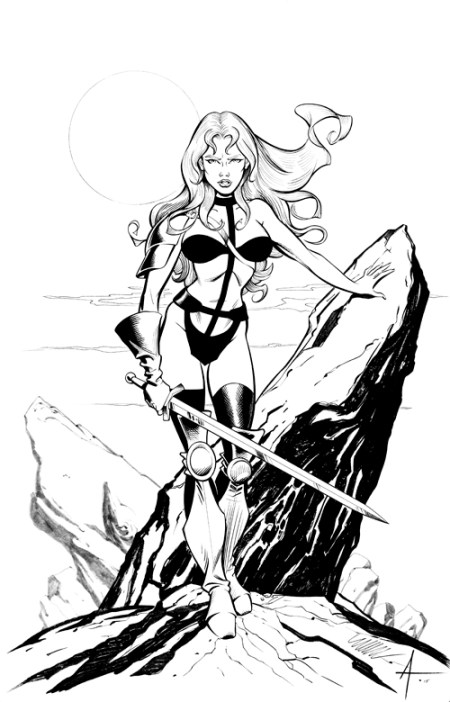
Below are three artworks I commissioned for my Taarna gallery. The first features pencils by Michael Dooney, whose best-known published work appeared in Teenage Mutant Ninja Turtles, with inks by Bob Almond, who by now needs no introduction to Comic Art Friday readers.

Taarna, pencils by Michael Dooney, inks by Bob Almond

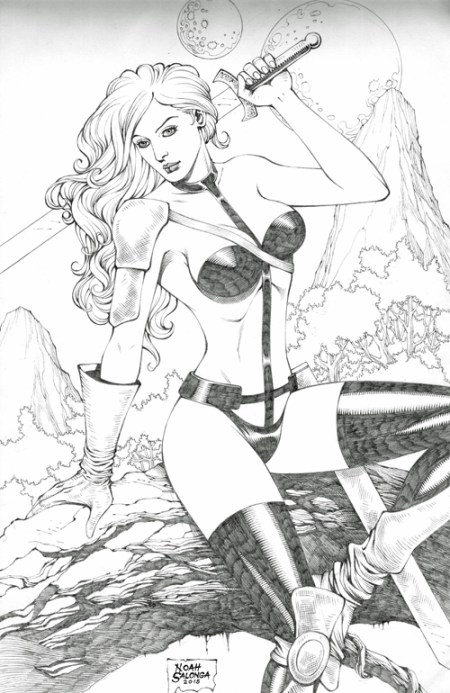
Next up: Noah Salonga, who’s worked on such titles as Red Sonja and Xena: Warrior Princess for Dynamite, and Grimm Fairy Tales for Zenoscope.

Taarna, pencils by Noah Salonga

And last but by no means least, Tone Rodriguez, who’s drawn everything from hardcore action books like The Snake Plissken Chronicles and Violent Messiahs, to the broad comedy of Futurama and The Simpsons.

Taarna, pencils and inks by Tone Rodriguez

All three artists capture the visual essentials of the character. Each one nails Taarna’s signature costume, her sword, and her flowing white hair. There’s no doubt that they’ve all clearly drawn the same character.

Now, notice the differences.

Tone Rodriguez’s Taarna is the most like the movie version in attitude. That scowl, the warrior stance — those could have been lifted right off the screen. Tone perfectly delineates that double curl across Taarna’s forehead, and remembers to add the shading of slightly darker gray hair that frames her face in the original. But did you catch the subtle details Tone adds to the costume? The laces on her boot covers, the ridges on her kneepads, the gorgeous filigree pattern on her shoulder armor and glove, the bracelet on her left wrist — that’s all Tone. No other artist would put all of those touches in there, because they aren’t in the original. Tone takes a very straightforward approach to the character, but finds ways to make his depiction of her uniquely his own.

By contrast, Michael Dooney doesn’t alter Taarna’s familiar costume even the tiniest bit. And his posing preserves the battle-ready physicality we expect. But Dooney’s Taarna seems softer, more subdued emotionally than Tone’s, despite the fact that her muscularity is tense and sharply defined. Her expression is more wary than defiant, and with her hand against the boulder behind her, she appears to be gathering strength, perhaps in anticipation of an oncoming foe yet unseen. Her hair swirling in the breeze gives the scene a sense of movement and life.

Noah Salonga’s Taarna varies the most from the film character. While her costume is spot-on, Salonga takes some liberties with her facial features, and especially her hair — her twin forelocks have been swept away, and the gray highlight has disappeared. Most notably, there’s the faintest tracing of a wistful smile across her lips, where the movie Taarna never looks remotely cheerful. Salonga places his Taarna in a posture of rest and repose — again, something we rarely see in her film appearance. I like the way she holds her sword back, almost as if she’s about to yawn and stretch.

In none of these three instances did I suggest to the artist how he ought to depict his subject. All three worked from the same static model sheet image of Taarna that I always offer when I commission a new portrait of her. I have no idea how familiar with the film any of the artists were. (I vaguely recall Tone remarking that he’d seen it once on late-night TV.) And yet each brought something special to his creation that makes his drawing stand apart from every other Taarna artwork in my collection. It’s very much the same character, no doubt. But each artist found a way to make her his own.

That’s why a character gallery never becomes boring. At least, not to me.

And that’s your Comic Art Friday.

SwanShadow Gives Thanks: Triskaidekaphobia Edition

November 24, 2016

Welcome to the thirteenth installment in my annual outpouring of gratitude. Each Thanksgiving since 2004, I’ve devoted this space to a reflection on some of the many people, places, and things that have graced my life. Because counting my blessings can become an infinite task once I get started, I’ve developed the device of choosing 26 representative items — one for each letter of the English alphabet — to stand as testament to the overwhelming abundance that I can only begin to address.

Without further ceremony, here are the things I’m thankful for on Thanksgiving 2016.

Antenna International. If you’ve ever toured a museum or other public attraction and used the audio guide, you’ve heard the work of this fine company, which specializes in the production of said audio guides. I recently had the privilege of narrating Antenna’s audio guide to Vikings: Beyond the Legend, an exhibition currently on display at the Cincinnati Museum Center. If you’re in southwest Ohio or the vicinity, go check it out.

Beef Jerky Store. A highlight of my annual trip to Las Vegas is a pilgrimage to this downtown establishment adjacent to the Fremont Street Experience, where I load up my suitcase with tasty snacks. When I was a keiki (that’s “child” to your mainlanders) in Hawaii, we called a place like this a crack seed store — “crack seed” being the Hawaiian term for various kinds of dried fruits, nuts, and other dehydrated edibles. Visiting the Beef Jerky Store takes me back to those long-ago childhood days.

Comixology. This year, I officially transitioned my comic book reading from paper to digital. Comixology is the app for that. (It’s been an adjustment, but I’m resolute.)

DubNation. What a year we’ve had as Golden State Warriors fans! Our team set an NBA record for success with an unprecedented 73-9 record; missed repeating as world champions by an eyelash; then in the offseason added Kevin Durant, one of the greatest players in the game, to a roster that already featured three superstars in two-time MVP Steph Curry, Klay Thompson, and Draymond Green. After decades of wallowing in mediocrity and worse, it’s a grand time to be a citizen of DubNation.

Evernote. I don’t know where I’d be without this app. Certainly dinners at our house would be far less interesting, because Evernote is where all of my recipes reside.

Family. As always, I’m grateful more than anything for those who love me most — the Pirate Queen, The Daughter, Grandma, Studio Assistant Tazz, and KJ, whose memory lives forever in heart and spirit. My extended ohana also includes numerous friends and connections, both nearby and far away.

Graboids. That’s our household nickname for reach tools. They come in handy for picking up dog toys and other items that middle-aged backs and knees hate bending for.

Hillary Clinton. The election didn’t go her way, but I’m still proud that she earned my vote.

Inkwell Awards. Founded by longtime comic book inker Bob Almond, the Inkwells annually acknowledge some of the most important — but least heralded — artists in the field.

Juice. Because who doesn’t love juice? Make mine cranberry.

Kamala Harris. California’s attorney general will make an outstanding impact as our new junior Senator. I was honored to voice several of Ms. Harris’s campaign ads this season. I don’t think she got elected because of my work, but I’m not saying I didn’t help a little. Maybe.

Luke Cage. Just when you think that Marvel Studios and Netflix couldn’t possibly outdo themselves after the stellar Jessica Jones, they follow up with a series that takes street-level superheroics up yet another notch. Terrific performances by Mahershala Ali, Simone Missick, Alfre Woodard, Rosario Dawson, and Mike Colter as the titular Power Man made this a must-binge.

Mcusta. Two of the most attractive specimens in my folding knife collection come from this Seki City, Japan bladeworks. I could admire my Mcusta Katana and Tactility all day long. Some days, I do.

NewPark 12. The glorious IMAX theater in our new local multiplex even enthused the Pirate Queen — generally not a fan of the cinema experience — about going out to the movies. It’s the first time I ever sat in a theater seat that I wanted to take home to my living room after the film ended.

OtterBox. I dropped and shattered my iPhone this summer. (Thanks, AT&T, for the speedy and relatively hassle-free replacement.) The sturdy case on my new device will, one hopes, prevent future mishaps of a similar nature.

President Barack Obama. Thank you, Mr. President, for eight years of honorable service. I truly believe that history will be far more kind to your legacy than the obstructionist Congress of your second term has been.

Quatermass and the Pit. One of my all-time favorite weird sci-fi classics. You’ve probably seen it here in the U.S. under the title Five Million Years to Earth. Basically, we’re all the descendants of giant grasshoppers from Mars.

Ray’s Crab Shack. A local spot serving up mass quantities of delicious seafood. Don your plastic bib, glove up, and get your crustacean on.

Steely Dan. Any major dude with half a heart surely will tell you, my friend, that Walter Becker and Donald Fagen got me through college, and many melancholy hours since. There are 66 songs on the Dan’s seven classic-period albums (beginning with Can’t Buy a Thrill and concluding with Gaucho), and not a single one of them sucks. I don’t know any other musical act about whom I can make that statement. 1977’s Aja ranks as one of the finest albums in the history of recorded music.

Treebeard. In my studio-office stands a gnarled walking stick that I acquired at a Renaissance Faire many, many years ago. It’s outfitted with a wrapped leather hand grip and bears the carved face of a bewhiskered wizard at its head. I call it Treebeard. I believe there may be magic in it.

Universal Studios Hollywood. I spent a week there early this year, as an alternate contestant for a TV quiz show that ended up not requiring my services. But I got to stay in a nice hotel, tour a theme park, preview the then-unopened-to-the-public Harry Potter attraction, see a couple of movies, hang out for two days in the soundstage where The Voice is taped, and make several cool new friends — all at a TV production company’s expense. You could have a worse vacation.

Van Jones. The CNN commentator kept it real in the midst of insanity on Election Night 2016. Thanks for eloquently saying what many of us were thinking, Mr. Jones.

Waimea Canyon. As has been frequently noted in this space, I spent a goodly chunk of my childhood in Hawaii. Until this spring, however, I’d never visited the island of Kauai. If you’ve never stood on the edge of “the Grand Canyon of the Pacific,” you owe it to yourself to get there at least once before you die. (Going after you die probably won’t have the same effect.)

Xenozoic. Mark Schultz’s sumptuous adventure comic — best known to non-aficionados as the source material for the fondly remembered animated series Cadillacs and Dinosaurs — remains a classic of the medium. The collected omnibus volume is the closest book to my desk on my office-studio bookshelf.

Yoda. “Try not. Do. Or do not. There is no try.” Live by these words, should you.

Zuckerberg. Thanks for keeping the Pirate Queen gainfully employed for the past year, Mark.

I am eternally grateful to you, friend reader, for your ongoing support of these random ramblings. May your life overflow with reasons to give thanks.
Comic Art Friday: Uncaged in Vegas

June 10, 2016

If you know me well at all, then you know this: I loves me some Las Vegas.

Which might seem a trifle odd if you do indeed know me, because then you also know that I’m not much of a gambler (I enjoy playing poker and blackjack, but I enjoy them as games, not as vehicles for fiscal risk-taking) and I’m definitely not a partier (in any sense of the word), while Vegas is more or less the universal nexus for both activities. But I am a huge fan of over-the-top glitz and kitsch, particularly when it comes to decor and architecture (we should discuss my googie obsession sometime), and Vegas is the universal nexus for all of that as well.

It’s also one of the greatest people-observing venues on the planet. Every time I go to Las Vegas, I see something I’ve never seen before and would never have thought I’d see. That’s not always a good thing, but it’s usually interesting.

Interesting also is this Vegas-themed Common Elements commission by veteran comics artist Larry Stroman, who has illustrated such series as Marvel’s Alien Legion and X-Men.

Luke Cage, Power Man and Ghost Rider, pencils and inks by Larry Stroman

The idea for a Sin City setting for this piece came from Larry’s art representative, Jerry Livengood at Serendipity Art Sales. Jerry’s suggestion made perfect sense, given that the connection between our heroes, Luke Cage and Ghost Rider, is the actor Nicolas Cage, who famously chose his professional surname in honor of the comics’ Power Man, and also portrayed a version of Ghost Rider in two (execrable, in this critic’s opinion) films. Cage also starred in a pair of movies with “Vegas” in their titles: the cult comedy Honeymoon in Vegas (fondly remembered for its sequence involving skydiving Elvis Presley impersonators) and Leaving Las Vegas, the 1995 drama for which Cage won the Best Actor Oscar. (My fingers feel all weird typing “Cage” and “Best Actor Oscar” in the same sentence. But you can look it up.)

Cage and Ghost Rider each makes his second Common Elements appearance here. I’m a little bit surprised, frankly, to see that Cage hasn’t shown up in the series more often, given that he was a favorite of mine during my comics-reading youth. In fact, I can vividly recall the first time I saw him, in the summer of 1972. My family had stopped in the midst of a cross-country journey — we had just returned from two years in Greece, and were on our way to California — to visit relatives in Kokomo, Indiana. On a trip to the grocery store, I paused — as was my wont — to check out the spinner rack where the comic books resided. And there, resplendent in his open-chested yellow shirt and chain-link belt, was the man himself, on the cover of Luke Cage, Hero For Hire #1. I had never seen a black superhero with his own self-titled comic before. (Marvel was still a year away from installing the Black Panther as lead feature in Jungle Action, which even then was not quite the same thing. Because… Jungle Action? Seriously?)

These days, Luke Cage has burst out into the cultural mainstream, courtesy of his co-starring role in Marvel’s hit Netflix series, Jessica Jones. Played by actor Mike Colter, Cage made a powerful impression as Jessica’s off-and-on love interest and fellow crimebuster. Colter will again assume the role in Cage’s upcoming eponymous series this fall, as well as 2017’s The Defenders, which will band together all of Marvel’s Netflix stars — Cage, Jessica, Daredevil, and the yet-to-be-seen Iron Fist.

I don’t know whether there’s ever been a comics storyline in which Cage took on Bright Light City. But if there hasn’t, doggone it, someone needs to write that.

And that’s your Comic Art Friday. Viva Las Vegas!

Comic Art Friday: Sisters are doin’ it for themselves

June 3, 2016

The tricky part of developing my Common Elements themed commissions is rarely the concepts themselves. My brain just naturally takes the bizarre twists and turns that uncovers previously unseen linkages between otherwise unconnected comic book characters.

No, the difficulty often lies in finding the right artist for each concept — particularly when the concept screams out for an artist of specific style, or personal background.

Take today’s featured artwork. I came up with the idea of bringing these three ladies together several years ago. Let’s introduce them, from left to right:

Gogo Yubari, Nico Minoru, and Vixen, pencils by Adriana Melo

Gogo Yubari, the schoolgirl-bodyguard-assassin played by Chiaki Kuriyama in Quentin Tarantino’s Kill Bill, Volume 1. When Gogo first appears on camera, Beatrix Kiddo, a.k.a. The Bride (QT’s muse Uma Thurman), introduces her with this ominous observation: “Gogo may be young, but what she lacks in age, she makes up for in madness.” The Bride’s battle with Gogo and her meteor hammer (a chain with a spiked ball on either end) is one of the highlights of the movie. (If you have to ask why a character from a Tarantino film is being lumped in with comic book characters, you haven’t seen enough Tarantino films.)

Nico Minoru, sorceress leader of the team of superpowered youths known as The Runaways. Nico, who for a while went by the superhero sobriquet Sister Grimm (no relation), inherited the ability to wield magic from her villainous parents. In the Runaways, Nico partners with other offspring of evil metahumans to help right the wrongs done by the preceding generation.

Vixen, longtime member of various Justice League permutations, and before that, of Suicide Squad. The first black superheroine in the DC Comics canon, Vixen’s a longtime personal favorite of mine. She possesses the power to tap into a mysterious force called the Red, through which she can utilize the abilities of any animal on Earth. Her code name comes from the fox-headed Tantu totem she wears.

Okay, so you’re thinking, three butt-kicking women you wouldn’t want to trifle with — but what’s their common element? Those of you old enough to remember the popular culture of the 1970s and ’80s will recall these three all-female rock bands: The Go-Go’s (yes, I know; never use an apostrophe to create a plural noun — but that’s how they spell it), hitmakers behind such classics as “Our Lips Are Sealed” and “We Got the Beat”; The Runaways, the “Queens of Noise” who introduced the world to future Rock and Roll Hall of Fame inductee Joan Jett; and Vixen, the glam-metal rockers best known for their 1988 hit “Edge of a Broken Heart.”

The perceptive among you now understand the challenge I faced with this Common Elements concept: I couldn’t very well assign a piece featuring three female characters who share names with all-female rock bands to a male artist. That just wouldn’t do. But it also wouldn’t do to assign it to a female artist just because she was female. It had to be someone whose drawing style fit with the bold, tough, take-no-prisoners attitudes and attributes of the trio being depicted. And for the longest time, I couldn’t come up with an artist who seemed right for the role.

Then one day, Adriana Melo‘s commission list opened up.

Clouds parted. Trumpets blared. Angels sang. I knew I’d found the perfect artist at last.

Adriana is no stranger to drawing powerful women in action. She’s been, at various times, the regular artist on Birds of Prey and Rose and Thorn for DC, Witchblade for Top Cow/Image, and Ms. Marvel for… well… the other guys. I’d have been hard-pressed to come up with a talent better matched to this concept — and her finished creation proves it.

And that’s your Comic Art Friday.

Comic Art Friday: The Jackie Robinson of comics

April 15, 2016

Allow me to begin today’s festivities by wishing you a happy Jackie Robinson Day.

In the event that you’re not a baseball aficionado — in which case, I might think somewhat less of you, but we can still be friends — I’ll explain that April 15 marks the anniversary of Jackie Robinson’s first appearance with the Brooklyn Dodgers in 1947, becoming the game’s first black player since baseball banned participation by African Americans in the late 1880s. The integration of the national pastime led not only to revolutionary change in the sporting world, but in society as a whole. No less a civil rights champion than Dr. Martin Luther King, Jr. credited baseball’s black pioneers with “making my job easy” by demonstrating that people of color could work successfully alongside their white counterparts, and even excel, when provided opportunity.

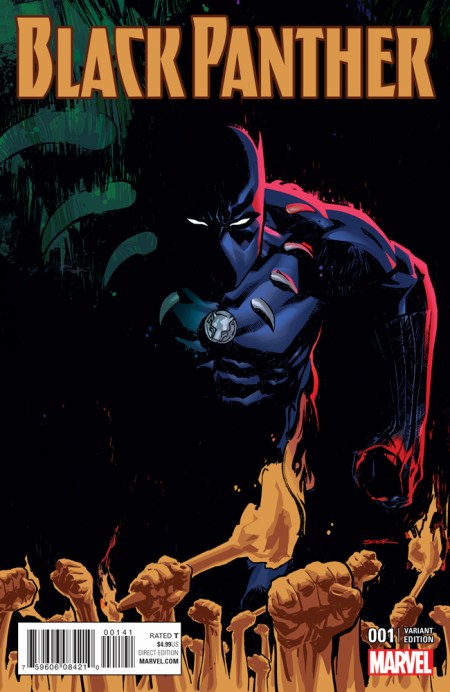
Variant cover for Black Panther #1 (2016 series), original art by Ryan Sook

It seems appropriate, then, to celebrate Jackie Robinson’s historic accomplishment with an artwork featuring the Black Panther, whose advent in Fantastic Four #52 (July 1966) represented to mainstream comics what Robinson’s arrival did to baseball. It’s Ryan Sook’s variant cover for Black Panther #1, the first issue of the new Marvel series that hit the stands last week. I acquired the original black-and-white ink art from Ryan last month at Silicon Valley Comic Con. I don’t usually have much interest in buying published covers or pages — my collection largely consists of commissioned pieces, as regular readers can attest — but I couldn’t pass up the chance to own this amazing cover. Thanks, Ryan! (You can see the published version, in full color, below.)

These are good days to be a Black Panther fan, which I’ve been since he began appearing regularly in The Avengers in 1968. Not only are we getting a fresh run of Panther stories in the comics — with scripts by award-winning author and social commentator Ta-Nehesi Coates, and art by the incredible Brian Stelfreeze — but T’Challa is also poised to make his big-screen debut next month in Captain America: Civil War. Portraying the Panther is actor Chadwick Boseman, who coincidentally also played Jackie Robinson in the film 42. Boseman will continue the role in a Black Panther solo film scheduled for release in July 2018. You’d best believe I’ll be among the first in line to see that one.

Black Panther #1 (2016 series), Ryan Sook variant cover

It’s worth mentioning that while the Panther was the first black superhero in mainstream comics, he wasn’t the first character of African descent to star in his own title. In December 1965, Dell Comics — best known for its licensed comics based on popular TV shows — published Lobo, a Western adventure featuring an African American gunfighter as its titular protagonist. The series, created by writer D.J. Arneson and artist Tony Tallarico, lasted only two issues. Not until Luke Cage, Hero For Hire arrived in June 1972 would a black superhero headline his own book. (The Black Panther took over the lead feature in Marvel’s Jungle Action comic beginning in July 1973. He moved to his own eponymous series in January 1977.)

I still remember the first time I stood in front of the spinner rack at the local supermarket and saw the Black Panther on the cover of a comic book. My younger self could scarcely have envisioned the day when the Panther would stand at the brink of multimedia superstardom, as he does today.

As I said earlier… good days indeed, for us T’Challa fans.

And that’s your Comic Art Friday.

Comic Art Friday: Frankenheimer’s castle

February 5, 2016

People who know that I’m a film buff sometimes ask me, “What’s your favorite movie?” Which is, of course, an impossible question to answer. I love many movies for many reasons, and they’re not interchangeable. How does one compare a favorite horror film (Psycho) to a favorite comedy (Blazing Saddles), or the appeal of two markedly different fantasy films (say, The Princess Bride vs. Heavy Metal)? Do I love Die Hard more or less than Double Indemnity? Streets of Fire more or less than Enter the Dragon?

You see the problem.

Anyway…

One night I happened to be parked in front of the television watching yet another of my favorite films, John Frankenheimer’s brilliant crime drama, Ronin. It’s a great piece of entertainment, combining a twisty plot; crackling dialogue; understated performances by a fine cast (including Robert DeNiro’s last truly stellar acting job before he dove headlong into self-parody, apparently permanently); and one of cinema’s all-time great car chase sequences. (Although it has his signature style all over it, many people don’t realize that Ronin was scripted by David Mamet, using the pseudonym Richard Weisz.) It’s also that rare film in which Sean Bean appears but does not die, although he does get booted from the story a third of the way in.

As I was viewing Ronin for the umpteenth time, a thought flashed to mind: “Isn’t there a superhero named Ronin?” Another thought quickly followed the first: “Didn’t Frankenheimer also direct The Birdman of Alcatraz and The Iceman Cometh? Birdman and Iceman are superheroes, too.”

And that’s how Common Elements concepts are born.

Iceman, Birdman, and Ronin, pencils by Val Semeiks

Ronin the superhero — as distinct from Ronin the movie — has actually been embodied by several different characters in the Marvel Comics universe, including Clint Barton (the Avenger better known as Hawkeye) and Eric Brooks (better known as Blade, the vampire hunter). Shown here is the original Ronin, Maya Lopez, who herself is probably more familiar to comics readers under her subsequent costumed identity, Echo. Maya is both one of the more prominent Latina heroines in superhero comics, and one of the genre’s few deaf characters.

Iceman — a.k.a. Robert “Bobby” Drake — is one of the founding members of the X-Men, going all the way back to the debut of the franchise in 1963. Historically, Bobby was the youngest in the original lineup, and was often portrayed by Marvel writers as somewhat immature and impulsive. More recently, Iceman gained publicity for coming out as gay — a revelation questioned by some readers as a retcon, given that Bobby has been romantically involved with numerous female characters over the course of his X-career.

Birdman will be familiar to those of a certain age (ahem…) as star of the fondly remembered 1960s animated TV series, Birdman and the Galaxy Trio. Designed by legendary comics artist Alex Toth (also responsible for such characters as Space Ghost and the Herculoids), Birdman is actually Ray Randall, a normal guy who receives an array of superhuman abilities from the Egyptian sun god Ra. He can fly using the powerful wings that erupt from his back, and can also fire beams of solar energy from his hands. Because his gifts derive from the sun, Birdman frequently found himself in dilemmas where the lack of sunlight robbed him of his powers temporarily. He was accompanied on his adventures by a pet eagle named Avenger.

Younger readers know Birdman from his comedic retooling in the late 1990s. In the Cartoon Network series Harvey Birdman, Attorney at Law, the former superhero is presented as a rather dimwitted defense lawyer, whose client list includes a diverse collection of his fellow Hanna-Barbera characters. Avenger is nowhere to be found in this adaptation, likely due to embarrassment.

Today’s featured artwork — #123 in my Common Elements theme — springs from the potent pencil of veteran comics artist Val Semeiks. This marks Val’s third foray into the world of Common Elements. As is true of both of his previous efforts, this one rocks.

And that’s your Comic Art Friday.