Archive for the ‘Comic Art Friday’ category

Comic Art Friday: Wonders from WonderCon, part 1

April 15, 2011

So, we had this WonderCon thing a couple of weekends back.

I’ve been a WonderCon regular for the past several years, mostly for opportunities to hobnob with comic artists and commission on-the-spot pieces for my collection, but also to just wander about and take in the spectacle. This turned out to be a pretty good con for me, art-wise. I didn’t accomplish every objective on my wish list, but I came home with several nice creations, as you’ll see over the next few installments of Comic Art Friday.
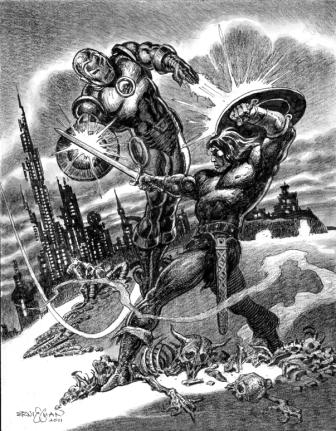
Iron Man and Conan the Barbarian, pencils and inks by comics artist Ernie Chan

Today’s featured piece actually had its genesis before the con even began. Ernie Chan almost always finds his way onto my WonderCon to-do list, but this year I had an idea for a Common Elements commission that I wanted Ernie to draw. I knew that if I contacted the Amazing Chan ahead of time, he’d produce something more intricate and detailed than the convention environment would permit. So, I e-mailed Ernie, and he agreed to draw this nifty scenario in his studio and bring it with him to the con.

This particular concept was right up Ernie’s alley, because he worked for many years on Marvel’s various Conan the Barbarian comics back in the day, mostly inking the pencils of the legendary John Buscema, but also drawing the occasional issue as well. In fact, I’d hazard a guess that no comic book artist alive has put his hand to as many published Conan images as has Ernie Chan. Asking him to bring to life this battle between the sword-slinging Cimmerian and the invincible Iron Man just made logical sense.

So what’s the “Common Element” between Conan and old Shellhead?, you’re asking yourself. Allow me to enlighten you, friend reader. First appearing in the pulp magazine Weird Tales during the 1930s, Conan’s fantastic adventures sprang from the fertile imagination of writer Robert E. Howard. In Marvel Comics continuity, Tony (Iron Man) Stark is the son of industrialist and inventor Howard Stark (who appears as a prominent character in the forthcoming motion picture, Captain America: The First Avenger). Thus, both Conan and Iron Man are — each in his own way — “sons of Howard.”

Which is why I’ve titled Ernie Chan’s artwork “Howard’s End.”

Ernie Chan, WonderCon 2011

Here’s the proud artist with his latest masterpiece.

I’ll have another WonderCon acquisition or two to display next Friday, as well as highlights from my convention experience. Drop around in seven.

And that’s your Comic Art Friday.
Comic Art Friday: Happy birthday, Supergirl!

March 25, 2011

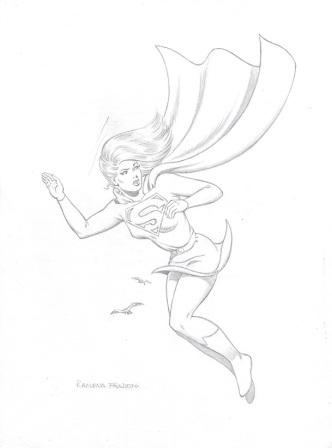
Supergirl turns 22 today.

Supergirl, pencils by comics artist Ramona Fradon

No, not that Supergirl.

My Supergirl.

Twenty-two years ago today, The Daughter entered my world, and changed it forever.

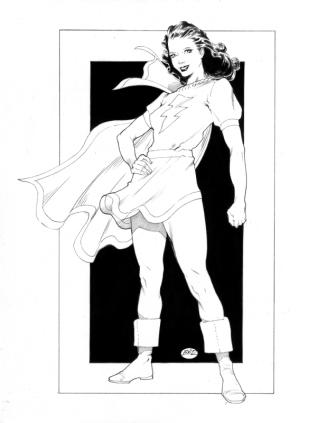
I’ve called her Supergirl for years, because she often used to wear a pink hoodie with the Kryptonian shield emblazoned on the chest. Truth to tell, though, she’s really more of a Mary Marvel — like Mary, she’s a brunette, and also like Mary, she retains her youthful innocence and charm even when she transforms into a superheroine.

Mary Marvel, pencils and inks by comics artist Michael Bair

I hope you have a spectacularly wonderful birthday, Supergirl. You’ve earned it this year. And I hope and pray that you enjoy many, many more birthdays to come. I love you as much as a father can.

And that’s your Comic Art Friday.

Comic Art Friday: I loved an Amazon before she was a website

March 11, 2011

You know that old saying, “Clothes make the man”? Shouldn’t that be, “Clothes make the woman”? Women — to generalize to the point of stereotype — tend to be more selective about their clothes than men are.

A hue and cry erupted in comics fandom some time back when DC Comics radically redesigned Wonder Woman’s iconic costume, putting the Amazing Amazon in an outfit that — to my eye, anyway — looks like she’s trying out for a mid-’90s version of the Avengers. (Remember that period when half the members of Marvel’s premier superteam wore leather jackets, like extras from West Side Story? Yeah, I know — I’ve tried to forget, too.)

The furor mostly ignored the fact that DC has tinkered with Diana’s fighting togs on several occasions. For several years in the late ’60s and early ’70s, she didn’t even wear a costume. In the main, however, the platform of Wonder Woman’s gear has followed a pattern — the tiara, the bustier, the star-spangled lower half, red footwear.

If I were designing Wonder Woman’s ideal outfit, it would look the way Gene Gonzales draws it in today’s featured artwork.

Wonder Woman, pencils and inks by comics artist Gene Gonzales

I’m partial to the old-school bustier with the golden eagle emblazoned on the front. It seems a more realistic reflection of Diana’s connection to ancient Greek mythology than the stylized version of the past several decades, in which the eagle has been transmogrified into a modern “WW” logo.

I like the notion — as impractical as it might be for fighting and flying — of Diana in a skirt. (Contrary to popular belief, Wonder Woman’s original costume was not skirted. Her earliest ensemble had a pair of flouncy culottes covering her pelvic region; as drawn by H.G. Peter, the original Wonder Woman artist, these looked like a pleated skirt. Peter soon modified the culottes into a pair of form-fitting bicycle shorts.)

I’m especially fond of the calf-laced ballet flats that Diana wore throughout the 1950s and into the early ’60s. Not only are these far more effective for running around in than the high-heeled boots Wonder Woman has sported for more of her history, but like the eagle-emblazoned top, the slippers recall at least the flavor of ancient Greece. To me, that’s an essential element of Wonder Woman’s character. (The primary problem with the slippers was that the artists who drew Diana during the years when she wore them could never agree on what they were supposed to look like — how many times did the laces criss-cross the leg, for example? Half the time, the laces didn’t even connect to the backs of the shoes, making it appear that Diana simply wrapped ribbons around her shins for no good reason.)

No one in the comics world ever seeks my opinion about anything. But if they did, I’d tell them that this ought to be Wonder Woman’s standard costume, forever and ever.

I may not know much about fashion, but I know what I like.

And that’s your Comic Art Friday.
Comic Art Friday: The chauffeur’s daughters

March 4, 2011

I’ll be honest — sometimes, the only reason for a new Common Elements commission is that the idea made me grin from ear to ear when I thought of it.

Well, not literally from ear to ear in that Julia Roberts / Cameron Diaz sort of way. My mouth is not that enormous. More like from mid-cheek to mid-cheek.

First, the art. (As always, you can click the image for a better view.)

Sabrina the Teenage Witch and Fairchild, pencils and inks by comics artist Mike DeCarlo

Comics veteran Mike DeCarlo, who has drawn and/or inked everything from Spider-Man to The Simpsons during his quarter-century-plus in the industry, teams Sabrina, the Teenage Witch — star of comics, animation, and live-action TV, and responsible for extending the acting career of Melissa Joan Hart well beyond her teens (and, some might opine, beyond the limits of her talent) — with Caitlin Fairchild, leader of the youthful superhero team Gen13, who’s often known simply by her surname.

Next, the concept.

As an aficionado of old-school Hollywood, one of my favorite classic films is Sabrina. (That’s Billy Wilder’s 1954 original, starring Humphrey Bogart, William Holden, and a luminous Audrey Hepburn in the title role, not the tepid 1995 remake with Harrison Ford, Greg Kinnear, and Julia Ormond, directed by Sydney Pollack.)

Bogie and Holden portray two wealthy brothers — David, a good-for-nothing playboy (Holden), and Linus, who’s older and more serious (Bogart) — competing for the affections of a young woman (Hepburn) who happens to be the daughter of their family’s chauffeur. It’s sort of a reverse spin on Cyrano de Bergerac, with Linus working to sabotage the budding romance between his brother and the chauffeur’s daughter in order to score a huge business deal with the family of another woman, to whom David is engaged. And of course, Linus ends up falling in love with the girl himself. (Who wouldn’t? It’s Audrey Hepburn, for crying out loud.)

Okay, you’re thinking — that explains Sabrina. But what’s the Fairchild connection? If you’ve seen the movie, you know: the character Sabrina’s last name is Fairchild.

That makes me smile. Doesn’t it you?

And that’s your Comic Art Friday.

Comic Art Friday: Three is a magic number

February 25, 2011

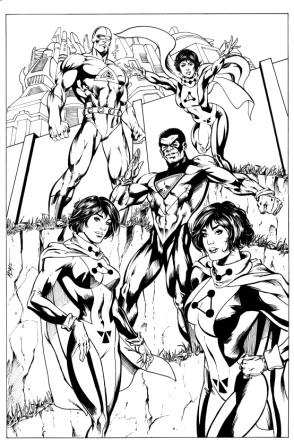
How many characters are depicted in this Common Elements commission, the latest masterwork by veteran Marvel Comics artist MC Wyman? Your answer will depend on how little you rely on your eyes, and how much you know about the characters. (Click the image for a better view.)

3-D Man, Triathlon, and Triplicate Girl, pencils and inks by comics artist MC Wyman

First, let’s introduce the players. The stony-faced gent at upper left is the 3-D Man, Technicolor hero of 1950s America. The smiling fellow in the center of the frame is Triathlon, fleet-footed member of the Avengers and later, recruit of the 50 States Initiative. The three identical women are the separated selves of Triplicate Girl, from the Legion of Super-Heroes.

The original 3-D Man was NASA test pilot Chuck Chandler, who, though a typically comic-booky sequence of events, found himself transformed by alien invaders into twin images embedded in the lenses of a pair of glasses worn by his younger brother Hal. (Hey, I said it was comic-booky, didn’t I?) When Hal donned the glasses and focused his concentration, Chuck would reassemble in three-dimensional form, with triple the strength, speed, and endurance of a man in his physical condition, and with the merged consciousness of both brothers, with Chuck’s mind predominant. Although the 3-D Man’s adventures took place in the 1950s — the heyday of 3-D movies — his first run of stories (scripted by veteran Marvel writer-editor Roy Thomas) actually appeared in 1977, in the pages of the anthology comic Marvel Premiere.

Twenty years after the Chandler brothers made their published debut, Marvel introduced another character with similar powers. Like the 3-D Man, Delroy Garrett — known in superhero guise as Triathlon — also possessed three times the abilities of a normal man. This similarity was no coincidence. Delroy’s powers came from a shadowy, quasi-religious organization called the Triune Understanding, which — unknown to Delroy — had stolen these powers from the 3-D Man. As Triathlon, Delroy served a hitch as a member of the Avengers, and years later participated in Marvel’s mega-events Civil War and Secret Invasion. By the time of the latter storyline, Delroy had become aware of the origins of his powers, and had adopted the name and costume of the 3-D Man, in which role he continues to this day.

Triplicate Girl — real name, Luornu Durgo — boasts a longer and more complex history than either of her male counterparts here. Luornu joined the 30th century Legion of Super-Heroes way back in Action Comics #276 (May 1961) as the first addition to that historic team (with founding members Saturn Girl, Lightning Lad, and Cosmic Boy). She has continued as a stalwart throughout the numerous permutations of the Legion between that day and this. During a key period, one of Luornu’s selves was killed in action, resulting in a recasting of her hero identity as Duo Damsel. In other Legion continuity reboots, she has also used the names Triad, Una, and Duplicate Damsel.

So, back to the original question: How many characters do you see? If you imagine that the 3-D Man you’re seeing is merely an image of Delroy “Triathlon” Garrett, you might say only two. If that 3-D Man is Chuck Chandler, then you’d say three… unless you consider that the original 3-D Man is, on some level, both Chuck and his brother Hal, in which case you might say four. But are Luornu Durgo’s separated selves one character, or three? Either answer is correct, depending on your point of view, as well as the particular Legion continuity you embrace.

You see? Schoolhouse Rock had it right. Three really is a magic number.

And that’s your Comic Art Friday.
No Justice for the Maestro

February 22, 2011

I could hardly be more shocked and stunned than I was earlier today, when I read the news of the sudden death of Dwayne McDuffie.

Dwayne McDuffie leads an animation panel, WonderCon 2008

If the name is unfamiliar to you, then I’ll assume that you’re not a fan of either comic books or animation, or if you are, you don’t pay much attention to the names in the credits of either. McDuffie was a prolific writer and editor of comics who became an equally prolific writer, story editor, and producer of animation, primarily for television.

In the former realm, McDuffie created one of the most unique series in the history of comics: Damage Control, which spotlighted the exploits of a company that cleaned up cities after superhero fights. He also co-founded Milestone Media, an entire comics line that focused on bringing greater diversity to the medium, both on the page and behind the scenes. From Milestone’s publications came Static, the young electricity-wielding hero who later went on to star in the long-running and popular animated TV series, Static Shock.

McDuffie’s contributions to animation didn’t end with Static Shock. He served as story editor and producer on the Justice League franchise, as well as on the various iterations of Ben 10. He recently wrote the script for Warner/DC’s latest direct-to-DVD project, All-Star Superman, which debuted in stores — ironically enough — today.

As successful as he became in animation, McDuffie never completely abandoned printed comics. A few years ago, he wrote an outstanding miniseries for Marvel entitled Beyond!, and a well-regarded run on Fantastic Four. More recently, he breathed fresh life into DC’s tentpole series, Justice League of America.

Unlike many creators, McDuffie maintained a close connection to the readers and viewers who consumed his product. His personal website hosted a thriving online discussion forum, in which McDuffie himself (nicknamed by his fans “The Maestro”) actively participated. Never shy of expressing his opinions — and he had strong opinions about everything — McDuffie in correspondence was much like the characters whose adventures he wrote: witty, thoughtful, and more than a little tough. He gave no quarter, but he had a deft way of disagreeing vehemently with opponents without resorting to ad hominem attacks.

I had the privilege of meeting McDuffie briefly at WonderCon in 2008, following a panel featuring himself and several other top animation writers. (I took the above photo during that panel.) Although I didn’t muster the gumption to mention it to him in person, it was one of my career goals as a voice actor to snag a role in one of the series McDuffie wrote. As recently as a week ago, I’ve participated in workshops where McDuffie scripts served as the fodder for honing my acting chops. I deeply regret that I will never have the opportunity to work with him professionally.

McDuffie spoke and wrote much about the uphill struggle of being an African-American creator in a mainstream comics industry often frustratingly closed to diverse talents and storylines. His founding of Milestone Media represented his best effort at giving other people of color the opportunities that he, like few other creators of his background, had been afforded, and expanding the palette of characters about whom great comics tales could be spun. And yet, McDuffie would have been the first to correct anyone who referred to him as a “great black comics writer” — he was just a darned great writer, period.

A darned great writer, gone far too soon.

Dwayne McDuffie leaves behind his wife, his mother, a monumental legacy of work, and a numberless legion of colleagues and fans who appreciated his character as much as his creative genius. He was a singular talent in two discrete media, and successful in both.

He was just 49 years old — almost exactly two months younger than I. His birthday was yesterday.

Rest in peace, Maestro.

Comic Art Friday: This One prays for Mantis

January 7, 2011

Ah, the 1970s. The Me Decade. The Disco Era. Leisure Suit Paradise.

Those were the days.

In comic book terms, we refer to the ’70s as the Bronze Age, the third major era of superhero comics. (For the non-cognoscenti out there, the Golden Age spans the late 1930s until the first appearance of the Barry Allen version of The Flash in October 1956. The Silver Age starts there and continues — depending upon which endpoint one prefers — until either the end of the 1960s or sometime in the very early 1970s.) Like the decade it encompassed, the Bronze Age was a wild and woolly time in comics, filled with bizarre characters and even more bizarre storylines.

And of course, I loved them all.

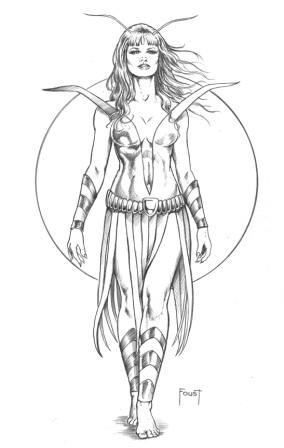
Mantis, pencils by comics artist Mitch Foust

The mysterious heroine called Mantis — drawn here by pinup specialist Mitch Foust — typifies everything that was wonderful (and weird) about the Bronze Age. Beginning with her debut in Avengers #112 (June 1973), the nameless (she was never called anything but Mantis), barefoot, Eurasian (she was born to a Vietnamese mother and a German father) martial arts expert:

* Worked as a courtesan in her native Vietnam, where she was discovered by the villain-turned-superhero known as the Swordsman.

* Joined the Marvel Universe’s premier super-team, the Avengers.

* Learned that she is the daughter of the supervillain Libra, a member of the evil Zodiac cabal.

* Battled countless threats to humanity.

* Was revealed as the Celestial Madonna, mother-to-be of the savior of the universe.

* Witnessed the death of her paramour Swordsman.

* Marries a member of a race of animated trees (the Cotati, named after the town right next door to mine).

* Departs into deep space to fulfill her destiny as Celestial Madonna, because if you’re the Celestial Madonna, that’s what you do.

In addition to her peculiar story arc, Mantis was also distinguished by — and is probably best remembered by Bronze Age comics readers for — her distinctive speech pattern, which omitted all personal pronouns. Mantis always referred to herself as “This One” rather than “I” or “me.” You can understand how a steady diet of “This One wants a sandwich” and “This One is going to the movies; would anyone else care to accompany This One?” would wear on the nerves of one’s fellow Avengers after a while, so it’s no surprise that the rest of Earth’s Mightiest Heroes didn’t shed too many tears when Mantis bolted the solar system with the tree man.

Mantis was created by longtime comics writer Steve Englehart, who became so enamored with the character that he reinvented her every time he moved from one comics publisher to another. When Englehart left Marvel for DC, he introduced Willow, a thinly disguised version of Mantis with an identical speech pattern. Later, while writing for Eclipse, Englehart came up with Lorelei, another burgeoning space mom who talked funny. (In writers’ parlance, we refer to a pet character like this — a sort of dream-world avatar for the author him/herself — as a “Mary Sue.”)

Strange (and frankly, kind of silly) though she was, I always liked Mantis. To me, she epitomizes everything that was cool about the Bronze Age, a time when comics still meant fantasy and fun instead of gritty grimness. How can you not love a kung fu hooker with antennae, who wears a costume based on a grass skirt, calls herself “This One,” and has a Madonna complex?

Comics could use a few Mantises today.

And that’s your Comic Art Friday.

Comic Art Friday: The very best of 2010… maybe ever

December 31, 2010

In previous years, I’ve presented my favorite comic art acquisitions of the foregoing 12 months on the last two Fridays before year’s end. Last year, I mustered sufficient ambition to make an entire week out of it.

2010 was a sparse collecting year for me, for reasons you can probably deduce if you follow this blog with even a modicum of regularity. Despite the small number of pieces I added this year, the quality overall was exceptional, as you’ve observed if you’ve been stopping in on Comic Art Fridays like you know you ought to. I’m delighted with every single commission that was done for me in 2010.

But when it comes to my Best of 2010, one artwork stands alone. And you haven’t seen it before now.

KJ as Electra Woman and KM as Dyna Girl, by comics artist Geof Isherwood

If you were a kid in the 1970s, the costumes will be familiar even if the faces of the women wearing them are not: Electra Woman and Dyna Girl, whose adventures elevated The Krofft Supershow on Saturday mornings in 1976.

Electra Woman (played by actress Deidre Hall, better known as Dr. Marlena Evans on the long-running NBC soap opera Days of Our Lives) was in everyday life a magazine journalist named Lori, while her youthful sidekick Dyna Girl was really her assistant Judy (played by Judy Strangis, better known as one of the students on the seminal high school drama Room 222). In a thinly disguised distaff knockoff of Batman and Robin, the duo battled crime using an amazing array of high-tech gadgets, the names of which invariably began with the prefix “Electra-” (at least it wasn’t “Bat-“). Most notable among their toys were their ElectraComs, clunkier versions of Dick Tracy’s famous wrist radio.

EW and DG’s 15-minute exploits lasted a single season — they shared their hour of airtime with segments featuring Dr. Shrinker (a mad scientist who invented a miniaturizing ray), Wonderbug (a flying dune buggy manned by three hip postadolescents), and Kaptain Kool and the Kongs (a faux rock band in the mode of the Monkees). Wonderbug and the Kaptain soldiered on for another year of Supershow after the Day-Glo superheroines and the incredible shrinking doctor got their walking papers.

But now you’re wondering… who’s that masquerading as Electra Woman and Dyna Girl?

On the left is my late wife KJ, a natural brunette who’s sporting a blonde wig here in imitation of Deidre Hall’s flowing locks. On the right is The Daughter, also referred to in this space as KM.

My original plan for this commission started long before KJ passed away due to breast cancer in July of this year. In fact, artist Geof Isherwood and I first discussed a KJ/KM tribute several years ago, but the project went onto the back burner — my fault, not Geof’s — for quite some time. In the aftermath of KJ’s passing, though, I knew it was time to complete the job.

When Geof and I brainstormed the idea initially, my concept was to dress KJ as Wonder Woman — the superheroine she most identified with — and The Daughter as Supergirl, which has been one of my pet names for her since she was young. The more I thought about it, though, the more I realized that wouldn’t work. KJ, who underwent a radical mastectomy in 2000 and was always a modest dresser even before that, would never have donned Wonder Woman’s signature bustier. She was, on the other hand, a dedicated Days of Our Lives fanatic — as is The Daughter even now — so portraying her in the guise of Deidre Hall’s Electra Woman struck me as the perfect compromise.

Although I commissioned this drawing in ink, Geof insisted on painting over his inks in watercolor, to create a stunning showpiece. This project became a labor of love for the artist, whose beloved wife Sonja also lost her battle with cancer in 2009. The final result is both a sterling example of Geof’s always brilliant work, and a fitting tribute to the two strong young women who have shared my life.

Geof Isherwood’s masterpiece reflects all of the reasons why I collect original comic art. I couldn’t have asked for more.

May you and yours enjoy a joyous, healthy, and fulfilling 2011, friend reader. Your Uncle Swan thanks you for all of your support and encouragement during his darkest, most challenging year, and promises to blog more often during the coming 12 months.

And that’s your final Comic Art Friday of 2010. Happy New Year, everyone!

Comic Art Friday: Doctor, Doctor, give me the news…

December 17, 2010

…I’ve got a bad case of loving you.

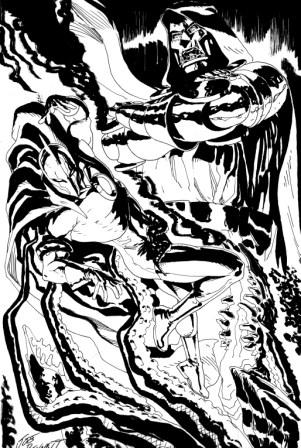
Doctor Fate and Doctor Doom, pencils and inks by comics artist Joe Bennett

Or, at the very least, I’ve got a bad case of loving this Common Elements artwork by Brazilian superstar Joe Bennett (Captain America and the Falcon, 52, Teen Titans), featuring a dynamic duo of metal-masked doctors — specifically, Doctor Fate (he’s the one in danger of being devoured by the creature that resembles the graboids from Tremors) and Doctor Doom (he’s the one towering over Fate’s plight with nefarious glee). You can click the image above for an expanded view.

Although Doctor Fate isn’t that familiar a name outside the universe of comics cognoscenti, he’s one of the oldest superheroes still going, having made his debut way back in May 1940’s More Fun Comics #55. The good Doctor was also one of the founding members of comics’ original superhero team, the Justice Society of America. He’s never been a major headliner, but he has certainly proven himself a durable character. Or, to be more precise, characters — given that several different entities (including at least two women, a disembodied spirit, and a chimpanzee) have donned Doctor Fate’s golden helmet over the course of 70 years.

For me, the one true Doctor Fate is the original — Kent Nelson, who was raised from boyhood by an ancient Egyptian sorcerer named Nabu, and schooled in the magical arts. Kent eventually becomes a physician who uses the arcane powers vested in his helmet (as well as his cloak and amulet) to battle evil. Much like his JSA contemporary, The Spectre, Doctor Fate wielded seemingly limitless supernatural might, which in turn gave him an aloof, antisocial air. These qualities made him seem perhaps less vulnerable and interesting than other heroes (and likely contributed to his lackluster popularity).

Doctor Doom, by contrast, has never had a popularity problem, having been the most prominent supervillain in Marvel Comics continuity since his debut in Fantastic Four #5 (July 1962). Pretty much every Marvel hero who’s been around for any length of time has tangled with Doom at least once, which is the only reason the megalomanical ruler of Latveria has never realized his dream of global domination.

Victor von Doom — and with a name like that, how could the poor guy not turn evil? — came to America as a young man, and was a college associate of Reed Richards (later Mr. Fantastic, leader of the Fantastic Four). Horribly scarred in a failed scientific experiment, Doom outfits himself with a mask and armor, setting out on a path of vengeance against those he blames for his plight — which includes just about every human being on the planet, but specifically Richards. If Reed Richards is the smartest person on Earth, Victor von Doom is a close Number Two, so the battle of wits between the two has been fought to a virtual draw for nearly five decades.

The match-up of these two Doctors illustrates (no pun intended) the kind of magic that happens more often than not in my Common Elements commissions. I provided Joe Bennett no instruction or direction about this artwork other than the two characters to be featured. The powerfully dramatic scenario you see here sprang entirely from the creativity of the artist, and came as a total — albeit pleasant — surprise to me when the piece was completed.

Which is why I choose, generally speaking, not to describe to an artist what I want drawn. Inevitably, the artist’s idea will be better than anything I’d have come up with. That’s why they’re artists, and I’m just a guy who admires and collects their work.

Next week: Our annual Best of Comic Art Friday, in which we’ll take a fond look back at my favorite acquisitions of the past 12 months.

And that’s your Comic Art Friday.
Comic Art Saturday: Happy 50th, Geof Isherwood!

December 4, 2010

Usually, we do our comic art posts on Fridays here at SSTOL. But I held off until Saturday this week, just so that I could pay homage to a terrific artist and gentleman who’s celebrating his half-century anniversary today.

The Suicide Squad, pencils by comics artist Geof Isherwood

Geof Isherwood — born December 4, 1960 — is an American expat who lives in Montreal, Canada. He’s best-known in mainstream comics for his work on such series as Marvel’s Power Man and Iron Fist, Dr. Strange, and Conan, and especially DC’s Suicide Squad, for which Geof was a member of the artistic team — originally as inker over Luke McDonnell, then as penciler with Robert Campanella inking — for roughly half of the book’s original run. In recent years, Geof has focused on his creator-owned projects, a thriving practice as a commission artist, and storyboards for motion pictures including Gothika and The Fountain.

Geof was one of the first artists from whom I ever bought a piece of original comic art. He was also among the first few artists I personally commissioned. Over several years of correspondence — not always about comics or art — I’ve come to think of Geof as a good friend, albeit one I’ve never met in person. He and I keep saying we’re going to remedy that omission one of these days.

So many of Geof’s creations rank among my favorite commissions, but I chose the one above to showcase on this auspicious occasion because it’s not only an incredible display of Geof’s talents, but also representative of the series with which he’s most closely associated: Suicide Squad. I chose the four members of the long-running, ever-changing team that would appear in the piece; the scenario is 100% Isherwood. Clockwise from 12 o’clock, that’s Deadshot, the Bronze Tiger, Vixen, and Nightshade.

This drawing so beautifully demonstrates the talents Geof brought to his Suicide Squad run that when Back Issue, the outstanding magazine devoted to comics from the 1970s and ’80s, decided to publish a feature story about the Squad (with Geof as one of several creators interviewed), BI editor Michael Eury used this artwork to illustrate the first page of the feature. The story and accompanying art appear in Back Issue #26 (February 2008), the “Spies and Tough Guys” edition.

Happy 50th, Geof! May your drawing hand and imagination continue to produce wonders for at least another half-century!

And that’s your Comic Art Friday.