Archive for the ‘Dead People Got No Reason to Live’ category

What it was, was Oscar

March 8, 2010

Congratulations! We survived another Oscarcast. Observations follow.

At least it wasn’t Ray Milland and Rosey Grier: The two-headed host — Steve Martin and Alec Baldwin — turned out to be a dreadful idea. Not because either was terrible, but because they simply didn’t work smoothly and effectively together. I don’t know whether Martin and Baldwin were poorly rehearsed, or just suffering from awkward chemistry. One host or the other would have been adequate, if not especially scintillating — Martin hosted the awards solo in 2000 and 2002, in not-particularly-memorable fashion — but the combination fell flat.

The sound of one man yawning: None of the major awards turned out to be a huge surprise, unless you really thought the Academy was going to pass up a chance to stick it to notoriously unpopular James “King of the World” Cameron by honoring his ex-wife Kathryn Bigelow and her magnum opus. The favorites in each of the big categories triumphed.

Double the displeasure: Expanding the Best Picture category to ten nominees was, as expected, a pointless drag on the production. No one really thought that there were more than five real contenders; namely, the films represented in the Best Director category — the victorious The Hurt Locker, Avatar, and dark horses Inglourious Basterds, Precious, and Up in the Air. Padding the show with twice as many introductory film clips merely took up air space.

Up with people: In a refreshing change, all four of the acting winners gave engaging, entertaining speeches. (I can’t prove it with verified test results, but I suspect that Jeff Bridges’s Dude-esque ramble may have been… what shall we say… chemically enhanced.) Equally refreshing, all four were people that most viewers would be glad to see win.

Sore loser: Quentin Tarantino, who looked as though Kathryn Bigelow had vomited in his lap when she won Best Director and he didn’t. I dig your films, QT, but your sportsmanship sucks.

Spare me the song and dance: We didn’t have to sit through performances of each of the Best Song hopefuls this year. A welcome omission, because seriously, when was the last time all five of the nominated songs were actually good? On the other hand, someone thought it made sense to stage an elaborate interpretive dance number incorporating music from the Original Score nominees. (Funny, I didn’t realize there was breakdancing in Sherlock Holmes.) Redeeming the moment, winning composer Michael Giacchino (Up) gave one of the night’s best acceptance speeches, encouraging young people to pursue their creative impulses and not allow naysayers to convince them that they’re wasting their time.

Didn’t work: The trend, continued from last year’s Oscarcast, of having each of the Best Actor and Best Actress nominees regaled with a speech by another celebrity. With the rare exception of an unexpected star turn by someone like Oprah Winfrey (who feted Gabourey Sidibe, nominated for Precious), these fawning tributes only serve to make both audience and nominees uncomfortable.

Worked, in kind of an off-kilter way: The tribute to recently deceased writer-director John Hughes, which culminated in the appearance onstage of numerous actors and actresses who became stars via Hughes’s legendary run of hit films in the 1980s. Cool to see these folks together in one place, but man… are we all getting old, or what?

Speaking of getting old: I understand why they do it, but I grow annoyed with the increasing insertion into the Oscarcast of no-talent young stars with no genuine cinematic credibility (i.e., the ubiquitous Miley Cyrus), just to draw in the teen audience. Uncle Oscar says: Get off my lawn, you meddling kids.

The death of me: I’m always curious to see who gets tagged with what I call the “Dead People Gig,” introducing the memorial segment honoring movie folks who’ve shuffled off this mortal coil since the last Oscar ceremony. This year, it was Demi Moore pulling double-death duty (she was also one of the participants in the John Hughes tribute). James Taylor performed an acoustic rendition of “In My Life” while the clips rolled. For once, there was no moment of shock generated by the appearance of someone I didn’t know had died. Interestingly, Michael Jackson — whose filmography consists basically of The Wiz — made the cut, while Farrah Fawcett — mostly known for TV work, but she did make several films, including such “classics” as Logan’s Run and Saturn 3 — missed.

Fashion forward: Oscars 2010 proved rather low-key on the sartorial front. Understated glamour was the norm this year, so there were fewer what in the name of Vera Wang was THAT? moments on the red carpet than at previous Oscarcasts. The most egregious offenders were Sarah Jessica Parker, whose strapless gown came equipped with an enormous silver breastplate that resembled a leftover centerpiece from an office Christmas party, and Charlize Theron, wearing what looked like two pink-frosted cinnamon rolls stuck to her bosom. Best-dressed of the evening included several of the usual suspects — Kate Winslet, Helen Mirren, Meryl Streep, and Queen Latifah. Jennifer Lopez’s lovely pink dress would have gained high honors, if not for its ridiculous train. Likewise, Best Actress winner Sandra Bullock lost points for her garish lipstick.

The voice of choice: As she did last year, voice actress Gina Tuttle contributed a pleasant and unobtrusive announcing job. And if Gina ever gets tired of that gig, Oscar producers… I’m in the book.

While my guitar gently weeps

February 16, 2010

This explains the police helicopter overhead the other night.

I’d read over the weekend about the murder of local artisan Taku Sakashta, an internationally renowned creator of hand-crafted guitars. Early Monday morning, Rohnert Park police chased down and eventually captured a suspect in the slaying — Joshua “Crash” Begley, a recently released felon with a list of priors stretching back more than a decade — just a block or two from our house.

At the moment, it’s unclear why Begley might have killed Sakashta — although, given Begley’s history of drug-related offenses, money for dope looks like a decent bet from here. Sakashta’s body was discovered last Thursday evening near his car, a Nissan 350Z, so there’s some thought that he might have surprised Begley attempting to steal the vehicle.

Sakashta’s custom guitars sold for upward of $30,000 each. He’s described by friends — including Ken Tominaga, owner of our little burg’s best sushi restaurant, Hana — as a sweet, gentle man who routinely worked late hours in his shop without locking the front door. He leaves behind a wife and many friends.

As for the suspect, he was in custody last Monday on drug charges when he briefly escaped using a handcuff key he’d secreted in his mouth. He was recaptured, then released on bail on Tuesday.

Less than three days later, Taku Sakashta was dead.

Nice going, Sonoma County law enforcement.

This disc has flown

February 11, 2010

A moment of silence, please, in memory of the late Walter Fredrick “Fred” Morrison, who shuffled off this mortal coil earlier this week.

Who was Fred Morrison? I’m glad you asked, friend reader, for indeed this esteemed gentleman played an essential role in my formative years.

Fred Morrison, you see, invented the Frisbee.

Morrison got the idea for his legendary sporting device from tossing a cake pan around when he was young. In 1948, after extensive research into the aerodynamics of bakeware, Morrison began marketing a modified, plastic version of the pan under the trade name Pluto Platter. After Morrison’s initial success, Wham-O Manufacturing bought the rights to the product and changed its name to Frisbee.

As the story goes, the name Frisbee came from a New England bakery — the Frisbie Pie Company — whose aluminum pans were already popular with college students for their fun-flinging capabilities. Wham-O, recognizing a marketable buzzword when they heard one, borrowed the name for Morrison’s flying discs.

The rest, as they say in the sporting goods business, is history.

Here in Rohnert Park, the Frisbee holds a lofty place in our local lore. In the 1970s, Sonoma State University was one of the last remaining bastions of bohemian — dare I use the word hippie? — subculture. Among the hallmarks of Granola State — as the university was often nicknamed in those tie-dyed, macraméd days — was the colorful fusillade of Frisbees that could be seen sailing across its verdant lawns on any sunny afternoon.

Although I didn’t attend SSU, I did obtain my final two years of secondary education on the campus immediately adjacent. Thus, I spent more than my fair share of time hurling a plastic plate to and fro with my friends.

Ah, youth.

Cameron Crowe’s novel Fast Times at Ridgemont High contains a hilarious scene that was, sadly, excluded from the hit film based on the book. In it, a couple of arrested postadolescents in the employ of Wham-O visit the school to perform a Frisbee demonstration. These self-important jocks insist that their sporting device of choice be referred to as “the disc,” because calling it a Frisbee would be plebeian and therefore uncool. (The pair collect the phone numbers of several Ridgemont females before taking their leave.)

There is, I’m told, no truth to the rumor that instead of being buried, Fred Morrison’s remains were simply cast willy-nilly upon the roof of a nearby house, and abandoned there.

As fitting as that might have been.

Gorilla the golden west

January 31, 2010

Today is January 31, and you know what that means…

January 31 is National Gorilla Suit Day!

It’s National Gorilla Suit Day.

This would be as appropriate a time as any to mention that I recently picked up The Completely MAD Don Martin, an exhaustive two-volume compendium of every cartoon every published in MAD Magazine by the late, great Don Martin, the founder of this auspicious holiday. It’s a treat to leaf through the pages and revisit the insane genius of one of history’s most unique humor artists.

If you can find the set online at a steep discount, as I did — and it’s not hard to do, with a bit of savvy surfing — I enthusiastically recommend that you pick up a copy. You’ll laugh yourself silly. But that’s okay. It’s good for you.

Tell ’em your Uncle Fonebone sent you.

Comic Art Friday: A quaint and curious volume of forgotten lore

January 29, 2010

Here’s an interesting historical fact: 165 years ago today — January 29, 1845 — Edgar Allan Poe’s immortal poem The Raven was published for the first time under its author’s byline, in the New York Evening Mirror.

Considered by many — your Uncle Swan included — to be among the greatest American poetic works, The Raven is without question one of the most recognizable, most referenced, and most frequently parodied poems ever written. It made its author a literary superstar in his own time, and an influential and culturally pervasive writer to this day.

What does this have to do with comic art?

Not one doggoned thing.

Except…

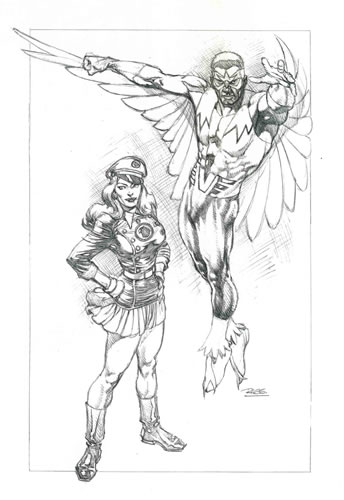
"Blackbirds of Prey," pencils by comics artist Rags Morales

It provides a ready excuse to delve into my archives and pull out this Common Elements classic. No ravens here, exactly, but a pair of fine black birds nonetheless.

That’s ace aviatrix Zinda Blake — better known as Lady Blackhawk, of the famous Blackhawk Squadron and more recently of the Birds of Prey — on the left. Her winged companion is one Samuel Wilson, familiar to most as Captain America’s longtime partner in crimefighting, the high-flying Falcon. The artist behind the pencil for this heroic pose-off is Ralph “Rags” Morales, whose work for DC Comics includes several series that fit today’s “ravenous” theme, including Hawkman, Nightwing, and Black Condor.

Speaking of Poe (and I was)…

Just 10 days ago, the legendary author’s fans celebrated the 201st anniversary of his birth. Every January 19 for the past 60 years, a mysterious black-clad figure has visited Poe’s gravesite in Baltimore in the early morning hours to perform a silent tribute: a toast with a glass of cognac, and a deposit of three roses on the writer’s tombstone. This year, for the first time in six decades, “the Toaster” — as the nameless individual has come to be known — did not appear as previously. Perhaps he (or she?) has at last joined the literary giant in the Great Beyond.

Quoth the Raven… “Nevermore.”

And that’s your Comic Art Friday.

A slice of Rye

January 28, 2010

J.D. Salinger is dead.

At least, we think he is.

I frame the above observation in this way because, as anyone knows who knows anything at all about the elusive author of The Catcher in the Rye, Salinger spent more than a half-century shrouding himself in mystery. The man who penned the 20th century’s seminal bildungsroman vanished into self-imposed seclusion in New Hampshire in the 1960s, surfacing in the press afterward only to engage in legal warfare with people determined to make him more public a figure than Salinger wanted to be.

What descriptions of Salinger’s life surfaced generally depicted a self-absorbed man of mercurial religious beliefs (at various times, Salinger was a devotee of Zen Buddhism, Christian Science, spiritism, and Scientology), singularly bizarre habits — according to his daughter Margaret’s 2000 memoir, Dream Catcher, Salinger pursued wide-ranging dietary philosophies that included macrobiotics, purging, and the consumption of his own urine — and a fascination with adolescence. He maintained a reclusive existence to the degree that no current photographs of him ever surfaced during the last several decades of his life.

Basically, Salinger became the kind of person that Holden Caulfield, the teenage protagonist of The Catcher in the Rye, might have grown up to be.

Like most American schoolkids, I read Catcher in an English class — Miss Johnson’s eighth-grade English class, in my case. I remember having to obtain signed permission from my parents to study the book, due to its (for its time, anyway) salty language and frank discussion of sexual topics. I’ve never felt compelled to revisit the novel in the 35 years since that class, yet I recall portions of it — several scenes, and specific lines of narration and dialogue — with remarkable clarity. That’s testimony, I suppose, to the power of Salinger’s work.

Although Catcher remains Salinger’s most famous creation, it’s the only novel (as such) that the author ever published. The remainder of his available writing consists of short stories and novellas, published almost exclusively in The New Yorker. A pair of connected stories, Franny and Zooey, were released in book form following their magazine debuts. When I read Franny and Zooey in college, I was struck by how much it reminded me — not in subject matter or style as much as in character — of a pair of books I enjoyed in my youth: Louise Fitzhugh’s Harriet the Spy and The Long Secret.

Salinger reportedly remained an avid motion picture buff throughout his life, despite the fact that he steadfastly refused to permit his writings to be adapted for the screen. (Salinger so detested My Foolish Heart, based on his short story “Uncle Wiggly in Connecticut,” that he vowed never again to let Hollywood touch his work.) It makes sense, then, that his son Matt became an actor. Unfortunately, Matt Salinger’s best-known cinematic appearance came in the title role of the execrable Captain America — who can forget the spectacle of Cap wearing a cowl fitted with rubber ears?

Rumor has it that, while he ceased publishing his work in the early ’60s, Salinger continued to write diligently. Joyce Maynard, who engaged in a much-publicized affair with the author in 1972 when she was 18 and Salinger was 53, reported having seen at least two completed manuscripts for novels during that period. At that rate, it seems reasonable to think that Salinger may have left a dozen or more books behind. It will be up to his children, I would guess, whether these unrevealed works ever see the light of day.

Me, I’d settle for a photograph.

Irony of the Day: Your lottery number is up

January 27, 2010

From the Don’t Count Your Chickens Before You Eat All the Eggs Department…

A 47-year-old woman who recently won $8,000 in the Ohio Lottery was struck and killed by a passing car as she left the bar where she was celebrating her windfall.

I wonder how much a cemetery plot and casket cost in Ohio? Hopefully, less than eight grand.

Postscript… with a bullet

January 20, 2010

It’s indicative how stunned I was by the death of novelist Robert B. Parker that I neglected to mention in my memorial post the most personal element of my Parker experience…

I actually met the man once.

This would have been, I believe, in the fall of 1982. Parker was on a tour promoting Ceremony, the ninth Spenser novel, which had just been published. One of his stops was a B. Dalton Bookseller location on Market Street in downtown San Francisco. I was in the midst of my first semester at San Francisco State University — my third collegiate year overall, after two years at Pepperdine and a year off working full-time. (I’d hum you a few bars of the school song, but I’ll confess that I have no idea what it is.) When I heard that my favorite author was in town, I hopped on the Muni Metro’s M Line and headed downtown to stare greatness in the face.

Parker’s popularity was still in its nascent stage at this point, so there wasn’t a mammoth crowd in the store, clamoring for the author’s autograph. In fact, during the time I was there, I could have counted on my fingers the people who stopped by Parker’s table, and still had enough fingers free to tap out “London Bridge” on a piano.

Parker, a bluff, broad-shouldered man with a walrus mustache, gave the distinct impression that this sort of personal appearance gig wasn’t his greatest thrill in life. Of course, he’d probably begun the tour in his native Boston and worked westward, so San Francisco was in all likelihood near the end of a long journey, during which he’d fielded the same inane book-tour questions (i.e., “Where do you get your ideas?” and “What’s Spenser’s first name?”) several dozen times. So I was willing to cut the guy some slack if he didn’t feel particularly chirpy.

Being on a student’s budget, I couldn’t afford to buy Ceremony in hardcover. Instead, I picked up the newly released paperback of the previous Spenser book, A Savage Place, and handed it to Parker to sign. (Because Parker wrote a new Spenser adventure annually, Delacorte/Dell would publish the preceding year’s Spenser in softcover simultaneously with the release of the latest novel’s hardcover edition. I always waited to read each book until I could purchase it in paperback. Every time I walked into a bookstore or library, I’d fight the temptation to devour the latest hardcover, forcing myself to hold out for the paperback twelve months later. It was a masochistic exercise in discipline.) Parker stoically scribbled his autograph on the title page and gave the book back to me.

Determined not to embarrass myself in front of this person whose work I so deeply admired, I had rehearsed my comments on the streetcar ride over. I told Parker that I enjoyed his books very much, and that I hoped one day to write a novel myself.

“Writers write,” Parker said. “If you want to be a writer, start writing.” Simple advice, but sound.

I then asked him the one question I’d prepared — “Do you think you’ll ever write a book specifically about Hawk?” — referring to Spenser’s ultra-efficient comrade-in-arms. Parker’s expression betrayed the fact that he’d heard this one a few bajillion times already, and he responded, “No. I really only see Hawk through Spenser’s eyes. I couldn’t write a book from his point of view.” (True as that was, Parker did eventually write a couple of Spenser novels in which Hawk played more than just a supporting role — 1992’s Double Deuce and 2005’s Cold Service.)

That was it. I moved off to pay for my book. I overheard Parker telling another customer that the Spenser story on which he was just beginning work would lay the foundation for some major changes to come in later books. In retrospect, I believe that he was probably referring to Valediction, published in 1984. In that book, Spenser and his paramour Susan separate for a time — events that reportedly mirror those in the lives of Parker and his wife Joan.

My autographed copy of A Savage Place rests on my desk as I type this post. I guess it’s a collector’s item now.

The final bullet

January 19, 2010

Books live forever. Authors, sadly, do not.

Robert B. Parker has been my favorite novelist since 1977, when I checked out Mortal Stakes, the third novel in his now-legendary series of books featuring the one-named private detective Spenser, from the Novato High School library and immediately fell in love. (In a purely platonic and literary sort of way.) I quickly went back and read the two preceding novels in the skein, The Godwulf Manuscript and God Save the Child.

My life has never been the same.

Parker ultimately wrote more than 50 novels, 37 of which feature Spenser — a character which spawned a television series and two separate batches of made-for-TV feature-length films. (More about these later.) Not content with that success, in recent years Parker created two more popular detectives: Jesse Stone, the alcoholic former baseball player-turned-L.A. cop who becomes police chief in the tiny (fictional) Massachusetts town of Paradise; and Sonya “Sunny” Randall, a petite, blonde female investigator (Parker created Sunny to be played onscreen by actress Helen Hunt, in a project that never materialized).

When not writing mysteries, Parker also put his hand to Westerns (his novel Appaloosa was recently made into a worthwhile film starring Ed Harris, Viggo Mortensen, and Renee Zellweger) and non-series crime fiction. My favorite of his one-shot books, Double Play, focuses on a tough guy named Burke who’s hired by Branch Rickey and the Brooklyn Dodgers to be Jackie Robinson’s bodyguard during the barrier-breaking athlete’s rookie season in the major leagues.

Early in his career, Parker was frequently compared to Raymond Chandler, the seminal American detective novelist. (Parker, in fact, was commissioned by Chandler’s estate to complete the late author’s unfinished Philip Marlowe story, Poodle Springs. He also wrote an entirely original sequel, entitled Perchance to Dream.) Quickly, though, Parker evolved his own style — terse, breezy, fast-paced, light on plot, and rife with punchy dialogue. His prose became less musical than Chandler’s, but also lacked his predecessor’s ponderous edge. I always thought Parker wrote a lot like Hemingway might have, if Hemingway drank less and possessed a sense of humor.

Parker’s work electrified the once-moribund hard-boiled detective genre, spawning a tsunami of disciples and imitators. (Some of whom, such as Robert Crais and Harlan Coben, turned out to be much better writers than Parker… but you always have to credit the guy who got there first.) Not only did he redefine the style and sensibility of the American private eye novel, Parker also established (in the fourth Spenser book, Promised Land) one of its most recognizable tropes — the silent-but-deadly sidekick — in the person of Hawk, Spenser’s enigmatic comrade-in-arms. (Crais’s Joe Pike and Coben’s Win Lockwood, along with innumerable other characters less effectively framed, owe their very existence to Hawk.)

As his work gained popularity, Parker developed a Hollywood connection that would define the latter half of his career. In the late 1980s, ABC Television produced Spenser: For Hire, a primetime action drama starring Robert Urich and a pre-Star Trek: Deep Space Nine Avery Brooks, which ran for three seasons. After the series’s cancellation, Urich and Brooks went on to reprise their roles in several TV films — these grew progressively worse as the budgets got tighter. (Brooks would also star in a deservedly short-lived ABC spinoff, A Man Called Hawk, whose connection to Parker’s novels was tenuous at best.)

Parker had minimal input into the TV versions of his characters — he famously resented the casting of the boyishly handsome Urich as the rugged ex-prizefighter Spenser — but enjoyed the royalty paychecks nonetheless. Eventually, the entire concept received a Parker-approved reboot via a trio of teleflicks produced for the A&E cable channel, this time with veteran actor Joe Mantegna in the lead role. (I never quite understood why Parker preferred the diminutive, distinctly Italian-in-heritage Mantegna as his burly Irish-American hero — Urich, at least, had the physical presence if not the acting chops — but there’s no accounting for tastes.) The low-rent Mantegna films flopped, rarely appearing even in reruns.

Over the past few years, Tom Selleck has assumed the role of Parker’s other hero, Jesse Stone, in several telefeatures for CBS. Selleck, ironically, was Parker’s first choice for a never-made theatrical Spenser film, before the ’80s Urich series. (As fine an actor as Selleck is, I don’t love him as Jesse Stone, who in the books is in his mid-30s — about half Big Tom’s present age.)

Critics knocked Parker, especially during the latter half of his career, for his increasingly sparse plotting. (Many of the Spenser books are “mysteries” in name only, in the sense that the focus of the stories is rarely “whodunit.”) For his fans, however, Parker’s work was never about plot, but rather about his characters. Those of us who have been reading about Spenser, Hawk, and Susan (Silverman, Spenser’s longtime relationship partner, whom he meets in the second novel) feel as though they are real people, and that we know them as intimately as we know folks in the real world. The same can be said, albeit to a lesser degree, about Jesse Stone and Sunny Randall and their respective supporting casts. While often providing few — and in truth, contradictory — details about their lives (i.e., Spenser famously refers to memories of his mother in a couple of Parker’s early books, memories later retconned out of existence when the author subsequently decided that Spenser’s mother died in childbirth), Parker made the reader believe that his characters lived and breathed and pondered the vagaries of life.

Certain themes recur frequently in Parker’s fiction. Chief among these could be described as machismo — the unwritten code of masculine honor to which all of his heroes (including the female Sunny Randall) subscribe. (I told you before: Hemingway with a sense of humor.) By way of contrast, Parker was also one of the first writers of hard-boiled fiction to frequently feature gay characters in a positive light — Lee Farrell, a Boston police detective, and Tedy Sapp, a bouncer and occasional Spenser backup, are minor recurring characters in the Spenser books who are openly gay, as is Sunny Randall’s best friend and confidant Spike. One of the early Spenser novels, Looking for Rachel Wallace, centers on a feminist author and activist who is by her own acknowledgment a “militant lesbian” — Rachel reappears as a trusted associate later in the series. (Parker’s two sons are both gay, and his son Daniel portrays Lee Farrell in one of the Mantegna-era Spenser movies.)

Even more notably, Parker’s lead characters are in some degree defined by their conflicted relationships with their significant others. Spenser and Susan’s partnership is briefly interrupted early in the series when she leaves him for another man, an event which culminates in the atypical novel A Catskill Eagle. Both Jesse and Sunny have ex-spouses with whom they are still in love, but can’t for various reasons sustain a committed relationship with. (It’s said that Parker and his wife Joan themselves had an unusual marriage, living together in the same house, but in separate quarters.)

Parker’s personal interests often colored his fiction. You didn’t have to read many of his novels to know that Parker loved cooking (Spenser was a kitchen gourmet at a time when that would still have been considered unmanly), physical exercise (one of his few nonfiction works is a primer on weight training), literature (Spenser’s dialogue, in particular, is loaded with literary allusions — Parker held a Ph.D. in English, and was formerly a professor at Northeastern University), and dogs (Parker’s book jacket photos frequently pictured him with his German shorthaired pointer, the model for Spenser and Susan’s Pearl in the later-period books; Sunny and Jesse both also own canine companions).

It’s sad to think that there won’t be many new tales of all of my old friends forthcoming. A new Jesse Stone novel is set for release in a few weeks — it’s already on my Kindle wish list. I don’t know the status of the next Spenser book (Parker had unleashed a new Spenser more or less annually since the mid-’70s), or whether there’s another Sunny story in the pipeline. I’ll just have to content myself with rereading the existing books, most of which hold up just fine for second and third reviews.

It’s even more sad that I’ll never know Spenser’s first name.

RIP, RBP.

That’s why he’s the King

January 18, 2010

Truer words were never uttered…

“The time is always right to do what is right.” — Dr. Martin Luther King, Jr.

Thanks for everything, Dr. King.