Archive for the ‘Hero of the Day’ category

Comic Art Friday: Catch me now, I’m falling

November 22, 2013

I thought long and hard — well, okay, as long and hard as I think about anything; which, given the attenuated nature of my attention span, is not all that long or hard, really — about what to post on a Comic Art Friday that falls on the 50th anniversary of President John F. Kennedy’s assassination.

Given that I was a toddler on this date in 1963, I haven’t any emotional tale to share about where I was or what I was doing when the news broke. I only kinda-sorta-vaguely recall the assassinations of Martin Luther King, Jr. and Robert Kennedy, and those occurred five years later. Thus, no deep personal insight here.

As a Presidential history buff, it does strike me as interesting that Kennedy’s assassination resonates with us the way that it does. Kennedy wasn’t the first President to be assassinated. That dubious honor fell to Abraham Lincoln, as has been extensively memorialized in print and on film. Two other Presidents — James Garfield and William McKinley — were bumped off within the following 40 years. By the time of Kennedy’s murder, it had been more than 60 years since a President had been killed, and Americans had largely begun to think that we had advanced beyond that sort of business.

Of course, we had not.

Captain America, pencils by comics artist Ron Adrian

Perhaps by coincidence, the Kennedy assassination would mark the start of a turbulent era in American public life. The rest of the 1960s and ’70s would see the polarizing Vietnam War, the full impact of the civil rights movement, the Watergate scandal, the resignations of Vice President Spiro Agnew and President Richard Nixon, and the Iranian hostage crisis. Politics in this country would never again be the same.

Ironically, it took a band of Englishmen to record one of the most provocative commentaries on this dark time in American history. In 1979, the Kinks released the album Low Budget, which featured a song entitled “Catch Me Now I’m Falling.” The lyrics read, in part:

I remember when you were down
You would always come running to me
I never denied you and I would guide you
Through all of your difficulties
Now I’m calling all citizens from all over the world
This is Captain America calling
I bailed you out when you were down on your knees
So will you catch me now I’m falling

That song reverberates through my synapses today as I think about the Kennedy assassination, and all that’s gone on in this country since then. We’ve fallen — and in my view, continue to fall — in many ways over this past half-century. And yet, by many other measures, we rise to levels that no other nation in the history of human civilization ever has.

Bizarre how that works.

I suppose that both our struggles and successes are to be expected, and are to some degree of a piece. We are remarkably accomplished as a people at making both good and bad, both love and hate, out of the same things; at finding unity in places that ought to divide us, while dividing ourselves over that which ought to unite us. Our greatest national strengths are often the cause of our most debilitating weaknesses… and vice versa.

I’m not entirely sure why that is. But that’s America for you.

And that’s your Comic Art Friday.

Comic Art Friday: Art for nouveau’s sake

November 15, 2013

Poster featuring Sarah Bernhardt, by Alphonse Mucha

Although I collect original comic art exclusively — and that within a fairly specific range — I appreciate many different styles and genres of art.

Since the days when I struggled through an introductory fine arts course in college, I’ve enjoyed master painters and their work. Among the immortals whose creations resonate with me: Titian (his Venus of Urbino is probably my favorite painting of all time), Giorgione, Veronese, Rubens, Vermeer, Renoir, Boucher, Frederic Leighton, Tissot, Albert Joseph Moore… well, there are others, but my typing finger cramped. I’m also a fan of great pinup artists, from Gil Elvgren and Alberto Vargas to Olivia De Berardinis and Dave Stevens. I even love gawking at unusual architecture — anything from Frank Lloyd Wright to Antonio Gaudi to the Las Vegas Strip.

The one artist outside the comics realm whose work I always carry with me is Alphonse Mucha, the Czech painter and printmaker whose distinctive style defined what came to be called Art Nouveau. Mucha first came to fame in the 1890s when he created a series of advertising posters featuring actress Sarah Bernhardt, who was to 19th century Paris what Meryl Streep is to modern Hollywood. Mucha’s unparalleled design sensibility inspired a host of homages and imitations. Even today, more than 70 years after his death, artists are still trying to recreate the Mucha magic.

I have an app on my iPhone that displays Mucha’s complete works at the tap of a finger. I tap often.

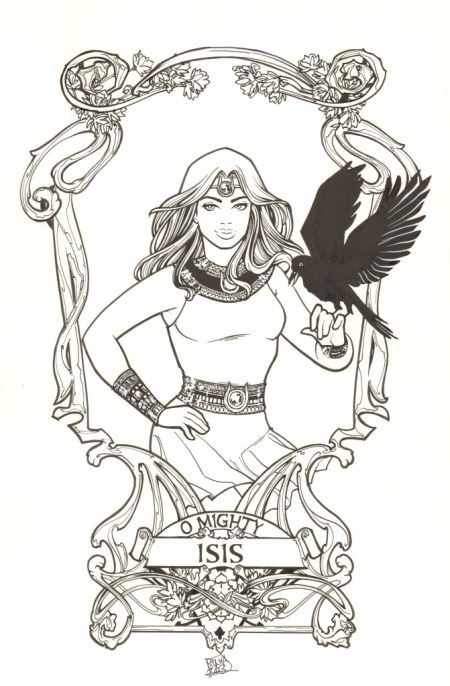
Isis, pencils and inks by comics artist Sanya Anwar

Earlier this year at Big Wow ComicFest, the Pirate Queen and I stopped by the booth of a Canadian cartoonist named Sanya Anwar. (People often are taken aback by the word “cartoonist,” thinking it refers only to those who draw humorous strips or panels. In fact, a cartoonist is simply a comics creator who both writes and draws. The term is equally applicable to such diverse talents as Charles Schulz, Will Eisner, Charles Addams, Jack Kirby, Art Spiegelman, and the aforementioned Dave Stevens.) Sanya’s signature project is a self-published comic entitled 1001, a reimagined twist on the classic Arabian Nights.

I was particularly impressed with a series of posters Sanya created using an Art Nouveau approach reminiscent of Mucha. I took her business card and made a mental note to contact her about a commission. Fast forward to today, and you see the result above.

Isis seemed like a perfect choice for Sanya’s commission project, given her visual and cultural sensibility. Also, since I so admired Sanya’s Muchaesque “Silk Road” posters, I asked her to create a piece with a similar flavor. The combination of character, artist, and style melded perfectly.

Comics and Art Nouveau are like a graphical Reese’s Peanut Butter Cup: Two great tastes that taste great together.

And that’s your Comic Art Friday.

Comic Art Friday: Typhoon Taarna

November 8, 2013

It struck me this morning as ironic that on the birthday of the late, great Tony DeZuniga — who led the tsunami of artists from the Philippines that took the American comics industry by storm in the 1970s — his native land is being pummeled by one of the nastiest typhoons on record.

Weird universe we live in.

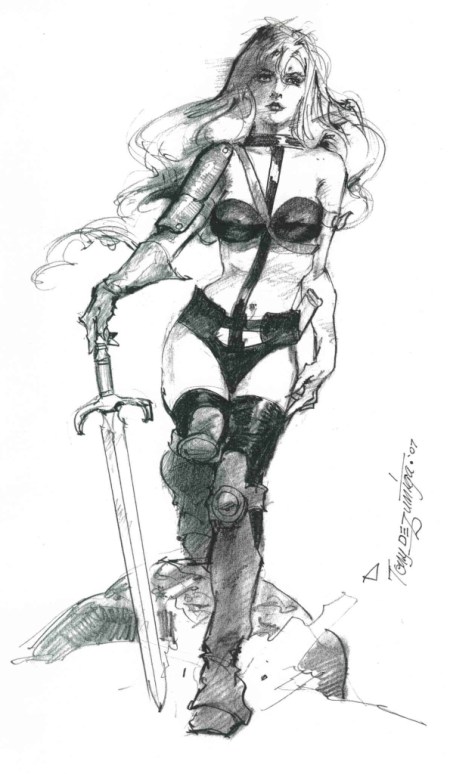
Taarna, pencils by comics artist Tony DeZuniga

I happened to be in the Philippines for a major typhoon once. On Thanksgiving Day in 1974, Clark Air Base — where my father was stationed at the time — was struck by Typhoon Irma, packing winds approaching 100 miles per hour. It was the most powerful typhoon to hit the area in the base’s 90-year tenure.

We lost electrical power by late morning. Fortunately, my mother had cooked the turkey early as a precautionary measure, so the bird was ready to roll at mealtime. Most of the accompaniments we ate cold, straight from the can. When we weren’t eating, we spent the day mopping up the water that blew in under the front door, bracing the windows with duct tape in case the winds shattered them, and praying that the roof would hold. It did. The bamboo pole that held our TV antenna aloft was not so fortunate.

Anyway, in memory of Mr. DeZuniga, that’s his rendition of Taarna, the heroine of the final segment of the animated film Heavy Metal, leading off this post. Below, you’ll see Taarna again, as drawn by Tony’s close friend and colleague, Ernie Chan, another member of the Filipino-American comics community who passed away a mere five days after Tony left us.

Again, irony.

Taarna, pencils and inks by comics artist Ernie Chan

Speaking of Taarna…

For several years, I maintained a reference page about Heavy Metal on Squidoo, the web community founded by marketing guru Seth Godin. A while back, I got a cryptic email from the site’s administrative team, advising me that they were shutting down my page due to some kind of inappropriate content.

Nothing in the notice explained exactly what content was under review. Although nudity is depicted in the film (okay, it’s animated nudity, but still), I didn’t use any nude images on the site. The text was 100% original — I wrote the entire page from scratch; no content was pirated from Wikipedia or any other site — and 100% profanity-free. The only links on the page went either to my Comic Art Fans gallery (where my Taarna commissions are displayed) or to Amazon (where readers could purchase the DVD of the film — the kind of link Squidoo encourages). So I have no idea what the issue was.

At any rate, I copied all of the text into a Word document for my own records, and deleted the page. If you want to know more about Heavy Metal — a landmark film in the history of animation, and an essential bridge between comics and the movies — you’ll have to look elsewhere than Squidoo.

You could always just ask me, of course. I know almost everything there is to know about the film.

I used to have a Squidoo page that demonstrated this.

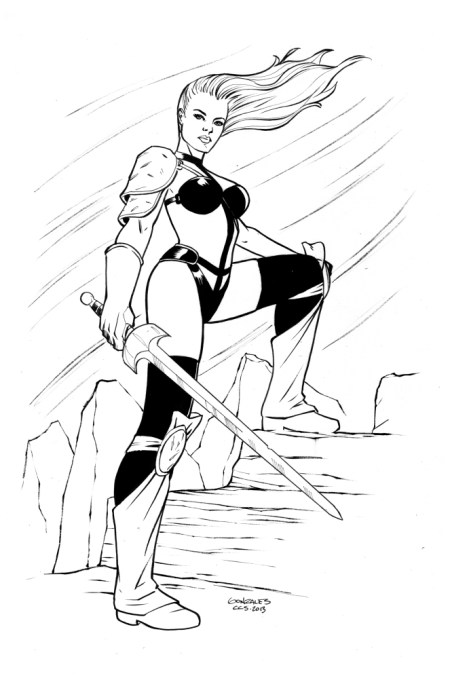
Taarna, pencils and inks by comics artist Gene Gonzales

Our final Taarna image is a new one, courtesy of Gene Gonzales, who — unlike Messrs. DeZuniga and Chan — is still with us, and still creating lovely artworks like this. I love the dramatic angle Gene employs here. Taarna looks strong and majestic, as a good Taarakian defender should. Her windblown hair is gorgeous as well.

Although…

…I hope that isn’t a typhoon stirring up.

And that’s your Comic Art Friday.

Comic Art Friday: A tall-walking big Black Cat

November 1, 2013

Followers of this space know my fondness for vintage superheroines. In fact, I’ve devoted an entire themed commission series, Bombshells!, to female costumed stalwarts who made their comics debuts before I was born.

Bombshell! Black Cat, pencils by Dan Veesenmeyer, inks by Bob Almond

Among my favorite characters from the Golden Age is the original Black Cat, who first appeared in Harvey Publishing’s Pocket Comics #1 in August 1941. (That was a fertile month for superheroines, incidentally. Such legendary figures as Phantom Lady, Pat Patriot, Miss Victory, and Wildfire also stepped onto the scene in books bearing the August ’41 date.) I say “original” because this character bears no relation — aside from code names — to the Black Cat more familiar to comics readers today: Felicia Hardy, the more-or-less-reformed ex-criminal who has alternately bewitched and bedeviled Spider-Man for the past three decades.

Unlike Marvel’s feline fatale, the first Black Cat carried no bad-girl baggage. Linda Turner, a former Hollywood stuntwoman turned star box office attraction, donned a mask, gloves, buccaneer boots, and a bathing suit (you know… like you would) to battle crime, often from the seat of a motorcycle. The skills she’d developed as a stunt performer, including adeptness with a lariat (Westerns being far more popular then than now) and karate, frequently came in handy in her new sideline. Linda even had her own masculine version of Lois Lane in the person of Rick Horne, a reporter for the Los Angeles Globe who never made the connection that Linda, whom he dated in the later years of the series, and the Black Cat were the same woman. (Apparently, journalism schools in the comics multiverse place little emphasis on observational acuity.)

Black Cat, pencils by James E. Lyle, inks by Bob Almond

For most of the Cat’s career, which included five years as the lead feature in Speed Comics before segueing to her own eponymous title in 1946, her adventures were drawn by Lee Elias, a gifted artist who had once served as Milton (Terry and the Pirates) Caniff’s assistant. Ironically, Elias also worked for a time on DC Comics’ Black Canary, the most blatant of the numerous Black Cat imitations that popped up during the 1940s. In the 1960s and ’70s, after a brief sojourn into newspaper strips, Elias illustrated horror titles (House of Mystery, House of Secrets, Witching Hour) for DC, and later, drew Power Man and Iron Fist and The Human Fly for Marvel. He also did some amazing work on the science fiction adventure series The Rook for Warren Publishing, the folks who brought you Vampirella.

What made the Black Cat such a terrific heroine? Aside from the sleek and powerful art by Lee Elias, it was the character herself. Smart, talented, beautiful but tough, and resourceful, Linda was Bruce Wayne without the edginess and gimmickry, or the adolescent boy sidekick. (Actually, she had one of those for a while. His name was Black Kitten. Some stories are best left untold.) The Black Cat proved that a female comics superhero could be both entertaining and successful, paving the way for numerous other characters — including the more familiar Wonder Woman, who arrived on the scene several months after the Cat’s debut.

Black Cat, pencils and inks by Gene Gonzales

Today’s art, from the top: The Black Cat as Bombshell!, with pencils by Dan Veesenmeyer and inks by Bob Almond; Linda kicking a criminal to the curb, with pencils by James E. Lyle and inks once again by Almond; the Cat swings into action, courtesy of Gene Gonzales.

And that’s your Comic Art Friday.

Comic Art Friday: I’m not saying I’m Batman, but you’ve never seen us together

October 18, 2013

Batman and Catwoman, pencils by Ron Adrian, inks by Di Amorim

When I was a young comics-reading lad, I always liked Batman.

Superman never really appealed to me because he was too… well… super. I mean, the guy could fly so fast he could travel through time, and so strong he could carry a planet out of its orbit. Who can identify with someone who can basically do anything he wants?

Batman, on the other hand, was just a really smart guy with lots of cool toys. He wasn’t inhumanly strong or fast, and he couldn’t fly. He was, however, the world’s greatest detective, and a supremely well-trained athlete — like Sherlock Holmes and a pre-plastic-surgery Bruce Jenner rolled into one. Or, to put it another way, he was Iron Man, without the armor, but with a host of other gadgets to accomplish most of the same tasks.

The Caped Crusader ruled in the late 1960s and early 1970s, especially when his adventures were chronicled by inventive creative teams: writer Denny O’Neil (and later, Steve Englehart) and artist Neal Adams (and in partnership with Englehart, Marshall Rogers) in Detective Comics, and writer Bob Haney and artist Jim Aparo in the Batman team-up series, The Brave and the Bold. (To this day, Aparo remains the definitive Batman artist to my eye. When I close my eyes and think, “Batman,” it’s Aparo’s rendering that I envision.)

I loved that Batman.

Then along came Frank Miller.

And the love died.

Batman and Catwoman, pencils by Al Rio, inks by Geof Isherwood

Frank Miller — a tremendously talented cartoonist (that’s the technical term for a comics creator who who both writes and draws, regardless of whether the material is comedic or dramatic), by the way — holds the unique distinction of single-handedly ruining two of my favorite superheroes — Batman and Daredevil. He did this by making both characters dark and hyper-violent, to the point of psychopathy: Batman, in Miller’s landmark 1986 miniseries The Dark Knight Returns; Daredevil, in Miller’s lengthy run (1979-1983) as first artist, then writer-artist, on the character’s eponymous series. Ironically, it was Denny O’Neil, whose Batman stories I so admired, who hired Miller for both jobs, in his capacity as editor, first at Marvel, then later at DC.

(More recently, Miller decided to become a film director so that he could destroy yet another of my boyhood idols: Will Eisner’s The Spirit. But that’s a rant for another day.)

Don’t get me wrong. I don’t oppose Batman being what he was originally intended to be — the grim avenger of the night. Let’s face it, he dresses in a bat costume for a reason. But Miller’s perspective robbed Batman of the features that made him so fascinating — his brilliant intellect; his investigative skills; his technical wizardry — and turned him into a thug in a bat suit. Someone could create great comics about a thug in a bat suit — in fact, Frank Miller did. But that character isn’t Batman. At least, not the Batman of whom I was once so enamored.

Some historian might well note that when Batman first appeared in comics in 1939, he was a much darker character. In his earliest issues, Batman even carried a handgun — and used it, frequently. (The same could be said of a number of Golden Age heroes; the Spectre, for example, took eerie delight in killing off evildoers using grotesque, often graphic, methods.) So, true enough.

But the Caped Crusader evolved away from that initial “gunslinging vigilante” image fairly quickly, just as Superman evolved away from “faster than a speeding bullet; more powerful than a locomotive; able to leap tall buildings in a single bound” into the almost godlike power-set with which we’re more familiar. For my money, the Batman who was the world’s foremost investigator and inventor — and a reasonably functional human being — is infinitely more interesting than the twisted, tortured, bloodthirsty antihero he is now.

But maybe that’s just me.

Always be yourself, unless you can be Batman. Then, always be Batman.

In an effort to reconnect with the more human (and more humane) side of the Dark Knight, today’s dynamic duo of artworks depicts Batman paired with his longtime nemesis-slash-paramour Selina Kyle, better known to the world as Catwoman. The piece at the top of the post features the pencils of former Supergirl artist Ron Adrian, embellished by his fellow Brazilian, Di Amorim. The scene in the center was penciled by the late, lamented Al Rio, with inks by the thankfully neither late nor lamented Geof Isherwood.

And that’s your Comic Art Friday.

Comic Art Friday: You can call her Princess… or not

October 11, 2013

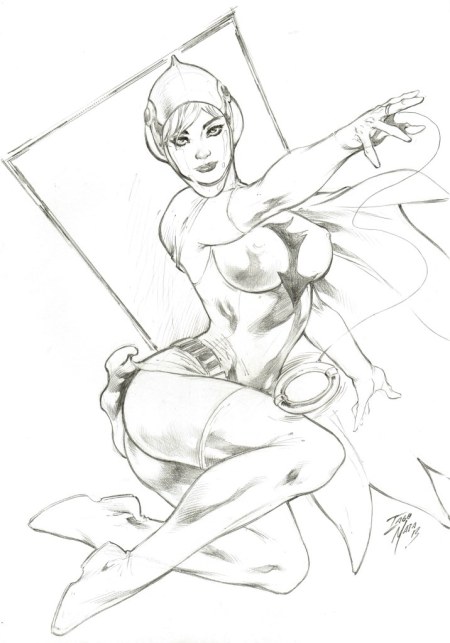
Princess a.k.a. Jun a.k.a. Agatha June a.k.a. Kelly, pencils by Iago Maia

Once upon a time (let’s call it the early 1970s), there was an anime series entitled Science Ninja Team Gatchaman (Kagaku Ninjatai Gatchaman in the original Japanese) about a five-member team of young superheroes-slash-ninja who dressed in costumes representing various birds. When ported over to the English-speaking marketplace in 1978, this series — in highly edited and rescripted form — became known as Battle of the Planets. Years later, the series was again recrafted for the West as G-Force: Guardians of Space. Still later — because Western packagers could never leave well enough alone — the show was retooled once more, this time as Eagle Riders.

Confused already? Okay, good.

To make matters even more convoluted, all of the characters in the series were given different names (and often very different personalities) in each version. The lone female member of the core team, whose costume represented a swan (any question as to why she was my favorite?), was called Jun in the original Japanese presentation. In Battle of the Planets, she became Princess. In G-Force, she was known as Agatha June (often “Aggie” for short). In Eagle Riders, her name was Kelly Jennar. (Why the characters in Eagle Riders suddenly had extraneous surnames is unclear to me. But then, has any of this nomenclatural folderol been clear to you?)

In all iterations, her primary fighting tool was a yo-yo. You did know that before it was marketed as a toy, the yo-yo was a Filipino weapon, yes? So the next time you yo-yo — y’know, like you do — you can thank the Ilocano people, not Mr. Duncan. Or Tommy Smothers.

Still confused? I must be telling the story correctly, then.

I first discovered Gatchaman in the late ’70s under the Battle of the Planets banner, so the young heroine depicted above by artist Iago Maia will always be Princess to me. But if you want to call her Jun, or Agatha June, or even Kelly, I won’t argue. Just don’t call her anything but awesome.

And that’s your Comic Art Friday.

Comic Art Friday: I say Martin, you say McDaniel

September 27, 2013

A while back, I was randomly browsing the comic art listings on eBay — you know, like you do — and I stumbled upon this drawing by artist Michael McDaniel of one of my favorite heroines, Wanda Maximoff, the Scarlet Witch.

The Scarlet Witch, pencils and inks by Matt Martin

Except… this isn’t a drawing by Michael McDaniel.

It’s a drawing by another artist, Matt Martin.

I can understand how the eBay seller, who I will presume is not terribly familiar with either artist’s work, could make that mistake. Both Matt Martin, who’s probably best known as a cover artist for Avatar Press (Lady Death, Crossed) and for his creator-owned series Snowman and Vortex, and Michael McDaniel, a popular pinup artist, sign their work with only their initials, MM.

Matt Martin’s signature, however, is unique in that he always surrounds it with a word balloon, as you can see in the Scarlet Witch piece above. Martin also stylizes his initials in an immediately recognizable fashion, as though the letters were dripping inky blood. (He’s primarily a horror artist, so that makes perfect sense.)

Conversely, McDaniel’s signature is clean and very linear, as shown in his own rendition of the Scarlet Witch, below.

The Scarlet Witch, pencils by Michael McDaniel

Having commissioned both artists on multiple occasions, I immediately recognized the mislabeled drawing as a Martin, rather than a McDaniel. That worked out fine for me. Now, I’m glad to have a Wanda in my collection by each of these talented gentlemen.

If you’d like to see another same-character comparison, take a gander at these two images from my Taarna gallery, both of which I commissioned directly from the artists in question.

First, here’s Michael McDaniel’s take on our Taraakian avenger.

Taarna, pencils by Michael McDaniel

Now, here’s Taarna, as envisioned by Matt Martin.

Taarna, pencils and inks by Matt Martin

Would you confuse the styles of these two creators, friend reader? I’m confident that you would not. But then, you’re probably not selling comic art on eBay.

In the above-cited instance, we’re talking about what I’m positive was an unintentional error on the part of the seller. (I want to make that clear. I’ve done business with this person numerous times over the years, and have never found him to be dishonest.) It underscores, however, the old maxim: Caveat emptor.

Stories abound of unscrupulous sellers misrepresenting art in order to increase its price tag. It’s not at all uncommon to find pieces in eBay’s comic art listings that are blatant copies of works by established name artists, or worse, outright forgeries. (In fact, I personally know a collector who unwittingly bought a forged version of an original drawing that I own, by an extremely popular artist.)

And I have no doubt that there are as many — perhaps more — cases like my Scarlet Witch, where the seller simply doesn’t know what he or she has. A buyer who is equally ill-informed might well end up purchasing something he or she will be disappointed to learn isn’t what it was represented to be.

Consider yourself warned.

And that’s your Comic Art Friday.

Comic Art Friday: You’re Thor? I’m tho Thor I can’t write an ethay

September 20, 2013

The truth can now be told: I’ve never much liked Thor.

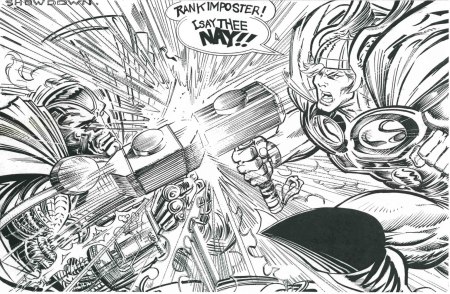
Steel vs. Thor, pencils by Trevor Von Eeden, inks by Joe Rubinstein

I actually think the concept of Thor — lightning-wielding proto-Viking with a flying hammer — is pretty awesome. The character himself? Not so much.

I want to like Thor. He’s a pillar of the Marvel Universe, an original Avenger, wears a wicked costume, and talks as though he wandered in from an improvisational Shakespeare road company. His adventures have been drawn by some of the greatest artists in comics history: Jack Kirby, John Buscema, Keith Pollard, and Walt Simonson, to name just a few. What’s not to like?

But from the dawn of my comics-reading days until now, Thor has always left me kind of cold.

Thor, pencils by Geof Isherwood, inks by Bob Almond

For me, Thor doesn’t work very well as a superhero. A superhero is a rather narrowly specific kind of fantasy character, a creature of modern urban mythology. Thor, who’s more or less a port-over from ancient Norse legend given a comic book twist, feels awkwardly shoehorned into superherodom. He’s too powerful to waste his time beating up Earthbound bad guys — which, let’s be frank, is also one of the main problems with the prototypical superhero, Superman — and yet, that’s mainly what superheroes do. It’s no accident that Thor’s best storylines place him outside the terrestrial realm and give him a more cosmic scope. But since he’s not a true spacefaring quasi-science-fictional character, like, say, Adam Strange or the various Green Lanterns, that doesn’t suit Thor very well either. So, he kind of floats in between, neither fish nor fowl.

We see this problem play out in Joss Whedon’s Avengers movie. Of all the titular heroes, Thor’s by far the least interesting — and, despite his familial connection to the villain of the piece, the one whose presence adds the least to the story. Which is saying something, considering how brutally that film treats Hawkeye, a character for whom I have a fair amount of affection. At least Hawkeye’s narrative, clumsy as it is, has some semblance of an arc.

Thor’s supporting cast can be fun. I’ve always had a soft spot for the Warriors Three, the triumvirate of bickering adventurers who occasionally pal around with the big guy. And Thor’s half-brother Loki makes a decent villain, as his enjoyable appearances in the first Thor and Avengers films attest. There’s at least a modicum of potential in the whole Asgardian thing.

Just not for me, I guess.

Thor, pencils and inks by Bob McLeod

To his credit, though, Thor does make for some appealing pictures.

At the top of this post is a Common Elements scenario pitting the Thunder God against another hammer-slinging hero, Steel. Penciler Trevor Von Eeden said that he wanted to comment on the relative merits of the two characters. I believe it’s clear whom Trevor favors in this duel. Veteran inker Joe Rubinstein contributed the finishes.

Next up, penciler Geof Isherwood and inker Bob Almond team up to present old Winghead in all his Mjolnir-gripping glory.

Lastly, Bob McLeod gives us a classic rendering of the Asgardian wunderkind.

Ah, Thor. I wish we could be better pals. Unfortunately, that would require you to be less lame. No Dr. Don Blake reference intended.

And that’s your Comic Art Friday.

Comic Art Friday: O Captain, my Captain!

September 13, 2013

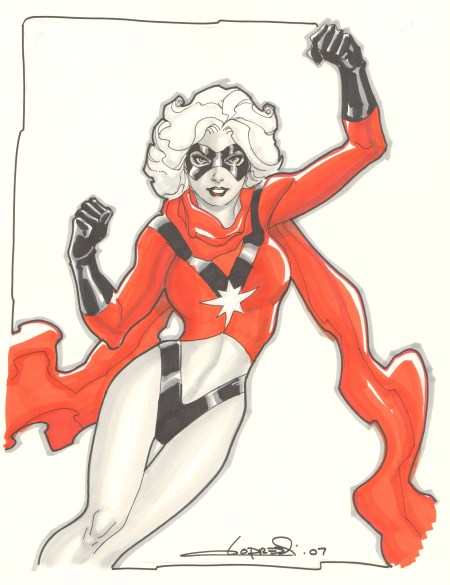
Ms. Marvel, pencils and inks by Aaron Lopresti

In the entertainment world, rumors are a dime a dozen. With the advent of social media, that value has plummeted to, say, about a dime per quadrillion.

Still, I was intrigued to note earlier this week the rumor that actress Katee Sackhoff — best known to genre fans as Starbuck on the reimagined Battlestar Galactica, and currently costarring on A&E’s modern-day Western-slash-police-drama Longmire — is being touted for a film role as one of my favorite superheroines, Ms. Marvel.

Except… okay… she’s not Ms. Marvel any more. She’s Captain Marvel now.

But not the guy in the red union suit with the lightning bolt on the chest. Then again, he’s not Captain Marvel any more.

I’ll explain.

Marvels vs. Marvels, pencils by Luke McDonnell

The original Captain Marvel first appeared in Fawcett Publications’ Whiz Comics #1 way back in February 1940. Enormously popular from the get-go — comics featuring Captain Marvel routinely outsold those starring Superman — the Big Red Cheese (as he was lovingly nicknamed) spawned an entire family of spinoff characters, including his sister Mary Marvel, his protege Captain Marvel Jr., and numerous Lieutenant Marvels. The publishing concern today known as DC Comics — National at the time — took Fawcett to court, arguing that Captain Marvel was a ripoff of their Man of Steel. (Never mind that Superman was himself, in some respects, a ripoff of Doc Savage and other characters who preceded him. But that’s an essay for another day.)

After years of legal wrangling, National/DC forced Fawcett to stop publishing the adventures of Captain Marvel and his cohorts, effectively pushing Fawcett out of the comics business. By the early 1970s, DC had won all rights to the Fawcett characters, and began putting out their own Marvel Family comics.

Only they couldn’t use “Captain Marvel” in the title of any of those books.

Why? Because in the intervening period when Captain Marvel lay fallow, the entity today known as Marvel Comics (who’d operated under various names, including Timely and Atlas, before settling on Marvel in the early 1960s) had created a new character named Captain Marvel, thus seizing claim to the then-inactive trademark. Marvel’s hero, unrelated to the Fawcett character other than in name, was a former soldier from a distant planet who embarked on a series of increasingly cosmic exploits. The real-world upshot meant that as long as Marvel kept a comic in active publication (that is, within a three-year window) with “Captain Marvel” in the title, DC couldn’t use that trademarked phrase in marketing any of its comics. Thus, DC resorted to “SHAZAM!” — their Captain Marvel’s transformational magic word — as the umbrella title for books featuring Cap and company.
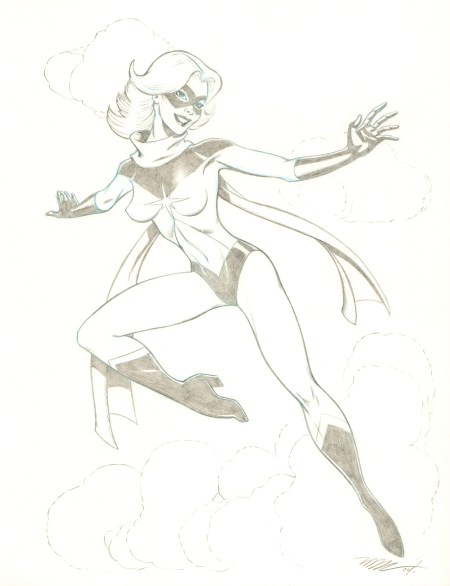
Ms. Marvel, pencils by Michael Dooney

In 1977, Marvel debuted Ms. Marvel, a distaff version of their Captain Marvel. (As both audience-expanding and trademark-grabbing moves, Marvel generated a host of female spinoffs during this period, including Spider-Woman and She-Hulk.) Ms. Marvel was the freshly superpowered incarnation of Carol Danvers, a supporting character who had floated around in the Marvel Universe background for several years prior. An officer in the U.S. Air Force, Carol’s new abilities (mainly super-strength, invulnerability, and flight) and costumed identity made her essentially Marvel’s equivalent to DC’s Wonder Woman, another powerhouse who likewise had a military career in her past.

Following the cancellation of her eponymous series after a two-year run, Carol (who flirted briefly with other codenames, including Binary and Warbird, but always returned to calling herself Ms. Marvel) moved on to a stint in the Avengers and occasional guest appearances in other Marvel books. She didn’t regain her own title until 2006, when writer Brian Reed and a revolving door of artists (Roberto de la Torre and Aaron Lopresti notched the longest tenures on the series) chronicled Ms. Marvel’s adventures until the book folded after four years. Last year, Carol ditched her longtime nom de guerre in favor of Captain Marvel (a name that had bounced around between a couple of different characters over the previous two decades), and began a new self-titled series under that banner.

Meanwhile, back at DC, the original Captain Marvel — who, as noted above, had headlined a variety of books with “SHAZAM!” in the title since the ’70s — finally gave up on the marketing nightmare a couple of years ago, and changed his own codename to Shazam (the name by which many readers called the character anyway, given the cover designation).
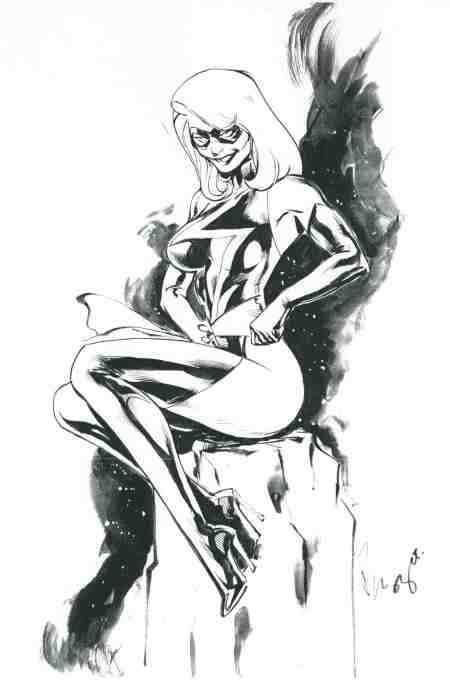
Ms. Marvel, pencils and inks by the comics artist Buzz

I’ve always really liked Ms. Marvel — I haven’t quite gotten the hang of calling her “Captain” yet — because from the time of her debut, she represented the kind of heroine that Marvel hadn’t had previously; an immensely powerful fighter who could battle mano a mano with any villain in the Marvel Universe. Plus, having grown up in a Air Force family, I felt a special connection to Carol due to her history in that service.

She remains one of my all-time favorites. I’d love to see her on the big screen someday. Katee Sackhoff, who exudes a kind of scrappy toughness, wouldn’t be a bad choice to portray her.

Of course, given how many decades I’ve been waiting for a Wonder Woman motion picture, I’m not holding my breath.
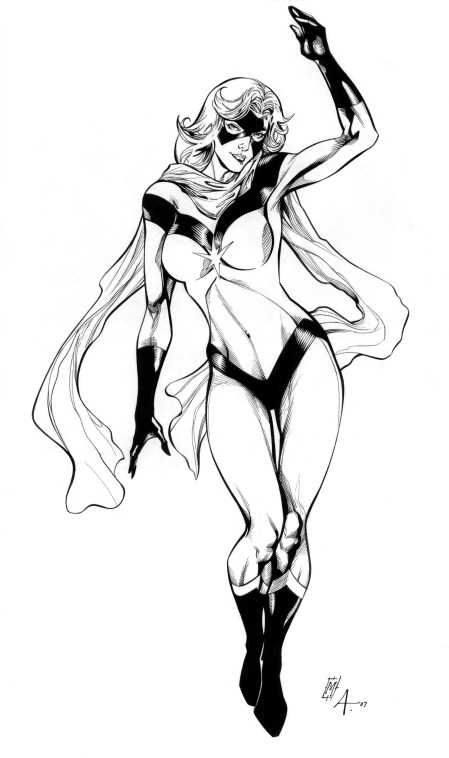
Ms. Marvel, pencils by Matthew Clark, inks by Bob Almond

A few notes on the art we’re presenting today, starting at the top of this post:

Ms. Marvel in her original (and still my favorite) costume by Aaron Lopresti, who at the time this piece was drawn (at WonderCon 2007) was the regular penciler on the Ms. Marvel comic.

A battle of the two Marvel Families, penciled by Luke McDonnell (JLA, Suicide Squad). On the left, from top to bottom: Mary Marvel; the original Captain Marvel; Captain Marvel Jr. On the right: Marvel’s first Captain Marvel (Mar-Vell of the Kree); Ms. Marvel; Marvel’s second Captain Marvel (Monica Rambeau).

Ms. Marvel, again in her original costume, penciled by Michael Dooney (Teenage Mutant Ninja Turtles). This piece was my very first Ms. Marvel commission, and also the first of my many commissions from Dooney.

Ms. Marvel in her second and longest-tenured costume (which I refer to snarkily as the Warbird Swimsuit), in beautiful brushed ink by the comics artist known as Buzz. (Buzz was supposed to draw Carol in her original costume, but forgot. I love this piece anyway… in spite of the Warbird Swimsuit.)

And back to the original — see how much better that looks? — with pencils by Matthew Clark (Adventures of Superman) and inks by Bob Almond (Black Panther, Infinity Gauntlet).

Finally, below: Ms. Marvel in battle against the sometime-villainous, sometime-heroic Moonstone; pencils by Scott Rosema (Space Ghost), inks again by Bob Almond.

And that’s your Comic Art Friday.

Ms. Marvel and Moonstone, pencils by Scott Rosema, inks by Bob Almond

Comic Art Friday: I wish I knew how it would feel to be free

August 30, 2013

This past Wednesday marked the 50th anniversary of Dr. Martin Luther King Jr.’s “I Have a Dream” speech, delivered on the steps of the Lincoln Memorial during the August 1963 March on Washington for Jobs and Freedom.

Thinking about that historic event put me in mind of a classic song, “I Wish I Knew How It Would Feel to Be Free.” Written in 1954 by jazz pianist Billy Taylor, the song was first recorded by Taylor in November 1963, just three months after Dr. King’s speech. Although dozens of artists have covered it since then — including a version by British pop singer Sharlene Hector that appeared in a Coca-Cola commercial a few years back — the best-known rendition of “I Wish I Knew” is the 1967 recording by the legendary Nina Simone.

As I sit here with Ms. Simone’s magnificent, inimitable voice resounding through my headphones, kindly take a moment to read and reflect on these lyrics, composed by Taylor and songwriting partner Dick Dallas.

I wish I knew how it would feel to be free.
I wish I could break all the chains holding me.
I wish I could say all the things that I should say —
Say ’em loud, say ’em clear, for the whole round world to hear.

I wish I could share all the love that’s in my heart —
Remove all the bars that keep us apart.
I wish you could know what it means to be me.
Then you’d see and agree that everyone should be free.

I wish I could give all I’m longing to give.
I wish I could live like I’m longing to live.
I wish that I could do all the things that I can do —
Though I’m way overdue, I’d be starting anew.

I wish I could be like a bird in the sky —
How sweet it would be if I found I could fly!
Oh, I’d soar to the sun and look down at the sea
And I’d sing ’cause I’d know how it feels to be free.

Like Dr. King — and like Billy Taylor, and Nina Simone — I long for the day when every person on earth can truly be free… free to be themselves, free to enjoy the wonders and blessings of life, free from hunger and want and pain and fear, free to be loved and accepted and embraced for their own individual uniqueness without reservation or qualification.

I don’t know that that dream will be fulfilled in my lifetime, or The Daughter’s lifetime, or even in this old round world’s lifetime.

But it sure would be sweet, wouldn’t it?

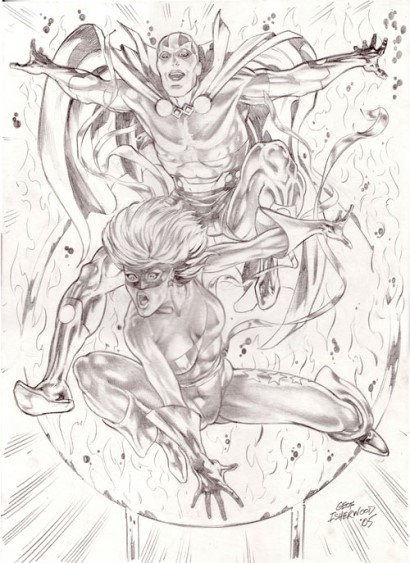
Free Spirit and Mister Miracle, pencils by comics artist Geof Isherwood

The Common Elements entry pictured above is entitled “Breaking Free,” mostly because it features Mister Miracle (whose real name is Scott Free) and Free Spirit, who was Captain America’s sidekick for a brief time in the mid-1990s. (Her real name is Cathy Webster, in case you’re keeping track.) Artist Geof Isherwood masterfully expresses the character’s feelings of liberation and joy in this gorgeous drawing. Every time I look at it, I feel just a little bit more as though I might know what it’s like to be free. That makes me smile.

And that’s your Comic Art Friday.