Archive for the ‘Reminiscing’ category

SwanShadow Gives Thanks: 10th Anniversary Edition

November 28, 2013

If you do something ten years in a row, it’s definitely a thing.

Every Thanksgiving beginning in 2004, I’ve paused here in my little corner of the World Wide Wackiness to express my appreciation for 26 people, places, and/or things, one for each letter of the English alphabet. Truth to tell, there are so many people, places, and/or things sharing my universe for which I am grateful, that if I seriously attempted to make an exhaustive list, I’d be typing from now until next Thanksgiving, by which time my fingers would long since have snapped off. Therefore, this has become my yearly exercise in gratitude, with its arbitrary format allowing me both room to range and boundaries at which to stop.

The list you’re about to read marks my 10th annual Thanksgiving post. (You are going to read it, aren’t you? You might as well; you’re here already.) Much has changed in my life during the decade since I composed the first one. No doubt, much more will change if I’m privileged to write others in Novembers yet to come. If I’m granted those opportunities, I promise to be as grateful — for everyone and everything listed, and for so much more — as I am on this Thanksgiving Day.

On this particular Festival of Turkey, I am thankful for…

Auditions. I have a weird job. The overwhelming majority of my working life is spent performing for free, in hope that someone will pay me money instead. Most workdays, I spend hours standing or seated (I switch it up a lot) in front of a microphone, auditioning for voiceover projects. Once in a while, I book one. As much I live for those latter moments, I also can’t help but appreciate how cool it is that for a few hours every day, it’s my task to just play.

Bay Bridge. We got a new one this year, finally — nearly a quarter-century after the original was horrifically damaged in the Loma Prieta earthquake of 1989, and three years after the not-yet-in-existence suspension span became the logo of the Golden State Warriors. The upgraded Bay Bridge will probably always play second fiddle to its more famous younger cousin around the corner, but it’s a beauty — and a treat to drive — nonetheless.

Crustaceans. Tasty giant insectoids that live underwater. I’m fond of all the edible species — lobsters, crabs, shrimp, langostines, crawfish, you name it. During our spring vacation in Australia,  the Pirate Queen and I dined on yet another variety that neither of us had ever tried: Moreton Bay bugs, prehistoric-looking creatures that resemble lobsters whose claws were snapped off, then were run over by a truck. Like their relatives worldwide, they sure were delicious.

Down Under. Speaking of Australia, we spent three incredible weeks touring the Island Continent and its next-door neighbor, the North Island of New Zealand. We saw a play at the Sydney Opera House, marveled at the mysterious sandstone monolith known as Uluru, explored a tropical rain forest north of Cairns, watched tiny penguins scurry ashore on St. Philip Island, enjoyed the view from two of the tallest towers in the Southern Hemisphere, and saw where the hobbits live. A spectacular adventure, and one that I should write much more about.

Enter the Dragon. The only motion picture to which I ever memorized every single line of dialogue. Throughout my teenage years, a poster depicting Bruce Lee in the film’s climactic fight scene graced my bedroom wall. In 2013, we lost Jim Kelly, who costarred alongside Lee as the irrepressible Williams. When Han, the villain of the piece, insists that Williams must prepare for defeat as well as victory, Williams replies with consummate cool, “I don’t waste my time with it. When it comes, I won’t even notice. I’ll be too busy looking good.”

Fountains of Wayne. When I need a quick pick-me-up, I throw on a tune by this power pop quartet from the Big Apple. Songs like “Denise,” “Maureen,” “Hey Julie” (my personal favorite), and the ubiquitous “Stacy’s Mom” never fail to put a grin on my face and some extra pizzazz in my step. The band’s name, incidentally, was cribbed from a garden ornaments store in Wayne, New Jersey.

Grandma. Not my Grandma, but The Daughter’s. With boundless patience and good humor, she shares her home with KM and her hyperactive canine companion Maddie. She graciously lets me drop in for visits, keeps me posted on goings-on in The Daughter’s life, and even hems a pair of pants for me on occasion. She’s not my mom, but after many years of dutiful service as my mother-in-law (she was my late first wife’s mother), she might as well be.

Heroes and heroines. Regular visitors here know that I own an extensive collection of original comic book superhero art. I started reading comics at age five, and from that time forward, the costumed characters who starred within those colorful pages became my fantasy friends. If you ask me why I love superheroes and superheroines, I can rattle off a litany of reasons. But the one that trumps all the others is this: It just feels good to be reminded that there are heroes in the world. The real ones don’t usually wear costumes. You know who you are.

iPad. It’s the device that serves up my VO scripts, delivers the news, keeps me in touch with friends and colleagues, and provides the occasional stress-alleviating game of virtual pinball. Thanks, Steve Jobs, wherever you are.

Jupiter Jones. The leader of the Three Investigators proved to my boyhood self that a smart chubby kid could be a hero. He proved it to Alfred Hitchcock, too. You could look it up.

KM, referred to more often here as The Daughter. The brightest, funniest, most thoughtful offspring any father could ever ask. I continue to be shocked and awed by the young woman she’s become. It’s unfathomable to me that she’ll be 25 next year. That’s the same number of years that I spent married to her mother KJ, who lost her battle with breast cancer in 2010, but left an indelible legacy in the daughter she birthed, raised, and continues to inspire.

LearnedLeague. It’s described by its creator and Commissioner, the honorable Thorsten A. Integrity, as “a creed, an ideal, a Weltanschauung.” I call it the universe’s greatest online trivia league, where some of the finest quizzers on Earth —  from Jeopardy! champions and Who Wants to Be a Millionaire winners to The Beast and The Governess from both the American and original UK versions of The Chase — assemble to do daily battle. An experience of knowledge warfare both adrenaline-pumping and humbling. Lately, more the latter.

Monterey Bay Aquarium. Endlessly fascinating and dazzlingly educational, it’s one of my favorite spaces to wander. Filled to bursting with phenomenal displays of ocean life, it’s as though Aquaman invited you to hang out at his house for the day.

Navigation apps. How did the directionally challenged among us get around before GPS? Maybe we didn’t. Some of us might still be out there, lost in the boondocks without a clue how to get home.

Oracle Arena, or as we like to call it during the NBA season, Warriors Ground. The oldest active arena in the Association is also the loudest, wildest, and — thanks to a long-overdue ownership change, leading to an influx of top-flight talent over the past couple of years — most exciting home court in basketball. With Splash Brothers Stephen Curry and Klay Thompson bombing away from downtown Oakland, All-Star David Lee maintaining a seemingly nonstop streak of double-doubles, center Andrew Bogut finally healthy to anchor the middle, and key acquisition Andre Iguodala completing the puzzle, the boys in blue and gold come ready to rock the house.

PayPal, for making it quick and easy to do business online, and for keeping the Pirate Queen gainfully employed.

Speaking of whom… all hail the Queen of Pirates, who shivers my timbers without ever threatening to make me walk the plank. (I think she’s thought about it, though.) We are at once the classic Odd Couple and a perfect match. It would be impossible to envision the second chapter of my adult life without her.

Renaissance Faire. Seriously, who doesn’t love spending a day surrounded by merry folk in Elizabethan drag, spouting in pseudo-Shakespearean patois like the mighty Thor? (Which raises the age-old question: Why did a supposed Norse quasi-demigod talk as though he’d wandered in from a road company of Hamlet? Discuss.) I totally get into the RenFaire atmosphere — it’s among the best venues for people-watching to be found anywhere. Park me on a hay bale while blackguards and wenches regale me with sea chanteys and bawdy songs, and I’m as giddy as Puck on a midsummer’s night.

Solvang. Remember: Copenhagen is Danish. Solvang is Dane-ish.

Tropicana Las Vegas. After burial in the bowels of the cavernous MGM Grand, followed by drowning in the screaming miasma of Circus Circus, TCONA — that’s the Trivia Championships of North America, for the uninitiated — finally found a fitting home in its third year, at the Tropicana. Laid-back, comfortable, user-friendly, and conveniently located, the Trop provided the best experience yet for our annual Continental Congress of quiz nuts. I was thrilled to hear earlier this month that we’ll be back there again next summer.

Uluru. The emotional highlight of our Australian expedition, nothing prepared me for the power and majesty of what Westerners formerly dubbed Ayers Rock. Scientists describe it as an inselberg — Uluru is to the Australian Outback what an iceberg is to the Arctic Ocean, albeit on a far more imposing scale. As immense as the rock we can see is, there’s a good 80% more of it under the desert surface. It’s as though God were holding this ginormous stone at the creation of the world, set it down in the center of Australia while He busied Himself with other creative tasks, then left it there. You should go see it. But be warned — billions (and I do mean billions) of obnoxious flies share the site.

Vermeer, Johannes. The legendary painter’s masterwork, Girl with a Pearl Earring — sometimes referred to as “the Dutch Mona Lisa” — made a tour stop in our fair city this summer. I’ve seen the image dozens of times, but standing before the actual canvas in all its luminous wonder shook me to my shoes. I literally had tears welling in my eyes as I looked upon this sublime beauty. A true representation of the power of art.

The Walking Dead. Both the TV series that the Pirate Queen and I have grown to love, and the video game series that keeps many of my talented voice acting friends employed. I haven’t scored a role yet. But I’ll keep trying.

Xhosa. How can you not love a language that sounds like humankind communicating with dolphins?

Yams… because it’s Thanksgiving, and they’re yummy.

Zite, the news aggregation app that puts all the cool stuff right at my fingertips. What’s great about Zite is that you can give it feedback on every article it offers — I like this or I don’t like that — and it adjusts future filtering based on your input. You can also set specific subject categories, from ocean-broad (“Politics”) to pinpoint-narrow (“Hunter Pence”), and the app will make sure you get a bounty of content on that topic. There are plenty of apps that function similarly, but I’ve yet to find one that does the job as efficiently and as effectively as Zite.

And as always, friend reader, I’m thankful for you, who take the time to stop in here from time to time and peruse my drivel. I don’t use that word “friend” lightly. I appreciate your kind attention, and hope that my words continue to prove worthy.

May you and the people you love have much to be grateful for on this Thanksgiving Day… and may we all be here for the next one.

Comic Art Friday: Catch me now, I’m falling

November 22, 2013

I thought long and hard — well, okay, as long and hard as I think about anything; which, given the attenuated nature of my attention span, is not all that long or hard, really — about what to post on a Comic Art Friday that falls on the 50th anniversary of President John F. Kennedy’s assassination.

Given that I was a toddler on this date in 1963, I haven’t any emotional tale to share about where I was or what I was doing when the news broke. I only kinda-sorta-vaguely recall the assassinations of Martin Luther King, Jr. and Robert Kennedy, and those occurred five years later. Thus, no deep personal insight here.

As a Presidential history buff, it does strike me as interesting that Kennedy’s assassination resonates with us the way that it does. Kennedy wasn’t the first President to be assassinated. That dubious honor fell to Abraham Lincoln, as has been extensively memorialized in print and on film. Two other Presidents — James Garfield and William McKinley — were bumped off within the following 40 years. By the time of Kennedy’s murder, it had been more than 60 years since a President had been killed, and Americans had largely begun to think that we had advanced beyond that sort of business.

Of course, we had not.

Captain America, pencils by comics artist Ron Adrian

Perhaps by coincidence, the Kennedy assassination would mark the start of a turbulent era in American public life. The rest of the 1960s and ’70s would see the polarizing Vietnam War, the full impact of the civil rights movement, the Watergate scandal, the resignations of Vice President Spiro Agnew and President Richard Nixon, and the Iranian hostage crisis. Politics in this country would never again be the same.

Ironically, it took a band of Englishmen to record one of the most provocative commentaries on this dark time in American history. In 1979, the Kinks released the album Low Budget, which featured a song entitled “Catch Me Now I’m Falling.” The lyrics read, in part:

I remember when you were down
You would always come running to me
I never denied you and I would guide you
Through all of your difficulties
Now I’m calling all citizens from all over the world
This is Captain America calling
I bailed you out when you were down on your knees
So will you catch me now I’m falling

That song reverberates through my synapses today as I think about the Kennedy assassination, and all that’s gone on in this country since then. We’ve fallen — and in my view, continue to fall — in many ways over this past half-century. And yet, by many other measures, we rise to levels that no other nation in the history of human civilization ever has.

Bizarre how that works.

I suppose that both our struggles and successes are to be expected, and are to some degree of a piece. We are remarkably accomplished as a people at making both good and bad, both love and hate, out of the same things; at finding unity in places that ought to divide us, while dividing ourselves over that which ought to unite us. Our greatest national strengths are often the cause of our most debilitating weaknesses… and vice versa.

I’m not entirely sure why that is. But that’s America for you.

And that’s your Comic Art Friday.

Comic Art Friday: Typhoon Taarna

November 8, 2013

It struck me this morning as ironic that on the birthday of the late, great Tony DeZuniga — who led the tsunami of artists from the Philippines that took the American comics industry by storm in the 1970s — his native land is being pummeled by one of the nastiest typhoons on record.

Weird universe we live in.

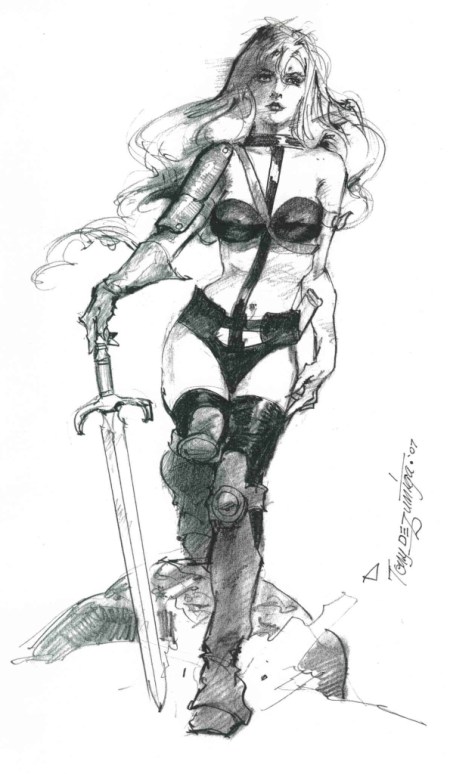
Taarna, pencils by comics artist Tony DeZuniga

I happened to be in the Philippines for a major typhoon once. On Thanksgiving Day in 1974, Clark Air Base — where my father was stationed at the time — was struck by Typhoon Irma, packing winds approaching 100 miles per hour. It was the most powerful typhoon to hit the area in the base’s 90-year tenure.

We lost electrical power by late morning. Fortunately, my mother had cooked the turkey early as a precautionary measure, so the bird was ready to roll at mealtime. Most of the accompaniments we ate cold, straight from the can. When we weren’t eating, we spent the day mopping up the water that blew in under the front door, bracing the windows with duct tape in case the winds shattered them, and praying that the roof would hold. It did. The bamboo pole that held our TV antenna aloft was not so fortunate.

Anyway, in memory of Mr. DeZuniga, that’s his rendition of Taarna, the heroine of the final segment of the animated film Heavy Metal, leading off this post. Below, you’ll see Taarna again, as drawn by Tony’s close friend and colleague, Ernie Chan, another member of the Filipino-American comics community who passed away a mere five days after Tony left us.

Again, irony.

Taarna, pencils and inks by comics artist Ernie Chan

Speaking of Taarna…

For several years, I maintained a reference page about Heavy Metal on Squidoo, the web community founded by marketing guru Seth Godin. A while back, I got a cryptic email from the site’s administrative team, advising me that they were shutting down my page due to some kind of inappropriate content.

Nothing in the notice explained exactly what content was under review. Although nudity is depicted in the film (okay, it’s animated nudity, but still), I didn’t use any nude images on the site. The text was 100% original — I wrote the entire page from scratch; no content was pirated from Wikipedia or any other site — and 100% profanity-free. The only links on the page went either to my Comic Art Fans gallery (where my Taarna commissions are displayed) or to Amazon (where readers could purchase the DVD of the film — the kind of link Squidoo encourages). So I have no idea what the issue was.

At any rate, I copied all of the text into a Word document for my own records, and deleted the page. If you want to know more about Heavy Metal — a landmark film in the history of animation, and an essential bridge between comics and the movies — you’ll have to look elsewhere than Squidoo.

You could always just ask me, of course. I know almost everything there is to know about the film.

I used to have a Squidoo page that demonstrated this.

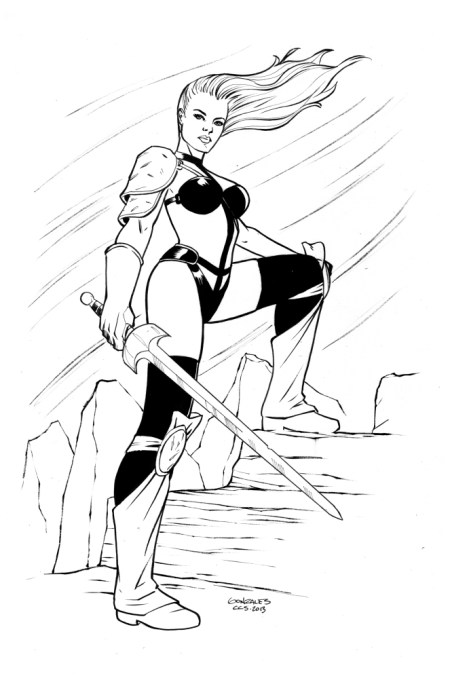
Taarna, pencils and inks by comics artist Gene Gonzales

Our final Taarna image is a new one, courtesy of Gene Gonzales, who — unlike Messrs. DeZuniga and Chan — is still with us, and still creating lovely artworks like this. I love the dramatic angle Gene employs here. Taarna looks strong and majestic, as a good Taarakian defender should. Her windblown hair is gorgeous as well.

Although…

…I hope that isn’t a typhoon stirring up.

And that’s your Comic Art Friday.

Comic Art Friday: I’m not saying I’m Batman, but you’ve never seen us together

October 18, 2013

Batman and Catwoman, pencils by Ron Adrian, inks by Di Amorim

When I was a young comics-reading lad, I always liked Batman.

Superman never really appealed to me because he was too… well… super. I mean, the guy could fly so fast he could travel through time, and so strong he could carry a planet out of its orbit. Who can identify with someone who can basically do anything he wants?

Batman, on the other hand, was just a really smart guy with lots of cool toys. He wasn’t inhumanly strong or fast, and he couldn’t fly. He was, however, the world’s greatest detective, and a supremely well-trained athlete — like Sherlock Holmes and a pre-plastic-surgery Bruce Jenner rolled into one. Or, to put it another way, he was Iron Man, without the armor, but with a host of other gadgets to accomplish most of the same tasks.

The Caped Crusader ruled in the late 1960s and early 1970s, especially when his adventures were chronicled by inventive creative teams: writer Denny O’Neil (and later, Steve Englehart) and artist Neal Adams (and in partnership with Englehart, Marshall Rogers) in Detective Comics, and writer Bob Haney and artist Jim Aparo in the Batman team-up series, The Brave and the Bold. (To this day, Aparo remains the definitive Batman artist to my eye. When I close my eyes and think, “Batman,” it’s Aparo’s rendering that I envision.)

I loved that Batman.

Then along came Frank Miller.

And the love died.

Batman and Catwoman, pencils by Al Rio, inks by Geof Isherwood

Frank Miller — a tremendously talented cartoonist (that’s the technical term for a comics creator who who both writes and draws, regardless of whether the material is comedic or dramatic), by the way — holds the unique distinction of single-handedly ruining two of my favorite superheroes — Batman and Daredevil. He did this by making both characters dark and hyper-violent, to the point of psychopathy: Batman, in Miller’s landmark 1986 miniseries The Dark Knight Returns; Daredevil, in Miller’s lengthy run (1979-1983) as first artist, then writer-artist, on the character’s eponymous series. Ironically, it was Denny O’Neil, whose Batman stories I so admired, who hired Miller for both jobs, in his capacity as editor, first at Marvel, then later at DC.

(More recently, Miller decided to become a film director so that he could destroy yet another of my boyhood idols: Will Eisner’s The Spirit. But that’s a rant for another day.)

Don’t get me wrong. I don’t oppose Batman being what he was originally intended to be — the grim avenger of the night. Let’s face it, he dresses in a bat costume for a reason. But Miller’s perspective robbed Batman of the features that made him so fascinating — his brilliant intellect; his investigative skills; his technical wizardry — and turned him into a thug in a bat suit. Someone could create great comics about a thug in a bat suit — in fact, Frank Miller did. But that character isn’t Batman. At least, not the Batman of whom I was once so enamored.

Some historian might well note that when Batman first appeared in comics in 1939, he was a much darker character. In his earliest issues, Batman even carried a handgun — and used it, frequently. (The same could be said of a number of Golden Age heroes; the Spectre, for example, took eerie delight in killing off evildoers using grotesque, often graphic, methods.) So, true enough.

But the Caped Crusader evolved away from that initial “gunslinging vigilante” image fairly quickly, just as Superman evolved away from “faster than a speeding bullet; more powerful than a locomotive; able to leap tall buildings in a single bound” into the almost godlike power-set with which we’re more familiar. For my money, the Batman who was the world’s foremost investigator and inventor — and a reasonably functional human being — is infinitely more interesting than the twisted, tortured, bloodthirsty antihero he is now.

But maybe that’s just me.

Always be yourself, unless you can be Batman. Then, always be Batman.

In an effort to reconnect with the more human (and more humane) side of the Dark Knight, today’s dynamic duo of artworks depicts Batman paired with his longtime nemesis-slash-paramour Selina Kyle, better known to the world as Catwoman. The piece at the top of the post features the pencils of former Supergirl artist Ron Adrian, embellished by his fellow Brazilian, Di Amorim. The scene in the center was penciled by the late, lamented Al Rio, with inks by the thankfully neither late nor lamented Geof Isherwood.

And that’s your Comic Art Friday.

Comic Art Friday: You can call her Princess… or not

October 11, 2013

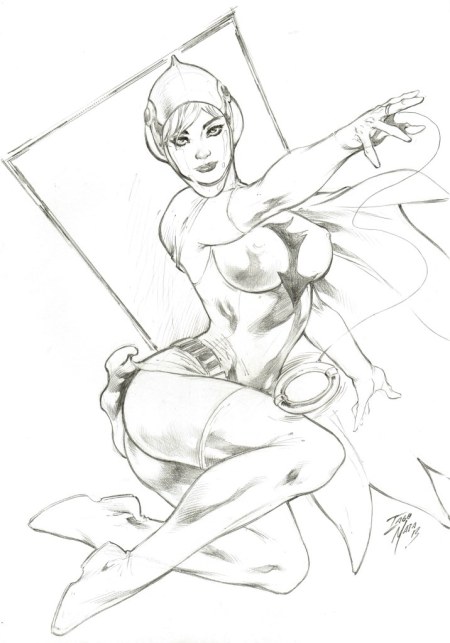
Princess a.k.a. Jun a.k.a. Agatha June a.k.a. Kelly, pencils by Iago Maia

Once upon a time (let’s call it the early 1970s), there was an anime series entitled Science Ninja Team Gatchaman (Kagaku Ninjatai Gatchaman in the original Japanese) about a five-member team of young superheroes-slash-ninja who dressed in costumes representing various birds. When ported over to the English-speaking marketplace in 1978, this series — in highly edited and rescripted form — became known as Battle of the Planets. Years later, the series was again recrafted for the West as G-Force: Guardians of Space. Still later — because Western packagers could never leave well enough alone — the show was retooled once more, this time as Eagle Riders.

Confused already? Okay, good.

To make matters even more convoluted, all of the characters in the series were given different names (and often very different personalities) in each version. The lone female member of the core team, whose costume represented a swan (any question as to why she was my favorite?), was called Jun in the original Japanese presentation. In Battle of the Planets, she became Princess. In G-Force, she was known as Agatha June (often “Aggie” for short). In Eagle Riders, her name was Kelly Jennar. (Why the characters in Eagle Riders suddenly had extraneous surnames is unclear to me. But then, has any of this nomenclatural folderol been clear to you?)

In all iterations, her primary fighting tool was a yo-yo. You did know that before it was marketed as a toy, the yo-yo was a Filipino weapon, yes? So the next time you yo-yo — y’know, like you do — you can thank the Ilocano people, not Mr. Duncan. Or Tommy Smothers.

Still confused? I must be telling the story correctly, then.

I first discovered Gatchaman in the late ’70s under the Battle of the Planets banner, so the young heroine depicted above by artist Iago Maia will always be Princess to me. But if you want to call her Jun, or Agatha June, or even Kelly, I won’t argue. Just don’t call her anything but awesome.

And that’s your Comic Art Friday.

Michael Rankins. Jeopardy! 1980s Fan Favorite. Vote. Yadda, yadda.

September 30, 2013

Choose Michael Rankins as your Jeopardy! 1980s Fan Favorite!

So, here’s the deal.

I’m Michael Rankins — you knew that, right? nobody’s real name is SwanShadow, for crying out loud — and way back in 1988, I was a five-time undefeated champion on Jeopardy!, America’s favorite quiz show. You can see how young and serious I was then, in the graphic above. (You’d think they’d have found a pic of me smiling, wouldn’t you?) I was also a semifinalist in the 1988 Jeopardy! Tournament of Champions; a participant in the first prime-time Jeopardy! tournament, Super Jeopardy! in 1990; the winner of the Jeopardy! Battle of the Bay Area Brains in 1998; and a Round One winner in the Jeopardy! Ultimate Tournament of Champions in 2005.

Okay, résumé over.

Now, I’m competing for the chance to go head-to-head against other 1980s Jeopardy! champions in the show’s 30th Anniversary Season Battle of the Decades! The Battle of the Decades is bringing back former Jeopardy! champions from the 1980s, 1990s and 2000s to compete in a multi-level tournament, that will begin airing in February 2014. The show’s producers have already selected 14 champions from each decade, but the 15th and final spot in each tournament is up to Jeopardy! fans — this means YOU — via an online voting campaign. I’ve been selected as one of five candidates for the 1980s Fan Favorite slot in this mega-event.

To get there, I need your help!

Here’s how you can throw me your support starting today, and continuing daily until 6:59 a.m. Pacific Daylight Time on Monday, October 7.

  • If you’re on Facebook, you can go to the Jeopardy! Facebook page (a.k.a. Facebook.com/Jeopardy) and use the Battle of the Decades voting tab. Just like on the Jeopardy! site, you can choose me as your Fan Favorite, and click “Vote Now!”
  • If you’re a Twitter user, you can vote for me by tweeting: Michael #JeopardyVote. (Be sure to include both my first name and the hashtag.) One such tweet per day counts as a vote for me.

It’s that easy! You can vote for me once each day in each format — that’s one vote on Jeopardy.com, one vote on the Jeopardy! Facebook page, and one vote via Twitter using my first name and the special hashtag: Michael #JeopardyVote. Again, voting starts today, and continues until next Monday morning, October 7, at 7 a.m. PDT.

I’m not the sort to ask folks for much — if you know me, you know that. But if you would take a moment each day this week to vote for me — once per day in all three locations, if you have Facebook and/or Twitter accounts — I would be eternally grateful. (Well, for this lifetime, anyway.) And I’d especially consider it an honor and favor if you’d invite your friends, family members, and other contacts to vote for me too.

By the way, each of the other four nominees is a worthy champion also. Some of them I’ve come to know at least a little over the years, and they’re all cool people. Any of us would do you proud in representing our Decade of the 1980s as your Fan Favorite. But if you’re inclined to give me your votes, please know that I treasure your generous support. (And please, vote fairly. No spambots. I want your help, but not that kind.)

Thanks for your time, friend reader.

Now, please… go vote for me as your Jeopardy! 1980s Fan Favorite!

Comic Art Friday: I am my art collection, and my art collection is me

July 19, 2013

The Great Comic Art Inventory of 2013 is finished.

When I say “finished,” that’s a slight overstatement. Not every entry in the database is 100% complete. There’s a small group of pieces — mostly items I bought via eBay between late 2007-early 2008 and mid-2010 — for which I still need to research and input purchase prices. (That information resides on my current PC’s immediate predecessor, so I’ll have to go to that computer to look it up.)

Comet and Vixen, pencils by comics artist Luke McDonnell

Aside from that, though, I’ve accomplished what I set out to do. There’s a unique entry for every piece of comic art in my collection (with the exception of 20 published pages from Millennium Comics’ Doc Savage, Man of Bronze: The Monarch of Armageddon #1, which I considered a single item). I’ve recorded the artist(s) and character(s) pertaining to each piece, as well as the item’s size, medium, purchase price or commission fee, and other pertinent details. For the first time in several years, I can tell at a glance exactly how many artworks I own, and can easily access all of the information about each work that I’d ever care to know. In many cases, more than I’ll ever care to know.

This inventory proved far more than a mere data-compiling exercise. To do the project justice, I required myself to connect, visually and physically, with every single item. I handled each piece — touched it, measured it (even those whose dimensions seemed obvious at first glance), looked at it up close and in person — often, for the first time in years. I saw each piece with fresh eyes. I was stunned by how emotional the experience was. It’s ineffably different holding an artwork in your hands — or at least, seeing the physical work — than observing a digital image on a screen. When you can really examine every pencil or pen line or brush stroke, you climb into the mind of the artist in a way that is otherwise impossible.

It’s a humbling reminder of why art is such an essential element of humanity.

Spider-Woman, pencils by comics artist Thomas Fleming

Not long ago, the Pirate Queen and I went to San Francisco’s DeYoung Museum to see Johannes Vermeer’s Girl with a Pearl Earring, currently touring the U.S. and Japan. I’ve seen this painting dozens of times in photographs. I’ve even watched the film that presents a fictional account of its creation. But viewing Vermeer’s actual canvas in person was altogether different, and powerful. Tears welled in my eyes as I stood before it, and saw the nuances that no reproduction can fully capture. In a gallery crowded with strangers, I felt for a moment utterly alone with the artist’s creative force, preserved in a painting nearly 350 years old.

I don’t own anything that approaches that Vermeer; no offense intended to any of the artists whose work I do possess. But as I paged through and pondered the hundreds of drawings in my collection, mostly late at night in the quiet of my living room, I felt many reactions equally potent. At times, I found myself enveloped in magical rapture. At others, I laughed out loud. In still other moments, my mind raced into the panel to invent an entire story based on the single scene that my eyes took in.

Daredevil, pencils by Michelangelo Almeida, inks by Bob Almond

And then, there were memories, and personal connections. More than half my collection consists of artworks I commissioned — pieces that exist only because I hired artists to draw them. Each of these carries a back story of how it came to be — correspondence, dialogue, and in a few cases, lasting friendships made. I’ve been fortunate, in that most of my commission experiences have been positive. I’ve not, unlike many of my collecting compatriots, had scenarios where an artist took money for a commission and never delivered the art, or had to be hounded for years before finally coming through. (I’ve had to chase a commission here and there, but rarely for more than a few months.) I’ve rarely had a commission result in a piece of art that I actively disliked. (There have been a couple, but looking at them again after the initial disappointment has faded into history, in most cases I appreciate them better now.)

I thought quite a bit about artists who’ve passed on since I commissioned them, or since I purchased their art. I’m grateful for the several pieces I own by Dan Adkins. I’m grateful for the many works — some commissioned, others not — by the amazingly talented Al Rio, and wish I had commissioned him even more. I’m glad I commissioned so many pieces from Ernie Chan and Tony DeZuniga, and I dearly miss chatting with them both at conventions. I discovered a lovely handwritten note that Jim Mooney — whose career as a comic book artist spanned more than a half-century — sent me when I bought a drawing from him. There’s a nice image by the once-ubiquitous George Tuska in one portfolio. I’m still sad that Dave Simons, a delightful man, never had a chance to complete the commission he started for me, though I love the Common Elements that Dave’s longtime collaborator Bob Budiansky created in his memory. And I still wish I had back the other drawing by Mike Wieringo that I sold mere months before his sudden, untimely death, to go with the one Ringo original I’ve held onto.

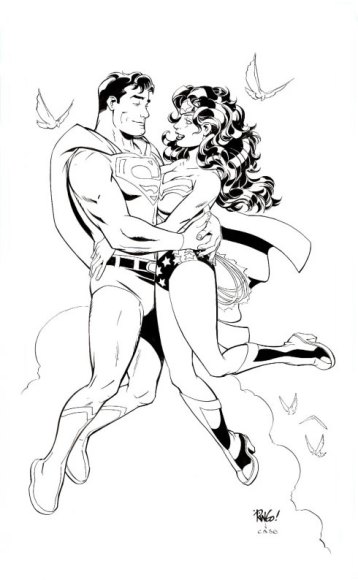
Superman and Wonder Woman, pencils by Mike Wieringo, inks by Richard Case

More than a few pieces in my collection were impulse buys — things I saw (usually on eBay) and thought, “Wouldn’t it be cool to have that?” Some of these purchases, in retrospect, might not have been wise investments. But there are others that, years down the road, make me ecstatic that I pulled that trigger. And the fact of the matter is that every preexisting piece I’ve bought somehow resonated with me in the moment — something about the image motivated me to spend money on it. It’s interesting to reflect upon what that resonance was, and to consider whether it still exists, or has faded with time.

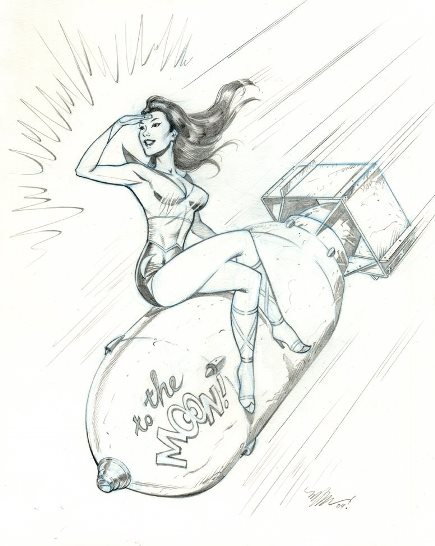
Equally intriguing, there’s the realization that my art collection is uniquely reflective of me. No one else would have commissioned all the works I’ve commissioned, or purchased the exact combination of other pieces that I’ve compiled. There’s no other theme collection quite like Common Elements. Although there are any number of nose art-inspired pinups, no one else has an aggregation of them referencing Golden Age superheroines, certainly not in the specific manner that Bombshells! does. No other collector, to my knowledge, collects images of both Taarna, the silent avenger from the film Heavy Metal, and Isis, from the ’70s Saturday morning TV series. Other collections of Wonder Woman, Supergirl, Storm, Mary Marvel, and the Scarlet Witch exist, but I don’t know of another collection with a focus on all five. And none combine the above with a Black Panther gallery, or a group of images of male-female couples or teams.

Bombshell! Moon Girl, pencils by comics artist Michael Dooney

No one else would have done this — built this specific collection, exactly this way. No one else could.

Therefore, when you look into my portfolios or online galleries, you look into me.

That’s amazing — and more than a little frightening — to think about.

And that’s your Comic Art Friday.

Comic Art Friday: There’s no “I” in “Superteam”

June 28, 2013

I’ve commented a few times recently about the inventory I’m conducting. I’m roughly a third of the way through the process: Common Elements and the book dedicated to Supergirl art are completely done, as is the book in which I keep miscellaneous odd-sized pieces that don’t fit well into the 14″ x 17″ Itoya Profolios I use for storage. At the moment, I’m halfway into the Bombshells! theme group, and will probably work on the Wonder Woman portfolio next.

Two Fridays ago, we considered a piece I rediscovered as I delved through that miscellaneous stack. Here’s another I’d forgotten was in there.

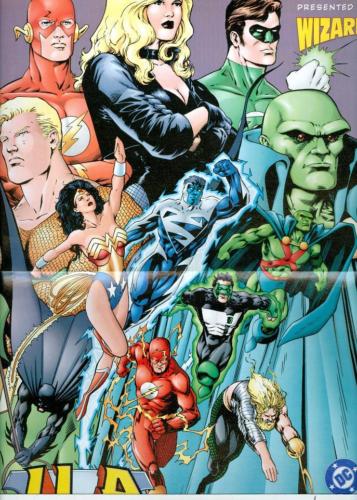
Justice League preliminary pencil sketch by Barry Kitson

It’s a preliminary sketch by Barry Kitson, the British superstar who first made his mark in the UK on Judge Dredd. On this side of the Pond, Kitson’s pencils have elevated numerous properties for both major comics publishers, including noteworthy runs on Marvel’s Amazing Spider-Man and The Order, and DC’s Teen Titans, Legion of Super-Heroes, Batman: Shadow of the Bat, and Adventures of Superman.

When I bought this sketch a few years back — and still more recently, when I stumbled upon it again — I had no idea why Kitson had drawn it. Thanks to another collector who posts to Comic Art Fans, however, I now know that it was a preliminary study for a mini-poster Kitson created for the late, more-or-less-lamented Wizard Magazine to promote DC’s then-upcoming JLA: Year One series, which Barry penciled. I found this image of the finished piece online, so you can see how it turned out once fully penciled, inked, and colored.

JLA: Year One mini-poster by Barry Kitson, published in Wizard Magazine

I still don’t know who “Pete” is, to whom Kitson inscribed the prelim. Based only on the note, I’m guessing that “Pete” was a collector who bought some of Kitson’s JLA: Year One pages, and Kitson included the sketch as a bonus. Unfortunately, I didn’t record the identity of the person from whom I bought the piece, and given that I’ve slept several hundred times since then, I no longer remember. Somehow, I don’t think that person’s name was Pete, but I could be wrong.

On the other hand, I remember quite well why I wanted the item in the first place, aside from the obvious fact that I don’t own anything else by Barry Kitson. My favorite comic series have always been supergroup and team-up books. I always felt I was getting more for my money when multiple heroes and/or heroines appeared on the cover of a comic. Thus, I gravitated toward books offering that benefit.

Which leads me into a bit of Listology…

Uncle Swan’s Top 12 Favorite Superhero Teams of All Time

12. Metal Men. This unusual bunch consisted of six sentient robots invented by the brilliant scientist Will Magnus. Each robot was constructed primarily from a different chemical element, and manifested the unique properties of — and personality traits suggested by — his or her constituent metal. Gold, the team leader, was brave and noble, and could stretch his robot body into any imaginable shape. Iron was strong, both in physical power and in attitude. Lead was dense, literally and figuratively. Tin was weak and emotionally unstable. Mercury was — wait for it — mercurial. Platinum, usually called Tina, was a beautiful female robot with a passionate crush on her creator Dr. Magnus. (More recent reboots added a second female member, the sharp-tongued Copper.) The Metal Men’s adventures played as much for comedy as for drama, which was probably why I enjoyed them so much back in the day.

11. The Champions. Remember when you were a kid, and you had access to a self-service soda fountain? There was always the temptation to mix all the different flavors together in one cup, just to see what it tasted like. If you did that same thing with superheroes, you’d get the Champions. In the mid-1970s, Marvel writer Tony Isabella had the idea of putting together a bunch of second-tier characters who had nothing in common, just to see what would happen. Thus, we had Angel and Iceman from the original X-Men lineup, teamed with the demigod Hercules, the demonic motorcyclist Ghost Rider, and the Russian spy turned superheroine Black Widow. Yeah, that made no sense at all. And ultimately, it didn’t work — the Champions folded after just 17 issues. They were fun while they lasted, though.

10. New Warriors. Despite the name, there was never an “Old Warriors” or “Original Warriors” team. Which begs the question, Why not simply call this group “Warriors”? I dunno. Maybe they wanted to distinguish themselves from the street gang in Walter Hill’s classic movie, or from my favorite basketball team. And how long can you call yourselves “New Warriors” before you stop being “new”? Whatever the case, the New Warriors came together as a band of rebellious young heroes under the leadership of high-tech urban ninja Night Thrasher. Founding members included human rocket Nova, flame-wielding Firestar, aquatic Namorita, energetic Speedball, and Marvel Boy, who quickly realized how lame his code name sounded and started calling himself Justice instead. Today, the New Warriors are best known as the catalysts for Marvel’s epic Civil War crossover event.

9. Heroes for Hire. As is typical of Marvel’s superteams, the all-about-the-Benjamins Heroes for Hire have undergone more lineup changes than you can shake a no-prize at. Originally, the team consisted of Luke Cage, a.k.a. Power Man, and his martial artist pal Iron Fist. The Daughters of the Dragon — Misty Knight and Colleen Wing — often worked alongside the duo. Over the decades, the ever-shifting roster has mostly centered around Misty as de facto leader — sometimes in partnership with Colleen, but lately without — with support from a variety of morally ambiguous types, including most frequently the mercenary Paladin. Shang-Chi (Master of Kung Fu), the Black Cat, Silver Sable, and the Punisher are among the more prominent characters who’ve wandered onto and off the team at various times. Always an entertaining assemblage.

8. Suicide Squad. Similarly to Heroes for Hire, Suicide Squad has served as a focal point around which to gather some of DC’s more questionably heroic characters. As originally conceived, the Squad consisted mostly of former supervillains who agree to serve as covert government agents in exchange for clemency. At the head of the organization is the powerful and ambitious Amanda “The Wall” Waller, who manipulates the team to further her own shadowy objectives. In addition to out-and-out baddies as Deadshot and Captain Boomerang, the Squad also enlisted more typically heroic members, including Bronze Tiger, Nightshade, and Vixen. A noteworthy event in the Squad’s early history involved the death of its field leader, Rick Flag.

7. Legion of Super-Heroes. My comics-reading friends and I often referred to these far-future Superhero Scouts as “the Legion of Stupid Heroes,” for their propensity toward juvenile code names (male members were typically designated as “Boy,” “Lad,” or “Kid,” while females were “Girl,” “Lass,” or some similarly ridiculous feminine identifier) and ludicrous powers (illustrated most notoriously by Bouncing Boy, who was basically a human Spaldeen, and Matter-Eater Lad, who… well… I’m killing brain cells just thinking about him). But I loved the Legion in spite of their silliness, because their adventures were fun, their youthful enthusiasm and camaraderie were endearing, and you could tell that the writers didn’t take the whole business too seriously. Hey, remember that? When superheroes didn’t always have to be so depressingly serious? Man, I miss those days.

6. Justice League of America. DC’s all-star super-squad raised the bar for all who would follow their 1960 debut. I still like the expanded original lineup the best: Superman, Batman, Wonder Woman, Green Lantern Hal Jordan, the Flash, Aquaman, Martian Manhunter, plus early additions Green Arrow, Hawkman, and the Atom. Basically, all the major superhero food groups are covered right there. (Don’t get me started on the proliferation of random spinoffs — Justice League International, Justice League Detroit, Justice League Dark, Justice League of Their Own… okay, I made that last one up. But you get the idea.) The JLA always seemed a bit superfluous — if you have Superman, Batman, and Wonder Woman, do you really need any of the others? — and its stories worked best when the Triumvirate were marginalized or absent altogether. Still, I have to give them credit for being the first superteam of the Silver Age and beyond. Which brings us to the original superhero conglomerate…

5. Justice Society of America. From the day I first discovered the JSA, I liked them better than their modern-day counterparts. For one thing, the original constituent characters are just so weird and loopy in that retro sort of way that you can’t help but dig them. I mean, come on — Hourman? A superhero whose powers run out in an hour? Who advertises that weakness to every villain he faces by making it HIS NAME? How do you not love that guy? Put him alongside the Spectre (a reanimated corpse who loves killing people in bizarre ways), the Sandman (“I’ll put you to sleep with my gas gun!”), the original Atom (who had no powers at all, aside from a heavy-duty case of Short Man Syndrome), and Doctor Fate (basically, Mandrake the Magician with a cool helmet), and you’ve got a recipe for comic greatness. The JSA’s present-day incarnation, with its ginormous cast featuring such stalwarts as Power Girl and the current Mister Terrific alongside holdover founders such as the original Flash and Green Lantern Alan Scott, has been fun too.

4. The Defenders. Billed as Marvel’s “non-team,” the defenders started with an unbeatable three-star core: the Hulk, Namor the Sub-Mariner, and Doctor Strange. The big three were soon joined by the cosmically powered Silver Surfer, plus a motley array of supporting players — most notably Valkyrie, Nighthawk, and Hellcat — who eventually came to dominate the stories. Unlike the aforementioned Champions, a cut-and-paste crew that never quite gelled, the Defenders’ nonsensical admixture of heroes pretty much always worked, even as the roster evolved to include such ill-fitting pieces as the Gargoyle and Damian Hellstrom, the Son of Satan. The former Justice League creative team of writers Keith Giffen and J.M. DeMatteis and artist Kevin Maguire reconvened the first four Defenders for a hilarious seriocomic miniseries in the mid-2000s.

3. X-Men. I still have a soft spot for the original roster: Angel, Cyclops, Beast (pre-blue fur), Iceman, and Marvel Girl (the not-yet-Phoenix Jean Grey), plus the wheelchair-bound Professor Charles Xavier. The first tears I ever shed over a comic book came with “The Death of Professor X” in Uncanny X-Men #42 (March 1968). I remember how sad I was when Marvel relegated the team to reprint stories for several years in the early 1970s. However, I remember with equal vividness seeing the cover of Giant-Size X-Men #1 on the comic rack at Subic Bay Naval Base in 1975, and being introduced to the second-generation team starring Wolverine, Storm, Nightcrawler, Colossus, and former villain Banshee alongside returnee Cyclops. The early issues of the revived run, written by Chris Claremont and drawn first by Dave Cockrum, then by John Byrne, remain among my favorite comics of all time. (I’ve enjoyed the various animated series and live-action films, too, though not as much as those amazing comics.)

2. The Fantastic Four. A squabbling family of superheroes — super-intelligent, emotionally distant dad; romantic but exasperated mom; brash kid brother; and gruff-but-lovable uncle — unlike anything that preceded them. The first comic book I can recall reading was a hand-me-down copy of Fantastic Four Annual #3. I was immediately addicted, as though the ink on the pages was suffused with crack cocaine. And it was the FF (quickly followed by Spider-Man) who sealed that addiction. They seemed so much like real people — unlike most heroes in juvenile fiction of the time, they fought and argued and teased and lovingly poked fun at each other, all while saving the world from galactic menaces. I wanted to be Reed Richards more than I wanted to be any other comic book hero until the arrival of the Black Panther: he was a super-genius with an insufferable ego and an answer for everything (hmm… know thyself?), who saddled himself with the lamest code name in comics (“Mister Fantastic”? Really?) and got stuck with the least useful superpower on the team.

1. The Avengers. For me, the Avengers really came to life once the founding lineup — Iron Man, Thor, Ant-Man (who soon changed code names to the more impressive Giant-Man), and the Wasp, plus the Hulk, who took off after the first issue — dissolved. Captain America, thawed from his icy suspended animation in Avengers #4 and granted “founding member” status in the Hulk’s stead, was tasked with rebuilding the team from scratch, and made what seemed like incomprehensible choices for “Earth’s Mightiest Heroes”: Hawkeye, Quicksilver, and the Scarlet Witch, all reformed villains. The new mix of quirky, often conflicting personalities gave the stories more emotional heft. With the return of ex-Ant/Giant-Man Hank Pym (now called Goliath, and eventually Yellowjacket) and the Wasp, and the additions of Hercules, the android Vision (who married the Scarlet Witch) and the Black Panther, the Avengers developed into a premier team. The roster would change almost constantly from then on — I think practically every hero and heroine in the Marvel Universe has been an Avenger at some point or other — but the tradition was now firmly established.

And that, superteam members, is your Comic Art Friday.

Comic Art Friday: Off the cliff

June 14, 2013

In last week’s Comic Art Friday post, I noted several theme commission collectors whose galleries continue to inspire my own efforts. With today’s featured artwork, I’m reaching back to one of the first theme collections of which I ever took serious notice.

Tesla Strong, pencils, inks, and markers by comics artist Phil Noto

Walt Parrish is revered in comic art collecting circles as “The Cliff Guy.” As you look at Phil Noto‘s drawing of Tesla Strong (daughter of Tom Strong, hero of Alan Moore and Chris Sprouse’s eponymous series for America’s Best Comics), which moved from Walt’s collection to mine about three years ago, you can appreciate where the nickname came from. Walt’s theme was “comics characters on a cliff.” That’s it — simple, elegant, evocative. His online galleries once held hundreds of artworks, from rough sketches to elaborately finished pieces, built around that concept.

Artists always seemed particularly inspired by the “Cliffs” theme, perhaps because it challenged them to come up with some unique way to depict a character on a cliff. So they played around with perspectives, angles, and poses. Characters stood on cliffs, fell off cliffs, dangled from cliffs, or even looked up at cliffs. Quite a number of the “Cliffs” drawings were intensely dramatic. Almost as many were humorous. All were unique.

About three years ago, Walt sold a large portion of his art collection. At the same time, he took down all the images from his “The Cliff Guy” website. His remaining galleries at Comic Art Fans, last updated in December 2010, showcase a smattering of pieces marked as “Art I Used to Have.” I don’t know whether Walt stopped collecting altogether, or if he merely decided to downsize his holdings and forgo a public presence for the remainder. I certainly don’t know his reasons for doing whatever he did, and it would be unfair for me to speculate.

All I know is, I miss the Cliffs.

I’m glad to own a reminder of Walt’s terrific theme. But I have to admit — it makes me more than a trifle sad to look at it, thinking of the once-inspiring collection whence it came.

Tesla seems sad, too.

At the moment, I’m engaged in a massive project: a comprehensive inventory and catalog of my comic art collection. It’s a ton of work, but it’s also been great fun, as I reconnect “up close and personal” with every single piece of art I own. I’m forced to recall how I acquired each item — both those I’ve commissioned, and the many others I’ve purchased that existed before they came my way — and the reasons for each acquisition. I’ve rediscovered a few pieces I’d completely forgotten that I owned — today’s feature being one example. I’ve certainly encountered some that made me question my judgment at the time of purchase. For the most part, I’ve experienced profound joy at seeing these creations again, at holding the paper in my hands and admiring each pencil line, pen mark, and brush stroke. The scans you see here never reveal the complete extent of the artist’s mastery. Only when observing the physical artwork directly can you truly drink in all of the magic.

Yet, with all of the laughter and wonder I draw from this exercise, there’s a darker undercurrent. I ask myself whether the day will come when these images no longer impart any pleasure to me, and I will find myself with endless stacks of paper that afford no value, tangible or intangible. Will there come a time when my galleries lie empty, save for a sorrowful sampling of “Art I Used to Have”?

I thought I might have reached that point three years ago, when KJ died. (For the benefit of any newcomers in the crowd, my first wife — referred to herein as KJ — passed away in 2010 at the far-too-young age of 44, following a 10-year battle with breast cancer.) To say that KJ tolerated my art collection is to understate the mystery that said collection — and my obsession with it — presented for her. Never having been a comics reader, she felt neither attraction nor attachment to images of fictional characters in outlandish costumes, and never really comprehended why I felt both. She certainly distressed at times over the fiscal investment that fueled my predilection. Yet, she graciously (or at the very least, mostly silently) went along as I filled ever-increasing numbers of portfolios and frames with superheroes and superheroines, with little more than a head shake and heavy sigh.

Amid the crushing, debilitating sadness that accompanied KJ’s final months, and the aftermath of her passing, I often asked myself whether she was right.

Indeed, I contemplated at more than one juncture selling off the entire lot that would sell, and destroying the rest in a bonfire. I thought perhaps that would be a fitting tribute, given her disdain for all of it. I could not see, at times, that even I would ever find happiness in these admittedly temporal, juvenile pictures again.

But eventually, the darkness parted.

And I stepped back from the cliff.

I have always been, and fear that I always will be, an insular creature. That I have lived so much in the fields of my own imagination stems largely from childhood circumstances that I’ll sketch in the briefest terms — I grew up an adoptive child, and an only child, in a family that moved constantly (my dad was career Air Force) and loved sparingly. Always a highly intelligent (I could show you the test scores) yet socially awkward kid, my closest friends were often the characters in fantasy novels and stories I read, in science fiction films and TV shows I watched — and especially, in my omnipresent comic books.

These heroes and heroines became an essential, inextricable component of my inner self. They gave the childhood and adolescent me the power to soar, to strive, to subdue, and to survive.

I’m an infinitely more complete person as an adult. These days, I read precious little fantasy literature, even comics. (Most comics being published today aren’t being written for me, anyway.) But the images in my comic art collection are like talismans, of times when I treasured the company of superheroes. I still see my would-be self in these characters. Just as I now see my daughter in, say, Tesla Strong.

These days, I just enjoy the pictures. I feel a tickle of nostalgic happiness when I look at every drawing in my collection, especially the ones I’ve commissioned. So I guess I’ll keep looking, at least for the time being.

Sure, I know they’re just fantasy. But also I remember all the times when they kept me off the cliff.

And to some extent, they still do. Even now.

Thanks, superheroes.

And that’s your Comic Art Friday.

Comic Art Friday: Everything old is new again (including this post)

March 8, 2013

[Note from your Uncle Swan: I’ve told this tale before — on March 21, 2005, to be precise. But since it’s been eight years to the month since I last told it, and inasmuch as that telling resides on my legacy blog which many of you have probably never visited, I think there’s little harm in telling it again. However, if you’re a long-time reader who followed me here from the old blog location, you may have read the following — minus an edit here or there — before. In that case, feel welcome to take this Comic Art Friday off.]

Someone — I believe it was Rod Stewart — once said, “Every picture tells a story, don’t it?” I don’t know whether that’s true of every picture, but it’s certainly the case with this one.

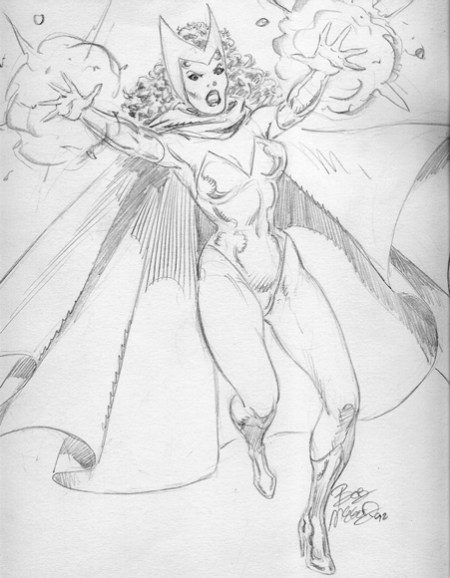
The Scarlet Witch, pencil art by Bob McLeod (1992)

I picked up this pencil sketch of Wanda Maximoff, the Scarlet Witch, from an art dealer at WonderCon in February 2005. Drawn in 1992 according to the signature — and signatures never lie — it’s the work of the great Bob McLeod, who created the very first piece of custom art I ever commissioned, a gorgeous pinup of one of my favorite heroes, the Black Panther.

Bob McLeod is best known in the sequential art trade as an inker. In fact, in my never-humble opinion, Bob is one of the finest inkers in the business — in part because he’s also a terrific pencil artist. But because McLeod is most closely associated with inking, one doesn’t see very much of his raw pencil art. (Well, you might have if you ever checked out Rough Stuff, the short-lived magazine that Bob edited for Two Morrows Publishing, the folks who bring you Alter Ego, Back Issue, and The Jack Kirby Companion. In Rough Stuff, Bob frequently showcased uninked pencils from artists whose work is rarely seen in that condition.)

That’s one reason I was so excited to find this sketch, which shows Bob’s fine grasp of expression and anatomy to perfect, unvarnished advantage. The other reason was that I thought it would be fun to have Bob revisit and complete the drawing thirteen years after he began it.

So, a few days after I purchased it, I packed the sketch off to Bob. Below, you see the finished art, vintage 2005.

The Scarlet Witch, inked pencils by Bob McLeod (2005)

Dramatic, huh? Yes, believe it or not, both of these pictures are scans of the exact same physical piece of art, scanned (about four weeks apart) at two stages of its development. Not only can you see the amazing change a comic art drawing undergoes from its pencil origins to camera-ready inks, but you can also get a sense of the way one artist’s personal style evolves over the course of several years.

In comparing the two versions, Bob McLeod joked that the Scarlet Witch appears to have shed about 30 pounds between 1992 and 2005. I wish it were that easy to lose a few, by means of a handful of brush strokes and a strategically applied eraser!

And that’s your Comic Art Friday.

(All-new material next week, I promise.)