Archive for the ‘Reminiscing’ category

Citizen of eWorld

November 30, 2009

A random post to an online forum I frequent jolted into memory a fact that I hadn’t considered before today…

I’ve been online for 15 years.

That’s almost as long as the World Wide Web itself has been around.

I bought my first computer way back in 1988, with a chunk of my original Jeopardy! winnings. This wonderful addition was an Apple Macintosh Plus, equipped with what seemed at the time like almost unlimited memory — a full megabyte of internal RAM, supplemented by an outboard hard drive boasting 20 (yes, 20!) MB. Heck, on my current Windows Vista-powered Dell notebook, a single keystroke exhausts 20 MB. (I’m exaggerating, but not by much.) But back in the day, that kind of juice meant I was living large in the cybernetic age.

Even more bizarre, I equipped that microscopically brained Mac with a slightly used floor-demo laser printer that cost more than all the computer hardware I’ve purchased in the 20 years since. Combined.

My Mac Plus and I chugged along happily together for six years, blissful in our word-processing glory. Then, in 1994, I started hearing about some newfangled “Internet” thing, and this “World Wide Web” that made it accessible to the common man. So, being about as common as men come, I invested in a fancy new Mac that not only possessed scads more computing power than my charming old relic, but even came with a color (!) monitor. Best of all, by connecting a snazzy dialup modem, I could launch myself out onto the WWW and communicate with folks near and far.

Talk about living large.

At the time, Apple offered its own self-branded online service for Mac users only, known as eWorld. I was, I’m fairly certain, one of the original handful of eWorld subscribers, joining shortly after the service went live in the summer of ’94. When eWorld debuted, it featured a quaint graphic interface that collected all of the possible online destinations under a handful of category umbrellas, organized to make the Internet feel like a global village.

Newsstand enabled one to connect with news and sports resources. What few e-commerce sites existed then were grouped under Marketplace. Such nexuses as Arts and Leisure Pavilion, Business and Finance Plaza, and Learning Center collected other types of sites. Computer Center offered Mac technical support. Community Center was eWorld’s native aggregation of forums and bulletin boards. If you couldn’t figure out where to go or what to do, you tapped the Info Booth icon.

Navigating eWorld was clunky and far from intuitive. in those halcyon days, though, one thrilled at the mere notion of linking to a world of information with a few clicks of a (single-button) mouse.

Frankly, there never was more than a smattering of citizens populating eWorld. That explains why Apple pulled the plug on the service less than two years later, fobbing us loyalists off on then-nascent America Online. In March 1996, my electronic address changed overnight from my very first, SwanShadow-at-eWorld-dot-com, to the somehow less cool-sounding SwanShadow-at-AOL-dot-com. (I imagine that latter e-dress is probably still extant, even though I haven’t accessed it in a half-decade or more.)

Without question, I’ve seen incredible change along the information superhighway over the last 15 years. It’s faster, infinitely more diverse, and innumerable ways exist to find what you’re searching for.

It’s just hard to believe I’ve been out here in the ether this long.

Quizmasters!

November 10, 2009

Here’s proof that life sometimes winds around in bizarre directions that one never expected.

The game show fanatics in the room will recall that back in 2005, Jeopardy! mounted its Ultimate Tournament of Champions — or, as I like to refer to it, the Quest for Ken Jennings. 145 of us former Jeopardy! stalwarts were invited to participate in a mega-round-robin that played out over half a television season, for an opportunity to win major cash and reclaim a smidgen of (for some of us, anyway) long-faded glory. Brad Rutter, who had won a previous Jeopardy! super-tourney called Million Dollar Masters, plowed through the field, ultimately besting Mr. Jennings (no relation) and Jerome Vered in the finals to claim the two-million-dollar grand prize.

Shortly after the UTOC concluded, a group of Jeopardy! veterans from around the Bay Area — including your Uncle Swan — got together to play an evening of pub trivia at a Berkeley watering hole. We dubbed ourselves the Ruttersnipes, in Brad’s honor. Jon Carroll, the San Francisco Chronicle‘s human interest columnist, tagged along to document the event.

Now, four years later, I’m hosting a weekly game for the same quiz company.

I landed the gig via a serendipitous confluence of circumstances. As many of you know, a few months ago my wife KJ involuntarily retired from work on medical disability. Almost simultaneously, our daughter KM finished junior college and continued her studies at a state university. With our income shrinking and our expenses rising, I had my eyes open for opportunities to generate some additional revenue.

At the same time, Brainstormer, a San Francisco-based pub quiz company that runs trivia nights in taverns and restaurants around the country, was looking for someone to host the Tuesday night game at an establishment a mere stone’s throw from my house. (Assuming, of course, that you’re throwing your stones with a rocket launcher. A howitzer, at the very least.)

As Cinderella once said… put it all together and what have you got? Bibbidi bobbidi boo.

So, if you happen to be cruising through Sonoma County on a Tuesday evening, and experience a hankering to challenge your mental faculties (and perhaps nosh on a few freshly crafted tacos for a mere one dollar each), stop by The Cantina in downtown Santa Rosa around 8 p.m. We’ve got music, we’ve got laughter, we’ve got mind-bending trivia. Best of all, there’s no cover charge.

If the sleek, dashingly handsome quiz host looks familiar… I’m probably home with the creeping crud that night.

But if there’s a nerdy, middle-aged fat guy running the game, that’s me.

Soup’s gone

October 22, 2009

So I come home tonight after a long day at the hospital with KJ, and the first thing I read on the news is that Soupy Sales died.

Go ahead, world… tear away another piece of my childhood.

Although I’m too young to have been around for his infamous kids’ shows from the 1950s and early 1960s — shame on you for thinking there’s nothing I’m too young to have been around for — Soupy was a big part of my nascent TV experience. Reruns of his mid-’60s variety show ran endlessly on Armed Forces Television, a staple of my military-brat youth.

More significantly, as a connoisseur of game shows, I watched Soupy on hundreds of episodes of programs like What’s My Line? (he was a regular panelist for seven seasons), Pyramid, To Tell the Truth, Match Game, and Hollywood Squares. In the ’70s, Soupy also hosted the juvenile version of the stunt game Almost Anything Goes, the forerunner of Nickelodeon’s Double Dare and its spinoffs.

Soupy’s legend in television was secured on New Year’s Day 1965, when as a gag he invited his young viewers to dig into their parents’ wallets and purses and mail him “those green pieces of paper with pictures of Presidents on them.” Contrary to popular belief, Sales wasn’t fired for this stunt — although he was suspended for a week — nor did his entreaty net a massive windfall. (Most of the mail submissions contained Monopoly money.) The incident, however, illustrates the unpredictable humor for which Soupy became famous, even when he was mostly known for entertaining kids.

Some years ago, TV comedy and comics writer Mark Evanier composed a detailed retrospective about Soupy’s career. In tonight’s blog post, Mark adds a few additional thoughts. Both articles are well worth a read.

Back when I was reviewing films for DVD Verdict, I penned a critique of a little-known “mockumentary” entitled …And God Spoke. It’s a pretty funny flick if you enjoy that Christopher Guest sort of thing, and one of its most hilarious bits is a cameo by Soupy Sales as himself, hired to portray Moses in a low-budget Biblical epic. Because if you couldn’t afford Charlton Heston, you’d definitely want the Soup Man.

Soupy Sales — whose birth name, incidentally, was Milton Supman — was 83. His two sons, Hunt and Tony Sales, are rock musicians who’ve worked as sidemen for such premier artists as David Bowie, Todd Rundgren, and Iggy Pop.

There. I didn’t mention pie once.

Comic Art Friday: Long tails, and ears for hats

September 11, 2009

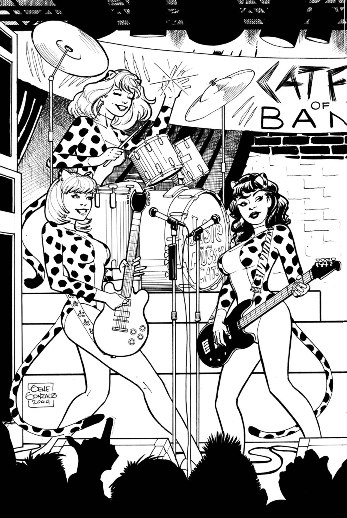
When last we convened for Comic Art Friday, we took our first look at a spectacular new addition to my Common Elements gallery — this super-sized six-character commission by Florida artist Gene Gonzales entitled “Catfight of the Bands.”

Catfight of the Bands, pencils and inks by comics artist Gene Gonzales

Today, let’s take a closer examination of the first of those two battling trios. (Never fear — we’ll catch up with the other three famous felines next Friday.)

From the preponderance of superhero art that appears here on Comic Art Friday, one might presume that comics in that genre were the only funnybooks I read during my formative years. Au contraire, mon frere. While superhero comics were — and still are — my core reads, as a kid I devoured every kind of comic book that I could find on the newsstands of the military bases where I grew up. I read sword and sorcery comics (I still read the current iterations of Conan and Red Sonja), horror comics (a particular pleasure in the early ’70s was the DC anthology Weird War Tales, which featured stories of the supernatural set on battlefields throughout history), Western comics (everything from Kid Colt, Outlaw to Bat Lash), military comics (you couldn’t call yourself a genuine service brat without reading Sad Sack), and juvenile comics (yes, friends, I read Casper the Friendly Ghost and Richie Rich, too).

And, I read Archie Comics. Heck, I loved Archie Comics. I’m man enough to admit that I read Betty and Veronica religiously back in the day.

My favorite Archie magazine? Josie and the Pussycats.

Josie and the Pussycats, pencils and inks by comics artist Gene Gonzales

Actually, I was reading the adventures of Josie and her friends before there was a Josie and the Pussycats. The perky redheaded teenager made her comics debut in 1963, as the star of the series She’s Josie. (Josie’s creator, longtime Archie artist Dan DeCarlo, named the character after his wife.) She’s Josie soon became just plain Josie, and centered on typical Archie-style teenage humor involving Josie and her high school pals, several of whom still costarred in the book when Josie decided to start her own rock band in 1969. (Not coincidentally, the Archie gang had exploded onto Saturday morning TV as a prefab pop group around the same time.)

When Josie (whose surname flip-flopped for years between Jones and James before settling on McCoy early in this current decade), her best friend Melody (also a Jones for many years, her last name became Valentine in the live-action Josie and the Pussycats movie a few years ago, and the comics followed suit), and their newest comrade Valerie (née Smith, later consistently Brown) donned their now-familiar leopard-spotted leotards and kitty-ear tiaras, the title of their comic took on the name of their newly formed act.

Thus legends are born.

Before long, Josie and the Pussycats had their own animated TV series. The show was eponymously titled for the first two years of its run (1970-72), then took a sci-fi turn and morphed into Josie and the Pussycats in Outer Space for another two seasons. Josie and the gang’s TV adventures borrowed heavily from the successful formula of Hanna-Barbera’s already popular Scooby-Doo, mostly involving the girls and their retinue solving comedic mysteries.

As did the Archies, Josie and the Pussycats — actually real-life session musicians using the band’s fictional identity — recorded several bubblegum pop singles in the early ’70s. Three then-unknown singers were “cast” as the singing voices of the Pussycats. The real-world “Melody” was a blonde named Cherie Moor (real name: Cheryl Jean Stoppelmoor), who came to greater fame later in the decade under her new stage name, Cheryl Ladd.

Ironically, most of the lead vocals on the Pussycats’ songs — including the familiar theme to the animated series — were performed by the singer cast as “Valerie,” Patrice Holloway, rather than by Cathy Dougher, who was “Josie.” Holloway almost didn’t the part, as Hanna-Barbera at first wanted to retool the Pussycats as an all-Caucasian trio. Music producer Danny Janssen, who assembled the real-life Pussycats and wrote several of their songs, refused to replace Holloway with a white performer. After several weeks of infighting, Hanna-Barbera agreed to restore Valerie to her original African-American heritage in the TV show, enabling Janssen to keep Holloway in the band. Valerie thus became the first black female character to appear regularly in an American animated TV show.

Three decades after their television debut, Josie and the Pussycats hit the live-action cinema. Rachael Leigh Cook portrayed Josie, Rosario Dawson played Valerie, and Tara Reid was typecast as the dizzy Melody. If you haven’t seen the movie… don’t. It’s 99 precious minutes of your life that you’ll never recoup. Trust me on this.

Josie and the Pussycats, blue pencil rough sketch by Gene Gonzales

Although I first hit on the idea to feature Josie and the girls opposite Catwoman and the two Black Cats a few years ago, it wasn’t until I saw Gene Gonzales’s rough sketch of the Pussycats on stage that I knew I’d found an artist with the appropriate sensibility to bring the concept to life. Thanks for allowing me to show off your inspiration, Gene!

Next week, we’ll wrap up our caterwauling by throwing the spotlight on the other half of this musical catfight.

Until then… that’s your Comic Art Friday.

The lion sleeps tonight

August 26, 2009

The first vote I ever cast for President in a national election, I cast for Senator Edward Kennedy.

The year was 1980. As much as it pained me — because I thought he was a decent guy who simply got in way over his head — I couldn’t bring myself to vote to reelect President Carter. You know darn well I wasn’t voting for the cowboy from Death Valley Days. As for John Anderson… you’re saying right now, “Who?” To which I can only reply, “Exactly.”

So I wrote in a vote for Ted.

It’s the only time I’ve ever exercised the write-in option in any election, for any office, ever. It might be the only time I ever exercise it. But I still believe that, in that particular election, it was the right move.

Ted Kennedy did more in service to this country during his storied tenure in the Senate than any dozen of his colleagues — of either party, or of both parties — that you’d care to name. I’m sorry that he didn’t live to see the health care reform for which he fought so hard in the waning days of his life. But I’m glad that he lived to see Barack Obama elected President.

Was Ted Kennedy a perfect man? He was not. (For the record, neither am I.) I don’t even know whether he was a good man, because I didn’t know him personally. But he was a great Senator. I remain convinced that he would have made a great President.

I’m proud that, the one time when the opportunity presented itself, I voted for him.

Thanks for everything, Senator.

Jeopardy! Summer Hiatus Challenge

July 27, 2009

Over at the Jeopardy! message boards, the 2009 Summer Hiatus Challenge begins today.

The SHC is an annual online trivia tournament designed to keep hardcore Jeopardy! fanatics occupied during the six midsummer weeks when the show is in reruns. Compiled by board regular “DadOfTwins,” the SHC always offers excellent mental exercise, with two full Jeopardy!-style categories of five answers each, posted daily Monday through Friday. It also invariably engenders impassioned, often humorous discussion and debate about the questions themselves.

The SHC is especially cool for me because it presents a rare opportunity to cross swords with other former Jeopardy! champions. In last year’s SHC, your Uncle Swan finished in a surprising fifth place, while two legends of the game — Steve Chernicoff (board ID “OldSchoolChamp”) and Eugene Finerman (board ID “EugeneF”) — were second and fourth, respectively.

I’ve come to know both of these stalwart gentlemen over the years. Steve, a semifinalist in the 1994 Jeopardy! Tournament of Champions and quarterfinalist in the 2005 Ultimate Tournament of Champions, was the alternate in the 1998 Jeopardy! Battle of the Bay Area Brains in which I participated, and was the captain and organizer of the Ruttersnipes, a pub trivia team featuring a collection of local Jeopardy! veterans plus San Francisco Chronicle columnist Jon Carroll. Eugene, a finalist in the 1987 Tournament of Champions and member of the Ultimate Tournament field, writes one of my favorite blogs, Your RDA of Irony, and is a frequent correspondent.

(You newbies who aren’t familiar with my experiences as a Jeopardy! champion can catch up with the rest of the class here.)

If you’re up for a bit of serious quiz mastery, drop over to the Jeopardy! forum and join the fun during the Summer Hiatus Challenge. You have nothing to lose but your dignity.

The threes of me

July 23, 2009

Those of you who’ve been reading this blog over the five years of its existence know that I’m not a fan of memes. You know, those little questionnaires or lists that are intended to give you something to write about on days when you can’t come up with something to write about (when I have those days, I — duh! — simply don’t write), and with which you’re supposed to “tag” your blogosphere buddies so that they, too, can participate in the merriment. (I’m not big on suggesting to other people what they ought to be writing about, any more than I’m a fan of being told what to write.)

I’m not, however, a total stick in the mud on the meme issue. Once in a blue moon, someone will tag me on a meme, and I’ll do it either because I like the person or the topic or both.

In this case, my friend Nathan tagged me with this list on Facebook. I enjoyed reading Nathan’s list, so I thought I’d return the favor. Ever the iconoclast, I’m doing the meme here rather than on Facebook, because this is where I write. And you can breathe easy — I’m not going to tag anyone, though you’re certainly welcome to pick up the ball and run with it if you’re thus inclined.

So, onward.

Three names by which I’m known.
1. Michael. This should be obvious, given that it’s my first name.
2. The Mic Guy. One of my chorus mates hung this one on me a dozen or so years ago, and it’s stuck so resolutely that I’m now using it as the brand for my voiceover business.
3. Uncle Swan. If you’re here, you know.

Three jobs I have had.
1. Receiving clerk. The year and a half that I was between colleges, I worked in a drug store. For most of the time, I was a sales clerk in the electronics department (we called it the camera department back in those pre-PC, cell phone, and iPod days). But for about six months, I ran the store’s warehouse, because the job was a prerequisite for management and someone above me was foolish enough to think that I might eventually aspire to managing a drug store. That person was sadly mistaken.
2. Radio advertising salesman. In my first job out of college, I worked in outside sales for a country music radio station. This will be hilarious to those of you who know that my affection for country music ranks somewhere between my fondness for serial pedophiles and my love for flesh-eating staphylococcus.* Right as I was arriving, the station was sold to some faceless corporation. One of the new owners’ first actions entailed firing half of the sales staff, yours truly included. In my case, the move was a relief — I sucked at advertising sales, and as for country music… I think we’ve covered that.
3. Radio Shack manager. In need of gainful employment following the redneck radio debacle, I wandered into my local Radio Shack store and filled out an application. (After all, I hold a university degree in broadcast communications.) Within a week, I had a job. Within three weeks, I was an assistant manager. After nearly a year of refusing promotion opportunities, I let them make me a store manager because they were going to fire me if I said “no” again. That tells you pretty much everything you need to know about Radio Shack.

* Nathan, who happens to be an actual card-carrying microbiologist, informs me that the flesh-eating bacteria is actually a strain of streptococcus, not staphylococcus. Here at SSTOL, we never allow scientific accuracy to get in the way of a good joke. As long as it’s not olympiaducoccus, it’s close enough for me.

Three places where I have lived. (Because I grew up in a military family, I could easily make this “Ten places where I have lived.” But in the spirit of the meme, I’ll pick three. And I’ll skip Hawaii, since I’ve written about that fairly recently.)
1. Iraklion (or Heraklion, if that’s how you roll), Crete, Greece. We were there for two years in the early 1970s. Lovely place, warm and friendly people, great food. Those sand fleas are murder, though.
2. Angeles City, Luzon, the Philippines. Another two-year stint for Uncle Sam, somewhat later in the Disco Decade. We arrived shortly after local despot Ferdinand Marcos declared martial law. We left just as the Vietnam War was ending. Strange times indeed.
3. Abilene, Texas. I spent a decade there one year. At least, it felt that way. The most hellacious place I’ve ever lived, and there isn’t even a close runner-up. If you’re from Abilene, I apologize for airing your dirty laundry in public, but… deep in your heart, you know I speak the truth.

Three favorite drinks.
1. Cream soda. The good stuff — Thomas Kemper, Virgil’s, et al. — when I can get it on sale, but even the supermarket brand suffices in a pinch.
2. Vanilla Coke. Are you sensing a theme here?
3. The vanilla milkshakes Jack in the Box used to serve when I was in high school, before Jack botched the recipe and turned them into syrupy swill.

Three TV Shows that I watch.
1. Burn Notice. Hopefully they won’t have to stop production due to star Jeffrey Donovan’s recent DUI arrest. The world needs more Bruce Campbell. More Gabrielle Anwar isn’t a bad thing, either.
2. Chopped. I’ve been a devotee of competitive cooking shows since the original Iron Chef was on the air. Food Network’s latest entry in the genre is more of the same, with a fun twist or two. Plus, how could you not love a show called Chopped?
3. In Plain Sight. Who knew that Albuquerque was so exciting?

Three places I have been. (This, I suppose, as contrasted with places where I’ve lived for any length of time.)
1. Taipei, Taiwan. My family went on vacation there while we were in the Philippines. More people crammed into less space than anywhere else I’ve ever seen, aside from Tokyo. Beware the lunatic taxi drivers.
2. Athens, Greece. We made several jaunts to Athens during our years in Crete. Aside from San Francisco, the most visually compelling city I’ve ever visited.
3. Cities I’ve only seen from their respective airports: Paris, France; Rome, Italy; Frankfurt, Germany; Anchorage, Alaska; Agana, Guam. But at least I can honestly say that I’ve been there.

Three of my favorite foods.
1. Sushi. Among my top choices: unagi, tako, saba, ebi, tobiko, and when I can find the good stuff in season, otoro.
2. Mashed potatoes. Sometimes, the simplest things in life are best.
3. Chili — preferably my own, served with rice and plenty of hot sauce.

Three things to which I’m looking forward.
1. Pat Fraley’s workshop on voice acting for video games two weeks from Saturday. I had a terrific time in a workshop with Pat earlier this year, and am thrilled to have another chance to study with him.
2. The long-anticipated completion of a quartet of commissions that artist Darryl Banks is drawing for my Bombshells! gallery. Each depicts one of the four key female characters in Will Eisner’s legendary comic series, The Spirit. Darryl’s work on the first two pieces in the series has been stunning.
3. A manned landing on Mars, and a cure for cancer. When I dream, I dream big.

Moonwalkers, part two

July 21, 2009

As we commemorate the 40th anniversary of the Apollo 11 lunar landing, we continue with the second half of that most exclusive of clubs: men who have walked on the moon. (You can read about the first six moonwalkers here.)

BlueMarble

7. David R. Scott, mission commander, Apollo 15. Reached the moon July 31, 1971.

Although Dave Scott finished fifth in his class at West Point, he joined the Air Force instead of the Army in order to pursue his dream of becoming a jet pilot. By the time he took command of Apollo 15, Scott was already a space veteran — he had accompanied Neil Armstrong on the glitch-plagued Gemini 8 mission, and had become the last American to orbit the Earth solo as the command module pilot on Apollo 9. He became the first member of Astronaut Group 3 to command a mission, and the first astronaut to lead a so-called “J Mission,” with an extended stay on the lunar surface (Scott and teammate Jim Irwin spent nearly three full days on the moon) and use of the Lunar Rover excursion vehicle.

Beyond the moon: Scott’s NASA career came to an abrupt end due to what came to be known as the Apollo 15 postage stamp incident. Scott, with the knowledge of his crew, had smuggled 398 commemorative stamp covers on his trip to the moon, and later sold 100 of the covers to Hermann Sieger, a collectibles dealer from Germany. The action was neither illegal or forbidden by NASA protocol, but when certain members of Congress got wind of the back-door business deal, political furor and Capitol Hill hearings ensued. As a result, neither Scott nor his two crewmates ever flew another space mission. (The 100 “Sieger covers” are now valued at between $15,000 and $18,000 each.) Today, Scott lives in the Los Angeles area and is a frequent consultant on film and television projects. He is 77 years old.

8. James B. Irwin, lunar module pilot, Apollo 15. Reached the moon July 31, 1971.

Like Dave Scott, Jim Irwin graduated from another service academy — in Irwin’s case, the U.S. Naval Academy — before joining the Air Force. Apollo 15 was Irwin’s first and only spaceflight, though he played key backup roles in training for two prior Apollo missions. The scientific nature of this particular mission required Irwin and Scott to undergo extensive training in geology — training that led to their discovery and identification of the so-called Genesis Rock, a chunk of lunar material believed to date from the formation of the moon.

Beyond the moon: Although Irwin never flew another NASA mission because of the aforementioned stamp incident, it’s likely that he would have been decertified for space in any event. He experienced cardiac symptoms during his and Scott’s time on the moon, and suffered a heart attack a few months after their return to Earth. Resigning from NASA in 1972, Irwin began a new career in ministry. He later led several unsuccessful expeditions to Turkey in search of the wreckage of Noah’s ark. Jim Irwin succumbed to a heart attack at his Colorado home in 1991 — the first of the moonwalkers to die, as well as the youngest. He was 61.

9. John W. Young, mission commander, Apollo 16. Reached the moon April 21, 1972.

Navy test pilot John Young was one of the graybeards of the Apollo program. He had already been into space three times before his trip to the moon — as pilot alongside Mercury veteran Gus Grissom on the first manned Gemini mission (Gemini 3); as command pilot aboard Gemini 10; and as command module pilot on Apollo 10, the second and final lunar orbital mission before Apollo 11‘s historic landing. During the latter mission, Young became the first man to orbit the moon solo, as his colleagues tested the lunar module. Commanding Apollo 16 earned Young an additional distinction as the first individual to make a return trip to lunar orbit.

Beyond the moon: John Young may well hold the title of NASA’s busiest astronaut. He continued with the  program into the Space Shuttle era — the only Mercury veteran to do so — and was at the helm for the Shuttle’s first space mission as well as one later flight. The first individual to make six journeys into space, Young is also the only person to have piloted four different types of spacecraft — a Gemini capsule, both Apollo vehicles (the command module and the lunar module), and the Shuttle. He retired from NASA in 2004 after 42 years in the space program. Young still lives in Houston, and is 78 years old.

10. Charles M. Duke, Jr., lunar module pilot, Apollo 16. Reached the moon April 21, 1972.

A Naval Academy graduate and Air Force pilot, Charlie Duke was already familiar to followers of the space program before his rookie flight on Apollo 16. It was Duke’s Carolina drawl at Mission Control that viewers heard speaking with Armstrong and Aldrin during the Apollo 11 moon landing. (Astronauts were frequently assigned capsule communicator, or “CAPCOM,” duties for flights on which they were not the designated backup crew.) Duke also had figured in the run-up to the ill-fated Apollo 13 mission. As Apollo 13‘s backup lunar module pilot, Duke’s bout of rubella resulted in fellow astronaut Ken Mattingly — who had not previously been exposed to the disease — being removed from the mission and replaced with Jack Swigert. Mattingly then joined Duke and Young as Apollo 16‘s command module pilot.

Beyond the moon: Duke retired from NASA in 1975 and became a successful entrepreneur. He is also active as a speaker and consultant. At age 73, Duke is the youngest member of the moonwalkers’ fraternity.

11. Eugene A. Cernan, mission commander, Apollo 17. Reached the moon December 11, 1972.

Gene Cernan, the son of immigrants from eastern Europe, came to NASA as a Naval aviator and aeronautical engineer. His first space mission was the star-crossed Gemini 9, where Cernan and Thomas Stafford moved from backup to primary crew after the astronauts originally assigned were killed in a plane crash. On Apollo 10, Cernan served as lunar module pilot (with Stafford as mission commander), making him the only astronaut to have descended to the moon in a lunar module on two separate occasions — albeit without landing on the initial trip.

Although the 11th person to walk on the moon, Cernan also holds the current distinction of having been the last person to have accomplished the feat, as the second man to reboard the lunar module after Apollo 17‘s final EVA. Cernan spoke the final words to date by a human being standing on the lunar surface:

As we leave the moon at Taurus-Littrow, we leave as we came, and God willing, as we shall return, with peace and hope for all mankind. As I take these last steps from the surface for some time to come, I’d just like to record that America’s challenge of today has forged man’s destiny of tomorrow. God speed the crew of Apollo 17.

Beyond the moon: Gene Cernan has spent most of his post-NASA career as a businessman and as a speaker on space-related topics. For a number of years, he was the regular spaceflight commentator for ABC News. He is the author of the autobiography Last Man on the Moon, which chronicles his astronaut years. In January of this year, Cernan appeared here in Santa Rosa at the Charles M. Schulz Museum for the opening of a space-themed Peanuts exhibit. Cernan is now 75 years old.

12. Harrison H. Schmitt, lunar module pilot, Apollo 17. Reached the moon December 11, 1972.

Harrison “Jack” Schmitt’s arrival on the moon was preceded by controversy. Originally, astronaut Joseph Engle had been scheduled as Apollo 17‘s lunar module pilot. When the final three Apollo missions were canceled, however, the scientific community that had so enthusiastically supported NASA insisted that a scientist — as opposed to a military officer (although Neil Armstrong had retired from the Navy before joining NASA) — should be part of the final moon mission of the era. Thus, Engle was replaced by Schmitt, a geologist with degrees from Caltech and Harvard — the only geological expert in the astronaut ranks.

Although Gene Cernan was vocal in his disapproval of Engle’s removal from his team, by all accounts he and Schmitt worked well together during their lunar excursion. During Apollo 17‘s outbound voyage, Schmitt snapped one of the most famous photographs ever taken — the shot of Earth from space usually referred to as “The Big Blue Marble.”

Beyond the moon: Schmitt left NASA in 1975 to run for the U.S. Senate. He served a single term as a Republican from New Mexico. After being defeated for reelection, Schmitt focused on consulting and education. Until last year, he chaired the NASA Advisory Council, a group of scientists, policymakers, and former astronauts charged with providing technical guidance to the NASA Administrator. Schmitt still lives in his native New Mexico, and is 74 years old.

And that’s it.

To this date, these are the only 12 people who have stood on the surface of the moon. No new member has joined their elite fraternity in almost 37 years.

Nine of the moonwalkers survive. Given that all nine are in their 70s, that status will likely not hold for long. It’s my sincere hope that at least some of them live long enough to see others do what they alone have done.

What a shame it would be for the human race if the moonwalkers — the representatives of our loftiest purpose, our greatest collective endeavor, our highest material achievement — became extinct.

As a citizen, I challenge President Obama, the members of Congress, and the administrators of NASA:

Ignore the naysayers.

Let’s go back to the moon.

And on to Mars.

Moonwalkers, part one

July 20, 2009

No, this is not a Michael Jackson post.

Apollo11crew

If you were five years or older on this date 40 years ago, you remember.

You remember the tingle of excitement. You remember the wonder. You remember the grainy images of two men in bulky white pressure suits and their static-charged banter with their handlers a quarter of a million miles away. And you remember the words:

That’s one small step for a man… one giant leap for mankind.

How could you not remember?

For the first time, human beings had set foot on the surface of another world.

Had you told me then, a third-grader basking in the glow of a cathode ray tube in a military-base townhouse in central Maine, that four decades later, the exclusive club opened on that amazing day by Neil Armstrong and Buzz Aldrin would have a grand total of twelve members, I would not have believed you.

I find it nearly impossible to believe even now.

And yet, it’s true. Two generations after humans first stood on the moon, only a dozen of our kind have ever done so. None have accomplished the feat since 1972 — 37 years ago.

I think that’s one of our greatest failures. As a nation, and as a species. We gave up on the incredible, and began settling for the mundane.

In an effort to inspire ourselves, let’s reflect for a moment on those bold pioneers who first touched the stars.

1. Neil A. Armstrong, mission commander, Apollo 11. Reached the moon July 20, 1969.

A former U.S. Navy aviator and experienced test pilot, Armstrong was one of only two civilians selected in 1962 for NASA’s second astronaut group, dubbed “the New Nine.” He commanded the Gemini 8 mission, and had been forced to abort that flight early due to a malfunctioning attitude thruster. Armstrong was chosen to lead the first lunar landing because he was considered NASA’s most capable pilot in critical emergency situations.

Beyond the moon: Armstrong left NASA shortly after Apollo 11. He has worked mostly as an engineering consultant and member of several corporate boards of directors. Armstrong served on the panel that investigated the explosion that prematurely terminated the Apollo 13 mission, and was vice-chairman of the Rogers Commission, which investigated the destruction of Space Shuttle Challenger in 1986. He is now 78 years old.

2. Edwin E. (Buzz) Aldrin, Jr., lunar module pilot, Apollo 11. Reached the moon July 20, 1969.

The MIT-educated Aldrin was a U.S. Air Force jet fighter and test pilot before joining NASA’s third astronaut group. His first spaceflight came as the pilot of Gemini 12, during which he undertook three EVAs (extra-vehicular activities, or “spacewalks”) totaling 5.5 hours. Aldrin’s experience working outside the spacecraft led to his selection for the Apollo 11 team. Aldrin’s “Contact light… okay… engine stop” as Apollo 11‘s lunar module Eagle came to rest were the first words ever spoken from the moon’s surface.

Beyond the moon: Aldrin’s early post-NASA years were marked by struggles with alcoholism and depression. He wrote about these difficulties in his 1973 autobiography Return to Earth, and more recently in its follow-up, Magnificent Desolation, published earlier this year. Aldrin has been and remains an active advocate for space exploration, and speaks extensively on the subject. The Disney/Pixar animated character Buzz Lightyear is named after Aldrin.

3. Charles M. (Pete) Conrad, Jr., mission commander, Apollo 12. Reached the moon November 19, 1969.

Pete Conrad overcame dyslexia to excel as a U.S. Navy aviator and flight instructor. At the time of his moon flight, Conrad was one of NASA’s most experienced astronauts, making his third trip into space aboard Apollo 12. Previously, Conrad had served as pilot on Gemini 5, and as commander aboard Gemini 11. Among the shortest members of the astronaut corps, the iconoclastic Conrad famously wisecracked about his size as he took his first step from the lunar module: “Whoopee! Man, that may have been a small one for Neil, but that’s a long one for me.”

Beyond the moon: Conrad was scheduled to return to the moon as commander of what would have been the Apollo 20 mission. The cancellation of the Apollo program found him instead as the initial commander of America’s first manned space station, Skylab. Conrad’s Skylab 2 crew (the Skylab 1 mission designation referred to the unmanned launch of the space station itself; the first launch of astronauts to the station was thus Skylab 2) set a space endurance record of 28 days. Leaving NASA, Conrad worked for McDonnell Douglas for 20 years. In 1996, he led a team that set the record for circumnavigating the globe in a Learjet. Conrad was killed in a motorcycle accident near his southern California home in 1999, at the age of 69.

4. Alan L. Bean, lunar module pilot, Apollo 12. Reached the moon November 19, 1969.

A member of NASA’s third astronaut group, Alan Bean was a former student of Pete Conrad’s at the Naval Flight Test School. The death of another astronaut in a motor vehicle accident opened an opportunity for Conrad to request Bean for his Apollo 12 crew.

Beyond the moon: Bean returned to space in 1973 as commander of the second Skylab crew, designated Skylab 3. After this record-setting mission, Bean served for several years as the civilian director of Astronaut Candidate Operations and Training. These days, he’s an accomplished artist who specializes in painting lunar landscapes. Bean also recently co-wrote, with fellow astronauts Owen Garriott and Joseph Kerwin, a book about the Skylab missions entitled Homesteading Space. Alan Bean lives is Houston and is 77.

5. Alan B. Shepard, Jr., mission commander, Apollo 14. Reached the moon February 5, 1971.

America’s first man in space became its oldest man on the moon when 47-year-old Mercury veteran Alan Shepard made his long-delayed return to active duty as commander of Apollo 14. Shepard had been deemed unfit for space for several years following his initial flight due to Ménière’s disease, an inner ear disorder. He spent the intervening years as Chief of the Astronaut Office until his condition was surgically corrected.

Ironically, Shepard replaced another member of the Mercury Seven, L. Gordon “Gordo” Cooper, on the team when Cooper was bumped due to his lackadaisical training habits and adversarial relationship with the NASA brass. Avid golfer Shepard made history in another way during his moon expedition, when he volleyed off a couple of golf shots into the lunar night with a jury-rigged six-iron (he attached the head of a Wilson club to the handle of a NASA-issued shovel).

Beyond the moon: Shepard resumed his duties as chief astronaut after Apollo 14. He retired in 1974 and became a successful entrepreneur. Moon Shot, a book Shepard coauthored with journalists Jay Barbree and Howard Benedict, formed the basis of a TV miniseries in 1994. Shepard died from leukemia in 1998, at the age of 74.

6. Edgar D. Mitchell, lunar module pilot, Apollo 14. Reached the moon February 5, 1971.

Ed Mitchell became a moonwalker on his one and only spaceflight. A member of NASA’s fifth astronaut class in 1966, the former Naval research pilot and flight instructor held a doctorate in aeronautics from what is now Carnegie Mellon University.

Beyond the moon: Mitchell is probably best known today for his widely publicized views on the paranormal. He conducted ESP experiments during the Apollo 14 mission, and believes that UFOs may actually be alien spacecraft. He has stated in interviews that the infamous Roswell, New Mexico event in 1947 was the crash of one such craft, and that NASA, the Pentagon, and other U.S. government agencies are involved in shielding the general public from the truth about evidence of visitors from other planets. Mitchell, now age 78, lives in West Palm Beach, Florida.

These are the first six. We’ll take a look at the other half of the Moonwalkers Club in tomorrow’s post.

Let’s all warble like nightingales

July 14, 2009

I loves me some Disneyland.

Living, as I do, some 450 miles from the front gates of the Magic Kingdom, I don’t get to visit Uncle Walt’s happiest place on Earth with anything approaching the frequency that I’d like. So, when I found myself attending a convention literally across the street from Disney’s Anaheim resort, I made it my business to squeeze in as many hours of blissful Mickey love as an already jam-packed schedule would permit.

With time at a premium, I had to be selective about the attractions that I visited. That meant taking a pass on a few old favorites with agonizingly lengthy lines — sorry, Peter Pan’s Flight — in favor of getting the most bang for my Disney Dollar. It also meant foregoing some of the most delightful but schedule-consuming parts of the Disney experience — wandering through the three Disney hotels, character dining at Goofy’s Kitchen, cruising the Downtown Disney shopping and dining complex, taking leisurely circuits on the Monorail and the Disneyland Railroad.

Alas. Sometimes, you’ve just gotta get stuff done.

Between three abbreviated trips, though, I managed to get around to most of the attractions that mean Disneyland to me, as well as several new experiences that have appeared on the Disneyscape since my last visit seven years ago. Some of the highlights follow.

Pirates of the Caribbean. Number One on my list since the first time I rode it 37 years ago, and not even an interminable action movie franchise can change that. Unlike many Disneyland fanatics, I’m not such a hardcore traditionalist that I resist change, so I was tickled to see the new tweaks that have been added to Pirates to tie the ride and the films closer together. The appearances of Captain Jack Sparrow and company, in my opinion, actually give the ride more of a thematic through-line. And the Davy Jones mist-projection effect is wicked cool.

Haunted Mansion. Another classic that has benefited from a handful of high-tech upgrades. I love the new talking bride effect in the wedding scene. She’s a fitting companion to Madame Leota and the singing busts.

Toy Story Midway Mania. The newest addition to the offerings at Disneyland’s companion park, Disney’s California Adventure (hereafter referred to as DCA), is worth the trip all by itself. It’s a spectacular melding of a traditional Disney dark ride (it reminded me a lot of Roger Rabbit’s Car Toon Spin) with a shooting gallery video game, with the added flair of 3D. The mothership park has its own newer ride based on a similar concept (Buzz Lightyear’s Astro Blasters), but TSMM kicks the basic notion up about five levels of awesomeness. I could spend hours hopping back into the queue for this one.

Splash Mountain. It’s worth getting soaked — and believe me, I did — to experience one of Disneyland’s best-designed attractions. I’m old enough to recall when most of the Audio-Animatronic characters in the final scene resided in the Tomorrowland attraction America Sings, which long ago retired to Yesterland.

Indiana Jones and the Temple of the Forbidden Eye. I’ve never quite gotten past the bizarre disconnect of finding Indiana Jones in Disneyland, but when it’s working (the technically complex attraction breaks down frequently), this is still an amazingly fun ride. I do wish the Imagineers could find ways to fill in the attraction’s several dead spaces. Then again, if they put more effects in, the ride would probably break down even more often.

Jungle Cruise. My enjoyment of this classic is closely tied to the raconteurial talents of the skipper who guides the tour. Skipper Randy earned a solid B on this trip — nothing fancy or outside the box, but skillfully delivered. I confess a preference for the skips who push the envelope and really make the monologue their own, but I realize that isn’t everyone’s bag.

Enchanted Tiki Room. A visit to Disneyland would be woefully incomplete without a stop at the original Audio-Animatronic attraction. As I told the energetic and enthusiastic cast member on duty during my visit, the Tiki Room never gets old to me. Even in my advancing middle age, I feel no shame in singing along with the animated birds, flowers, and tikis. For 15 minutes, it’s my 1960s Hawaiian childhood all over again. Be sure you get a Dole Whip frozen pineapple dessert at the stand outside. Dole Whip is life.

Big Thunder Mountain Railroad. The older I get, the less of an adrenaline junkie I am — not that I was much of one to begin with. But of all the Disney roller coasters, this one remains my favorite. The ride is less monotonous than Space Mountain — which, aside from the environment, is an awfully pedestrian coaster — and more jarring and electric than the Matterhorn. It’s also the only one where the theming really works. Always a treat.

Soaring Over California. The signs outside this DCA ride warn that people who are afraid of heights may want to skip the experience. No one on the planet is more acrophobic than I am, but I absolutely love this ride. The idea is that you’re soaring in a giant hang-glider over a series of scenic California locations. The effect is achieved through a combination of ride effects and an enormous IMAX screen — and what an effect it is! The one thing that would make this ride more effective is less abrupt transitions between the sequences. Oh… and 3D.

The Many Adventures of Winnie-the-Pooh. When last I visited Disneyland, the Pooh dark ride was still under construction. (Somewhere I have a photo of my daughter sitting in the ride vehicle that was then on display as a teaser for the coming attraction.) I’m glad I finally got to see the finished product. It’s a throwback to such old-school Fantasyland attractions as Snow White’s Scary Adventures and Mr. Toad’s Wild Ride, but with a modern twist. Nicely executed. (Bonus: No wait to ride.)

Monsters Inc.: Mike and Sulley to the Rescue: Another of the newer dark rides, this one at DCA. It’s an excellently themed attraction that makes clever use of the characters from Monsters Inc., though I doubt that the storyline makes much sense to anyone who hasn’t seen the film. For some reason, this ride is tucked away in an obscure corner of DCA that makes it difficult to find — at least, it did for me. I’ve never had to ask for directions at the Disney resort before, but I needed help from a friendly cast member this time.

Sleeping Beauty’s Castle Tour. The walk-through dioramas relating Princess Aurora’s story have been completely redone, incorporating distinctive visual effects. This little gem has always been one of Disneyland’s hidden treasures, but now it’s every bit as stunning as any of the other Fantasyland attractions. Very, very cool.

Independence Day fireworks. The Disney people outdid themselves with the aerial display on the night of July 4th. They threw in several pyrotechnical effects I’d never seen before. I can’t recall the last time I enjoyed a fireworks show as much.

Beyond my unavoidable time constraints, the only disappointment of my Disneyland journey was missing the Finding Nemo retooling of Tomorrowland’s venerable Submarine Voyage. This has always been a slow-loading attraction with a lengthy wait, and with the new theming, everyone who visits the park — especially everyone with Nemo-loving kids — wants to see it. I’ll have to catch it next time around.

Shopping is an essential facet of the Disney experience, and I’m pleased to report that I contributed my fair share to Mickey’s corporate coffers. I brought home souvenirs for the girls: KJ got a sweatshirt, a new Disneyland tote bag to replace the one she’s been carrying for the past seven years, a Mickey mug, and an addition to her spoon collection. KM got a Tinker Bell T-shirt and a Cinderella mug, the latter laser-etched with the legend, “Once a Princess, Always a Princess.” (She’ll need that as a reminder when she heads off to college next month.)

For myself — yes, of course, I bought goodies for myself; it was my trip, right? — I picked up a vintage baseball shirt (memo to Disney Merchandising: stock more apparel in plus sizes, because fat guys spend money too), a rolling tote that will be the new addition to my travel ensemble, and a terrific mug reading, “Beneath this Grumpy exterior beats the heart of a dashing hero.” As Baloo would say, “You’d better believe it!”

After singing my heart out on the BHS International stage and tripping the Disney light fantastic, I capped my Anaheim trip on Sunday afternoon by taking in a baseball game pitting the homestanding Los Angeles Angels of Anaheim against the visiting Baltimore Orioles. More about that in my next post.

Until then, save me a seat in the Tiki Room.