What it was, was Oscar

Posted March 8, 2010 by swanshadow
Categories: Aimless Riffing, Celebritiana, Cinemania, Dead People Got No Reason to Live, Listology, Ripped From the Headlines, Sexiest People Alive, Teleholics Anonymous, The Swan Tunes In

Congratulations! We survived another Oscarcast. Observations follow.

At least it wasn’t Ray Milland and Rosey Grier: The two-headed host — Steve Martin and Alec Baldwin — turned out to be a dreadful idea. Not because either was terrible, but because they simply didn’t work smoothly and effectively together. I don’t know whether Martin and Baldwin were poorly rehearsed, or just suffering from awkward chemistry. One host or the other would have been adequate, if not especially scintillating — Martin hosted the awards solo in 2000 and 2002, in not-particularly-memorable fashion — but the combination fell flat.

The sound of one man yawning: None of the major awards turned out to be a huge surprise, unless you really thought the Academy was going to pass up a chance to stick it to notoriously unpopular James “King of the World” Cameron by honoring his ex-wife Kathryn Bigelow and her magnum opus. The favorites in each of the big categories triumphed.

Double the displeasure: Expanding the Best Picture category to ten nominees was, as expected, a pointless drag on the production. No one really thought that there were more than five real contenders; namely, the films represented in the Best Director category — the victorious The Hurt Locker, Avatar, and dark horses Inglourious Basterds, Precious, and Up in the Air. Padding the show with twice as many introductory film clips merely took up air space.

Up with people: In a refreshing change, all four of the acting winners gave engaging, entertaining speeches. (I can’t prove it with verified test results, but I suspect that Jeff Bridges’s Dude-esque ramble may have been… what shall we say… chemically enhanced.) Equally refreshing, all four were people that most viewers would be glad to see win.

Sore loser: Quentin Tarantino, who looked as though Kathryn Bigelow had vomited in his lap when she won Best Director and he didn’t. I dig your films, QT, but your sportsmanship sucks.

Spare me the song and dance: We didn’t have to sit through performances of each of the Best Song hopefuls this year. A welcome omission, because seriously, when was the last time all five of the nominated songs were actually good? On the other hand, someone thought it made sense to stage an elaborate interpretive dance number incorporating music from the Original Score nominees. (Funny, I didn’t realize there was breakdancing in Sherlock Holmes.) Redeeming the moment, winning composer Michael Giacchino (Up) gave one of the night’s best acceptance speeches, encouraging young people to pursue their creative impulses and not allow naysayers to convince them that they’re wasting their time.

Didn’t work: The trend, continued from last year’s Oscarcast, of having each of the Best Actor and Best Actress nominees regaled with a speech by another celebrity. With the rare exception of an unexpected star turn by someone like Oprah Winfrey (who feted Gabourey Sidibe, nominated for Precious), these fawning tributes only serve to make both audience and nominees uncomfortable.

Worked, in kind of an off-kilter way: The tribute to recently deceased writer-director John Hughes, which culminated in the appearance onstage of numerous actors and actresses who became stars via Hughes’s legendary run of hit films in the 1980s. Cool to see these folks together in one place, but man… are we all getting old, or what?

Speaking of getting old: I understand why they do it, but I grow annoyed with the increasing insertion into the Oscarcast of no-talent young stars with no genuine cinematic credibility (i.e., the ubiquitous Miley Cyrus), just to draw in the teen audience. Uncle Oscar says: Get off my lawn, you meddling kids.

The death of me: I’m always curious to see who gets tagged with what I call the “Dead People Gig,” introducing the memorial segment honoring movie folks who’ve shuffled off this mortal coil since the last Oscar ceremony. This year, it was Demi Moore pulling double-death duty (she was also one of the participants in the John Hughes tribute). James Taylor performed an acoustic rendition of “In My Life” while the clips rolled. For once, there was no moment of shock generated by the appearance of someone I didn’t know had died. Interestingly, Michael Jackson — whose filmography consists basically of The Wiz — made the cut, while Farrah Fawcett — mostly known for TV work, but she did make several films, including such “classics” as Logan’s Run and Saturn 3 — missed.

Fashion forward: Oscars 2010 proved rather low-key on the sartorial front. Understated glamour was the norm this year, so there were fewer what in the name of Vera Wang was THAT? moments on the red carpet than at previous Oscarcasts. The most egregious offenders were Sarah Jessica Parker, whose strapless gown came equipped with an enormous silver breastplate that resembled a leftover centerpiece from an office Christmas party, and Charlize Theron, wearing what looked like two pink-frosted cinnamon rolls stuck to her bosom. Best-dressed of the evening included several of the usual suspects — Kate Winslet, Helen Mirren, Meryl Streep, and Queen Latifah. Jennifer Lopez’s lovely pink dress would have gained high honors, if not for its ridiculous train. Likewise, Best Actress winner Sandra Bullock lost points for her garish lipstick.

The voice of choice: As she did last year, voice actress Gina Tuttle contributed a pleasant and unobtrusive announcing job. And if Gina ever gets tired of that gig, Oscar producers… I’m in the book.

Comic Art Friday: To Ell’en back

Posted March 5, 2010 by swanshadow
Categories: Comic Art Friday

The blonde on the bomb is Ellen Dolan. She’s the daughter of the police commissioner of Central City. One day, she’ll be the mayor of that dark and dangerous metropolis. And she’s sweet on a masked vigilante known only as The Spirit.

The Spirit's Bombshells: Ellen Dolan, pencils and inks by comics artist Darryl Banks

And therein lies a tale.

Ask any group of knowledgeable comics historians, “Who was the single most influential artist in mainstream comics?” and you’ll get one unanimous answer: Jack Kirby, co-creator of Captain America, the Fantastic Four, the Avengers, and the original X-Men, and sole auteur of the Fourth World cycle, among hundreds of others.

Ask the same historians, “Who was Number Two?” and the answer will be nearly as unanimous: Will Eisner.

Whereas Kirby’s creative genius ranged broadly over six decades in comics, Eisner is best known for a single creation: the long-running Sunday newspaper feature The Spirit. That’s not to say that Eisner didn’t create numerous other worthwhile projects — he certainly did; Eisner’s 1978 graphic novel A Contract with God rewrote critical thinking about comics as both literature and high art. But there’s no question that, from a pop culture perspective, The Spirit remains his most familiar brainchild.

Briefly, The Spirit revolves around the adventures of a young police detective named Denny Colt, who, after surviving a near-death encounter with some underworld types, permanently buries his former identity (literally; he takes up residence in a subterranean sanctuary hidden beneath his own tombstone) and assumes a new one — that of the masked crimefighter known only as The Spirit.

The business-suit-clad Spirit isn’t a superhero in the traditional sense. His only disguise is a domino mask; he possesses no superhuman ability (except perhaps for a remarkable knack for withstanding physical abuse); and he functions more like a consulting detective a la Sherlock Holmes than like, say, Batman. Sometimes, The Spirit serves merely as a background character in the stories in his own strip — stories which range far beyond swashbuckling derring-do to intimate, twisty, eccentric tales about the odd folks whose actions (sometimes nefarious, sometimes innocent) bring them into contact with The Spirit.

Over the course of The Spirit’s 13-year career, he encountered numerous beautiful, exotic women. In fact, most of the memorable characters in the strip — aside from The Spirit, and his police contact, irascible Commissioner Eustace P. Dolan — were female. Some appeared only for one story, and vanished as quickly as they had arrived. Four, however, recurred often enough to make a permanent mark on the series, and on The Spirit himself.

Soon after I conceived my Bombshells! theme — pinups in the style of World War II-era bomber nose art, featuring comic book heroines who debuted in the 1940s and ’50s — I hit on the idea of a special subset of Bombshells! dedicated to these four legendary women. I knew immediately the perfect artist for the project: Darryl Banks. Darryl’s most prominent contributions to comics history are his co-creation (with writer Ron Marz) of the Kyle Rayner version of Green Lantern, and his recasting (also with Marz) of the Hal Jordan version of Green Lantern as the cosmic supervillain Parallax, during an eight-year run as illustrator of the Green Lantern series.

My favorite of Darryl’s artistic efforts, though, was Millennium Comics’ 1990 miniseries Doc Savage: The Monarch of Armageddon, considered by many Doc Savage enthusiasts (including yours truly) as the most faithful comic book adaptation of the Man of Bronze. Even more specifically, I thought about a commissioned artwork Darryl drew for me a few years ago, depicting Doc and his intrepid cousin Patricia. Darryl’s take on Pat Savage had exactly the feel I wanted for my Spirit Bombshells! portraits. I was thrilled when Darryl agreed to tackle the project.

Doc Savage and Patricia Savage, pencils and inks by comics artist Darryl Banks

Ellen Dolan stars in the first of Darryl’s Spirit Bombshells! pinups. Ellen is the most consistent female presence in The Spirit’s life, and the closest to a genuine love interest in the strip. She’s a compelling character who evolves over the years, from her beginnings as an impetuous college student (and something of a stock damsel-in-distress) to a sharp-witted, capable, modern woman. As noted in our introduction, toward the end of the original series Ellen becomes mayor of Central City — not only her father’s daughter, but also his boss. And every inch The Spirit’s equal. Comics historians frequently cite Ellen as one of the earliest feminist characters in the medium.

Next Friday, we’ll look at the second of Eisner’s fetching females, and we’ll talk more about what makes The Spirit such a pivotal creation in the history of comics. Be here in seven.

And that’s your Comic Art Friday.

Dominance and Submission

Posted March 2, 2010 by swanshadow
Categories: Aimless Riffing, Blogosphere, Listology, Reminiscing, Soundtrack of My Life

We don’t do memes very often here at SSTOL, but every once in a blue moon, someone on my blogroll will post one that looks kind of fun.

The man known only as the Mysterious Cloaked Figure served up this intriguing challenge a while back: Answer a series of 20 questions about yourself, using titles of songs recorded by one of your favorite musical artists. I immediately came up with a couple of possibilities, but ultimately went with the one whose catalog offered the most entertaining possibilities.

So, without further ado, here’s my life as told by Blue Öyster Cult. (For the record, I’m using titles only from the period during which I was actively buying BÖC records, which ended with their 1983 album The Revölution By Night.)

1. Are you male or female?
Subhuman

2. Describe yourself:
Veteran of the Psychic Wars

3. How do you feel about yourself?
I’m on the Lamb But I Ain’t No Sheep

4. Describe where you currently live:
Shadow of California

5. The first thing you think of when you wake up:
This Ain’t the Summer of Love

6. If you could go anywhere, where would you go?
Cities on Flame with Rock and Roll

7. What is your favorite form of transportation?
Wings Wetted Down

8. Your best friend is:
Godzilla

9. What is your favorite color?
Heavy Metal: the Black and Silver

10. What’s the weather like?
Feel the Thunder

11. If your life were a TV show, what would it be called?
I Love the Night

12. What is life to you?
Goin’ Through the Motions

13. What is the best advice you have to give?
Don’t Fear the Reaper

14. If you could change your name, what would it be?
Baby Ice Dog

15. What is your favorite food?
Unknown Tongue

16. How would you like to die?
O.D.’d on Life Itself

17. Your soul’s present condition:
Redeemed

18. The faults you can bear:
7 Screaming Diz-Busters

19. How would you describe your love life?
Before the Kiss, a Redcap

20. What are you going to post this as?
Dominance and Submission

Postscript: People who know me as a middle-aged adult are often surprised to discover that I was a huge Blue Öyster Cult fan in my younger days. To them I say…

You’re Not the One (I Was Looking For)

Vancouver memories and Canada dreams

Posted March 1, 2010 by swanshadow
Categories: Aimless Riffing, Celebritiana, Random Acts of Patriotism, Ripped From the Headlines, Sports Bar, Teleholics Anonymous, The Swan Tunes In

I miss the Winter Olympics already.

Miscellaneous thoughts and observations from the 21st Winter Games in Vancouver…

The start of the Games was overshadowed by the death of Nodar Kumaritashvili, a luger from the former Soviet republic of Georgia, in a crash during a pre-Games training run on the day of the opening ceremonies. All of the sliding events (luge, bobsleigh, and skeleton) were subsequently altered, with the men starting from the (lower) women’s launch point and the women starting at the junior-level gate. Even with these adjustments, we saw a higher-than-usual number of wipeouts in these events, even among the most skilled competitors.

The Canadian women’s curling team had a member who was five months pregnant. Seriously, if you can do it at a world-class level when you’re heavily gravid, it’s really not much of a sport.

Speaking of curling, a shout-out to local Sonoma County company Loudmouth Golf, suppliers of wackily patterned pants for the Norwegian men’s curling squad. Seriously, if you can do it at a world-class level wearing ludicrous trousers, it’s really not much of a sport.

Canadian Joannie Rochette skated the short program of her life, less than three days after her mother’s sudden death from a heart attack. Joannie’s free skate was equally dazzling, netting her a bronze medal and the adulation of millions.

Bode Miller skiied home with a complete set of medals — a gold in super-combined, a silver in super-giant slalom, and bronze in the downhill. In so doing, he actually managed to seem slightly less full of himself than he did four years ago in Torino, where he was a total bust.

Memo to NBC’s Bob Costas: Put. The Just for Men. Down. Although, to Bob’s credit, his dye jobs looked better in Vancouver than they did two years ago at the Summer Games in Beijing.

Shaun “The Flying Tomato” White and Jeret “Speedy” Peterson busted out impossible-seeming aerial moves in the snowboard halfpipe and freestyle skiing, respectively, proving that if you want to be really good at anything, you need a snappy nickname.

Women’s halfpipe starred its own pair of tomatoes — silver medalist Hannah Teter and bronze medalist Kelly Clark.

Thanks to Bill Demong, Johnny Spillane, and their Nordic Combined teammates, Team USA won three medals in a class of events where no American had so much as sniffed the podium in, like, forever.

Has there ever been a more amazing female figure skater than South Korea’s Kim Yu-Na? If so, I must have missed seeing her. In technique, in artistry, and in power, Yu-Na was so many light-years ahead of the rest of the competitors that I almost felt embarrassed for the field.

Lost amid the highly deserved excitement over Apolo Ohno’s becoming the most decorated U.S. Winter Olympian ever was the fact that his close friend Shani Davis won Team USA’s only speed-skating gold, in the men’s 1000 meters. Shani added a silver in the 1500. The most heart-warming story in speed skating came via J.R. Celski, who earned a bronze in 1500 meter short-track (thanks to a spectacular wipeout involving two Korean competitors) in his first competition after a horrific injury last fall.

We love Steve Holcomb and the Night Train, the gold-winning team in men’s four-man bobsleigh (and yes, that’s how they spell it at the Olympics). Steve’s celebratory “Holkie Dance”? Not so much.

Smackdown of the Games: Evan Lysacek’s win over the Ivan Drago of figure skating, Evgeni Plushenko.

Russian President Vladimir Putin was so incensed by his country’s lack of gold medals in Vancouver that he called for the ouster of Russia’s sports ministry. Tough sledding (pun intended) since that Soviet machine went away, eh, Vlad?

Proving that she does, in fact, know her shin from Shinola, Lindsay Vonn overcame a much-publicized injury to bag gold in the downhill and bronze in the super-G. Her teammate Julia Mancuso took home a pair of silver medals, in the downhill and super-combined.

Seth Wescott repeated as the only man ever to win gold in Olympic snowboard cross, a sport that I am convinced recruits its participants from insane asylums.

Halfpipe bronze medalist Scott Lago was sent home by the U.S. Olympic Committee, after photos appeared on the Internet showing Scott and a female companion engaging in risque business with his medal.

Memo to NBC’s makeup department: The technician who worked on the broadcast crew at the figure skating events needs to be fired.

Hannah Kearney and pink-tressed Shannon Bahrke displayed knees of steel as they pounded to gold and bronze, respectively, in women’s moguls. Bryon Wilson notched a bronze in the men’s version. How anyone could stand up after that event is beyond me.

Silver was the color of the season for Team USA hockey, with both the men’s and women’s teams coming in second to the homestanding Canadian squads. The USA men drove the Maple Leafers to overtime in the gold-medal game, with a last-minute goal by Zach Parise of the NHL’s New Jersey Devils. Buffalo Sabres goalkeeper Ryan Miller battled valiantly between the pipes, earning recognition as the hockey tournament’s Most Valuable Player.

Perhaps the most shocking moment of the Games — aside from the Kumaritashvili and Rochette tragedies — occurred in the men’s 10,000-meter speed skating event. Dutch skater Sven Kramer lost the gold medal following his disqualification after the Netherlands’ coach, Gerard Kemkers, directed Kramer into the incorrect lane for the race’s final lap. An understandably angry Kramer appeared inconsolable after the race. If the Dutch have an equivalent to the witness protection program, Kemkers is probably in it right now.

I don’t believe ice dancing is really a sport — it’s more of a competitive exhibition — but silver medalists Meryl Davis and Charlie White did us proud nonetheless, as did fourth-place finishers Tanith Belbin and Ben Agosto.

Neither of our teenage figure skaters, Mirai Nagasu and Rachael Flatt, came home with a medal (they finished fourth and seventh), but both gave their finest performances to date. Watch out for Mirai in 2014 — she’ll be on the podium for sure.

Will we ever forget the image of the malfunctioning hydraulics on the Olympic cauldron at the opening ceremonies? Good on the Canadians for poking fun at themselves by revisiting the misfire at the end of the Games.

And oh yeah… how did we ever watch the Olympics before HDTV?

Hero of the Day: Abby is nine

Posted February 28, 2010 by swanshadow
Categories: Aimless Riffing, Hero of the Day, My Home Town, SwanStuff

Happy birthday to my personal assistant Abby, who is celebrating her ninth birthday today.

Abby says: "Nine years old, and they still make me wear this stupid hat."

That makes her about 50 in prorated human years, which means that, relatively speaking, she’s now older than I am.

Abby would like you to know that she is never too old to wear a silly hat and play with a new toy on her birthday.

Or watch a little Olympic hockey.

Abby says: "Take the picture already -- I've got a toy to gnaw on."

Well… she doesn’t really care about the hockey.

Comic Art Friday: Legacies

Posted February 26, 2010 by swanshadow
Categories: Comic Art Friday

I get a kick out of dreaming up new combinations of heroes for my Common Elements commission theme. That little inward chuckle from uncovering a heretofore untapped linkage between two unrelated comics characters? Man, I love that.

Sometimes, though, my Common Elements combinations surprise even me, in that I stumble upon a second — or even a third — layer of connection bubbling just beneath the surface, sometimes long after a piece has entered my collection.

Take this one, for example.

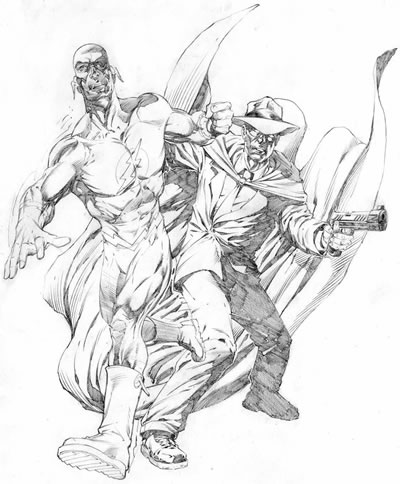
The Flash and the Crimson Avenger, pencils by comics artist Christopher Ivy

I titled this drawing by Christopher Ivy (best known as an inker, but a fine pencil artist as well) “A Study in Scarlet,” not because it has anything to do with the Sherlock Holmes chronicle by that name, but because it features two heroes dressed in red: The Flash, and the Crimson Avenger. The common element between these two stalwarts couldn’t be more obvious or prosaic. But they make an interesting combination anyway, so I went with it.

I’d had Chris’s piece in my gallery for more than a year before another commonality struck me. There’s a long tradition in comics of legacy heroes — that is, instances where one superhero takes up the mantle (and often, the costume and code name) of another who went before. This pairing (however inadvertently) pays homage to this tradition.

The Flash might be comics’ best-known example of a legacy hero. The Flash shown here — real name, Barry Allen — wasn’t the first super-speedster to wear that name. The original Flash — real name, Jason “Jay” Garrick — made his debut in Flash Comics #1, in January 1940. Like most of the costumed do-gooders of the World War II era, the first Flash vanished from the newsstands not long after the war ended. In 1956, DC Comics revived the Flash’s code name and superpower to create a new hero. Enter the second Flash.

Barry Allen died in 1986, during the event known as the Crisis on Infinite Earths. Barry’s sidekick, a young man named Wally West who ran really fast and battled evil using the moniker Kid Flash, assumed the nom de guerre and jumpsuit of his mentor, becoming the third Flash. Twenty years later, Barry’s hyperquick grandson Bart Allen briefly took over the reins of Flash-hood. Now Barry is back, alive and in costume, having become his own legacy.

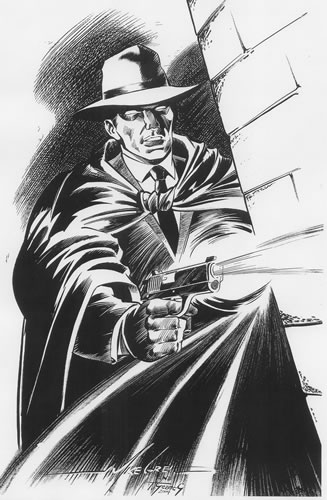
The Crimson Avenger, pencils by Mike Grell, inks by Terry Staats

The history of the Crimson Avenger boasts fewer twists than that of The Flash. Still, as was the case with the various Scarlet Speedsters, there was one way back when, another more recently, and a third of modern vintage. The first Crimson Avenger, Lee Travis, arrived on the scene in October 1938, in Detective Comics #20. (Note that date; it’ll be important later on.) In creative terms, the Avenger was a direct swipe of the then-popular radio hero, the Green Hornet, simply with a change in color scheme. Both characters were newspaper publishers who dressed up in costumes featuring masks, fedoras, and gas guns, and each fought crime in the company of his respective one-named Asian valet (the Hornet had Kato, while the Avenger had Wing).

Nearly 20 years after the first Crimson Avenger vanished from the comics pages, another appeared. The career of the second Avenger, Albert Elwood, lasted a single 1963 issue of World’s Finest Comics. From that point, the Crimson Avenger identity would lie fallow until the cusp of the new millennium. In 2000, a young woman (whose real name may or may not be Jill Carlyle, depending on the source you consult) would pick up the title — as well as the original Avenger’s twin Colt .45s — to continue the war against wickedness.

So, we’ve seen two common elements between The Flash and the Crimson Avenger. But I’ve thought of one other, which may have even greater significance than either of the previous.

I mentioned before that the Crimson Avenger made his comic book debut in October 1938. That early appearance marks the Avenger as the first masked crimefighter in comics history, beating the more highly renowned Batman to the punch by more than half a year. (Superman, the template for all costumed heroes, arrived a few months before the Crimson Avenger, but the Man of Steel didn’t wear a mask.) The Crimson Avenger’s significance as the seminal masked mystery man continues in the lore of the DC Comics universe to this day — both of DC’s primary superhero teams, the Justice League of America and the Justice Society of America, invoke the memory of the original Crimson Avenger when inducting new members into their ranks.

What does that have to do with The Flash? Well, Barry Allen’s 1956 debut in Showcase #4 is generally recognized as the launch of comics’ Silver Age, the return of superheroes to marquee status in the medium following the post-World War II drought. (As hardcore aficionados know, only five costumed crimefighters survived in continuous publication from their Golden Age premieres into the modern day — Superman, Batman, Wonder Woman, Aquaman, and Green Arrow.)

Thus, these scarlet-clad stars share unique stature as landmarks in history: The Crimson Avenger marks the advent of the Golden Age of costumed heroes, while The Flash marks their Silver Age comeback. Those of us who treasure the superhero genre owe a great debt to these two gentlemen, and to their creators.

And that’s your Comic Art Friday.

Idol 2010: Your Top 12 guys, America

Posted February 25, 2010 by swanshadow
Categories: American Idol, Celebritiana, Listology, Ripped From the Headlines, Sexiest People Alive, Soundtrack of My Life, Teleholics Anonymous, The Swan Tunes In

In yesterday’s post, we examined the 12 female competitors comprising the feminine half of this season’s cast of American Idol. Today, it’s time to smell the testosterone. As in our previous list, we’ll give you the performers in order of their initial appearance in this round, as well as noting the song each presented.

Twelve men trod the stage. Who will survive the first cut?

It could be…

Todrick Hall (“Since You’ve Been Gone”) — It was a good thing Seacrest told us at the beginning what the song was, or I wouldn’t have had a clue. Todrick’s an exciting performer, and he’s a decent enough singer, but this shot practically defined self-indulgence — shouty and spasmodic just for the sake of being “unique.” Nevertheless, the night would have many lower points than this. Take, for instance…

Aaron Kelly (“Here Comes Goodbye”) — Aaron can sing a little, but he’s as nervous as a goat at a Jamaican cookout. This is another of those cases, like Katie Stevens among this year’s girls, where I’d rather be hearing this individual’s fully developed talent two or three years from now, instead of a kid struggling to make the giant leap today. Right now, Aaron would make a cute Mouseketeer if Disney revived The Mickey Mouse Club. Beyond that? I predict a career in casual footwear. Which is more than I can say for…

Jermaine Sellers (“Get Here”) — To quote the often incoherent Randy Jackson of previous seasons, “That was all pitchy and weird, dawg.” As several of the judges noted, this was a peculiar choice of song for a guy with Jermaine’s voice. I’m not sure what he was trying to accomplish with this twisted rendition, but I’ll give him the benefit of the doubt and hope that he did not, in fact, accomplish whatever it was. Because if this is actually how he hoped this would sound? Ouch. But not nearly as ouch as…

Tim Urban (“Apologize”) — Good googily goop… what was that? Oh, yes — this was the guy they brought back from elimination after some other kid got booted from the Top 24. If this is the best Tim can do, the producers should have checked out whether someone — anyone — else was available. Or maybe they should have just gone with 11 male singers and a bye week. Or something. Because this was eleven kinds of wretched. Tim needs to “Apologize” to everyone who watched this episode. Including…

Joe Muñoz (“You And I Both”): Did he sing? I must have dozed off. Neither awful enough nor good enough to keep me awake. Next! Unless next means…

Tyler Grady (“American Woman”): Now this was awful enough to keep frozen corpses awake. Tyler reminded me of a kid on his 21st birthday getting his first drunk on in a karaoke bar after watching a dozen episodes of That ’70s Show. If there’s small justice in the world, he’ll be one of Thursday’s first cuts. If there’s large justice, he’ll be one of the first cuts, and get kicked hard in the seat of the pants on his way out of the studio. Perhaps by…

Lee Dewyze (“Chasing Cars”): There were some seriously off-key notes in Lee’s performance, and yet, there was something about the overall effect that I rather enjoyed. Unlike the judges, who see Lee as the new David Cook, I see Lee as the new Elliott Yamin — not because he sounds like Elliott (he doesn’t, at all), but because he’s a diamond in the rough who has the potential to blossom and grow, and really develop into something special as the season goes along. Assuming that he gets the opportunity, instead of…

John Park (“God Bless The Child”): God bless us all for enduring this. I fully expected Billie Holiday to rise from the grave and smack John to the floor with her skeletal, zombified hand. You have to have soul — and preferably, old lived-in soul — to sing this song. John’s a kid from the ‘burbs with a nice voice. But for sultry jazz? Just… no. Which brings us to…

Mike Lynche (“This Love”): A odd song choice for Big Mike, but he made this work fine. As Ellen Degeneres pointed out, he threw in a few off-pitch moments, but it was a fun, charming, likable performance. Do I want to hear several more like this one? Probably not. After all, we already had Ruben Studdard. And I also thought we already had…

Alex Lambert (“Wonderful World”): Isn’t this the same dude who finished in second place last year? Oh… different A. Lambert. That A. Lambert, bizarre as he was, had at least a smidgen of talent and personality. This A. Lambert, not so much. I’m sure he’s a pleasant kid, but he’s nervous and awkward and dances as though he needs directions to the men’s room, desperately. There’s the door, junior — close it on your way out. And take that mullet with you. Speaking of hair, here come the abundant tresses of…

Casey James (“Heaven”): Although he’s not a country singer, Casey reminds me physically of Bucky Covington from a few seasons back. I’m trying not to allow that unfortunate resemblance to prejudice me against him. (Kara DioGuardi slobbering lustfully all over him every time he comes out doesn’t help, either. Get a grip on your biological clock, Cougar Town.) He’s an engaging performer, and easily the most comfortable on stage among all of the men, but his voice is — alas — merely adequate. It’s clear that the producers want him to succeed, and in the face of a mediocre male cast, he probably will. Probably even longer than…

Andrew Garcia (“Sugar, We’re Going Down”): When Andrew broke out an acoustic rewrite of Paula Abdul’s “Straight Up” during Hollywood Week, I thought to myself, “Now here’s something interesting.” I didn’t like his acoustic rewrite of Fall Out Boy quite so much, but still, I found it more pleasantly ear-catching than almost anything else that preceded it. I hope Andrew’s got something in his bag of tricks besides acoustic rewrites, though, because he’s ridden that horse about as far as it will run.

Simon Cowell recently predicted that a female contestant will win Idol this season. I’m predicting that he’s right, because the guys didn’t impress me in their first time out. Several of them, truth to tell, need to be sent packing posthaste. Since only two get the boot this week, the fastest exits should be granted to some combination of Tim, Tyler, Alex, and Jermaine.

When we reach the halfway point of the competition, your Uncle Swan believes you’ll be stuck with these six gentlemen, like ’em or don’t: Casey, Lee, Andrew, Mike, Todrick, and… (do I have to pick six? yes, because I said I would, darn it) maybe Joe. Not one of them will make the final pairing, which will deliver 100% hot girl-on-girl action to decide American Idol 2010.

Six weeks from now, we’ll find out whether I have any idea what I’m talking about.

SwanShadow…out!

Idol 2010: Your Top 12 girls, America

Posted February 24, 2010 by swanshadow
Categories: American Idol, Celebritiana, Listology, Ripped From the Headlines, Sexiest People Alive, Soundtrack of My Life, Teleholics Anonymous, The Swan Tunes In

It’s that time again, isn’t it?

Frankly, I blew off last year’s entire season of American Idol, because I just couldn’t drag myself through the whole sordid ordeal again. Besides, was it going to get any better than Jordin Sparks? Most likely, not.

But it’s a new decade, and your Uncle Swan comes back refreshed, reinvigorated, and ready to rock. Let’s see how quickly this season’s class of mediocre vocal talents can strangle all this enthusiasm out of me.

Listed below (in order of appearance on last night’s telecast, with the song performed by each) you’ll find the 12 female wannabes whom The Powers That Be at 19 Entertainment have chosen to inflict on us, and my impressions thereof after Week One of the competition. (Because, seriously, no one cares about anything that happened on the show before this week, aside from FOX and its advertisers. Except for the “Pants on the Ground” guy, and that fad lasted the entire 15 minutes it deserved.)

Ladies, if you please:

Paige Miles (“All Right Now”) — Paige has a great big voice, and (mostly) knows how to use it. I agree with Simon that this brassy rocker wasn’t the best choice of song, just because it’s harsh and belty and not well suited to displaying vocal range. But she’s certainly no worse than most of the contestants in this year’s distaff group. I’d like to hear her sing something that shows more softness and subtlety. And quickly, before she’s voted off. Which could be soon, but not as soon as…

Ashley Rodriguez (“Happy”) — Whew… not all that impressive. Her voice isn’t the grand, glorious instrument that Paige has — although she thinks it is — so she needs to avoid material that calls for that type of voice. There was just too much instability in the sound, not in terms of pitch, as much as in confidence, or lack thereof. She won’t be around long. I predict, however, that she will be around long enough to witness the exit of…

Janell Wheeler (“What About Love?”) — Ye gods. If you’re going to sing a song by Ann and Nancy Wilson, you’d better be able to bring it large. Janell? Can’t. Doesn’t belong here, period. Absolutely painful to listen to. She’ll be one of the early eliminations, if not indeed one of the very first two. Which is to say, she’s no…

Lilly Scott (“Fixing a Hole”) — Lilly is a tough call. I’m not crazy about her voice, and she picked a dreadful song (I loves me some Beatles, but that tune sucks swamp water, Sir Paul). Still, there’s something quirky and appealing about her sound, and her neo-hippie persona. I can’t see her winning the competition, but I could imagine some indie label wanting to market her CD. Even more, I could hear her oozing from the speakers at my friendly neighborhood Starbucks. Which is more than I can say for…

Katelyn Epperly (“Oh Darling”) — I agreed with Ellen on two specifics: Katelyn tends to oversing (she pushes her voice too hard, for you non-vocalists in the audience), and she’s interesting. She’s another one that I don’t think will get close to sniffing the finals, but she could stick around for a few weeks because she’s cute and perky and blonde. Like Frieda in Peanuts, she gets bonus points for naturally curly hair. Earning negative points tonight, on the other hand, is…

Haeley Vaughn (“I Wanna Hold Your Hand”) — Concluding the Beatles set on a self-consciously goofy, screechy, ultimately ridiculous note — that’s Haeley. I give her credit for trying to do something a little different, but there’s good different and there’s… well… what the devil was that? different. This, alas, was the latter. Fortunately for Haeley, she was followed to the stage by…

Lacey Brown (“Landslide”) — She was the last cut before the Top 24 last year, and if I recall accurately, the girl who edged her out hit the door before anyone learned her name. Lacey did nothing tonight to convince me that she deserved a second chance. Her version of “Landslide” would have Stevie Nicks turning in her grave like a rotisserie chicken in the supermarket deli, were it not for the fact that Stevie is still alive. Although, if she was watching Idol tonight, she might have died from embarrassment. Lacey’s a goner.

Michelle Delamor (“Fallin'”) — Michelle makes her living singing at corporate events, and her performance experience shows. She was the first contestant to take the stage tonight who both looked and sounded as though she knew exactly what she was doing here. That said, her overly polished style has the faint whiff of theme park tameness about it. I liked everything she did, then I completely forgot almost every element of it the moment she hit the wings. Could be a top contender if she can unleash some originality. Some edge. Some… something. But I’ll take Michelle any day over…

Didi Benami (“The Way I Am”) — I have to begin this by acknowledging that I find this woman annoying, simply on the basis of her affected, overly melodramatic personality. Even given that, I didn’t care for this performance at all. Worse, it put me to sleep. What was I talking about just then? Oh, yes…

Siobhan Magnus (“Wicked Game”) — I always dread it when someone on Idol busts out one of my favorite songs, because they murder it more often than not. This, however, was a lovely (apart from that first low note, which was beneath the lower end of Siobhan’s tessitura) rendition of the Chris Isaak classic — a song I wouldn’t have imagined a young female singer doing much justice. A pleasant surprise, and one that I quite enjoyed. She’s my second favorite of the night, right after…

Crystal Bowersox (“Hand in My Pocket”) — Crystal is the hidden talent in this year’s Idol class. She’s not trying to be anything but what she is, and that something is completely unlike anything any of the other girls are doing. Is that going to hurt her in the long run? I don’t know. It worked for Taylor Hicks. Then again, whatever happened to Taylor Hicks? The last I heard, he was road-tripping the rubber chicken circuit in a touring company of Grease. Is that the path Crystal wants to follow? We’ll see. (Note for next week: Lose the harp, unless you want to be busking on streetcorners again soon.)

Katie Stevens (“Feelin’ Good”) — With the exception of the aforementioned Ms. Sparks, I never like the kid singers on Idol. Katie’s no exception to that rule. Yes, she can sing, but in that sort of theatrical, too-old-for-her-britches way that pageant girls sing. There’s talent in there somewhere, but it’s talent I’d probably rather hear when she’s 27 than at 17. She’ll get a lot of the grandma votes, though, so expect her to survive for half the season, at least.

Taking what we’ve heard so far, Uncle Swan boldly predicts that the following six ladies will still be tripping the light fantastic with Seacrest and the crew at the halfway point: Crystal, Siobhan, Michelle, Katie, Katelyn, and Lilly.

Drop back in six weeks, and we’ll see how I did. But first, swing around tomorrow, and we’ll break down the 12 guys who are also vying for the title of American Idol 2010.

SwanShadow… out.

Comic Art Friday: My heroes have always been heroines

Posted February 19, 2010 by swanshadow
Categories: Breast Cancer Awareness, Comic Art Friday, Good Reads

Today’s Comic Art Friday is dedicated to my birthday girls: my wife KJ and my goddaughter Shelby. As regular readers here know, KJ has been battling metastatic breast cancer for the past three years. One thing we’ve learned in these past 36 months: We don’t take birthdays — or any days — for granted.

The Invisible Woman, pencils by comics artist Geof Isherwood

In recent days, I’ve been reading Mike Madrid’s entertaining book The Supergirls, a breezy history of superheroines in comics from the Golden Age until now. Aside from the occasional pang of jealousy — this book is very much like one I had intended to write someday — I’m enjoying the author’s fresh perspective on facts I already know rather well.

In his chapter on 1960s Marvel Comics, Madrid observes something that often frustrated and puzzled me in my comics-reading youth: Marvel’s early superheroines were pretty much useless. It’s strange that a publishing concern that made at least token efforts toward progressiveness in other areas — Marvel featured African-American supporting characters (Gabriel Jones in Sgt. Fury and His Howling Commandos, Joe “Robbie” Robertson in The Amazing Spider-Man) long before the practice was fashionable, and had numerous marquee heroes of color (Black Panther, the Falcon, Luke Cage, Brother Voodoo, Black Goliath) years before DC had even one — struggled to put quality female heroes into its pages.

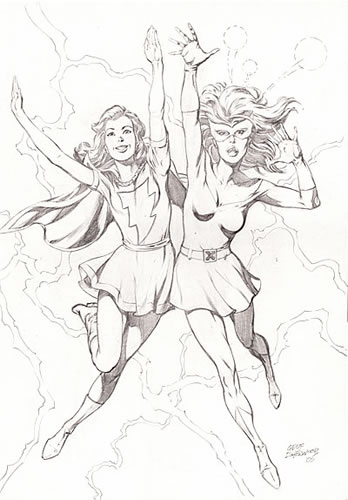
Mary Marvel and Marvel Girl, pencils by comics artist Geof Isherwood

Unlike DC’s Wonder Woman and Supergirl, whose powers were the equal of any of the men (even though they rarely got the opportunity to demonstrate this, especially in the case of Supergirl), Marvel’s heroines of the 1960s were uniformly ineffectual. The Invisible Girl (seen at the top of this post, in a pencil drawing by Geof Isherwood) turned invisible — a handy skill for a voyeur, perhaps, but not much good in a fight. The fashion-obsessed Wasp shrank to insect size and flew — again, not much help when some supervillain is bashing your brains in. The X-Men’s Marvel Girl (alongside Mary Marvel in the Common Elements commission above, also by Isherwood) could push objects around with her mind — kind of cool, but still somewhat ephemeral compared with her male counterparts’ optic blasts or ice shields. The Scarlet Witch (below — yes, that’s Isherwood yet again) could… well… we never could figure out exactly how Wanda’s powers worked. We just knew that she couldn’t kick a lot of evildoer butt using them.

The Scarlet Witch, pencils by comics artist Geof Isherwood

It wasn’t until Ms. Marvel arrived on the scene in the late ’70s that Marvel finally created a heroine with maximum power potential. And even then, they couldn’t figure out how to deploy her effectively.

To Marvel’s credit, they’ve worked at upgrading most of their legacy heroines. The Invisible Woman — Susan Storm shed the “Girl” tag decades ago — added powerful force fields to her invisible arsenal. Marvel Girl transmogrified into the world-destroying Phoenix, before coming back down to Earth under her civilian name, Dr. Jean Grey. The Scarlet Witch — as much as I detest what Marvel’s writers have done to her character in recent years — may now be one of the most formidable beings in the Marvel Universe, with the ability to warp the very fabric of reality, as witnessed by the House of M storyline of a few years ago.

And, over time, Marvel has generated a veritable plethora of outstanding female heroes, including such characters as Storm, She-Hulk, Elektra, Kitty Pryde, the Black Widow, the White Queen, Valkyrie, Monica Rambeau, Thundra, the Daughters of the Dragon, Silver Sable, and at least three versions of Spider-Woman — as well as Spider-Girl, the alternate-future teenage daughter of a now-retired Spider-Man. So… they’re trying.

Comics are still largely a man’s world, sad to tell. It’s worth noting, though, that three of the best superhero comics being published right now feature female heroes.

Wonder Woman has never been better than in her current monthly series, as written by Gail Simone and illustrated by Aaron Lopresti. After an agonizingly trite start to her present-day adventures — which worked harder at making Kara a teenage sexpot than the Maid of Steel — Supergirl has developed in new and exciting ways with (at long last!) a sensitive creative team in writer Sterling Gates and artist Jamal Igle. And Terry Moore’s independent book Echo is an absolute joy, starring a beautifully realized lead character in stories with warmth and heart.

There’s hope for the ladies yet.

And that’s your Comic Art Friday.

Guam to run all night, Guahan to run all day

Posted February 18, 2010 by swanshadow
Categories: Aimless Riffing, Random Acts of Patriotism, Reminiscing, Ripped From the Headlines, The Body Politic

This just in from the South Pacific…

To mark the beginning of his final year in office, Felix Camacho, the governor of Guam, issued an executive order changing the name of Micronesia’s largest island to Guahan — the original name of the island in the language of its indigenous people, the Chamorros.

Guam — begging your pardon, Guahan — has an interesting — and in many ways, tragic — history. Ferdinand Magellan made the first European pit stop on the island in 1521, during his famous (or infamous, depending on one’s perspective) circumnavigational voyage. The Spanish colonized Guam in 1668, and held control of it until 1898, when both Guam and the Philippines were passed to U.S. hands at the end of the Spanish-American War.

The Japanese captured Guam the day after after the Pearl Harbor attack and occupied it until American forces reestablished authority in July 1944. (Ironically, Guam’s primary source of income today — aside from the extensive U.S. military presence — is Japanese tourism.)

My own peregrinations as an Air Force brat took me to Guam once, albeit so briefly that it barely rates mention. On our way back to the States from our two-year tour in the Philippines, we had about a three-hour layover at Andersen Air Force Base on the island’s northern edge. Not that we saw much. As I recall, we spent the time between flights sitting in a tiny coffee shop in the air terminal, in stiflingly humid heat.

Since World War II, Guam has held a peculiar status as a United States territory. It has its own elected internal government, much like a full-fledged state of the Union, and its people are U.S. citizens. (Unlike, say, the people of American Samoa, who are U.S. nationals — meaning that they are entitled to travel with a United States passport — but not U.S. citizens.) Guamanians, however, do not vote formally in the U.S. presidential elections (Guam casts a straw poll vote for President, but has no standing in the Electoral College), and they have only token representation in Congress — a single delegate to the House of Representatives (a delegate without voting privileges) and no U.S. Senator.

Over the years, there have been a number of initiatives to elevate Guam to commonwealth status, like that of Puerto Rico, and more recently, Guam’s nearby neighbor, the Northern Mariana Islands. Thus far, none of these proposals has succeeded. Many Guamanians — with some justification — feel themselves second-class citizens, in that they have the title but lack two of the most significant benefits: a voice in the federal government, and a genuine say in the choice of President.

That status seems unlikely to change, regardless of what the island’s people call themselves.