Soup’s gone

Posted October 22, 2009 by swanshadow
Categories: Celebritiana, Cinemania, Dead People Got No Reason to Live, Reminiscing, Ripped From the Headlines, Teleholics Anonymous

So I come home tonight after a long day at the hospital with KJ, and the first thing I read on the news is that Soupy Sales died.

Go ahead, world… tear away another piece of my childhood.

Although I’m too young to have been around for his infamous kids’ shows from the 1950s and early 1960s — shame on you for thinking there’s nothing I’m too young to have been around for — Soupy was a big part of my nascent TV experience. Reruns of his mid-’60s variety show ran endlessly on Armed Forces Television, a staple of my military-brat youth.

More significantly, as a connoisseur of game shows, I watched Soupy on hundreds of episodes of programs like What’s My Line? (he was a regular panelist for seven seasons), Pyramid, To Tell the Truth, Match Game, and Hollywood Squares. In the ’70s, Soupy also hosted the juvenile version of the stunt game Almost Anything Goes, the forerunner of Nickelodeon’s Double Dare and its spinoffs.

Soupy’s legend in television was secured on New Year’s Day 1965, when as a gag he invited his young viewers to dig into their parents’ wallets and purses and mail him “those green pieces of paper with pictures of Presidents on them.” Contrary to popular belief, Sales wasn’t fired for this stunt — although he was suspended for a week — nor did his entreaty net a massive windfall. (Most of the mail submissions contained Monopoly money.) The incident, however, illustrates the unpredictable humor for which Soupy became famous, even when he was mostly known for entertaining kids.

Some years ago, TV comedy and comics writer Mark Evanier composed a detailed retrospective about Soupy’s career. In tonight’s blog post, Mark adds a few additional thoughts. Both articles are well worth a read.

Back when I was reviewing films for DVD Verdict, I penned a critique of a little-known “mockumentary” entitled …And God Spoke. It’s a pretty funny flick if you enjoy that Christopher Guest sort of thing, and one of its most hilarious bits is a cameo by Soupy Sales as himself, hired to portray Moses in a low-budget Biblical epic. Because if you couldn’t afford Charlton Heston, you’d definitely want the Soup Man.

Soupy Sales — whose birth name, incidentally, was Milton Supman — was 83. His two sons, Hunt and Tony Sales, are rock musicians who’ve worked as sidemen for such premier artists as David Bowie, Todd Rundgren, and Iggy Pop.

There. I didn’t mention pie once.

Comic Art Friday: RIP, George Tuska

Posted October 16, 2009 by swanshadow
Categories: Comic Art Friday, Dead People Got No Reason to Live

Sad news this Comic Art Friday…

George Tuska, a comic artist whose career began in the earliest days of comic books, passed away last night at the age of 93.

Iron Man vs. the Hulk, pencils by comics artist George Tuska

Only a week or so ago, I received notice via the Comic Art collectors’ e-mail list that Tuska had decided to stop accepting new commissions. I’m reminded of our local hero, Charles Schulz, whose final Peanuts strip appeared in newspapers on the day of his death. It’s almost as though these gentlemen had been drawing for so long that when they decided to stop drawing, they had nothing left to live for.

Tuska’s life in comics began in 1939, when he began working for the legendary Will Eisner. Although Tuska would eventually draw every genre of comic known to humankind, his original specialty was crime stories, in particular the gritty sort that appeared in Lev Gleason’s infamous Crime Does Not Pay.

In the 1960s, Tuska became one of the busiest artists in the superhero genre. He was the regular penciler on Marvel’s The Invincible Iron Man for nearly a decade (September 1968-January 1978), and while he was by no means the first artist to draw Iron Man, Tuska’s depiction of the character was the seminal one for a generation of Marvelites. Even today, when I close my eyes and think “Iron Man,” it’s the George Tuska version I envision. Tuska had a knack for making Tony Stark’s armor come alive — in fact, he drew Shellhead’s supersuit in a way that made it seem almost as pliable as Batman’s cape, yet still metallic somehow. He was, I think, the first artist to subtly change the expression on Iron Man’s faceplate to reflect the emotions of the man inside. It wasn’t technically authentic, maybe, but it worked.

From my perspective, Tuska’s other key achievement at Marvel was his work on Luke Cage, Hero for Hire, the first mainstream comic book to bear the name of a black superhero in its title. Tuska illustrated the first three issues of the series, then returned to draw several more, beginning with issue #7. When the title of the book changed to Luke Cage, Power Man, Tuska once again came back to the character, adding another dozen or so issues to his credits. Again, as with Iron Man, when I think of Luke Cage, it’s Tuska’s depiction that I most associate with the character.

Perhaps because of his experience on the Cage title, Tuska was the artist Marvel chose to draw another series featuring an African-American hero, Black Goliath. Other Marvel titles to which Tuska contributed significantly included The Avengers, Sub-Mariner, X-Men, Ghost Rider, and the Western series Kid Colt, Outlaw. He also drew the first several issues of the Man-Wolf series in Marvel’s monster anthology, Creatures on the Loose.

Tuska was known in the industry as “King of the Fill-In” because his adaptable style and speedy production made him invaluable as a fill-in artist — drawing a single issue of a title when the regular artist took time off, or fell behind schedule. At Marvel, he drew dozens of fill-in issues throughout the ’60s and ’70s, touching practically every book Marvel published during that span at least once.

After leaving Marvel in 1978, Tuska assumed the art chores on DC’s World’s Greatest Superheroes newspaper strip, a job he held for 15 years. During this period, he also drew comic books for DC, mostly in the various Superman titles.

Tuska retired from comics in the mid-1990s. As noted earlier, however, he continued to draw commission projects until shortly before his death. Although I never was fortunate enough to commission him, the artwork shown above is a commissioned piece I picked up from another collector five years ago. It’s not dated, but I believe Tuska drew it sometime in the early part of this decade. It’s Tuska’s Iron Man in a classic action pose, doing battle with the Hulk. Everything you need to know about the artist’s style and approach to layout and character is right there on the page.

According to his friend and biographer, Dewey Cassell, Tuska is survived by his wife of 61 years, Dorothy, their three children, numerous grandchildren, great-grandchildren, and friends, and a legion of fans.

Thanks for all of the wonderful art, Mr. Tuska. Those sure were some great times.

And that’s your Comic Art Friday.

It’s only news if somebody cares

Posted October 15, 2009 by swanshadow
Categories: Aimless Riffing, Celebritiana, Ripped From the Headlines, Sexiest People Alive, Soundtrack of My Life

This just in from the world of music…

Country star Garth Brooks is ending his retirement.

At the same time, the Norwegian pop trio a-ha — best known for the ’80s hit “Take On Me,” and its influential video — is announcing its retirement.

Here’s the unfortunate news for these artists.

No one knew that Garth Brooks had retired…

…or that a-ha hadn’t.

The Not Having Been Discovered Yet List

Posted October 12, 2009 by swanshadow
Categories: Aimless Riffing, Celebritiana, Dead People Got No Reason to Live, Hero of the Day, Listology, Random Acts of Patriotism, Ripped From the Headlines

I hope you’re enjoying your Columbus Day — or, as I prefer to call it, Not Having Been Discovered Yet Day (an homage to the late, great comic genius, Flip Wilson).

Sure, Christopher Columbus was directly responsible for the deaths of hundreds of thousands — some historians suggest millions — of indigenous North Americans. And yes, he introduced the slave trade to the New World. And despite what you may have heard, he wasn’t the first European to make landfall or establish a colony in the Western Hemisphere — hello, Leif Ericson — nor to prove that the Earth was round (the shape of the Earth was understood from ancient times; the Biblical book of Isaiah, written around 700 B.C., described “the circle of the Earth”).

But Crazy Chris had a terrific press agent: namely, storyteller Washington Irving. Irving’s 1828 fictionalized biography, The Life and Voyages of Christopher Columbus, popularized most of the commonly accepted legend about the explorer.

Which is the main reason there’s a Columbus Day.

Listing all of the various and sundry items named for the self-styled Admiral of the Ocean Sea would take us until… well… next Columbus Day. So instead, I’ve selected my seven absolute favorite Columbus name-checks.

7. Columbus Salame. One of the Bay Area’s finest producers of tasty meat products. I lunched on sandwiches made from Columbus deli ham just yesterday. Delicious.

6. The District of Columbia. This will come a shock to fans of filmmaker Alex Proyas, but the abbreviation at the end of Washington, D.C. does not stand for Dark City. I lived in our nation’s capital for several months when I was young — my father was stationed at nearby Andrews Air Force Base.

5. Columbus, Ohio. My wife used to work for Nationwide Insurance, which is based there. Thanks for all the paychecks.

4. The Columbia River. On a speaking trip to Eugene, Oregon some years back, I was treated to a lovely dinner in a restaurant overlooking the river. Roll, Columbia.

3. Motion picture director Chris Columbus. The only one of Columbus’s films that I truly enjoy is his first, Adventures in Babysitting, but that one is so choice that I’m willing to overlook abject junk like Home Alone and Mrs. Doubtfire. “Nobody leaves this place without singing the blues.”

2. The World’s Columbian Exposition of 1893, sometimes referred to as the Chicago World’s Fair. Author Erik Larson wrote an excellent nonfiction book, The Devil in the White City, about the development of the Exposition and the concurrent activities of serial killer H.H. Holmes. If you haven’t read Larson’s tome, I highly recommend it.

1. Lt. Columbo. I always wondered whether Peter Falk’s disheveled detective was a descendant of the Italian-born explorer (whose name in his native tongue would be pronounced Christoforo Columbo). “Ah, pardon me, ma’am… just one more thing… do you mind if I steal your continent?”

Comic Art Friday: She’s a ringer!

Posted October 9, 2009 by swanshadow
Categories: Comic Art Friday

In honor of the discovery earlier this week of Saturn’s Phoebe ring — the largest planetary ring in the solar system by a factor of a bazillion — today’s Comic Art Friday salutes the one superheroine who could have told us the doggoned thing was there all along: Saturn Girl.

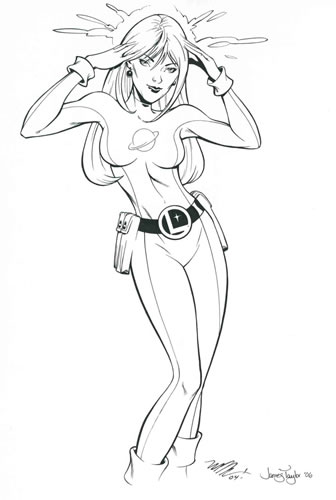
Saturn Girl, pencils by Michael Dooney, inks by James Taylor

In the 30th century, vivacious Imra Ardeen from Titan, Saturn’s largest moon, is one of three gifted teenagers who together found the Legion of Super-Heroes. Imra, whose power is mental telepathy, takes the code name Saturn Girl. I never could figure out why Imra called herself Saturn Girl, since (a) Saturn didn’t have anything to do with her powers, and (b) she wasn’t actually from Saturn. Why not call herself Titan Girl?

I guess Mind-Reader Girl would have sounded too silly. Then again, on a team that would eventually include people calling themselves Bouncing Boy, Princess Projectra, and Matter-Eater Lad, is any code name too silly?

Saturn Girl and Green Lantern Alan Scott, pencils by comics artist Anthony Carpenter

Speaking of silly, the artwork above features Imra alongside the original Green Lantern, Alan Scott, who wears one of the silliest costumes in the history of comics. But he has a cool power ring. (Imra’s named after a planet with rings. There’s a Common Element for you.)

Although afflicted with a confusing moniker and a wimpy superpower — because it was the Silver Age, and pretty much all female superheroes had wimpy powers — Saturn Girl remained a stalwart in the Legion, and one of its most identifiable members. As a charter Legionnaire, she was looked upon as an elder stateswoman (at least, as elder as a teenager can be) and de facto leader. Imra’s prominence in the group has held consistent throughout the decades, and the Legion’s ever-changing permutations, right up to the present day.

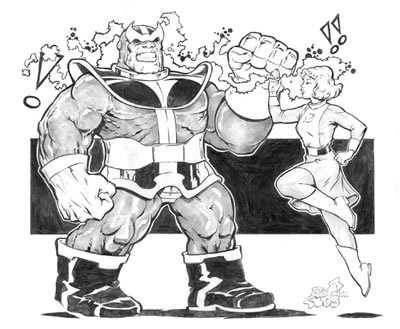
Below, we see Imra facing off with the dreaded cosmic supervillain Thanos. They’re both from the moon Titan, albeit in different comic-book universes. (There’s another Common Element.)

Saturn Girl and Thanos, pencils by comics artist Steve Mannion

You’ll notice that Thanos does not refer to himself as Saturn Boy. Or Saturn Man. Or Saturn anything. That’s because Thanos stayed awake in astronomy class, and knows that he isn’t from Saturn. (Imra was out with a migraine that day.)

In the past few years, Imra has become something of a TV star. She was one of the lead characters in the recent Legion of Super-Heroes animated series (at least in the first season of the show; she was mostly MIA in Season Two). She has also appeared, in radically modified form, as a guest star on Smallville, where she’s played by the girl who was Mackenzie Phillips’s teenage sidekick in the final season of the Disney Channel X-Files knockoff, So Weird. (You’d pretty much have to call a show So Weird if Mackenzie Phillips stars in it, wouldn’t you? But that’s a topic for another day.)

Funny how she never mentions that Phoebe ring, though.

And that’s your Comic Art Friday.

The UFL truth

Posted October 8, 2009 by swanshadow
Categories: I Love the Giants, My Home Town, Ripped From the Headlines, Sports Bar

Tonight, at AT&T Park — the home of your San Francisco Giants — the new United Football League (to be referred to hereafter as the UFL) kicks off its inaugural season.

Nobody cares.

This maiden contest pits the homestanding California Redwoods (whose uniforms, in stark contrast to the obvious hues suggested by the name, are a sickly lime green) against the visiting Las Vegas Locomotives.

Nobody cares.

All four of the UFL’s teams — the others are the New York Sentinels and the Florida Tuskers, the latter of which will play home games in the Tampa Bay area — are coached by NFL veterans. The Redwoods’ main clipboard holder is Dennis Green, former head coach of the Minnesota Vikings and Arizona Cardinals, who has local ties as a two-time assistant coach with the San Francisco 49ers and head coach at Stanford University.

And still nobody cares.

The last serious attempt to burrow into the National Football League’s stranglehold hegemony occurred back in the early 1980s, when the United States Football League (USFL) struggled along for three seasons. (I use the word “serious” because no one took seriously the short-lived XFL, concocted by by the same geniuses who brought you the WWE.)

The USFL played its games in the late spring and early summer, avoiding direct competition with the NFL. The moment that the USFL — in a fit of self-destructive bravado — decided to move its season to the fall, the NFL pulled in the reins. The upstart league died with barely a whimper.

I actually enjoyed the USFL for two reasons. For one, the local team, the Oakland Invaders (a certain similarly named NFL squad was slumming in Los Angeles at the time), played many of its home games on Saturday afternoons, making it possible for those of us with Sunday responsibilities to attend. For another, the Invaders’ tickets were relatively inexpensive and readily available, unlike those of the then-dynastic 49ers, so that even on my college student budget I could take in a few contests each year.

As most startup sports leagues do, the USFL went through near-constant franchise turmoil throughout its three-year run. Between the second and third seasons, the Invaders absorbed the former Detroit franchise, the Michigan Panthers, and the two teams’ rosters merged. This resulted in the Invaders, a mediocre club their first two seasons, suddenly becoming a powerhouse — thanks to the addition of several top players from the former USFL champion Panthers, including quarterback Bobby Hebert. The rejuvenated Invaders compiled a 13-4-1 record on their way to the league championship game, which Oakland lost in a 28-24 thriller to the Philadelphia Stars.

Then the USFL went away.

I anticipate the same dire fate for the UFL. Only, I doubt it’ll take three years.

Go Redwoods?

Nobody cares.

[UPDATE: I’m informed that the first UFL game between the Redwoods and the Locomotives is actually being played in Las Vegas, not in San Francisco. You know what? Nobody cares.]

The Phoebe ring

Posted October 7, 2009 by swanshadow
Categories: Ripped From the Headlines, That's Cool!, Weird Science

Fascinated as I am by all things astronomical, today’s news of the discovery of a new ring of Saturn piqued my interest.

I know what you’re thinking: Saturn’s got a bunch of rings already. What’s the big deal?

The big deal is that the Phoebe ring, as the newly identified phenomenon is being called, is not another of the familiar rings that encircle the equator of the sixth planet from the sun like a series of enormous belts. For one thing, the Phoebe ring is beyond huge — its inner edge begins at about 128 times the radius of Saturn. The ring itself is about 20 times as thick as Saturn’s diameter. So it’s less like a belt than like a cosmic inner tube, with an antlike Saturn at its hub.

To put it another way, more than one billion Earths could fit inside the Phoebe ring.

Is that big enough for you?

Astronomers have been searching for something in the vicinity of the Phoebe ring since the 1970s, when Cornell University’s Joseph A. Burns first suggested the object as an explanation for the unusual properties of Saturn’s moon Iapetus. It’s taken this long to find the mystery ring because, although the Phoebe ring is ginormous, it’s nearly invisible. Scientists used NASA’s Spitzer Space Telescope — a orbiting satellite that “sees” in infrared (and apparently, no relation) — to pinpoint what Dr. Burns first postulated three decades ago.

The fun part of the news for me was hearing Andrew Fraknoi on the radio tonight, chatting with the anchors on KCBS about the discovery. Andy is the head astronomy professor at Foothill College, and for many years was the chairman of the Astronomical Society of the Pacific. Whenever there’s an astronomy event in the news, Andy’s usually the guy to whom the Bay Area media reaches out for an explanation. About 25 years ago, I took Andy’s introductory astronomy class at San Francisco State, to fulfill a natural science requirement. I don’t recall the grade I received, but I remember that it was an interesting course.

I’m still waiting, though, to learn why such a significant scientific discovery was named after Lisa Kudrow’s character on Friends.

Giants post-script, 2009

Posted October 5, 2009 by swanshadow
Categories: I Love the Giants, My Home Town, Sports Bar

As the San Francisco Giants began their 2009 campaign, I wrote:

If the Giants hit the way they did in 2008… well, it’ll be a long summer in San Francisco.

As it happened, the Giants did, in fact, hit this season pretty much the way they did last season. The team batting average (.262 in ’08, .257 in ’09) and on-base plus slugging percentage (.703 last year, .699 this year) actually declined. Still, the Giants managed their first winning campaign in five years, thanks largely to one of the best pitching staffs — if not indeed the best staff — in the major leagues.

San Francisco came within two games of completely reversing its dismal 2008 record — the club improved from 72-90 to 88-74, a 16-game uptick — and remained in the National League wild-card race until only five games were left to play. By any measure, that’s a monumental achievement.

Instead of being a long summer, it proved to be just a few weeks too short.

So, while the glow of exploded expectations remains fresh, let’s talk about who did what for the G-Men in ’09.

Starting pitching: Tim “The Freak” Lincecum made good on his 2008 Cy Young Award with another stellar season (15-7, 2.45 ERA, four complete games — two of which were shutouts — and a league-leading 261 strikeouts). Fortunately for Timmy, he didn’t have to carry all of the weight this year. Matt Cain rebounded from a disappointing ’08 to log the best season of his young career (14-8, 2.89. four complete games, 171 K’s). Barry Zito’s year mirrored the preceding one — he stank up the joint for the first two months of the season (1-6 at the end of May), then pitched solidly for the next four months (9-7 after June 1). Jonathan Sanchez threw a no-hitter against San Diego on July 10 — the first by a Giants pitcher since John “The Count” Montefusco accomplished the feat in 1976 — in the middle of another hot-and-cold campaign. In what likely will be the coda of a Hall of Fame career, 45-year-old Randy “The Big Unit” Johnson pitched fairly well (8-6 in 17 starts) before an injury sidelined him until the closing days of the season. Johnson’s farewell appearance — in relief, in the season’s final game — earned him a blown save (the Giants won in extra innings, on a Pablo Sandoval home run). Waiver-wire pickup Brad Penny, who joined the team on September 1 after a dismal year in Boston, pitched with fire and bravado in the final month, posting a 4-1 record and a 2.59 ERA in six starts for the Giants. Grade: A-.

Relief pitching: The Giants’ bullpen, an unqualified disaster in ’08, developed into one of the National League’s best in ’09. Closer Brian Wilson, an All-Star last season, posted another solid year (38 saves, third in the NL) despite adding drama to almost every game he entered. The ‘pen benefited most from the arrival of lefty Jeremy Affeldt, who proved himself one of the top set-up specialists in baseball (a 1.73 ERA in 74 appearances). Rookie Brandon Medders and veteran Justin Miller led the rest of the relief corps, pitching consistently as the middle-inning workhorses before Miller went down with a season-ending injury in late summer. Sergio Romo struggled after an early injury. Merkin Valdez failed to live up to his considerable promise, Aging Bob Howry — the oldest member of the staff at 35, outside of the Big Unit — set a career record for walk-off home runs surrendered to rookies. Late-season promotion Dan Runzler, on the other hand, looks like a gamer. Grade: B.

Catching: Veteran Bengie Molina again demonstrated his value behind the plate. Offensively, Molina stumbled beneath the burden of being the club’s miscast cleanup hitter. “Big Money” smacked 20 home runs for the first time in his career, but his overall production sagged. He drove in 80 runs — down from 95 in ’08 — dropped his batting average nearly 30 points, and struck out 30 more times than the previous year despite playing in 13 fewer games. Molina’s backup, career minor leaguer Eli Whiteside, showed exceptional defensive and game-calling skills, but an anemic bat (.228 with two home runs). One of the key offseason problems for Giants management will be whether to resign the deteriorating Molina for another year, or hand the catching job to top prospect Buster Posey. Grade: B-.

Infield: The Giants discovered their first post-Barry Bonds everyday star in Pablo Sandoval. The 22-year-old Kung Fu Panda broke out big-time in his first full season, leading the team in every offensive category — .330 BA (second in the NL), 25 home runs, 44 doubles, 90 RBI, and a whopping .943 OPS — while splitting time between third base and first. Sandoval’s infectious joie de vivre added spark to an otherwise lackluster lineup. Free agent pickup Juan Uribe, intended as a utility player, blossomed in an ever-changing role as second baseman Emmanuel Burriss’s season was aborted by injury, and shortstop Edgar Renteria gimped through the year with bone chips in his elbow. Uribe’s .824 OPS made him second on the club in offense thump behind Sandoval. The Giants traded at the deadline for second baseman Freddy Sanchez, but a host of ailments impeded his ability to take the field, much less contribute effectively. Another trade acquisition, first baseman Ryan Garko, was another nonfactor. Another first base candidate, Travis Ishikawa, settled into mediocrity at the plate after a red-hot spring training. Second baseman-outfielder Eugenio Velez returned late in the season from a minor league demotion with rejuvenated offensive aggressiveness — the Giants just have to find a position for his below-average defense. Grade: B.

Outfield: The best way I can think of to describe the Giants’ outfield this year? A whole lotta nothin’. The vast expanses of AT&T Park were patrolled in ’09 mostly by guys who couldn’t hit water if they jumped off the McCovey Cove promenade. Of the five players who saw the most outfield innings — Randy Winn, Aaron Rowand, Fred Lewis, Nate Schierholtz, and the aforementioned Velez — not one hit for a .270 average or drove in 65 runs, and only Rowand clouted double-digit home runs (16 — Schierholtz and Velez were tied for second among the outfielders with five HR each). That’s a monumental black hole among the traditional power positions. If you seek a reason for San Francisco’s offensive ineptitude, look no further. Grade: D.

Dugout: Results count, so credit manager Bruce Bochy and his staff — especially pitching coach Dave Righetti and bullpen coach Mark Gardner — for making the most of this lopsided mix. If I had to guess, I would bet that Bochy and most of his team will be retained for next season (no formal announcement has been made, but the rumor is already circulating), but that hitting coach Carney Lansford will be kicked to the curb. (Lansford’s replacement may be minor league instructor Hensley “Bam Bam” Meulens, who’s said to be responsible for Velez’s late-season turnaround.) Grade: B.

Overall: For a team that many — yours truly included — thought might be one of the worst clubs in baseball going into the season, 2009 was a phenomenal year. With even one more capable bat to complement Sandoval, the Giants would be playing postseason baseball right now. Management will have to exhaust every option to bring more offense to the club between now and next spring. With a magnificent rotation — the Giants will need to decide whether to pursue Brad Penny for an ongoing deal — and an improving bullpen, San Francisco simply must find ways to push more runs across the plate. This ’09 team was 75-25 in games in which the offense scored three or more runs. Just imagine what Lincecum, Cain, Zito, Wilson, Affeldt and company might do behind a lineup that could tally four runs per game. That smells like a World Series to me. Grade: B.

Comic Art Friday: Sable metrics

Posted October 2, 2009 by swanshadow
Categories: Comic Art Friday

I’ve been reading comic books, and admiring the art contained in them, for more than 40 years. (Which reminds me — get off my lawn.) I can’t begin to guess how many comic book artists’ work I’ve viewed during that span of time. Of course, there have been numerous pencilers and inkers whose work I’ve loved. Not surprisingly, there have been quite a few whose art, at best, didn’t impress me, and at worst, repulsed me. (Hello, Rob Liefeld.)

Silver Sable and Jon Sable, pencils by comics artist Mike Grell

There’s always been one category of artists who’ve held a special place in my admiration: those whose work I can always, and immediately, recognize. That category is less densely populated than you might suppose. Comics have always been a derivative, imitative industry, with creators liberally borrowing (and sometimes, outright plagiarizing) from one another. Publishers contributed by mandating rigid “house styles,” patternized approaches that their staff artists and freelancers were duty-bound to mimic. (When Jack Kirby — without question the most influential artist in mainstream American comic books — moved from Marvel to DC in the early 1970s, DC editors routinely had other artists redraw the heads of Kirby’s Superman figures, because Kirby’s likeness of the Man of Steel strayed too far “off-model.”)

Even artists who rate among my favorites can be easy to confuse for one another. Keith Pollard’s work evokes John Buscema’s, for example, while Geof Isherwood evokes Barry Windsor-Smith. Comic artists who got into the business via the tutelage of others often evolve similar styles. A dozen or more name artists came into comics in the early 1970s as assistants of Neal Adams, and retained some measure of Adams’s influence — guys like Bob McLeod and Joe Rubinstein, to name two. So, even though I’ve looked at scads of comic art, I can’t always tell at a glance who drew it, even if it’s an artist I enjoy.

One artist whose work I’ve always recognized in a heartbeat, and whom I’d never confuse with anyone else, is Mike Grell.

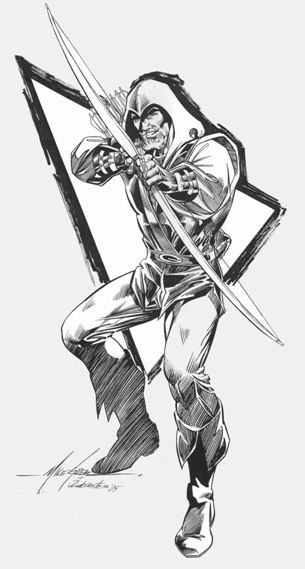
Green Arrow, pencils by Mike Grell, inks by Joe Rubinstein

Mike Grell burst onto the comics scene in 1973, as the artist on DC’s Legion of Super-Heroes. His run on that book is still fondly remembered by Legion aficionados. Grell also drew attention with his well-received work on Aquaman and Green Lantern/Green Arrow. His unmistakable style garnered Grell (no pun intended) legions of fans, as he became one of the era’s signature artists. The striking pinup above features Grell’s version of Green Arrow, as inked by Joe Rubinstein over Grell’s original pencils.

Grell’s true talent, though, shone through when he began to create his own characters. In 1975, he devised, wrote, and drew The Warlord for DC, a series that melded sword-and-sorcery heroic fantasy with space opera-style science fiction. When he left DC in the early 1980s, Grell developed a similar series — Starslayer — as a creator-owned property, published first by Pacific Comics, then by First Comics. The drawing below, penciled by Grell and once again inked by Joe Rubinstein, depicts Tamara D’Orsini, the female lead of Starslayer.

Tamara D'Orsini, pencils by Mike Grell, inks by Joe Rubinstein

Then, in 1983, Grell unleashed his magnum opus: Jon Sable, Freelance, a series about a safari hunter turned mercenary whom Grell described as “a cross between James Bond and Mickey Spillane’s Mike Hammer.” The independent comic proved sufficiently popular that in 1987, ABC-TV produced a dreadful action drama based on it. And when I say dreadful, I’m being kind.

The short-lived TV show, entitled simply Sable, bore only passing resemblance to Grell’s comic book. It’s probably most noteworthy for its unaired original pilot, in which Gene Simmons of the rock group KISS starred as the title character (Simmons was replaced for the seven episodes of the series by an unknown — then as well as now — actor named Lewis Van Bergen), and for its female costar Rene Russo, who though then unknown did not remain so, but instead went on to A-list motion picture stardom. Unlike Lewis Van Bergen, who so far as I know went on to the night shift at In ‘N’ Out Burger.

In the Common Elements commission that leads off this post, Mike Grell teams Jon Sable — who in the skilled hands of his creator looks nothing like either Gene Simmons or Lewis Van Bergen — with another mercenary turned hero, Silver Sablinova (code name: Silver Sable), who in the 1980s and ’90s battled bad dudes in the pages of Marvel Comics’ Silver Sable and the Wild Pack. I’ve often wondered whether these two stalwarts, who bear similar names and chose identical professions, might be somehow related… in a cross-dimensional, trans-universal sort of way.

But that’s an exploration for another time.

That’s also your Comic Art Friday.

Time to think pink

Posted October 1, 2009 by swanshadow
Categories: Breast Cancer Awareness, SwanStuff

It’s October, and if you’ve been a follower of this blog for much of the past five years, then you know where this is headed.

October is National Breast Cancer Awareness Month.

I’ve never been one for causes or campaigns, but this is one I embrace wholeheartedly and trumpet full-throatedly.

In case you’re new here, a little historical perspective. In September 2000, my wife KJ was diagnosed with breast cancer. At the time, she was 34 years old. Over the next nine months, she endured the gamut of treatment — first surgery, then chemotherapy, then radiation treatments. Although there had been some significant lymph node involvement, she looked forward to a positive prognosis.

After six years of reasonable post-treatment health, KJ broke her left femur — that’s the thigh bone, to us non-medical types — during routine housework. Subsequent x-rays and tests confirmed the worst of our fears. Her cancer had metastasized to her skeleton. The site at the top of her femur, where the fracture occurred, was by far the largest tumor location, but not the only one. Radiologic scans revealed smaller tumors throughout her spine.

The new prognosis contained ugly words. Like incurable. And life-limiting. Tough words to hear at any time of life, but especially when you’re just a year past 40, and your only child is about to graduate from high school.

That was two and a half years ago. KJ continues to fight the good fight, with the help of oral chemotherapy drugs and periodic infusions of medication designed to strengthen her bones, simultaneously slowing the incursion of tumor and reducing the risk of crippling fractures. She had been able to continue working until a month ago, when her oncologist placed her on what is likely to become permanent disability status. Her situation has been complicated by other health issues unrelated to her cancer, but at the moment, she’s holding her own — as effectively as is humanly possible.

We’ve learned to value every moment of every day, in ways that we might not have, otherwise. Some days are better than others. This much we know: Every day living is better than any day dying. The difference between the two is more a matter of perspective and attitude than of medical charts and test results.

Today’s been a pretty good day.

One thing that never changes: Breast cancer sucks. (No pun intended.) We despise it with passionate fury.

We love and support every woman (and man, which we often forget) who is battling this tenacious enemy, as well as the people in their lives who try to help them keep battling.

We praise the medical, technical, and phamaceutical professionals who are helping to sustain life — and the quality of it — while seeking determinedly for a cure.

And we pray for the day when no human being will have to stare down the barrel of this cosmic gun.

If you’re a woman of any age, please learn to self-examine, and be dedicated to the practice. If you’re over 30, have a serious conversation with your physician about your risk factors, but also be aware that breast cancer strikes many women with no obvious familial, environmental, or lifestyle risks. (KJ was one.) If your doctor prescribes regular mammograms, get them.

If you’re not a woman, but you love one or more, read her/them the above paragraph.

These are hard times for everyone, we know. (Believe me, we know.) If, however, you can find it in your heart and wallet this month, please make a donation to the breast cancer charity of your choice. We’re fond of Susan G. Komen for the Cure, but there are dozens of fine organizations doing excellent work deserving of your support. So, support them if you can. A pledge to a friend or coworker who’s participating in a breast cancer walk-a-thon this month is one quick, easy, and painless way to do your part.

Let’s kill this thing.