Archive for the ‘Celebritiana’ category

Comic Art Friday: Witches and warlocks

October 30, 2009

Tomorrow is Hallowe’en — All Hallows’ Eve, if you don’t want want to get lazy about it — which makes today Hallowe’ene’en.

I’m not sure that designation will catch on, but I thought you’d want to know.

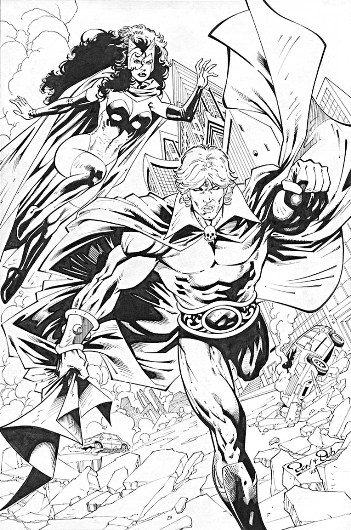
The Scarlet Witch and Adam Warlock, pencils by Ron Adrian, inks by Bob Almond

This being Hallowe’ene’en and all, what could be more appropriate than a Common Elements artwork featuring a witch and a warlock? Not just any witch and warlock, of course, but the Scarlet Witch and Adam Warlock — drawn here by the talented Brazilian penciler Ron Adrian and embellished by the man who puts the “king” in “inking,” Bob Almond.

The Scarlet Witch isn’t really a witch, of course, but a mutant with the power to alter probability. Nor is Adam Warlock really a warlock — that’s just his name. Much like Billy Warlock, who to the best of my knowledge is not an actual warlock either, just a soap opera actor.

Not being a real witch doesn’t make the Scarlet Witch any less cool. If anything, it makes her even more cool, because you have to be pretty cool to let people think you’re a witch when you’re really not. Sort of like Kristin Chenoweth, who, although famous for portraying a witch, is not an actual witch. Although she can sing an F above high C, and I’m fairly certain that you’d have to have supernatural powers to do that. So, she might be.

In similar fashion, not being an actual warlock doesn’t make Adam Warlock any less cool. Not being Billy Warlock, however, is pretty cool. Unless you’re Billy Warlock, in which case you’re stuck with it. Although Billy Warlock was married to Marcy Walker, which might have been kind of cool for a while. Then again, Marcy Walker has been married, like, five times, so it might not be all that cool after all.

A Common Elements commission starring the Scarlet Witch and Adam Warlock, however, is totally cool.

Even on Hallowe’ene’en.

And that’s your Comic Art Friday.

Soup’s gone

October 22, 2009

So I come home tonight after a long day at the hospital with KJ, and the first thing I read on the news is that Soupy Sales died.

Go ahead, world… tear away another piece of my childhood.

Although I’m too young to have been around for his infamous kids’ shows from the 1950s and early 1960s — shame on you for thinking there’s nothing I’m too young to have been around for — Soupy was a big part of my nascent TV experience. Reruns of his mid-’60s variety show ran endlessly on Armed Forces Television, a staple of my military-brat youth.

More significantly, as a connoisseur of game shows, I watched Soupy on hundreds of episodes of programs like What’s My Line? (he was a regular panelist for seven seasons), Pyramid, To Tell the Truth, Match Game, and Hollywood Squares. In the ’70s, Soupy also hosted the juvenile version of the stunt game Almost Anything Goes, the forerunner of Nickelodeon’s Double Dare and its spinoffs.

Soupy’s legend in television was secured on New Year’s Day 1965, when as a gag he invited his young viewers to dig into their parents’ wallets and purses and mail him “those green pieces of paper with pictures of Presidents on them.” Contrary to popular belief, Sales wasn’t fired for this stunt — although he was suspended for a week — nor did his entreaty net a massive windfall. (Most of the mail submissions contained Monopoly money.) The incident, however, illustrates the unpredictable humor for which Soupy became famous, even when he was mostly known for entertaining kids.

Some years ago, TV comedy and comics writer Mark Evanier composed a detailed retrospective about Soupy’s career. In tonight’s blog post, Mark adds a few additional thoughts. Both articles are well worth a read.

Back when I was reviewing films for DVD Verdict, I penned a critique of a little-known “mockumentary” entitled …And God Spoke. It’s a pretty funny flick if you enjoy that Christopher Guest sort of thing, and one of its most hilarious bits is a cameo by Soupy Sales as himself, hired to portray Moses in a low-budget Biblical epic. Because if you couldn’t afford Charlton Heston, you’d definitely want the Soup Man.

Soupy Sales — whose birth name, incidentally, was Milton Supman — was 83. His two sons, Hunt and Tony Sales, are rock musicians who’ve worked as sidemen for such premier artists as David Bowie, Todd Rundgren, and Iggy Pop.

There. I didn’t mention pie once.

It’s only news if somebody cares

October 15, 2009

This just in from the world of music…

Country star Garth Brooks is ending his retirement.

At the same time, the Norwegian pop trio a-ha — best known for the ’80s hit “Take On Me,” and its influential video — is announcing its retirement.

Here’s the unfortunate news for these artists.

No one knew that Garth Brooks had retired…

…or that a-ha hadn’t.

The Not Having Been Discovered Yet List

October 12, 2009

I hope you’re enjoying your Columbus Day — or, as I prefer to call it, Not Having Been Discovered Yet Day (an homage to the late, great comic genius, Flip Wilson).

Sure, Christopher Columbus was directly responsible for the deaths of hundreds of thousands — some historians suggest millions — of indigenous North Americans. And yes, he introduced the slave trade to the New World. And despite what you may have heard, he wasn’t the first European to make landfall or establish a colony in the Western Hemisphere — hello, Leif Ericson — nor to prove that the Earth was round (the shape of the Earth was understood from ancient times; the Biblical book of Isaiah, written around 700 B.C., described “the circle of the Earth”).

But Crazy Chris had a terrific press agent: namely, storyteller Washington Irving. Irving’s 1828 fictionalized biography, The Life and Voyages of Christopher Columbus, popularized most of the commonly accepted legend about the explorer.

Which is the main reason there’s a Columbus Day.

Listing all of the various and sundry items named for the self-styled Admiral of the Ocean Sea would take us until… well… next Columbus Day. So instead, I’ve selected my seven absolute favorite Columbus name-checks.

7. Columbus Salame. One of the Bay Area’s finest producers of tasty meat products. I lunched on sandwiches made from Columbus deli ham just yesterday. Delicious.

6. The District of Columbia. This will come a shock to fans of filmmaker Alex Proyas, but the abbreviation at the end of Washington, D.C. does not stand for Dark City. I lived in our nation’s capital for several months when I was young — my father was stationed at nearby Andrews Air Force Base.

5. Columbus, Ohio. My wife used to work for Nationwide Insurance, which is based there. Thanks for all the paychecks.

4. The Columbia River. On a speaking trip to Eugene, Oregon some years back, I was treated to a lovely dinner in a restaurant overlooking the river. Roll, Columbia.

3. Motion picture director Chris Columbus. The only one of Columbus’s films that I truly enjoy is his first, Adventures in Babysitting, but that one is so choice that I’m willing to overlook abject junk like Home Alone and Mrs. Doubtfire. “Nobody leaves this place without singing the blues.”

2. The World’s Columbian Exposition of 1893, sometimes referred to as the Chicago World’s Fair. Author Erik Larson wrote an excellent nonfiction book, The Devil in the White City, about the development of the Exposition and the concurrent activities of serial killer H.H. Holmes. If you haven’t read Larson’s tome, I highly recommend it.

1. Lt. Columbo. I always wondered whether Peter Falk’s disheveled detective was a descendant of the Italian-born explorer (whose name in his native tongue would be pronounced Christoforo Columbo). “Ah, pardon me, ma’am… just one more thing… do you mind if I steal your continent?”

A poem… by Henry Gibson

September 16, 2009

I doubt that it will attract the notice that the passing of Patrick Swayze garnered, but character actor Henry Gibson also died earlier this week.

Like most TV viewers, I first was introduced to the mousy, soft-spoken comic actor on Rowan and Martin’s Laugh-In. Gibson would appear, wearing a quaint suit and holding an enormous artificial flower, to recite a humorous, often ironic rhyme about some innocuous subject. His bits always began with Gibson’s quavering, deadpan monotone, “A poem… by Henry Gibson.” His presentations concluded with a bow and a self-effacing, “Thank you.”

Gibson turned up frequently on television in his post-Laugh-In career, usually playing the kind of nebbishy, passive-aggressive types for whom he became famous. Most notably, he was a regular on the ABC series Boston Legal, as the put-upon Judge Brown. He also appeared in numerous films, including the recent hit Wedding Crashers, and earned a Golden Globe nomination for his work in Robert Altman’s Nashville.

My favorite Gibson role was his voicing of Wilbur — the humble, radiant pig whose best friend is a talented spider — in the animated adaptation of E.B. White’s Charlotte’s Web. The casting was perfect, with Gibson bringing a delightful, plucky innocence to the role.

Until today, I did not know that Henry Gibson wasn’t really Henry Gibson. The actor, who was born James Bateman, took his familiar stage name as a pun on playwright Henrik Ibsen. I remember long ago noting the sonic similarity between the two names, but I’d always assumed that this was merely a coincidence.

I thought it appropriate that, in Gibson’s memory, we offer the following verse.

A poem… about Henry Gibson.
He always brought us laughter
When with blossom he’d appear;
His charming bits of doggerel
Made us grin from ear to ear.
As years passed, we discovered
He could also play things straight;
His talents as an actor
Proved nothing less than great.
We always will remember
This quirky little fellow;
His voice odd and distinctive…
His sunflower, bright yellow.

Thank you, Henry.

Swayze goes Swayze

September 15, 2009

Even the legendary Dalton loses a fight once in a while.

The air grew a bit chill around me when I fired up the laptop last evening and read the news that Patrick Swayze had passed away at age 57. We all knew the moment was coming — we probably knew it more than a year and a half ago, when Swayze revealed that he had been diagnosed with pancreatic cancer — but while not unexpected, it was nevertheless sad.

Swayze went down battling. In the midst of life circumstances that would have cause many of us to cocoon at home to await the inevitable, Swayze completed an entire season of a physically demanding TV series. He appeared in public when his health permitted. He gave interviews. He talked openly about his fight, and his determination to win.

You think Chuck Norris is tough? Patrick Swayze smacked Chuck Norris in the mouth and stole his lunch money every day for 20 months.

If Swayze had made only three films — Road House, Dirty Dancing, and Ghost — he would have had a career that ninety percent of Hollywood would have gladly sacrificed their own pancreases (pancreii?) for. Most actors would kill for a single role that defined them as pop-cultural icons. Swayze had three.

Road House may be the most frequently broadcast movie in the history of basic cable. (Is there a night during the week when you can’t find it somewhere on the dial?) Dirty Dancing garnered Swayze an enduring image, an endlessly repeated tagline — “Nobody puts Baby in a corner!” — and even a hit single… although the less said about “She’s Like the Wind,” the better. Ghost made Swayze’s name a hip-hop catchphrase. I doubt he collected a royalty every time some rapper said, “I’m Swayze,” but he should have.

Of course, Swayze made a ton of other films as well, in addition to his television work. But he’ll be remembered for this immortal trio.

Personally, I think Road House is one of cinema’s great disposable classics. It’s beyond ridiculous (come on… a heroic bouncer with a ludicrous hairdo? that only worked for Mr. T.), horrifically acted (from the expression-challenged Kelly Lynch to the scenery-gobbling Ben Gazzara to the host of bit players embodying every white trash stereotype known to man), and as predictable as tomorrow’s sunrise, but doggoned if it isn’t entertaining. How can a movie that features Jeff Healey’s incendiary blues guitar, a singing spotlight for the always delightful Kathleen Wilhoite, Sam Elliott being Sam Elliott, and a shirtless Swayze ripping out a man’s trachea with his bare hands not be entertaining?

I always liked the fact that Swayze — a serious and thoughtful man, by all accounts — maintained a sense of humor about himself. He famously poked fun at his own image in a Saturday Night Live sketch with Chris Farley, in which the unlikely duo played Chippendales wannabes. Swayze even popped up in an uncredited cameo in the dreadful Dirty Dancing sequel, Havana Nights.

Like the great Dalton, Patrick Swayze kept being nice until it was time to not be nice.

Unfortunately, the bad guys sometimes win.

Comic Art Friday: Long tails, and ears for hats

September 11, 2009

When last we convened for Comic Art Friday, we took our first look at a spectacular new addition to my Common Elements gallery — this super-sized six-character commission by Florida artist Gene Gonzales entitled “Catfight of the Bands.”

Catfight of the Bands, pencils and inks by comics artist Gene Gonzales

Today, let’s take a closer examination of the first of those two battling trios. (Never fear — we’ll catch up with the other three famous felines next Friday.)

From the preponderance of superhero art that appears here on Comic Art Friday, one might presume that comics in that genre were the only funnybooks I read during my formative years. Au contraire, mon frere. While superhero comics were — and still are — my core reads, as a kid I devoured every kind of comic book that I could find on the newsstands of the military bases where I grew up. I read sword and sorcery comics (I still read the current iterations of Conan and Red Sonja), horror comics (a particular pleasure in the early ’70s was the DC anthology Weird War Tales, which featured stories of the supernatural set on battlefields throughout history), Western comics (everything from Kid Colt, Outlaw to Bat Lash), military comics (you couldn’t call yourself a genuine service brat without reading Sad Sack), and juvenile comics (yes, friends, I read Casper the Friendly Ghost and Richie Rich, too).

And, I read Archie Comics. Heck, I loved Archie Comics. I’m man enough to admit that I read Betty and Veronica religiously back in the day.

My favorite Archie magazine? Josie and the Pussycats.
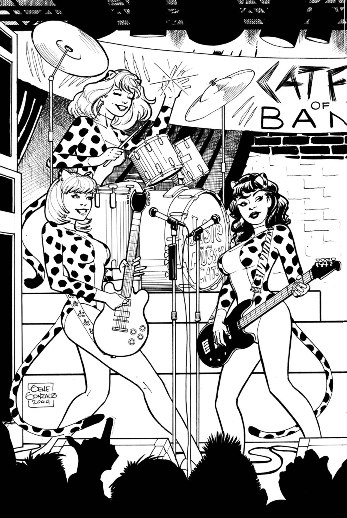
Josie and the Pussycats, pencils and inks by comics artist Gene Gonzales

Actually, I was reading the adventures of Josie and her friends before there was a Josie and the Pussycats. The perky redheaded teenager made her comics debut in 1963, as the star of the series She’s Josie. (Josie’s creator, longtime Archie artist Dan DeCarlo, named the character after his wife.) She’s Josie soon became just plain Josie, and centered on typical Archie-style teenage humor involving Josie and her high school pals, several of whom still costarred in the book when Josie decided to start her own rock band in 1969. (Not coincidentally, the Archie gang had exploded onto Saturday morning TV as a prefab pop group around the same time.)

When Josie (whose surname flip-flopped for years between Jones and James before settling on McCoy early in this current decade), her best friend Melody (also a Jones for many years, her last name became Valentine in the live-action Josie and the Pussycats movie a few years ago, and the comics followed suit), and their newest comrade Valerie (née Smith, later consistently Brown) donned their now-familiar leopard-spotted leotards and kitty-ear tiaras, the title of their comic took on the name of their newly formed act.

Thus legends are born.

Before long, Josie and the Pussycats had their own animated TV series. The show was eponymously titled for the first two years of its run (1970-72), then took a sci-fi turn and morphed into Josie and the Pussycats in Outer Space for another two seasons. Josie and the gang’s TV adventures borrowed heavily from the successful formula of Hanna-Barbera’s already popular Scooby-Doo, mostly involving the girls and their retinue solving comedic mysteries.

As did the Archies, Josie and the Pussycats — actually real-life session musicians using the band’s fictional identity — recorded several bubblegum pop singles in the early ’70s. Three then-unknown singers were “cast” as the singing voices of the Pussycats. The real-world “Melody” was a blonde named Cherie Moor (real name: Cheryl Jean Stoppelmoor), who came to greater fame later in the decade under her new stage name, Cheryl Ladd.

Ironically, most of the lead vocals on the Pussycats’ songs — including the familiar theme to the animated series — were performed by the singer cast as “Valerie,” Patrice Holloway, rather than by Cathy Dougher, who was “Josie.” Holloway almost didn’t the part, as Hanna-Barbera at first wanted to retool the Pussycats as an all-Caucasian trio. Music producer Danny Janssen, who assembled the real-life Pussycats and wrote several of their songs, refused to replace Holloway with a white performer. After several weeks of infighting, Hanna-Barbera agreed to restore Valerie to her original African-American heritage in the TV show, enabling Janssen to keep Holloway in the band. Valerie thus became the first black female character to appear regularly in an American animated TV show.

Three decades after their television debut, Josie and the Pussycats hit the live-action cinema. Rachael Leigh Cook portrayed Josie, Rosario Dawson played Valerie, and Tara Reid was typecast as the dizzy Melody. If you haven’t seen the movie… don’t. It’s 99 precious minutes of your life that you’ll never recoup. Trust me on this.

Josie and the Pussycats, blue pencil rough sketch by Gene Gonzales

Although I first hit on the idea to feature Josie and the girls opposite Catwoman and the two Black Cats a few years ago, it wasn’t until I saw Gene Gonzales’s rough sketch of the Pussycats on stage that I knew I’d found an artist with the appropriate sensibility to bring the concept to life. Thanks for allowing me to show off your inspiration, Gene!

Next week, we’ll wrap up our caterwauling by throwing the spotlight on the other half of this musical catfight.

Until then… that’s your Comic Art Friday.
From the Get Over It Department, Supermodel Division

September 7, 2009

Here’s a little celebrity news item from the Sydney Daily Telegraph:

Supermodel Elle Macpherson has revealed she fears that she looks old compared to her young TV co-stars as she has not had plastic surgery.

The supermodel is anxious about appearing on the new CW show The Beautiful Life because she hasn’t had plastic surgery.

The 46-year-old added that she is shocked at how she looks compared to her younger co-stars, including Mischa Barton and Sara Paxton.

Macpherson said: “Sometimes I really see that I’m the one that hasn’t done anything because I think people must think, ‘Oh my God, she looks old’.”

Let me see if I understand this correctly…

Elle Macpherson is worried that she looks old compared to Mischa Barton and Sara Paxton.

Mischa Barton is 23 years old. Sara Paxton is 21. Elle Macpherson is 46 — twice Ms. Barton’s age.

Here’s a breakthrough thought, Elle: If you’re chronologically qualified to be someone’s mother, it’s okay if you look older than that person. For a 46-year-old woman — which you are — you look just fine. Quit worrying, already.

This illustrates the stupidity of Western culture’s perceptions of beauty. A 46-year-old woman should not think she should look like a 23-year-old. Or a 21-year-old. Or anything other than a 46-year-old. Because it should be okay for each of us to be what we are, and not what someone  half our age is, or what we ourselves used to be two decades ago.

This also illustrates one reason why plastic surgeons and pharmaceutical companies are rich, and half the people in Hollywood look like circus freaks.

Embrace the real, people.

When I’m Elle Macpherson’s age, I hope I look as good as she does.

Hmm? I’m what?

Never mind.

Things that make me say, “Huh?”

August 29, 2009

“Huh?” Inducer #1: Andy Lee, the punter for the San Francisco 49ers, hit the scoreboard at the new Cowboy Stadium in Dallas with a punted football in warmups prior to tonight’s game between the Niners and the Cowboys. Apparently, a similar feat was achieved by the punter for the University of Tennessee in a game last week.

Let me get this straight: The Cowboys spent $1.2 billion on a stadium, and nobody thought to check whether the scoreboard was high enough?

“Huh?” Inducer #2: Cinematic schlockmeister Rob Zombie is remaking the 1958 horror classic The Blob. However, says Zombie:

My intention is not to have a big red blobby thing. That’s the first thing I want to change. That gigantic Jello-looking thing might have been scary to audiences in the 1950s, but people would laugh now.

Let me get this straight: Zombie’s going to remake The Blobwithout the Blob? (Memo to RZ: Someone already beat you to thisover a decade ago. How about, you know, an original idea for a change?)

“Huh?” Inducer #3: My cell phone service provider frequently leaves recorded messages on my office voice mail to alert me to special offers on wireless minutes, hardware upgrades, and such like. This week, they left me a recorded message to tell me that after September 1, new FCC regulations will prohibit their leaving me any future recorded messages.

Let me get this straight: WHAT?

The lion sleeps tonight

August 26, 2009

The first vote I ever cast for President in a national election, I cast for Senator Edward Kennedy.

The year was 1980. As much as it pained me — because I thought he was a decent guy who simply got in way over his head — I couldn’t bring myself to vote to reelect President Carter. You know darn well I wasn’t voting for the cowboy from Death Valley Days. As for John Anderson… you’re saying right now, “Who?” To which I can only reply, “Exactly.”

So I wrote in a vote for Ted.

It’s the only time I’ve ever exercised the write-in option in any election, for any office, ever. It might be the only time I ever exercise it. But I still believe that, in that particular election, it was the right move.

Ted Kennedy did more in service to this country during his storied tenure in the Senate than any dozen of his colleagues — of either party, or of both parties — that you’d care to name. I’m sorry that he didn’t live to see the health care reform for which he fought so hard in the waning days of his life. But I’m glad that he lived to see Barack Obama elected President.

Was Ted Kennedy a perfect man? He was not. (For the record, neither am I.) I don’t even know whether he was a good man, because I didn’t know him personally. But he was a great Senator. I remain convinced that he would have made a great President.

I’m proud that, the one time when the opportunity presented itself, I voted for him.

Thanks for everything, Senator.