Archive for the ‘Cinemania’ category

Comic Art Friday: Avengers assemble!

May 4, 2012

Unless you’ve been living in an underwater grotto for the past year or so, you know what today is: the U.S. premiere of Marvel Studios’ summer blockbuster, The Avengers. (Also known as Avengers Assemble, if you happen to live in the U.K. In which case, you already saw the movie a week ago.) While I didn’t feel compelled to queue up for a midnight showing, I do have the flick on my weekend to-do list.

In the meantime, I thought it would be fun to revisit a few pieces from my galleries featuring the heroes from the film’s roster of Avengers. It’s a much shorter list than the slate of current and past Avengers in the Marvel Comics universe, which, the last time I counted, has included more than 80 heroes and heroines over the superteam’s half-century of history.

Interestingly, there’s never been an incarnation of Avengers in the comics that included the movie’s Big Six — Captain America, Iron Man, Thor, Black Widow, Hawkeye, and the Hulk — at the same time. The Hulk, a founding member of the team, ditched the others by the second issue of the original run. He made guest appearances in a couple more early stories, but was gone entirely by issue #6. To the best of my knowledge, ol’ Greenskin hasn’t been an active Avenger at any time since early 1964, a year before Hawkeye signed on, and nearly a decade before the Widow became a permanent member.

Let’s start with one of the first drawings I acquired when I began collecting original art. Thor faces off with his not-so-jolly green compadre in this scene penciled by Dan Jurgens and inked by Bob Almond.
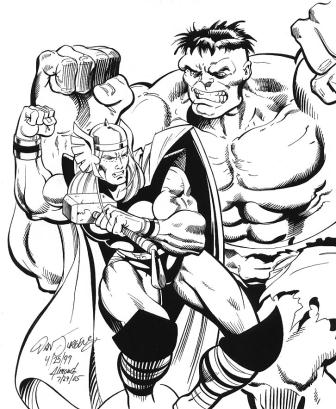
Thor vs. the Hulk, pencils by Dan Jurgens, inks by Bob Almond

Next up, here’s the Incredible One again, this time doing battle with yet another fellow founding Avenger, Iron Man. The late, great George Tuska — the definitive Iron Man artist of the 1970s — lent his potent pencil and imagination to this one.

Iron Man vs. the Hulk, pencils by George Tuska

People who don’t follow comics closely might assume that Captain America was an original Avenger, so identified is he with the team. In fact, Cap didn’t join until Avengers #4 — he was busy being frozen in ice prior to that. No sooner had the Star-Spangled Super-Soldier thawed out, though, that he became the heart and soul of the ever-changing ensemble, assuming his longtime leadership role in Avengers #16 when the remaining founding members — Iron Man, Thor, Ant-Man (who’d changed his code name to Giant-Man by then), and the Wasp — departed en masse. Cap’s been the center of the Avengers most of the time since. Here he is with his doppelganger and one-time fellow Avenger, the U.S. Agent (or USAgent, if you prefer), as drawn by Ron Lim and embellished by Bob Almond.
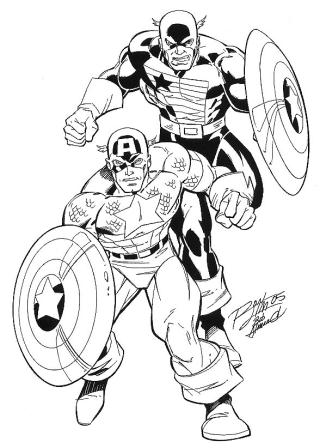
Captain America and the U.S. Agent, pencils by Ron Lim, inks by Bob Almond

The Black Widow didn’t become a full-fledged Avenger until 1973, though she made periodic guest shots before then. At the time she joined the team, the Widow was probably best known as the partner (both in and out of costume) of the blind crimefighter Daredevil, whose comic she co-headlined for four years. Readers of a certain age, however, will recall that before she settled in with the Man Without Fear, the spy formerly known as Natasha Romanoff starred in her own year-long series in Marvel’s Amazing Adventures in 1970 and ’71. In this Common Elements commission by Ty Romsa, the Widow chills with Silver Sable, one of the very few Marvel heroes who has never been an Avenger. (At least, not yet.)

Silver Sable and Black Widow, pencils by Ty Romsa

Alas, I don’t have a solo drawing of Hawkeye in my collection. Which surprises me, because I’ve always liked the guy. (I’m tempted to throw up my Mike Grell Green Arrow instead, just to see whether anyone would even notice the difference.) He does, however, make an appearance in my Common Elements series, in a terrific piece drawn by the legendary Ernie Chan.

Go see The Avengers. But wait a day or two until the crowds thin out. It’ll still be the same movie, but you’ll be able to get a better seat.

And that’s your Comic Art Friday.
Comic Art Friday: In which Uncle Swan does you a patriotic solid

July 22, 2011

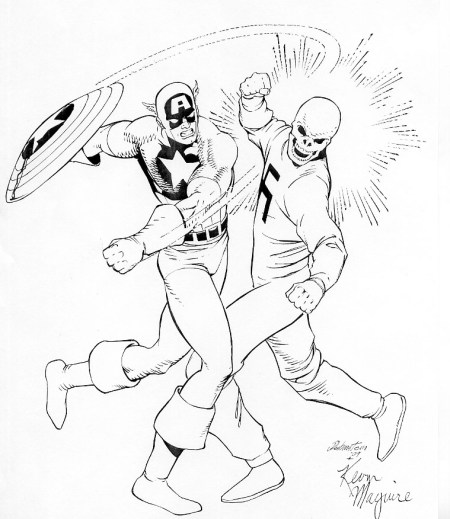
In case you were planning to see Captain America: The First Avenger, which premieres in theaters nationwide today…

Here’s how it ends.

Captain America smacks down the Red Skull, pencils by  Kevin Maguire, inks by Joe Rubinstein

I just saved you the price of a ticket.

You’re welcome.

And that’s your Comic Art Friday.
Comic Art Friday: The chauffeur’s daughters

March 4, 2011

I’ll be honest — sometimes, the only reason for a new Common Elements commission is that the idea made me grin from ear to ear when I thought of it.

Well, not literally from ear to ear in that Julia Roberts / Cameron Diaz sort of way. My mouth is not that enormous. More like from mid-cheek to mid-cheek.

First, the art. (As always, you can click the image for a better view.)

Sabrina the Teenage Witch and Fairchild, pencils and inks by comics artist Mike DeCarlo

Comics veteran Mike DeCarlo, who has drawn and/or inked everything from Spider-Man to The Simpsons during his quarter-century-plus in the industry, teams Sabrina, the Teenage Witch — star of comics, animation, and live-action TV, and responsible for extending the acting career of Melissa Joan Hart well beyond her teens (and, some might opine, beyond the limits of her talent) — with Caitlin Fairchild, leader of the youthful superhero team Gen13, who’s often known simply by her surname.

Next, the concept.

As an aficionado of old-school Hollywood, one of my favorite classic films is Sabrina. (That’s Billy Wilder’s 1954 original, starring Humphrey Bogart, William Holden, and a luminous Audrey Hepburn in the title role, not the tepid 1995 remake with Harrison Ford, Greg Kinnear, and Julia Ormond, directed by Sydney Pollack.)

Bogie and Holden portray two wealthy brothers — David, a good-for-nothing playboy (Holden), and Linus, who’s older and more serious (Bogart) — competing for the affections of a young woman (Hepburn) who happens to be the daughter of their family’s chauffeur. It’s sort of a reverse spin on Cyrano de Bergerac, with Linus working to sabotage the budding romance between his brother and the chauffeur’s daughter in order to score a huge business deal with the family of another woman, to whom David is engaged. And of course, Linus ends up falling in love with the girl himself. (Who wouldn’t? It’s Audrey Hepburn, for crying out loud.)

Okay, you’re thinking — that explains Sabrina. But what’s the Fairchild connection? If you’ve seen the movie, you know: the character Sabrina’s last name is Fairchild.

That makes me smile. Doesn’t it you?

And that’s your Comic Art Friday.

No Justice for the Maestro

February 22, 2011

I could hardly be more shocked and stunned than I was earlier today, when I read the news of the sudden death of Dwayne McDuffie.

Dwayne McDuffie leads an animation panel, WonderCon 2008

If the name is unfamiliar to you, then I’ll assume that you’re not a fan of either comic books or animation, or if you are, you don’t pay much attention to the names in the credits of either. McDuffie was a prolific writer and editor of comics who became an equally prolific writer, story editor, and producer of animation, primarily for television.

In the former realm, McDuffie created one of the most unique series in the history of comics: Damage Control, which spotlighted the exploits of a company that cleaned up cities after superhero fights. He also co-founded Milestone Media, an entire comics line that focused on bringing greater diversity to the medium, both on the page and behind the scenes. From Milestone’s publications came Static, the young electricity-wielding hero who later went on to star in the long-running and popular animated TV series, Static Shock.

McDuffie’s contributions to animation didn’t end with Static Shock. He served as story editor and producer on the Justice League franchise, as well as on the various iterations of Ben 10. He recently wrote the script for Warner/DC’s latest direct-to-DVD project, All-Star Superman, which debuted in stores — ironically enough — today.

As successful as he became in animation, McDuffie never completely abandoned printed comics. A few years ago, he wrote an outstanding miniseries for Marvel entitled Beyond!, and a well-regarded run on Fantastic Four. More recently, he breathed fresh life into DC’s tentpole series, Justice League of America.

Unlike many creators, McDuffie maintained a close connection to the readers and viewers who consumed his product. His personal website hosted a thriving online discussion forum, in which McDuffie himself (nicknamed by his fans “The Maestro”) actively participated. Never shy of expressing his opinions — and he had strong opinions about everything — McDuffie in correspondence was much like the characters whose adventures he wrote: witty, thoughtful, and more than a little tough. He gave no quarter, but he had a deft way of disagreeing vehemently with opponents without resorting to ad hominem attacks.

I had the privilege of meeting McDuffie briefly at WonderCon in 2008, following a panel featuring himself and several other top animation writers. (I took the above photo during that panel.) Although I didn’t muster the gumption to mention it to him in person, it was one of my career goals as a voice actor to snag a role in one of the series McDuffie wrote. As recently as a week ago, I’ve participated in workshops where McDuffie scripts served as the fodder for honing my acting chops. I deeply regret that I will never have the opportunity to work with him professionally.

McDuffie spoke and wrote much about the uphill struggle of being an African-American creator in a mainstream comics industry often frustratingly closed to diverse talents and storylines. His founding of Milestone Media represented his best effort at giving other people of color the opportunities that he, like few other creators of his background, had been afforded, and expanding the palette of characters about whom great comics tales could be spun. And yet, McDuffie would have been the first to correct anyone who referred to him as a “great black comics writer” — he was just a darned great writer, period.

A darned great writer, gone far too soon.

Dwayne McDuffie leaves behind his wife, his mother, a monumental legacy of work, and a numberless legion of colleagues and fans who appreciated his character as much as his creative genius. He was a singular talent in two discrete media, and successful in both.

He was just 49 years old — almost exactly two months younger than I. His birthday was yesterday.

Rest in peace, Maestro.

And don’t call me Shirley

November 29, 2010

When I heard last evening that Leslie Nielsen had died at the age of 84, I immediately thought — as I presume most people did — of the comedic roles he played during the last three decades of his acting career, beginning with Airplane! and continuing most notably with the TV series Police Squad! and the Naked Gun movies it spawned.

Often lost in that thought, however, is that Nielsen’s first comedy successes resulted from his not previously having been viewed as a comic actor. It’s a marvelous study in contrast — which is, after all, the very essence of comedy.

What made Airplane! funny was the absurdity of seeing actors whose screen images were stereotypically strait-laced — Nielsen, Lloyd Bridges, Robert Stack, Peter Graves, George Kennedy — doing and saying outlandish things. Think about the classic scene where Graves’s airline pilot makes homosexually suggestive remarks to a young boy: “Have you ever been in the cockpit of an airplane before? Have you ever seen a grown man naked? Have you ever been in a Turkish prison? Do you like movies about gladiators?” It’s shockingly funny, because at that point we mostly knew Peter Graves as the humorless secret agent Jim Phelps from Mission: Impossible. Did Graves ever utter a funny line in the entire run of that series? Did he ever even crack a smile? I don’t think so. Thus, when he makes these outrageous comments in Airplane!, it’s hilarious because, well, we didn’t know Peter Graves had that in him.

Now imagine, say, Will Ferrell in that same Peter Graves role. (Yes, I know Will Ferrell was in junior high school when Airplane! was made. Just go with me here.) It wouldn’t be as funny, because we expect outrageous comments from the mouth of Will Ferrell. The jokes would be the same, and Ferrell’s take on them might be more inherently humorous, but the impact of contrast would be lacking.

When Airplane! appeared, most people knew Leslie Nielsen — if indeed they knew him at all — as the sober-sided space captain in Forbidden Planet, or the equally somber ocean liner captain in The Poseidon Adventure, or the daring but dull Revolutionary War hero Francis Marion in the Disney miniseries The Swamp Fox. He was not an actor one expected to hear tossing off deadpan one-liners like the one in the headline of this post. Nielsen’s stiff-upper-lipped persona (as well as a previously untapped gift of timing) made him the perfect contrast for humor — a contrast he milked to great financial reward for the next 30 years.

Unfortunately — at least in my view — Nielsen didn’t know when to quit. In the aftermath of his first Naked Gun bonanza, he cranked out more than a dozen execrable films showcasing his newfound penchant for deadpan comedy, each of which proved more rancid than its predecessor. It’s one thing to find a fresh horse to ride; it’s entirely another to keep beating that horse long after it’s expired. Had Nielsen contented himself with the two movies that made his reputation, plus the TV series that inspired the second of those two movies, he’d be remembered as an unqualified comic genius. As it is, our fond memories of those noteworthy roles are muted by the likes of Repossessed, 2001: A Space Travesty, and Scary Movies 3 and 4.

If you like science fiction, and have never seen Forbidden Planet, you owe it to yourself to check it out on cable (it turns up periodically on the classic movie channels) or DVD. It’s one of the very few films from the bug-eyed monster era of sci-fi flicks that still holds up well today. (It’s more or less a retelling of Shakespeare’s The Tempest, in space opera dress.) Nielsen is effective in stolid action hero mode, Walter Pidgeon gnaws scenery as a brilliant but mad scientist, and Anne Francis — later the star of TV’s first female-lead detective series, Honey West — fills out a miniskirted space dress with aplomb.

Thanks for the good times, Mr. Nielsen. And remember… when you’re offered a choice between steak and fish for dinner, always choose the lasagna.

Descent into the Pitt

November 23, 2010

Sad news for genre film fans today: Ingrid Pitt, one of the leading ladies of horror movies during the 1970s, has died — this time, for real — at the age of 73.

Ingrid Pitt, horror superstar

Pitt became a cult star by way of her appearances in Hammer Films’ The Vampire Lovers and Countess Dracula, The House That Dripped Blood from Amicus Productions (generally thought of as “Hammer Lite”), and the seminal psychological thriller, The Wicker Man (the original 1973 classic, not the insipid Nicolas Cage remake).

What many aficionados didn’t realize at the time was that the Polish-born Pitt — née Ingoushka Petrov — was a World War II concentration camp survivor, the daughter of a Jewish mother and a German father. I’m thinking that after enduring the atrocities of Nazi barbarism, facing vampires and other fictional monsters must have been a piece of strudel.

Despite her horror pedigree, Pitt assayed numerous film and TV roles outside the genre, often to positive reviews. She frequently played villainous women who got their fatal comeuppances in the final act. Not content with her onscreen work, Pitt also became a successful writer, penning a dozen or so books, plus reams of magazine and online articles, columns, and stories.

I was a major Hammer horror geek back in my misspent youth. I retain many fond memories of Ingrid Pitt… although in my heart of hearts, I was always a Barbara Shelley man.

Rest in peace, Countess Dracula.

Comic Art Friday: You’ll not see nothing like the Mighty Quinn

November 19, 2010

For the benefit of anyone who may have strolled in late, the cornerstone of my comic art collection is a series of artworks (93, at last count) known collectively as Common Elements. Each Common Elements drawing features at least two — and on occasion, more — comic book heroes and/or heroines who share some quality (similar name, costume characteristic, superpower, etc.), but are otherwise unrelated.

Sometimes the common element is fairly obvious — Mike Grell’s Jon Sable and Silver Sable piece is one such example. But the real treat for me is coming up with a Common Elements pairing so obscure that only the most Holmesian viewer will figure it out without assistance.

Take this latest, from the supremely talented Brazilian artist Al Rio.

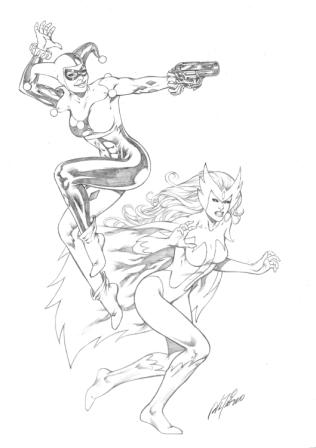
Harley Quinn and Snowbird, pencils by comics artist Al Rio

The jester with the potent-looking popgun is Dr. Harleen Quinzel, better known as Batman’s nemesis Harley Quinn. The woman wearing the winglike tiara and cape is Snowbird, a founding member of the Canadian superteam Alpha Flight, and comics’ most prominent (only?) superhero of Inuit — we used to say “Eskimo” back in the day when we were less particular about calling people what they prefer to be called — origin.

So what do a clownish villainess and a heroine from the Great White North share in common? Well, step into the Wayback Machine, my dear Sherman, and I’ll tell you a tale.

In July 1966, folk-rock superstar Bob Dylan was seriously injured in a motorcycle accident. Dylan spent most of the next year or so recovering at his home near Woodstock, New York. Toward the end of his convalescence, Dylan and his backup ensemble, Levon and The Hawks — later famous in their own right under a different name, The Band — spent about three months recording a plethora of new material in Dylan’s basement studio. The resulting recordings, together known as the Basement Tapes, floated around in bootleg form for nearly a decade before receiving an officially sanctioned label release in 1975.

One of the earliest leakages from the Basement Tapes sessions was a bouncy comedic number entitled “Quinn the Eskimo.” According to Dylan, the idea for the song came from the 1959 film The Savage Innocents, in which noted Mexican-American actor Anthony Quinn stars as an Inuit trapper accused of murder. British pop-rock sensations Manfred Mann (“sensations” is plural because Manfred Mann was the actual name of a band, of which a guy also named Manfred Mann was the leading member) recorded a worldwide hit cover of Dylan’s tune in 1968, retitled as “The Mighty Quinn” — the song’s catchy refrain goes, “Come on without / Come on within / You’ll not see nothing like the Mighty Quinn.” (Manfred Mann — the man, not the band — was born in South Africa as Manfred Lubowitz, which would not have made a very good name for a band at all.)

More than 20 years after the song had been a radio staple, actor Denzel Washington starred in the film The Mighty Quinn. In the movie, Washington’s character Xavier Quinn is not an Inuit trapper, but an American-educated police chief on a small Caribbean island. (Although, let’s be honest — it would be interesting to see Denzel play an actual Eskimo.) In one memorable scene, actress Sheryl Lee Ralph, as Xavier’s cabaret-singer ex-wife, performs a reggae remix of the Dylan song.

Given this fascinating show business success story (you were fascinated, weren’t you?), it seemed only natural to me to pair up comics’ most famous Quinn with the medium’s most famous Eskimo. Because, in the words of the song, “When Quinn the Eskimo gets here, everybody’s gonna jump for joy.”

I know I did.

And that’s your Comic Art Friday.

I have a power ring; I’m just wearing it as a belt

November 17, 2010

Once again, I get robbed.

This year, People Magazine passes me over for its annual Sexiest Man Alive honor in favor of Ryan Reynolds, whose chief claims to fame include (a) portraying comic book superhero Green Lantern (the Hal Jordan Green Lantern, for those of you sufficiently comics-savvy to know that the title of Green Lantern applies to literally dozens of characters in the DC Comics universe) in the upcoming motion picture; and (b) being Mr. Scarlett Johansson.

Okay, so I’m not an alien-tech-equipped superhero, and frankly, I don’t think Ms. Johansson is my type. (Nor, doubtless, I hers.) But just once, you’d think People Magazine could show a little love to those millions of portly middle-aged gentlemen whose sexiness derives, not from matinee-idol looks which, let’s be honest, will need to be propped up with surgery and Botox in a decade or so, but from that most potent of sexual engines: the brain.

Experience and cunning trump chiseled cheekbones and washboard abdominals any time, ladies. Just sayin’.

Can I get a witness?

The Verdicts are in: Why Did I Get Married Too? and Bill Maher: “…But I’m Not Wrong!”

September 15, 2010

My tenure as a juror began today.

Which makes this the perfect opportunity to promote the fact that I’ve published two — count ’em, two — new reviews this week for DVD Verdict, cyberspace’s premier hotspot for film and television criticism.

If you’re into romantic comedy with a message, you might enjoy my examination of Tyler Perry’s Why Did I Get Married Too?

If biting, politically conscious stand-up humor better suits your tastes, check out my look at Bill Maher’s “…But I’m Not Wrong!”

Or, if you just want to kick back and relax with a couple of insightful critiques, you might as well read both.

Back to the future

August 10, 2010

The immortal baseball scribe Thomas Boswell once wrote, “Time begins on Opening Day.”

Someone else (I’d tell you his or her identity, but there’s no consensus on the Internet) opined, “Today is the first day of the rest of your life.”

Ian Anderson, the auteur behind the legendary rock band Jethro Tull, sang of “skating away on the thin ice of a new day.”

Or, as the great Buckaroo Banzai, MD, PhD, put it: “Remember, no matter where you go, there you are.” (That doesn’t really have anything to do with the other quotes. I just love that line.)

At any rate, the long hibernation of SSTOL has ended. A new day dawns here today. You can now expect to drop by this tiny corner of cyberspace and find fresh content a-bubbling, which hasn’t been true for some while… the reasons for which you know. (If you don’t know, you can find out here.)

We commence the rebirth of the cool with an announcement which in itself is pretty darn cool: I’m returning to the staff of DVD Verdict — the ‘Net’s premier location for entertainment product reviews — as a writer of cogent criticism.

I first joined DVD Verdict way back in 2002. During my previous tenure on staff, I penned 145 detailed product reviews, and also served an 18-month stint as an associate editor. I resigned with deep regret about three years ago, when my late wife KJ’s illness was diagnosed. In my heart of hearts, I always knew the day would come when I’d want to write for the site again.

Today, that day has come.

I extend my sincere appreciation to Chief Justice (that’s Editor-in-Chief in the non-Verdict world) Michael Stailey, Chief Counsel (read: Managing Editor) Melissa Hansen, and their crew of talented collaborators for welcoming me warmly back into the fold. I’m looking forward to contributing to the site again, especially in anticipation of some exciting initiatives that will continue Verdict’s ascent into the stratosphere of online entertainment resources.

So, come join me at DVD Verdict. You’ll be glad you did.

And hey — welcome also to the next phase of SSTOL. I’m looking forward to sharing with you here once again.

Thanks for keeping the faith.