Archive for the ‘Comic Art Friday’ category

Comic Art Friday: Wonder Woman Day is Sunday!

October 23, 2009

In addition to October being National Breast Cancer Awareness Month — a fact of which you, friend reader, have already been made aware — this is also National Domestic Violence Awareness Month.

Which means that Sunday is Wonder Woman Day.

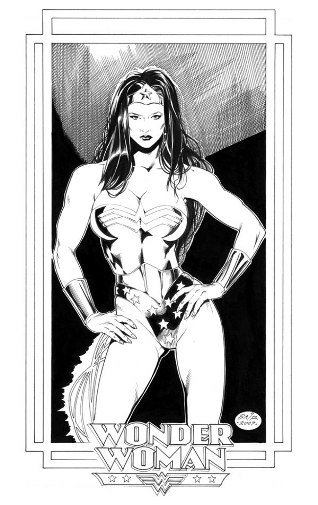
Wonder Woman, pencils and inks by comics artist Michael Bair

For the past three years, the last Sunday in October has been celebrated as Wonder Woman Day as a symbolic way of empowering women to free themselves from violent relationships. The cities of Portland, Oregon and Flemington, New Jersey officially designate Wonder Woman Day as an opportunity to support local women’s and family shelters, and to promote awareness of domestic violence as a social issue.

Thanks to the encouragement of the event’s organizer, comics and pop culture author Andy Mangels, dozens of comic book artists each year donate Wonder Woman art for a silent auction, the proceeds of which benefit shelters in the two sponsoring cities.

Wonder Woman, pencils by Al Rio, inks by Bob Almond

Each of today’s featured artworks traces its origins back to a previous Wonder Woman Day auction. I acquired the first piece shown above — a stunning portrait by Michael Bair — on Wonder Woman Day II in 2007. The second drawing was originally a preliminary sketch drawn by Al Rio for his Wonder Woman Day contribution that same year. I later commissioned inker extraordinaire Bob Almond to embellish Al’s pencils.

If you’d like to check out the art available in this year’s auctions, simply follow the Wonder Woman Day link.

And that’s your Comic Art Friday.

Comic Art Friday: RIP, George Tuska

October 16, 2009

Sad news this Comic Art Friday…

George Tuska, a comic artist whose career began in the earliest days of comic books, passed away last night at the age of 93.

Iron Man vs. the Hulk, pencils by comics artist George Tuska

Only a week or so ago, I received notice via the Comic Art collectors’ e-mail list that Tuska had decided to stop accepting new commissions. I’m reminded of our local hero, Charles Schulz, whose final Peanuts strip appeared in newspapers on the day of his death. It’s almost as though these gentlemen had been drawing for so long that when they decided to stop drawing, they had nothing left to live for.

Tuska’s life in comics began in 1939, when he began working for the legendary Will Eisner. Although Tuska would eventually draw every genre of comic known to humankind, his original specialty was crime stories, in particular the gritty sort that appeared in Lev Gleason’s infamous Crime Does Not Pay.

In the 1960s, Tuska became one of the busiest artists in the superhero genre. He was the regular penciler on Marvel’s The Invincible Iron Man for nearly a decade (September 1968-January 1978), and while he was by no means the first artist to draw Iron Man, Tuska’s depiction of the character was the seminal one for a generation of Marvelites. Even today, when I close my eyes and think “Iron Man,” it’s the George Tuska version I envision. Tuska had a knack for making Tony Stark’s armor come alive — in fact, he drew Shellhead’s supersuit in a way that made it seem almost as pliable as Batman’s cape, yet still metallic somehow. He was, I think, the first artist to subtly change the expression on Iron Man’s faceplate to reflect the emotions of the man inside. It wasn’t technically authentic, maybe, but it worked.

From my perspective, Tuska’s other key achievement at Marvel was his work on Luke Cage, Hero for Hire, the first mainstream comic book to bear the name of a black superhero in its title. Tuska illustrated the first three issues of the series, then returned to draw several more, beginning with issue #7. When the title of the book changed to Luke Cage, Power Man, Tuska once again came back to the character, adding another dozen or so issues to his credits. Again, as with Iron Man, when I think of Luke Cage, it’s Tuska’s depiction that I most associate with the character.

Perhaps because of his experience on the Cage title, Tuska was the artist Marvel chose to draw another series featuring an African-American hero, Black Goliath. Other Marvel titles to which Tuska contributed significantly included The Avengers, Sub-Mariner, X-Men, Ghost Rider, and the Western series Kid Colt, Outlaw. He also drew the first several issues of the Man-Wolf series in Marvel’s monster anthology, Creatures on the Loose.

Tuska was known in the industry as “King of the Fill-In” because his adaptable style and speedy production made him invaluable as a fill-in artist — drawing a single issue of a title when the regular artist took time off, or fell behind schedule. At Marvel, he drew dozens of fill-in issues throughout the ’60s and ’70s, touching practically every book Marvel published during that span at least once.

After leaving Marvel in 1978, Tuska assumed the art chores on DC’s World’s Greatest Superheroes newspaper strip, a job he held for 15 years. During this period, he also drew comic books for DC, mostly in the various Superman titles.

Tuska retired from comics in the mid-1990s. As noted earlier, however, he continued to draw commission projects until shortly before his death. Although I never was fortunate enough to commission him, the artwork shown above is a commissioned piece I picked up from another collector five years ago. It’s not dated, but I believe Tuska drew it sometime in the early part of this decade. It’s Tuska’s Iron Man in a classic action pose, doing battle with the Hulk. Everything you need to know about the artist’s style and approach to layout and character is right there on the page.

According to his friend and biographer, Dewey Cassell, Tuska is survived by his wife of 61 years, Dorothy, their three children, numerous grandchildren, great-grandchildren, and friends, and a legion of fans.

Thanks for all of the wonderful art, Mr. Tuska. Those sure were some great times.

And that’s your Comic Art Friday.
Comic Art Friday: She’s a ringer!

October 9, 2009

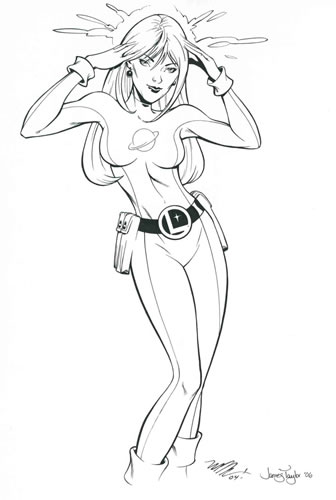
In honor of the discovery earlier this week of Saturn’s Phoebe ring — the largest planetary ring in the solar system by a factor of a bazillion — today’s Comic Art Friday salutes the one superheroine who could have told us the doggoned thing was there all along: Saturn Girl.

Saturn Girl, pencils by Michael Dooney, inks by James Taylor

In the 30th century, vivacious Imra Ardeen from Titan, Saturn’s largest moon, is one of three gifted teenagers who together found the Legion of Super-Heroes. Imra, whose power is mental telepathy, takes the code name Saturn Girl. I never could figure out why Imra called herself Saturn Girl, since (a) Saturn didn’t have anything to do with her powers, and (b) she wasn’t actually from Saturn. Why not call herself Titan Girl?

I guess Mind-Reader Girl would have sounded too silly. Then again, on a team that would eventually include people calling themselves Bouncing Boy, Princess Projectra, and Matter-Eater Lad, is any code name too silly?

Saturn Girl and Green Lantern Alan Scott, pencils by comics artist Anthony Carpenter

Speaking of silly, the artwork above features Imra alongside the original Green Lantern, Alan Scott, who wears one of the silliest costumes in the history of comics. But he has a cool power ring. (Imra’s named after a planet with rings. There’s a Common Element for you.)

Although afflicted with a confusing moniker and a wimpy superpower — because it was the Silver Age, and pretty much all female superheroes had wimpy powers — Saturn Girl remained a stalwart in the Legion, and one of its most identifiable members. As a charter Legionnaire, she was looked upon as an elder stateswoman (at least, as elder as a teenager can be) and de facto leader. Imra’s prominence in the group has held consistent throughout the decades, and the Legion’s ever-changing permutations, right up to the present day.

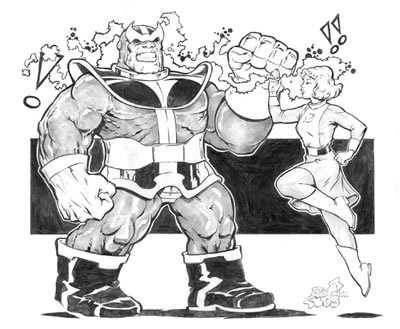
Below, we see Imra facing off with the dreaded cosmic supervillain Thanos. They’re both from the moon Titan, albeit in different comic-book universes. (There’s another Common Element.)

Saturn Girl and Thanos, pencils by comics artist Steve Mannion

You’ll notice that Thanos does not refer to himself as Saturn Boy. Or Saturn Man. Or Saturn anything. That’s because Thanos stayed awake in astronomy class, and knows that he isn’t from Saturn. (Imra was out with a migraine that day.)

In the past few years, Imra has become something of a TV star. She was one of the lead characters in the recent Legion of Super-Heroes animated series (at least in the first season of the show; she was mostly MIA in Season Two). She has also appeared, in radically modified form, as a guest star on Smallville, where she’s played by the girl who was Mackenzie Phillips’s teenage sidekick in the final season of the Disney Channel X-Files knockoff, So Weird. (You’d pretty much have to call a show So Weird if Mackenzie Phillips stars in it, wouldn’t you? But that’s a topic for another day.)

Funny how she never mentions that Phoebe ring, though.

And that’s your Comic Art Friday.
Comic Art Friday: Sable metrics

October 2, 2009

I’ve been reading comic books, and admiring the art contained in them, for more than 40 years. (Which reminds me — get off my lawn.) I can’t begin to guess how many comic book artists’ work I’ve viewed during that span of time. Of course, there have been numerous pencilers and inkers whose work I’ve loved. Not surprisingly, there have been quite a few whose art, at best, didn’t impress me, and at worst, repulsed me. (Hello, Rob Liefeld.)

Silver Sable and Jon Sable, pencils by comics artist Mike Grell

There’s always been one category of artists who’ve held a special place in my admiration: those whose work I can always, and immediately, recognize. That category is less densely populated than you might suppose. Comics have always been a derivative, imitative industry, with creators liberally borrowing (and sometimes, outright plagiarizing) from one another. Publishers contributed by mandating rigid “house styles,” patternized approaches that their staff artists and freelancers were duty-bound to mimic. (When Jack Kirby — without question the most influential artist in mainstream American comic books — moved from Marvel to DC in the early 1970s, DC editors routinely had other artists redraw the heads of Kirby’s Superman figures, because Kirby’s likeness of the Man of Steel strayed too far “off-model.”)

Even artists who rate among my favorites can be easy to confuse for one another. Keith Pollard’s work evokes John Buscema’s, for example, while Geof Isherwood evokes Barry Windsor-Smith. Comic artists who got into the business via the tutelage of others often evolve similar styles. A dozen or more name artists came into comics in the early 1970s as assistants of Neal Adams, and retained some measure of Adams’s influence — guys like Bob McLeod and Joe Rubinstein, to name two. So, even though I’ve looked at scads of comic art, I can’t always tell at a glance who drew it, even if it’s an artist I enjoy.

One artist whose work I’ve always recognized in a heartbeat, and whom I’d never confuse with anyone else, is Mike Grell.

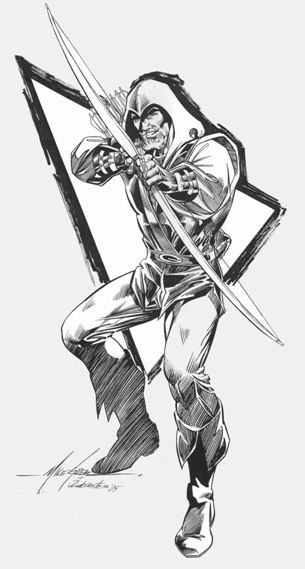
Green Arrow, pencils by Mike Grell, inks by Joe Rubinstein

Mike Grell burst onto the comics scene in 1973, as the artist on DC’s Legion of Super-Heroes. His run on that book is still fondly remembered by Legion aficionados. Grell also drew attention with his well-received work on Aquaman and Green Lantern/Green Arrow. His unmistakable style garnered Grell (no pun intended) legions of fans, as he became one of the era’s signature artists. The striking pinup above features Grell’s version of Green Arrow, as inked by Joe Rubinstein over Grell’s original pencils.

Grell’s true talent, though, shone through when he began to create his own characters. In 1975, he devised, wrote, and drew The Warlord for DC, a series that melded sword-and-sorcery heroic fantasy with space opera-style science fiction. When he left DC in the early 1980s, Grell developed a similar series — Starslayer — as a creator-owned property, published first by Pacific Comics, then by First Comics. The drawing below, penciled by Grell and once again inked by Joe Rubinstein, depicts Tamara D’Orsini, the female lead of Starslayer.

Tamara D'Orsini, pencils by Mike Grell, inks by Joe Rubinstein

Then, in 1983, Grell unleashed his magnum opus: Jon Sable, Freelance, a series about a safari hunter turned mercenary whom Grell described as “a cross between James Bond and Mickey Spillane’s Mike Hammer.” The independent comic proved sufficiently popular that in 1987, ABC-TV produced a dreadful action drama based on it. And when I say dreadful, I’m being kind.

The short-lived TV show, entitled simply Sable, bore only passing resemblance to Grell’s comic book. It’s probably most noteworthy for its unaired original pilot, in which Gene Simmons of the rock group KISS starred as the title character (Simmons was replaced for the seven episodes of the series by an unknown — then as well as now — actor named Lewis Van Bergen), and for its female costar Rene Russo, who though then unknown did not remain so, but instead went on to A-list motion picture stardom. Unlike Lewis Van Bergen, who so far as I know went on to the night shift at In ‘N’ Out Burger.

In the Common Elements commission that leads off this post, Mike Grell teams Jon Sable — who in the skilled hands of his creator looks nothing like either Gene Simmons or Lewis Van Bergen — with another mercenary turned hero, Silver Sablinova (code name: Silver Sable), who in the 1980s and ’90s battled bad dudes in the pages of Marvel Comics’ Silver Sable and the Wild Pack. I’ve often wondered whether these two stalwarts, who bear similar names and chose identical professions, might be somehow related… in a cross-dimensional, trans-universal sort of way.

But that’s an exploration for another time.

That’s also your Comic Art Friday.

Comic Art Friday: American Flaggs!

September 25, 2009

Of the 87 artworks in my Common Elements commission gallery, I’ve only had the opportunity to witness the creation of a small fraction. Four pieces in the series — two by penciler Ron Lim and inker Danny Bulanadi, and two by the great Tony DeZuniga — were drawn before my eyes at comic book conventions. Another, by Darick Robertson, was crafted during a signing event at my local comics shop.

Until recently, however, I’d never watched a Common Elements commission come into being via the magic of the Internet.

John Beatty is best known to comics aficionados as an inker, in partnership with such pencil artists as Mike Zeck (on the groundbreaking miniseries Marvel Super-Heroes Secret Wars, and for lengthy runs as the interior artists on Captain America and as cover artists on G.I. Joe), Kelley Jones (Batman), and Michael Golden (the war adventure The ‘Nam). Like many of the best inkers, John is also a terrific penciler in his own right. His drawing style, which to my eye reflects the influence of Jack Kirby — although it’s fair to say that almost every superhero artist of the past 50 years borrows at least a smattering of influence from Kirby — led me to commission him to draw this pairing of Kirby’s Captain America pastiche Fighting American and Reuben Flagg, the antihero of Howard Chaykin’s satirical series, American Flagg!

Fighting American and American Flagg, pencils and inks by comics artist John Beatty

Fighting American has an interesting backstory. Created in 1954 by Kirby and his longtime creative partner Joe Simon — the same team who created Captain America nearly a decade and a half earlier — Fighting American reflected the anti-Communist paranoia of the McCarthy era. The character, whose original 1950s run lasted a brief seven issues, played like an over-the-top parody of the patriotic Cap, battling Red Menace stereotypes with names like Poison Ivan. It’s hard to tell whether Kirby and Simon were feeding off the tenor of the times or spoofing it, but I vote for the latter.

Unfortunately, as too often happens in comics, the character later fell into the hands of lesser talents who didn’t get the joke. When it comes to comics, “talents” hardly get “lesser” than those of Rob Liefeld, the poster boy for everything that went wrong with the industry in the 1990s. Liefeld’s Awesome Entertainment turned Kirby and Simon’s character into yet another of his own innumerable hyperviolent (and horrifically drawn) adolescent fantasies. Marvel Comics sued Liefeld for introducing elements into the Fighting American mythos that smacked too strongly of Captain America (which character Liefeld had drawn for Marvel before striking out on his own), including a Cap-like shield. (A compromise was reached between the companies which allowed Liefeld’s character to keep his shield, but not to use it as a throwing weapon.)

Like Fighting American, Howard Chaykin’s American Flagg! was a parody of its era — in the latter case, the ultraconservative Ronald Reagan ’80s. Chaykin’s series portrayed a near-future America in which the global economy crashed, the axes of power shifted (the most powerful nations on Earth became Brazil and a united Africa), and the U.S. government relocated to Mars to ride out the crisis. In the midst of it all, an out-of-work actor named Reuben Flagg lived out his former television role as a Plexus Ranger, a member of the cowboyesque police force sponsored by the Mars-based government and its corporate sponsors.

The quality of American Flagg! waxed and waned, depending largely on the connection Chaykin maintained with the project — which, after the first couple of years, wasn’t much. Still, the series provided an often-intriguing commentary on then-current events and attitudes, flavored with Chaykin’s penchant for ribald humor and wacky visuals.

Speaking of wacky visuals, when John Beatty took a look at the characters I’d assigned for his Common Elements commission, he decided to poke a bit of fun at the more ridiculous aspects of their respective costumes. Thus, his Fighting American is puzzled by the cowboy boots in Reuben Flagg’s Plexus Ranger ensemble, while Reuben wonders why his compatriot has donned his underwear on top of his tights. A hilarious idea, which John carried off beautifully.

As mentioned above, I had the privilege of watching John draw this piece online, thanks to modern technology. You, should you be so inclined, can check out the recorded video version. John was joined for the event by comic art collector (and noted Sylvester Stallone buff) Craig Zablo, and their lively banter about life and comics proved both insightful and entertaining. The entire presentation runs four hours — never fear, you can skip ahead as you wish — and is divided into two segments.

Here’s the link to Part One.

Here’s the link to Part Two.

Thanks to John Beatty for his outstanding artwork, and for allowing me to share the links to his video. If you enjoy John’s presentation, there’s also an edited video on YouTube chronicling the birth of my aforementioned Darick Robertson commission. You’re welcome to partake of that one as well.

By the way, there’s a Common Element between today’s two featured heroes that isn’t as obvious as it might appear. In addition to their similar themes and satirical approaches, both characters share the same surname — Fighting American’s secret identity is Nelson Flagg. Maybe he and Reuben are related, in a transdimensional sort of way.

And that’s your Comic Art Friday.

Comic Art Friday: Three cats, 9 Lives

September 18, 2009

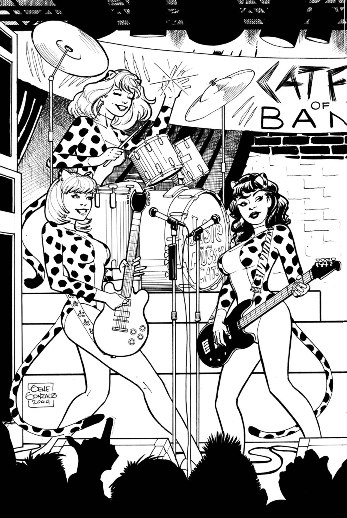
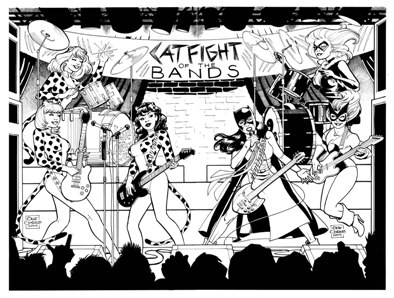
Two weeks ago, we took our first peek at artist Gene Gonzales’s spectacular creation for my Common Elements theme, entitled “Catfight of the Bands!” Last Friday, we focused the spotlight on one of the two bands featured, the ever-popular Josie and the Pussycats.

In today’s third and final installment, we’ll showcase the other feline ensemble — a three-piece combo which, in contrast with Josie and her pals’ lengthy career in comic books, TV animation, musical recordings, and live-action feature film, exists nowhere except in the imaginations of Mr. Gonzales and myself.

Catwoman and the Black Cats, pencils and inks by comics artist Gene Gonzales

It was Gene’s inspiration to dub our impromptu trio “9 Lives.” Clockwise from the left, that’s Selina (Catwoman) Kyle on guitar and vocals, Felicia (The Black Cat) Hardy on drums, and Linda (The Black Cat) Turner on bass.

Yes, I realize that we have two Black Cats. More on that momentarily.

Catwoman — known in her earliest appearances as simply The Cat — debuted in the very first issue of Batman’s eponymous comic, way back in 1940. Originally, Selina Kyle was a Gotham City socialite who moonlighted as a (you’re way ahead of me) cat burglar. Throughout the Golden Age, the renamed Catwoman vacillated between heroism — she worked alongside the Caped Crusader on several occasions — and villainy.

She became a full-time member of Batman’s rogues’ gallery in 1966, just in time for the campy ABC television series, in which she was portrayed by two actresses — Julie Newmar and Eartha Kitt. (Former Miss America Lee Meriwether, a costar on the sci-fi series Time Tunnel, would assume the role for the Batman feature film concocted to capitalize on the show’s meteoric popularity.) Catwoman would again be established in the public consciousness as a villain, thank to Tim Burton’s 1992 film Batman Returns.

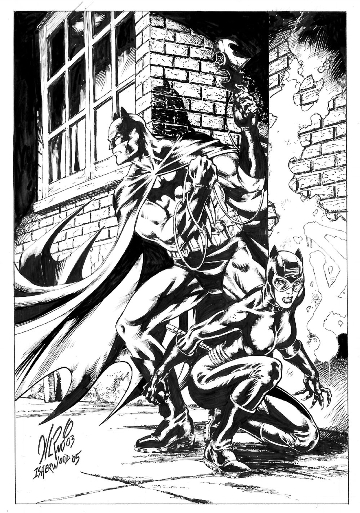
Batman and Catwoman, pencils by Al Rio, inks by Geof Isherwood

In recent years, DC Comics has cast Catwoman more frequently in a positive light. Since the 1990s, she has headlined two separate series in which she has behaved more or less in traditionally superheroic fashion. The second Catwoman series, which was canceled earlier this year, featured a dazzling array of cover art by Adam Hughes.

During her lengthy career, Selina has worn a dozen or more different costumes. The dress/cowl/cape version she wears in “Catfight” is my favorite of her many outfits — and, as it happens, a favorite of artist Gonzales as well. Above, penciler Al Rio and inker Geof Isherwood depict Catwoman in her modern-era catsuit and goggles.

Only a few months after Catwoman’s debut, Harvey Comics — a company better known for juvenile humor titles such as Casper the Friendly Ghost and Richie Rich — presented its own feline-themed superheroine. Movie actress and stuntwoman Linda Turner donned a mask, swimsuit, and buccaneer boots to fight crime as the Black Cat. Linda was often assisted in her exploits by the male version of Lois Lane, newspaper reporter Rick Horne, who — in the manner of the famously clueless Miss Lane — never seemed to tumble to the fact that Linda Turner and the Black Cat were the same woman.

Linda managed to maintain her secret for a decade, until her series was canceled in 1951. A vast assortment of creators chronicled her adventures, most prominently British-born artist Lee Elias, who drew the Black Cat from 1946 through the end of her run.

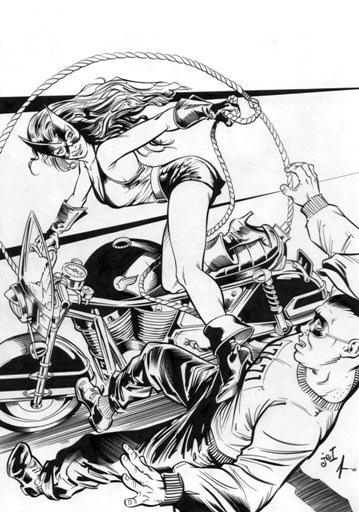
Although the Black Cat possessed no paranormal abilities, her training in stunt work provided her with a host of handy skills for busting evildoers. Among her most prominent talents was her deftness in handling a motorcycle. Here, penciler James E. Lyle and inker Bob Almond catch the Cat dealing a bad guy a crushing kick from aboard her favorite two-wheeled transport.

The Black Cat (Linda Turner), pencils by James E. Lyle, inks by Bob Almond

As often happens in comics when a good superhero name goes unused long enough for the trademark to expire, Marvel unleashed its own Black Cat in 1979. Though she shared her nom de guerre with her predecessor Linda Turner, Felicia owed much more of her character to Selina Kyle. Like Catwoman, the modern Black Cat began her career as a cat burglar and jewel thief, and was primarily a villain for most of her early appearances. Also like Selina, Felicia eventually reformed — more or less — and recently served as a member of the superteam Heroes for Hire.

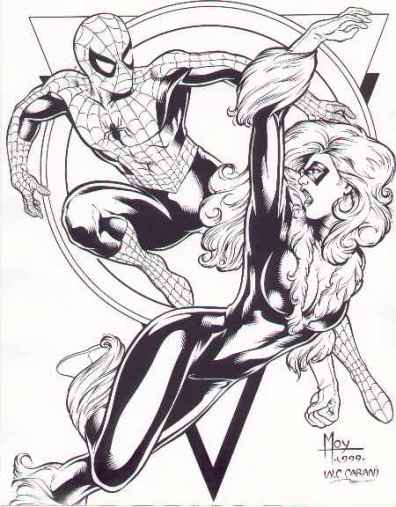
Another key commonality between Marvel’s Black Cat and DC’s Catwoman is their love connection to their respective companies’ marquee superheroes. As Catwoman is to Batman, the Black Cat is to Spider-Man. Felicia and the web-slinging Peter Parker have shared an on-again, off-again affair for 30 years — in real-world years, of course. Below, penciler Jeffrey Moy and inker W.C. (Cory) Carani — a duo best known for a lengthy run on Legion of Super-Heroes — portray Spidey and Felicia at their battling best.

Spider-Man and the Black Cat, pencils by Jeffrey Moy, inks by W.C. Carani

A cat may have nine lives, but a Catfight of the Bands requires three weeks of Comic Art Friday goodness. Once again, my sincere thanks to Gene Gonzales for his masterful creation.

And that’s your Comic Art Friday.
Don’t forget… tomorrow is International Talk Like a Pirate Day! Ye best limber yer lips, or Cap’n Swan’ll keel-haul ye!

Comic Art Friday: Long tails, and ears for hats

September 11, 2009

When last we convened for Comic Art Friday, we took our first look at a spectacular new addition to my Common Elements gallery — this super-sized six-character commission by Florida artist Gene Gonzales entitled “Catfight of the Bands.”

Catfight of the Bands, pencils and inks by comics artist Gene Gonzales

Today, let’s take a closer examination of the first of those two battling trios. (Never fear — we’ll catch up with the other three famous felines next Friday.)

From the preponderance of superhero art that appears here on Comic Art Friday, one might presume that comics in that genre were the only funnybooks I read during my formative years. Au contraire, mon frere. While superhero comics were — and still are — my core reads, as a kid I devoured every kind of comic book that I could find on the newsstands of the military bases where I grew up. I read sword and sorcery comics (I still read the current iterations of Conan and Red Sonja), horror comics (a particular pleasure in the early ’70s was the DC anthology Weird War Tales, which featured stories of the supernatural set on battlefields throughout history), Western comics (everything from Kid Colt, Outlaw to Bat Lash), military comics (you couldn’t call yourself a genuine service brat without reading Sad Sack), and juvenile comics (yes, friends, I read Casper the Friendly Ghost and Richie Rich, too).

And, I read Archie Comics. Heck, I loved Archie Comics. I’m man enough to admit that I read Betty and Veronica religiously back in the day.

My favorite Archie magazine? Josie and the Pussycats.

Josie and the Pussycats, pencils and inks by comics artist Gene Gonzales

Actually, I was reading the adventures of Josie and her friends before there was a Josie and the Pussycats. The perky redheaded teenager made her comics debut in 1963, as the star of the series She’s Josie. (Josie’s creator, longtime Archie artist Dan DeCarlo, named the character after his wife.) She’s Josie soon became just plain Josie, and centered on typical Archie-style teenage humor involving Josie and her high school pals, several of whom still costarred in the book when Josie decided to start her own rock band in 1969. (Not coincidentally, the Archie gang had exploded onto Saturday morning TV as a prefab pop group around the same time.)

When Josie (whose surname flip-flopped for years between Jones and James before settling on McCoy early in this current decade), her best friend Melody (also a Jones for many years, her last name became Valentine in the live-action Josie and the Pussycats movie a few years ago, and the comics followed suit), and their newest comrade Valerie (née Smith, later consistently Brown) donned their now-familiar leopard-spotted leotards and kitty-ear tiaras, the title of their comic took on the name of their newly formed act.

Thus legends are born.

Before long, Josie and the Pussycats had their own animated TV series. The show was eponymously titled for the first two years of its run (1970-72), then took a sci-fi turn and morphed into Josie and the Pussycats in Outer Space for another two seasons. Josie and the gang’s TV adventures borrowed heavily from the successful formula of Hanna-Barbera’s already popular Scooby-Doo, mostly involving the girls and their retinue solving comedic mysteries.

As did the Archies, Josie and the Pussycats — actually real-life session musicians using the band’s fictional identity — recorded several bubblegum pop singles in the early ’70s. Three then-unknown singers were “cast” as the singing voices of the Pussycats. The real-world “Melody” was a blonde named Cherie Moor (real name: Cheryl Jean Stoppelmoor), who came to greater fame later in the decade under her new stage name, Cheryl Ladd.

Ironically, most of the lead vocals on the Pussycats’ songs — including the familiar theme to the animated series — were performed by the singer cast as “Valerie,” Patrice Holloway, rather than by Cathy Dougher, who was “Josie.” Holloway almost didn’t the part, as Hanna-Barbera at first wanted to retool the Pussycats as an all-Caucasian trio. Music producer Danny Janssen, who assembled the real-life Pussycats and wrote several of their songs, refused to replace Holloway with a white performer. After several weeks of infighting, Hanna-Barbera agreed to restore Valerie to her original African-American heritage in the TV show, enabling Janssen to keep Holloway in the band. Valerie thus became the first black female character to appear regularly in an American animated TV show.

Three decades after their television debut, Josie and the Pussycats hit the live-action cinema. Rachael Leigh Cook portrayed Josie, Rosario Dawson played Valerie, and Tara Reid was typecast as the dizzy Melody. If you haven’t seen the movie… don’t. It’s 99 precious minutes of your life that you’ll never recoup. Trust me on this.

Josie and the Pussycats, blue pencil rough sketch by Gene Gonzales

Although I first hit on the idea to feature Josie and the girls opposite Catwoman and the two Black Cats a few years ago, it wasn’t until I saw Gene Gonzales’s rough sketch of the Pussycats on stage that I knew I’d found an artist with the appropriate sensibility to bring the concept to life. Thanks for allowing me to show off your inspiration, Gene!

Next week, we’ll wrap up our caterwauling by throwing the spotlight on the other half of this musical catfight.

Until then… that’s your Comic Art Friday.

Comic Art Friday: Catfight of the bands!

September 4, 2009

Collectors of comic art fall generally into two camps. Some collect published art — the original pencil and ink drawings from which comic books are printed. Others collect unpublished art, which encompasses drawings commissioned directly from an artist, drawings created by artists specifically for sale to fans, and convention sketches, which are essentially fast-turnaround commissions drawn at comic book conventions. Many collectors have both published and unpublished comic art in their galleries, but most specialize in one or the other.

Catfight of the Bands, pencils and inks by comics artist Gene Gonzales

As you know if you’ve been a Comic Art Friday for any length of time — whether in this location or at our prior address — my collection is almost entirely composed of the unpublished variety. The lion’s share of my holdings are pieces that I’ve commissioned myself, either directly from the artist or through a representative. My two signature theme collections, Common Elements and Bombshells!, both consist — in their entirety — of art that was drawn specifically at my request.

Why did I choose the path I follow? I’d be disingenuous if I didn’t acknowledge the economic factor. Published art, especially pages drawn by well-known artists or featuring iconic images of popular characters, can be quite expensive — classic cover art and full-page splash panels frequently run into four figures, and the truly great pieces fetch more than that.

There’s also an aesthetic issue. Because comics are a sequential narrative medium, a panel page in isolation doesn’t often hold much appeal for me. It’s a little like reading only one page of a comic book — without the rest of the story, it doesn’t make much sense.

That’s just my perspective, of course. And I do in fact drool over the collections of fellow hobbyists who’ve amassed impressive galleries of published work.

The real reasons I prefer commissioned art, though, are visceral. I relish the charge that comes with seeing, for the first time, an image that never existed before I commissioned it. And, I enjoy the satisfaction of looking through my portfolios at art that’s unique — nothing exactly like any of my commissioned pieces exists anywhere else.

Today’s featured artwork pretty well encompasses all of the joys of commission collecting in one incredible package.

The concept of a “battle of the bands” between Josie and the Pussycats and a trio of feline-themed females from the more serious end of the comics spectrum — DC’s Catwoman, Marvel’s modern-day Black Cat, and the original Black Cat from the Harvey Comics title of the 1940s — first occurred to me years ago, in one of those flashes of wild imagination that have spawned most of my Common Elements ideas. Originally, I’d thought about a three-artist scenario — a penciler with Archie Comics experience to draw the Josie half of the piece, a traditional superhero artist to draw the opposite half, and an inker to detail the entire page and give it a unified finish.

Then, some time ago, comics artist and commercial illustrator Gene Gonzales posted a Josie and the Pussycats sketch to his daily art blog. I liked his approach to these characters, so my mental wheels began turning. Gene has done several previous commissions for me, including one for Common Elements and three for my Bombshells! theme, so I knew that he could handle the superheroines as well. Plus, because Gene inks his own pencils, he could tie the completed piece together with style.

Catfight of the Bands initial thumbnail by Gene Gonzales

I proposed the idea to Gene. He embraced the scenario with gusto. Almost immediately, he sketched out a thumbnail showing how he might approach the concept. I loved his choices, and suggested a few minor tweaks. Gene was open to my ideas, and before long, we had a commission in the works.

That’s how magic gets made.

Some time later, Gene showed me the rough pencil art for his “Catfight of the Bands.” Gene noted that, because he would be inking the piece himself, he would add much of the detail as the art evolved from pencils to inks. I could already see, though, how much fun his vision of the scene would entail. (No pun intended.)

Catfight of the Bands rough pencil draft by Gene Gonzales

If you’re wondering why Gene signed the art twice, this piece is what’s called in the trade a double-page spread. Although intended for display as a single composition, it’s drawn on two separate pages of comic art board. Gene designed the image so that no character overlaps the center division. Thus, the half featuring the Pussycats is complete in itself, as is the half starring the rival band that Gene dubbed 9 Lives. In the unlikely event that I ever store this piece in a portfolio, each piece can occupy its own sleeve and still look like a complete picture.

Over our next two Comic Art Friday installments, we’ll take a closer look at each of our tuneful tigresses.

For now, that’s your Comic Art Friday.
If you’re interested in seeing the process that goes into creating a comic art commission, comics artist John Beatty recently produced a webcast, during which he partially inked a new Common Elements commission. Follow the link to view the replay of John’s webcast.

Iron Goofy, Incredible Duck, and the Amazing Spider-Mouse

August 31, 2009

This may be the biggest pop culture business story of the decade: The Walt Disney Company is buying Marvel Entertainment for $4 billion.

Already, the fanboys — and, to be fair, the occasional fangirl — are burning up the ‘Net with their prediction of what will happen when the House of Ideas collides with the House of Mouse.

The truth is simple: We’ll see.

Disney is now, and pretty much has been throughout recent memory, all about licensing. There’s no question that the reason they want Marvel isn’t because they crave a niche in the rapidly shrinking world of comics publishing. Heck, Disney can’t be bothered to publish comic books starring the characters they already own — they summarily dumped the last vestige of this connection, the hugely popular Disney Adventures magazine, a while back, with hardly a fare-thee-well — much less floppies about people running around in brightly colored underwear.

What intrigues Disney’s beancounters is the tremendous stable of familiar characters that Marvel represents — characters ripe for exploitation on toys, T-shirts, and oodles of memorabilia. A quick stroll around Anaheim’s Disneyland Resort will clue you in to how thoroughly and aggressively the Mouse House has co-opted the characters from their last mega-acquisition, Pixar Animation Studios. The mind boggles at the fun Disney will have — and the kajillions they’ll profit — marketing Spidey, Wolverine, and the rest of the Merry Marvel Marching Society.

What does it all mean for Marvel in terms of its comics line? Who knows? Comics are a dying industry. Movies and video games, on the other hand, have never been hotter, and Marvel offers a veritable cornucopia of product to churn through. I don’t know how much longer comics will last, regardless of who holds the reigns. With Disney pulling the strings, however, it seems likely that Marvel’s signature superheroes will plow ahead in one form or another for the foreseeable future, and perhaps beyond.

As for the worriers who believe that suddenly Marvel’s going to get all family-friendly because Disney takes over: (a) I’m not sure that would be an awful thing if it happened, and (b) remember, this is the company whose ABC Television Network brings you Desperate Housewives and Grey’s Anatomy.

In the words of the immortal Stan Lee…

Excelsior!

Immortal beloved

August 28, 2009

People approach me often and ask…

“Where do you get all of these crazy ideas for your Common Elements commissions? How does it enter into your brain to match Vixen and Comet, because they both share names with Santa’s reindeer? Or Deadman and the Huntress, because their first names are state capitals?”

I simply stare at such people with calm reserve and say to them, “Stay thirsty, my friends.”

Although I can’t explain my arcane thought processes, I do recall the genesis of the Common Elements concept featured in today’s Comic Art Friday artwork. I was surfing the cable box one evening a couple of years ago when I happened upon a showing of the 1994 film Immortal Beloved on one of the movie channels. In case you haven’t seen the film, it stars Gary Oldman as the legendary composer Ludwig van Beethoven (or “Lud,” as I like to call him). In the summer of 1812, Beethoven wrote a series of letters to an unidentified woman whom he addressed as “Immortal Beloved.” The movie portrays the investigation conducted by Beethoven’s secretary after the composer’s death, attempting to ferret out the secret identity of “Immortal Beloved.” (I’ll not spoil the picture for you, but suffice it to say that the mystery woman’s name does not turn out to be Rosebud.)

As I watched the movie, it occurred to me that there are at least two “immortal beloveds” in the comics pantheon — that is, immortal women who are the lovers of superheroes. Unlike Beethoven’s unknown paramour, there’s no secret about the identity of either of these. On the left is Sif — frequently referred to as The Lady Sif — the Asgardian warrior woman loved by the mighty Thor. On the right is Clea, apprentice and consort to the Marvelverse’s Sorcerer Supreme, Dr. Strange.

Sif and Clea, pencils by comics artist Mitch Foust

I chose Mitch Foust, who specializes in drawings of impressively beautiful women, to craft this pairing of immortal beloveds. Mitch drew the piece at his booth during this year’s San Diego Comic-Con. According to Mitch, the artwork engendered a considerable amount of fanboy discussion as to which of the two, Sif or Clea, would make the superior girlfriend, and which would make a better companion in battle.

From my perspective, this question — Sif or Clea? — is merely another variation on what I like to call the Eternal Question. You might be familiar with one or more of its other manifestations:

Ginger or Mary Ann?

Betty or Veronica?

Gwen or MJ?

Julie or Eartha?

Or, if you want to get all Biblical about the thing…

Leah or Rachel?

If you want my opinion — and of course you do, or you’d be reading some other blog right now — it’s Sif all the way. Oh, sure, there’s a certain je ne sais quoi about a woman who can do magic, like Clea here. But if you’ve ever seen, say, The Wizard of Oz or Sleeping Beauty, you know that those conjuring chicks can turn nasty on you in a heartbeat. Give me the broad with the sword (hah! pun!) every time. At least you can see her coming.

Also, if you’re keeping score, it’s Mary Ann, Betty, MJ, Julie — by a whisker, mostly because when I think of Eartha today, I think of her terrifying roles in Boomerang and The Emperor’s New Groove — and of course, Leah. (In the latter case, Jacob preferred Rachel for her beauty, while the homely Leah had greater domestic talents; i.e., fertility. As the late, great Flip Wilson once explained it: If you go for the homely girl, you know exactly what you’re getting. Besides, the pretty girl will get homely eventually anyway.)

Feel welcome to add your own answers to the Eternal Question in the comments section. Ladies’ perspectives (and alternative pairings) gladly welcomed — we’re all about gender equality here at SSTOL.

And that’s your Comic Art Friday.