Archive for the ‘Soundtrack of My Life’ category

It’s only news if somebody cares

October 15, 2009

This just in from the world of music…

Country star Garth Brooks is ending his retirement.

At the same time, the Norwegian pop trio a-ha — best known for the ’80s hit “Take On Me,” and its influential video — is announcing its retirement.

Here’s the unfortunate news for these artists.

No one knew that Garth Brooks had retired…

…or that a-ha hadn’t.

Comic Art Friday: Long tails, and ears for hats

September 11, 2009

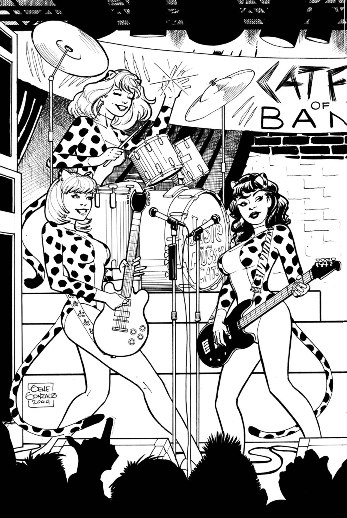
When last we convened for Comic Art Friday, we took our first look at a spectacular new addition to my Common Elements gallery — this super-sized six-character commission by Florida artist Gene Gonzales entitled “Catfight of the Bands.”

Catfight of the Bands, pencils and inks by comics artist Gene Gonzales

Today, let’s take a closer examination of the first of those two battling trios. (Never fear — we’ll catch up with the other three famous felines next Friday.)

From the preponderance of superhero art that appears here on Comic Art Friday, one might presume that comics in that genre were the only funnybooks I read during my formative years. Au contraire, mon frere. While superhero comics were — and still are — my core reads, as a kid I devoured every kind of comic book that I could find on the newsstands of the military bases where I grew up. I read sword and sorcery comics (I still read the current iterations of Conan and Red Sonja), horror comics (a particular pleasure in the early ’70s was the DC anthology Weird War Tales, which featured stories of the supernatural set on battlefields throughout history), Western comics (everything from Kid Colt, Outlaw to Bat Lash), military comics (you couldn’t call yourself a genuine service brat without reading Sad Sack), and juvenile comics (yes, friends, I read Casper the Friendly Ghost and Richie Rich, too).

And, I read Archie Comics. Heck, I loved Archie Comics. I’m man enough to admit that I read Betty and Veronica religiously back in the day.

My favorite Archie magazine? Josie and the Pussycats.

Josie and the Pussycats, pencils and inks by comics artist Gene Gonzales

Actually, I was reading the adventures of Josie and her friends before there was a Josie and the Pussycats. The perky redheaded teenager made her comics debut in 1963, as the star of the series She’s Josie. (Josie’s creator, longtime Archie artist Dan DeCarlo, named the character after his wife.) She’s Josie soon became just plain Josie, and centered on typical Archie-style teenage humor involving Josie and her high school pals, several of whom still costarred in the book when Josie decided to start her own rock band in 1969. (Not coincidentally, the Archie gang had exploded onto Saturday morning TV as a prefab pop group around the same time.)

When Josie (whose surname flip-flopped for years between Jones and James before settling on McCoy early in this current decade), her best friend Melody (also a Jones for many years, her last name became Valentine in the live-action Josie and the Pussycats movie a few years ago, and the comics followed suit), and their newest comrade Valerie (née Smith, later consistently Brown) donned their now-familiar leopard-spotted leotards and kitty-ear tiaras, the title of their comic took on the name of their newly formed act.

Thus legends are born.

Before long, Josie and the Pussycats had their own animated TV series. The show was eponymously titled for the first two years of its run (1970-72), then took a sci-fi turn and morphed into Josie and the Pussycats in Outer Space for another two seasons. Josie and the gang’s TV adventures borrowed heavily from the successful formula of Hanna-Barbera’s already popular Scooby-Doo, mostly involving the girls and their retinue solving comedic mysteries.

As did the Archies, Josie and the Pussycats — actually real-life session musicians using the band’s fictional identity — recorded several bubblegum pop singles in the early ’70s. Three then-unknown singers were “cast” as the singing voices of the Pussycats. The real-world “Melody” was a blonde named Cherie Moor (real name: Cheryl Jean Stoppelmoor), who came to greater fame later in the decade under her new stage name, Cheryl Ladd.

Ironically, most of the lead vocals on the Pussycats’ songs — including the familiar theme to the animated series — were performed by the singer cast as “Valerie,” Patrice Holloway, rather than by Cathy Dougher, who was “Josie.” Holloway almost didn’t the part, as Hanna-Barbera at first wanted to retool the Pussycats as an all-Caucasian trio. Music producer Danny Janssen, who assembled the real-life Pussycats and wrote several of their songs, refused to replace Holloway with a white performer. After several weeks of infighting, Hanna-Barbera agreed to restore Valerie to her original African-American heritage in the TV show, enabling Janssen to keep Holloway in the band. Valerie thus became the first black female character to appear regularly in an American animated TV show.

Three decades after their television debut, Josie and the Pussycats hit the live-action cinema. Rachael Leigh Cook portrayed Josie, Rosario Dawson played Valerie, and Tara Reid was typecast as the dizzy Melody. If you haven’t seen the movie… don’t. It’s 99 precious minutes of your life that you’ll never recoup. Trust me on this.

Josie and the Pussycats, blue pencil rough sketch by Gene Gonzales

Although I first hit on the idea to feature Josie and the girls opposite Catwoman and the two Black Cats a few years ago, it wasn’t until I saw Gene Gonzales’s rough sketch of the Pussycats on stage that I knew I’d found an artist with the appropriate sensibility to bring the concept to life. Thanks for allowing me to show off your inspiration, Gene!

Next week, we’ll wrap up our caterwauling by throwing the spotlight on the other half of this musical catfight.

Until then… that’s your Comic Art Friday.

My name’s Paul, and that’s between y’all

August 13, 2009

Musician and technological innovator Les Paul died today, at the ripe old age of 94.

It’s sometimes said of people who’ve recently passed away — I’m sure I’ve written it in reference to dozens of folks — that it would be impossible to overestimate their influence. When it comes to the art of music and the industry of recording, there might well be no one of whom the saying is more true.

Les Paul — whose original name was Lester Polfuss, and you can see why he changed it — made modern popular music possible when he created the solid-body electric guitar. Just try to imagine what rock, pop, jazz, or country would sound like without that instrument. You can’t, because they wouldn’t exist — at least, not in anything approaching the forms to which we’re accustomed.

It’s also important to note that Paul was a brilliant player of the instrument he invented. He not only produced the tool, but also developed a sizable lexicon of technique for its use.

If that one innovation was all that Paul contributed to music, we’d still be hailing him today. But wait… there’s more! (I’ve always wanted to do that.)

Paul also created multitrack recording. Which is to say that he’s responsible for the entire recording industry as we know it today — not just musical recordings, but pretty much everything we hear on television or in film. Whenever you hear an artist singing or speaking over a separately recorded instrumental track, or layered instrumentals or vocals, or any kind of recording that necessitated multiple sources being combined into a single signal — again, just about all of the recorded sound you hear anywhere — you have Les Paul to thank for both the idea and the execution.

For live performances, he invented the Les Paulverizer, the first electronic device for in-the-moment sound-on-sound production (or live looping, as it’s often called). With this system — the inner workings of which Paul never publicized, and which he continually upgraded for over 50 years — Paul could transform a solo performer (himself, for instance) or a duo (himself and then-wife and collaborator Mary Ford) into an entire ensemble, all from a control box attached to his guitar. (Or so it appeared — Paul confessed in later years that the on-stage control mechanism was nothing more than a prop.)

No wonder they called the man “the Edison of music.” That might even be giving Edison a little too much credit.

Until shortly before his death, Les Paul was still playing his music live every Monday night at a New York City jazz club. I doubt I’ll live to be 90-plus, but on the off chance, I hope I’m still doing things I love.

Les Paul is dead, may he rest in peace. But his legend, like the sounds from his multitrack recording equipment, will just keep going and going.

Let’s all warble like nightingales

July 14, 2009

I loves me some Disneyland.

Living, as I do, some 450 miles from the front gates of the Magic Kingdom, I don’t get to visit Uncle Walt’s happiest place on Earth with anything approaching the frequency that I’d like. So, when I found myself attending a convention literally across the street from Disney’s Anaheim resort, I made it my business to squeeze in as many hours of blissful Mickey love as an already jam-packed schedule would permit.

With time at a premium, I had to be selective about the attractions that I visited. That meant taking a pass on a few old favorites with agonizingly lengthy lines — sorry, Peter Pan’s Flight — in favor of getting the most bang for my Disney Dollar. It also meant foregoing some of the most delightful but schedule-consuming parts of the Disney experience — wandering through the three Disney hotels, character dining at Goofy’s Kitchen, cruising the Downtown Disney shopping and dining complex, taking leisurely circuits on the Monorail and the Disneyland Railroad.

Alas. Sometimes, you’ve just gotta get stuff done.

Between three abbreviated trips, though, I managed to get around to most of the attractions that mean Disneyland to me, as well as several new experiences that have appeared on the Disneyscape since my last visit seven years ago. Some of the highlights follow.

Pirates of the Caribbean. Number One on my list since the first time I rode it 37 years ago, and not even an interminable action movie franchise can change that. Unlike many Disneyland fanatics, I’m not such a hardcore traditionalist that I resist change, so I was tickled to see the new tweaks that have been added to Pirates to tie the ride and the films closer together. The appearances of Captain Jack Sparrow and company, in my opinion, actually give the ride more of a thematic through-line. And the Davy Jones mist-projection effect is wicked cool.

Haunted Mansion. Another classic that has benefited from a handful of high-tech upgrades. I love the new talking bride effect in the wedding scene. She’s a fitting companion to Madame Leota and the singing busts.

Toy Story Midway Mania. The newest addition to the offerings at Disneyland’s companion park, Disney’s California Adventure (hereafter referred to as DCA), is worth the trip all by itself. It’s a spectacular melding of a traditional Disney dark ride (it reminded me a lot of Roger Rabbit’s Car Toon Spin) with a shooting gallery video game, with the added flair of 3D. The mothership park has its own newer ride based on a similar concept (Buzz Lightyear’s Astro Blasters), but TSMM kicks the basic notion up about five levels of awesomeness. I could spend hours hopping back into the queue for this one.

Splash Mountain. It’s worth getting soaked — and believe me, I did — to experience one of Disneyland’s best-designed attractions. I’m old enough to recall when most of the Audio-Animatronic characters in the final scene resided in the Tomorrowland attraction America Sings, which long ago retired to Yesterland.

Indiana Jones and the Temple of the Forbidden Eye. I’ve never quite gotten past the bizarre disconnect of finding Indiana Jones in Disneyland, but when it’s working (the technically complex attraction breaks down frequently), this is still an amazingly fun ride. I do wish the Imagineers could find ways to fill in the attraction’s several dead spaces. Then again, if they put more effects in, the ride would probably break down even more often.

Jungle Cruise. My enjoyment of this classic is closely tied to the raconteurial talents of the skipper who guides the tour. Skipper Randy earned a solid B on this trip — nothing fancy or outside the box, but skillfully delivered. I confess a preference for the skips who push the envelope and really make the monologue their own, but I realize that isn’t everyone’s bag.

Enchanted Tiki Room. A visit to Disneyland would be woefully incomplete without a stop at the original Audio-Animatronic attraction. As I told the energetic and enthusiastic cast member on duty during my visit, the Tiki Room never gets old to me. Even in my advancing middle age, I feel no shame in singing along with the animated birds, flowers, and tikis. For 15 minutes, it’s my 1960s Hawaiian childhood all over again. Be sure you get a Dole Whip frozen pineapple dessert at the stand outside. Dole Whip is life.

Big Thunder Mountain Railroad. The older I get, the less of an adrenaline junkie I am — not that I was much of one to begin with. But of all the Disney roller coasters, this one remains my favorite. The ride is less monotonous than Space Mountain — which, aside from the environment, is an awfully pedestrian coaster — and more jarring and electric than the Matterhorn. It’s also the only one where the theming really works. Always a treat.

Soaring Over California. The signs outside this DCA ride warn that people who are afraid of heights may want to skip the experience. No one on the planet is more acrophobic than I am, but I absolutely love this ride. The idea is that you’re soaring in a giant hang-glider over a series of scenic California locations. The effect is achieved through a combination of ride effects and an enormous IMAX screen — and what an effect it is! The one thing that would make this ride more effective is less abrupt transitions between the sequences. Oh… and 3D.

The Many Adventures of Winnie-the-Pooh. When last I visited Disneyland, the Pooh dark ride was still under construction. (Somewhere I have a photo of my daughter sitting in the ride vehicle that was then on display as a teaser for the coming attraction.) I’m glad I finally got to see the finished product. It’s a throwback to such old-school Fantasyland attractions as Snow White’s Scary Adventures and Mr. Toad’s Wild Ride, but with a modern twist. Nicely executed. (Bonus: No wait to ride.)

Monsters Inc.: Mike and Sulley to the Rescue: Another of the newer dark rides, this one at DCA. It’s an excellently themed attraction that makes clever use of the characters from Monsters Inc., though I doubt that the storyline makes much sense to anyone who hasn’t seen the film. For some reason, this ride is tucked away in an obscure corner of DCA that makes it difficult to find — at least, it did for me. I’ve never had to ask for directions at the Disney resort before, but I needed help from a friendly cast member this time.

Sleeping Beauty’s Castle Tour. The walk-through dioramas relating Princess Aurora’s story have been completely redone, incorporating distinctive visual effects. This little gem has always been one of Disneyland’s hidden treasures, but now it’s every bit as stunning as any of the other Fantasyland attractions. Very, very cool.

Independence Day fireworks. The Disney people outdid themselves with the aerial display on the night of July 4th. They threw in several pyrotechnical effects I’d never seen before. I can’t recall the last time I enjoyed a fireworks show as much.

Beyond my unavoidable time constraints, the only disappointment of my Disneyland journey was missing the Finding Nemo retooling of Tomorrowland’s venerable Submarine Voyage. This has always been a slow-loading attraction with a lengthy wait, and with the new theming, everyone who visits the park — especially everyone with Nemo-loving kids — wants to see it. I’ll have to catch it next time around.

Shopping is an essential facet of the Disney experience, and I’m pleased to report that I contributed my fair share to Mickey’s corporate coffers. I brought home souvenirs for the girls: KJ got a sweatshirt, a new Disneyland tote bag to replace the one she’s been carrying for the past seven years, a Mickey mug, and an addition to her spoon collection. KM got a Tinker Bell T-shirt and a Cinderella mug, the latter laser-etched with the legend, “Once a Princess, Always a Princess.” (She’ll need that as a reminder when she heads off to college next month.)

For myself — yes, of course, I bought goodies for myself; it was my trip, right? — I picked up a vintage baseball shirt (memo to Disney Merchandising: stock more apparel in plus sizes, because fat guys spend money too), a rolling tote that will be the new addition to my travel ensemble, and a terrific mug reading, “Beneath this Grumpy exterior beats the heart of a dashing hero.” As Baloo would say, “You’d better believe it!”

After singing my heart out on the BHS International stage and tripping the Disney light fantastic, I capped my Anaheim trip on Sunday afternoon by taking in a baseball game pitting the homestanding Los Angeles Angels of Anaheim against the visiting Baltimore Orioles. More about that in my next post.

Until then, save me a seat in the Tiki Room.

Eighth is not enough

July 13, 2009

Most of you probably know whence I headed off on my recent annual hiatus. For the benefit of the newcomers, however…

VIH_logo_250x109

I spent the first week of this month with my chorus, Voices in Harmony, at the Barbershop Harmony Society‘s International Convention in Anaheim, California. This marked our third consecutive year of competing in the International Chorus Contest — which is pretty cool in itself, considering that we’re only three years old. (The ensemble. Not the individual members. Although we descend to that level of emotional maturity on rare occasion.)

VIH placed eighth in this year’s contest. Disappointing, seeing that we placed third a year ago with similar scores. But that’s a reflection of the quantum leap that many of our fellow competitors took during the past twelve months. The two choruses that won the gold and silver medals this year both eclipsed the previous record high score for choruses. The chorus that placed sixth scored a 90% average — no chorus had ever before scored a 90 without placing in the top three. (We took third last year with an average score of 89.8.)

So, we have our work cut out for us over the next contest cycle, as we look forward to next July in Philadelphia.

Congratulations to the Ambassadors of Harmony from St. Charles, Missouri, on their record-shattering win. The Ambassadors surpassed a powerful challenge by the Vocal Majority from Dallas, which hadn’t been defeated at International in their last 10 appearances, dating back three decades. (The chorus that wins the International contest is required to sit out for two competition cycles, and thus can only compete every third year.)

Choruses from suburban Minneapolis, Denver, and Toronto rounded out the top five.

For the first time ever, the director of the winning chorus was also a member of the championship quartet. Dr. Jim Henry, best known to barbershop fans as the bass of the legendary Gas House Gang, teamed with three other previous gold medal singers — lead Mike Slamka, baritone Brandon Guyton, and tenor Fred Farrell — to form Crossroads, which edged out a tough slate of foursomes to take home the gold.

As for me… well… I drowned my dashed medalist dreams at Disneyland. And at an Angels baseball game.

I’ll write about my adventures in the Magic Kingdom in my next post.

The King is dead

June 25, 2009

The steam was still rising from my fresh-from-the-oven post about the long-anticipated passing of Farrah Fawcett when I received a bulletin about another celebrity — indeed, one of entertainment’s biggest names of the past half-century.

Michael Jackson, gone at age 50.

Whew.

It’s practically impossible to overestimate Michael’s impact on the music industry, and on the side business of celebrity. He practically defined the term “child star” as the lead vocalist of the Jackson Five. At the height of his adult solo career, he was the best-known, most beloved, and most highly revered individual performer in all of show business. It’s fair to say that he launched the music video industry into respectability. This was a guy who made so much money with his own music that he bought The Beatles’ catalog, too.

When Michael dubbed himself “The King of Pop,” he wasn’t just selling wolf tickets.

And then came the weirdness.

What always fascinated me about the latter-day Michael Jackson — you know, the cat-nosed, gray-complected, amusement-park-dwelling, germophobic, baby-dangling, accused-pedophile whack-job Michael Jackson — is that as bizarre a figure as he became, even people who despised the sight of the guy often felt just a touch sorry for him.

That’s a tough balancing act.

Nobody pities O.J. Simpson. Nobody feels sorry for Phil Spector. Michael Vick? Barry Bonds? Jose Canseco? Please.

But with rare exceptions — all of whom, I’m certain, will chime in here with comments — folks couldn’t help thinking that this charismatic, tremendously talented person must have experienced some horrific damage early in life to turn out the way that he did. For all of the crazy things he said and did — and that other people said that he did — Michael Jackson resonated tragedy. That didn’t excuse him. But it did make people wish his life had gone differently.

Although I never much idolized music figures even when I loved music the most, Michael Jackson was a favorite of mine when I was young. Michael was a few years older than I, but we were close enough in age to be peers, and for his life and career to be a fantasy to my juvenile self. I watched the Jackson Five cartoon religiously every Saturday morning. I played the Jackson Five card game zealously with my parents until the Tito cards started to fray around the edges. And I wore the grooves out on Michael’s first couple of solo albums.

The kid sang a love song to a rat, for crying out loud, and I was all over it.

Even as my musical tastes evolved — I was much more an arena rocker as a teen than a disco angel — I always kept an ear open to what Michael was up to. And more often than not, I enjoyed what I heard. When you rattle off his megahit singles from the ’80s — “Off the Wall,” “Billie Jean,” “Beat It,” “Wanna Be Startin’ Somethin’,” “Thriller,” “Bad,” “The Way You Make Me Feel,” “Man in the Mirror,” “Smooth Criminal” — that’s a repertoire that includes some of the greatest pop music ever recorded, hands down, no questions asked. I can still conjure every one of those songs in my head all these years later, and they all still sound amazing.

Much will be written in the hours and days ahead about the dark and twisted path Michael’s life followed during its last two decades. Perhaps, at some juncture, I’ll write about some of that myself.

But right now, while news of his untimely death rings afresh, I just want to close my eyes, and hear those songs, and feel the boundless, effortless energy of those performances.

The King of Pop is dead.

Long live the King.

What’s Up With That? #79: WWDBD? (What would Debby Boone do?)

June 23, 2009

Here’s a story I would never have expected to read while quaffing my morning java.

Joseph Brooks, the Oscar- and Golden Globe Award-winning songwriter responsible for one of the most insidious earworms ever composed — the saccharine Debby Boone megahit “You Light Up My Life” — has been indicted in New York City for allegedly raping or otherwise sexually assaulting 11 women. Nine of the victims were led to Brooks by way of his Craigslist ad seeking female actors to audition.

I’m certain that the Debster would not approve.

Brooks, who also wrote and directed the film based on his ubiquitous song, directed a handful of other forgettable movies since that 1977 blockbuster — most notably 1985’s Invitation to the Wedding, starring John Gielgud and Ralph Richardson. He also produced and served as musical director for the cult classic Eddie and the Cruisers.

In the late ’80s, Brooks composed the music and co-wrote the lyrics for the musical Metropolis, based on Fritz Lang’s seminal 1927 science fiction film. Apparently the phrase “do the robot” meant something different to Brooks than it meant to Lang.

In light of this and other recent front-page news, one theme rings clear:

When Craigslist calls, do not answer.

At least, not in person, by yourself. Take along backup. There’s safety in numbers.

Maybe see if Debby Boone will go with you.

When the ivy walls are far behind

May 23, 2009

My daughter KM graduated from the local community college this morning.

To me, it seems a bit peculiar to refer to the end of KM’s two-year stint as “graduating,” given that she’s already been accepted to a four-year state university and will continue there as a junior in the fall. Still, the event marks a considerable achievement and a bargeload of hard work on her part. Even if it’s more a new beginning than a conclusion, I’m delighted for her to graduate — if only from one collegiate experience to another.

Certainly, for many — perhaps most — of KM’s fellow commencees (um, sure, that’s a word), an associate’s degree from the JC will be the end of their educational journey. For those folks, I’m glad that they received all of the pomp and circumstance (the song of that same name included) that their accomplishment merited. They each seemed just as thrilled to receive the purple folder that will eventually house their junior college diploma as if they had earned a four-year degree. And I’m certain that quite a few of them had invested far more than just the two calendar years that an AA or AS implies.

KM glowed in her black gown and mortarboard, draped with a gold satin stole representing her status as an honor student. I could not have been more proud when she stepped across the lawn to accept her diploma cover from the college president, as a faculty member read off her remarkable academic record:

  • University transfer.
  • Doyle Scholar.
  • Candidate for highest honors — an indication of a cumulative grade point average in excess of 3.6.

Those of you who know me know that I’m not sentimental about all that much. My daughter is the universe’s loftiest exception to that rule. As I tried to keep my hands steady to snap KM’s photograph, tears streamed down my face.

I don’t know whether she heard me shout, “Way to go!” as she shook the president’s hand.

But I meant it, with all my soul.

I have an amazing daughter. She may not always believe I think so, but I do. She’s going to accomplish great things in this world someday, if life, breath, and grace allow, and I pray that they will. The world needs more young people like her.

Then again… she’s one of a kind.

Comic Art Friday: One-way ticket to midnight

May 22, 2009

People (at least, they look like people — they might be aliens in clever disguise) ask me, “How do you come up with the ideas for your Common Elements theme?”

Since there may be folks who are just discovering us in our new WordPress digs, I’ll briefly explain what Common Elements is all about. (You old-timers can feel welcome to skip the next paragraph.)

Common Elements is an ongoing series of commissioned original artworks — 82 entries, at this writing — each of which presents a combination of comic book heroes who, though otherwise unrelated, share some feature in common. Sometimes, the “common element” is obvious — one of the earliest entries, drawn by Scott Rosema, spotlighted a match-up of Iron Man and Iron Fist. In other cases, the common element is more obscure.

Here’s one such case.

The masked gent wielding the gas gun is Wesley Dodds, comics’ first and greatest Sandman. His blade-brandishing companion is Taarna, heroine of the tentpole sequence in the classic science fiction anthology film, Heavy Metal. The artist who brought this tableau to potent life is Edgar Tadeo, who, though primarily known as an inker (on such series as Wolverine and X-Men: Worlds Apart), is a gifted penciler as well.

Although the Sandman moniker has been worn by several characters over the decades, gas-masked, fedora-sporting Wes Dodds was the original. In fact, the Dodds incarnation of Sandman ranks as one of comics’ oldest costumed superheroes, having debuted in Adventure Comics #40 (July 1939). Sandman was also one of the charter members of comics’ seminal superhero team, the Justice Society of America, when that august body first appeared in late 1940.

Like his contemporary Batman, Sandman possessed no superhuman abilities. Instead, Dodds relied on highly developed detective instincts and specialized technology — specifically, a gun that emitted gases which Sandman could use to put criminals to sleep, or compel them to tell the truth. His mask protected Wes from the effects of his own gas. (Say… I know a few people who could use a mask like that.)

A couple of years after his premiere, Sandman underwent some radical changes. He scrapped his fedora, business suit, and gas mask in favor of a more typical superhero costume — purple and yellow tights. Sandman also, like many heroes of the ’40s, took on a teenage sidekick designed to appeal to younger readers. In this instance, Wes adopted the nephew of his murdered fiancee, a boy who adopted the nom de guerre Sandy. Sandman and Sandy continued as the cover feature of Adventure until 1945.

As with most of the “mystery men” of comics’ Golden Age, Sandman disappeared from view by the late 1940s. He and his Justice Society comrades resurfaced in the pages of DC’s Justice League of America two decades later, by way of periodic team-ups between the old-school heroes and their Silver Age opposite numbers.

Over the succeeding years, several characters other than Wes Dodds have picked up the Sandman mantle. Most notably, popular fantasy writer Neil Gaiman created a version completely unrelated to the costumed heroes of the same name — Morpheus, the mythological Lord of Dreams. Gaiman’s Sandman helped launch DC’s mature-readers line, Vertigo Comics, with dark tales of the macabre.

In current continuity, Wes Dodds is deceased, and the now-adult Sandy battles evil in the reconstituted Justice Society as Sandman — complete with gas mask and fedora.

By now you may be wondering: What’s the common element shared by Wes Dodds and the silent, mysterious avenger Taarna?

As previously noted, Taarna appears in the 1981 animated film Heavy Metal. Ten years later, the rock band Metallica made a song entitled “Enter Sandman” the centerpiece of their eponymous album.

Call it heavy metal.

And that’s your Comic Art Friday.

[You can view previous Comic Art Friday posts here.]

Fresno in my rear-view mirror

May 18, 2009

I just flew in from Fresno… and boy, is that joke tired.

The chorus and I performed in the city I like to call “Gateway to Bakersfield” this past weekend. As it usually is whenever I’m in Fresno — which, thank heaven, is not all that often — it was blazing hot and muggy. Of course, we decided to go with a solid black stage ensemble which accentuated the heat and mugginess. The things we do for love.

Still, we had fun, and received some useful feedback from the judging panel. All in all, a worthwhile tuneup for International competition in Anaheim the first week in July.

Temperature aside, Fresno treated me rather nicely during the 24 hours I spent there.

I found inexpensive overnight lodging at a chain-affiliated establishment that caters to business travelers, which meant that the place was nearly deserted on a pre-summer weekend. (One exception: the honeymooning couple in the room next door. Congratulations, Mike and Diana. I hope you enjoy a long and happy life together.)

A helpful young woman named Patricia checked me in upon arrival. I presume that her name was Patricia, as that was the word she had tattooed across her chest. It’s possible, of course, that “Patricia” was a child, partner, or loved one of some other variety. I’m just applying Occam’s razor here.

Although the hotel had seen better days — if indeed Fresno ever had better days — my room was efficiently appointed and reasonably comfortable. Comfortable, that is, with the exception of the bed, which was hard enough to rank somewhere between corundum and diamond on the Mohs scale, and to qualify as a torture device under the Geneva Conventions. Seriously, Indian fakirs would lie on this monstrosity and plead for nails instead. I was grateful that I only needed to endure the pain for a single night.

Because we wrapped our evening of singing after usual restaurant hours, I feasted on a midnight repast at a nearby location of America’s favorite 24-hour eatery. I ordered breakfast fare — tougher for the short-order cook to screw up — which arrived quickly and quite palatably prepared. The waitress, a pleasant woman of Samoan heritage, kept my lemonade glass filled and whisked away my emptied dishes with aplomb while I pored over Wil Wheaton’s Just a Geek on my Kindle and observed the night manager’s smooth pickup technique as he attempted to score some play from a pair of local talents occupying a corner booth.

As I pulled out of town on Sunday, it occurred to me that, while Fresno might not be my cup of Earl Grey, it seemed to be working just fine for most of the people I encountered during my brief stay. The staff and patrons at the hotel, at the performance venue, at the restaurants, and at the Arco station where I filled my gas tank before departing… all appeared cheerful and satisfied. Endless 100-degree heat in the bucolic middle of nowhere doesn’t shmear my bagel, but for them what likes it — or perhaps, have no experience with any other existence — it’s a life.

And there’s not a darned thing wrong with that.

Fun Fresno factoid: Until January of this year when term limits kicked in, Fresno’s mayor was former NFL player Alan Autry, who co-starred as Carroll O’Connor’s sidekick Bubba Skinner on In the Heat of the Night back in the 1980s and ’90s. It is my firm conviction that every actor who’s ever played a supporting role on a TV series will eventually be elected to public office. Just ask Fred Thompson, Sheila Kuehl, Fred Grandy, Ben Jones, the late Sonny Bono, and yes, Clint Eastwood. (Rowdy Yates on Rawhide, for those of you too young to know or too old to remember.)