Archive for the ‘Teleholics Anonymous’ category

TCONA 3: Most of my pursuits are trivial

August 16, 2013

I just flew in from Las Vegas, and boy, is my brain tired.

Actually, the Pirate Queen and I flew back from Bright Light City two days ago, and I’m mostly not tired any more. I’d headed to Vegas last weekend for the third annual Trivia Championships of North America — henceforth, TCONA, or I’ll be typing all day. The Pirate Queen joined me on Sunday following the festivities, and we spent a blissful three days checking out the sights and sounds of one of my favorite vacation destinations.

But let’s talk TCONA.

What began two summers ago as a largely informal gathering of game show champions, Quiz Bowl veterans, and pub quiz mavens has ballooned in this third installment into a real live media event. Not only were crews from two nationally televised game shows — NBC’s Million Second Quiz, and The Chase, GSN’s new Stateside version of the UK hit — on site to conduct in-person auditions, but the stars of both the US and UK editions of The Chase also participated in several of the weekend’s competitions. The Experts, easily the best weekly quiz program on YouTube, taped four episodes before a live audience. And of course, there was in attendance the usual assortment of trivia geeks from all over the continent, and beyond. (I met at least one fellow who’d come all the way from Sweden. Or maybe Norway. Somewhere in Scandinavia, anyway.)

A summary of one attendee’s highlights follows.

The weekend commenced on Friday morning with a multi-part written quiz. This opening salvo serves not only to start the neurons firing, but also to provide an initial gauge of one’s level among the competitors. My first thought after completing the test was that I should have ingested more coffee before we began. I was relatively pleased, once the scores were published later that day, to discover that I hadn’t fared as poorly as I feared, and in fact, I’d outpointed several folks whose names are far better known in the trivia world than my own. With another triple latte in my system, I might have performed even better.

One of TCONA’s primary individual events is 5×5, a buzzer battle whose gameplay bears distant similarity to a certain television quiz program with which I am intimately acquainted. Despite the aforementioned acquaintance, I never seem to do very well at 5×5, and this year’s contest was no exception. I lost my first match thanks to a foolishly aggressive final wager — I was leading up to that point — on a question about Celebrity Apprentice, a program with which I am clearly not as intimately acquainted as I thought. I was never a factor in my second game, and thus lost any hope of advancing to further rounds.

I had high expectations for myself in another individual event, LearnedLeague Live. At TCONA 1, I won my first round against seven other competitors, despite never having played the game before. Last year, I held my own at an eight-player table that included several seasoned LearnedLeague veterans; I didn’t win the table, but I felt that I acquitted myself decently. This year, I made the critical error of playing at a table featuring two of the greatest (and two of my favorite) players in Jeopardy! history, Jerome Vered and Dan Melia. Note to self: Next year, instead of sitting with people you like, sit with people you might stand a chance of beating. Assuming there are any.

For the main team event, Quiz Bowl, I reconnected with two other members of last TCONA’s silver-medal-winning squad for a run at fresh hardware. Our team captain, Dave Legler, who once bagged $1.7 million on the game show Twenty-One, recruited as our fourth player a trivia host from Chicago, Jeremy Cahnmann. Combine that with our not-so-secret weapon, Jonathan Hess, a soft-spoken grad student from South Carolina who knows more arcane information than I’ve forgotten — and I’ve forgotten a lot over the years — and little old me (you remember that I’ve won eight games on that TV quiz show with the Canadian ex-pat, right?), and we liked our chances going in. We galloped off to a tremendous start, going undefeated in our first three games and winning our four-team bracket. Then, in our first elimination match, we ran into a tough crew led by Anne Hegerty, one of the “chasers” on the original British version of The Chase. As coincidence would have it, the game commenced with a battery of Anglocentric material that Anne leaped all over like a wolf attacking a Porterhouse. Our side rallied, though, making up ground furiously as the game progressed, only to lose in the end by the value of a single question. It was a hard loss to stomach… but there’s always next year.

Luckily for me, redemption came in the other team event, the Pub Quiz Mashup. Another Jeopardy! Ultimate Tournament of Champions veteran, Dr. Shane Whitlock, invited me to team up with him and his charming bride. We added three other players to fill our roster, which Shane dubbed (in the time-honored pub quiz tradition of quirky team names) “Natalie Portmanteau.” After seven often-hilarious rounds of play, we walked away with the silver medal. Except… well… we didn’t exactly. An apparent scoring error, uncovered between the end of the event and the medal presentation the following day, resulted in our being bumped from second place to third. So we got the bronze medal instead of the silver. I don’t care — it started out silver, and I’m sticking to that. It’ll always be silver to me.

Having the two hottest new game shows in television making their first TCONA appearances generated considerable buzz. Both Mark “The Beast” Labbett, the “chaser” on the US version of The Chase, and the show’s producer came in for Q&A sessions. (Not only is Mark a smart fellow, he’s also ginormous. They don’t call him The Beast for nothing.) Quite a few folks auditioned for Million Second Quiz; it’ll be interesting to watch the show and see how many people I know who made the final cut.

Speaking of game shows, if you aren’t already watching The Experts every Monday (or whenever you choose — it’s on YouTube, so tune in when it suits you, but the new eps post on Mondays), you should be, doggone it. Produced by my Jeopardy! colleague Alan Bailey, it’s consistently as entertaining a 20 minutes as you’ll spend. Alan and his crew shot four new games on Saturday night, including an all-star slugfest between The Chase‘s Anne Hegerty (whose subject specialty was Terry Pratchett’s Discworld) and Jeopardy! superstars Brad Rutter and Roger Craig (experts on Mad Men and Prince, respectively). All four games offered action, suspense, brain-shredding trivia superiority by the contestants, and abundant joviality for all. I won’t spoil the outcomes for you — you’ll just have to hie yourself over to YouTube when the new shows post, and check them out for yourself.

There were, as usual, plenty of ancillary events in and around all of the above. Quiz hosts and trivia producers from all over North America bring their favorite material and stage impromptu games throughout the weekend, which anyone can drop into and play. TCONA is also the home of the World Championship of Kno’dgeball, an amusing yet bizarre hybrid of trivia and dodgeball. (Your Uncle Swan declines participation in the latter, preferring not to combine mental challenge with risk of bodily injury. But the Kno’dgeballers do seem to enjoy themselves.)

Of course, TCONA’s most memorable highlights are always the connections and reconnections with my fellow trivia mavens. TCONA is the one place each year where I run into some of the many amazing people I’ve met via Jeopardy! — Bob Harris, Roger Craig, Brad Rutter, Steve Chernicoff, Dan Melia, Shane Whitlock, Alan Bailey, Jerome Vered, and I’m probably forgetting others, for which I’ll apologize in advance. (Yes, all of those people are as intelligent as they appear on TV. More, even.) It’s also a chance to meet up again with my Quiz Bowl teammates Dave and Jonathan, as well as many other new acquaintances I’ve made over these past three events, including such quiz show stars as Who Wants to Be a Millionaire winners Ed Toutant and Joe Trela, whose exploits I’ve admired from the other side of the tube. It was fun to put faces to many of the names with whom I compete in LearnedLeague — I think at least half of Rundle A West, my current LL bracket, was in attendance this year, several of whom I met for the first time.

Kudos to the TCONA team for lining up an infinitely superior venue this time out. The Tropicana met the event’s needs as well as anyone could have hoped after the horrors of Circus Circus last year. The Trop’s not perfect — in particular, its dining options are limited, especially in the budget-friendly/quick-service areas (there’s neither a buffet nor a true food court). Still, it’s an easy stroll across the street to the MGM Grand, New York New York, or the tram-connected Excalibur/Luxor/Mandalay Bay trio, so ample eating choices are right nearby. On the positive side, the conference center is easily accessible, and eminently convenient if you’re staying in the Trop’s Club Tower — basically, step off the elevator and you’re there. I couldn’t have been more satisfied with my room, which was large, well-appointed, clean, and comfortable. The in-room high-speed wifi worked splendidly. (Don’t get me started about the execrable Internet access situation I encountered when I moved over to Excalibur after the convention ended.) And, if you like to while away your free time and dollars in the casino, I found the Trop’s blackjack dealers as friendly and helpful as any I’ve encountered anywhere in Vegas.

Speaking of the Trop, TCONA shared the hotel’s weekend hospitality with another niche convention: the National Pole Dancing Championships. (Yes, that’s a thing. I kid you not.) I can assure you that, for the most part, you’d have had scant difficulty determining which guests were there for the trivia, and which for the pole dancing. Let’s just say that, were you to draw a Venn diagram depicting quiz nerds and pole dancers, there would be precious little overlap between the two sets. Maybe none.

Before I departed, I registered in advance for TCONA 4. You could join me in Vegas (probably at the Trop, but that’s yet to be negotiated) next August 8-10. But I’ll warn you: You’d better bring your A game.
Comic Art Friday: The tao of Steve

May 31, 2013

Big Wow ComicFest… the gift that keeps on giving.

In last week’s Comic Art Friday, we checked out the superfluity of goodness that came home with me from the Bay Area’s favorite comics confab earlier this month. That abundance did not yet include an additional item that I commissioned during the con for completion afterward.

Now it does.

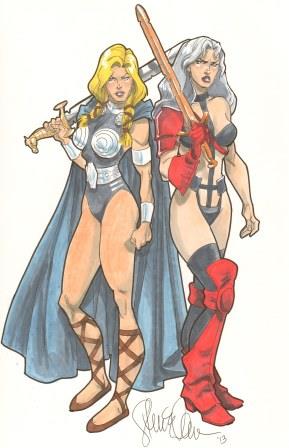
Valkyrie and Taarna, mixed media art by Steven E. Gordon

When I first rolled up on Steven E. Gordon‘s table in Artist’s Alley on Saturday, his name did not immediately register with me. I did, however, admire the samples of his art that were on display. After chatting for a bit with Steve and his wife, I told him I’d return on Sunday with a commission project for him. Steve advised me that he probably wouldn’t be able to start the piece before the con ended, but that he would gladly take my information and send me the art when it was done.

At home on Saturday night, I Googled Steve to get a better idea of his style, with a view to choosing a Common Elements concept appropriate to his talents. I was astounded to discover that I actually knew Steve’s previous work quite well — I just didn’t realize who he was.

As it turns out, Steve Gordon possesses one of the most extensive and impressive resumes in the animation business. In film, he’s worked as an animator, designer, and animation director on numerous projects, ranging from Disney classics (The Black Cauldron; The Great Mouse Detective; Oliver and Company) to several directed by the legendary Ralph Bakshi (Lord of the Rings; American Pop; Cool World). In television, Steve has contributed his talents to a host of series, from Mighty Mouse to The Avengers.

With the light of giddy anticipation breaking over my mental horizon, I realized that I just met a key contributor to one of my all-time favorite animated features: Ralph Bakshi’s sword-and-sorcery epic, Fire and Ice — the product of Bakshi’s collaboration with the dean of fantasy illustrators, the late, lamented Frank Frazetta. Sometimes described (not altogether inaccurately) as “Conan the Animated Barbarian,” Fire and Ice melds Frazetta’s unmistakable design aesthetic with Bakshi’s storytelling and unique cinematic style, including ample use of the latter’s trademark rotoscoping technique. From a narrative perspective, it’s not the most original film Bakshi ever directed, what with veteran comics scribes Roy Thomas and Gerry Conway importing a bucketload of tropes they’d each previously employed writing Conan’s adventures for Marvel. But without question, Fire and Ice stands among Bakshi’s most visually appealing creations, thanks in large part to Frazetta’s input, along with background artists James Gurney (Dinotopia) and Thomas Kinkade (yes, that Thomas Kinkade), as well as Peter Chung, who would go on to create Aeon Flux for MTV. And of course, the work of animation director Steven E. Gordon.

Having made the Fire and Ice connection, I knew what Steve’s Common Elements assignment would be — two characters who would fit perfectly into Bakshi and Frazetta’s world of swordplay and mystical mayhem: Marvel’s Viking vixen, Valkyrie, and Taarna, the iconic heroine from my beloved Heavy Metal: The Animated Film.

Aside from the obvious “blade-slinging beauty” angle, Val and Taarna share two other, more subtle commonalities. Both have real monomymic real names — Valkyrie’s true identity is simply called Brunnhilde — and both are seen to be reincarnated in multiple persons. Over her career in comics, the spirit of Brunnhilde has been reborn in several women, most notably Barbara Norriss and Samantha Parrington. At the conclusion of Heavy Metal, we find Taarna’s spirit alive new in the young girl seen previously in the linking segments (titled “Grimaldi”) throughout the film.

Steve’s sensibility as an animation designer fits these heroines like an armored gauntlet. Who wouldn’t want to watch an entire movie of Taarna and Val wading into pitched battle against hordes of hostile foes? Sign me up!

Not only did Steve turn out his take-home commission assignment beautifully and speedily — I received a scan of the finished piece less than a week after Big Wow concluded — he also graciously autographed the cover of my Fire and Ice DVD. (He did seem a touch surprised that someone actually owned one.) Now if only I could run into Ralph Bakshi one of these days…

And that, friend reader, is your Comic Art Friday.

Comic Art Friday: Justice may be blind, but it can see in the dark

February 15, 2013

One of my personal projects for this year is building a database for my comic art collection. As astounding as this may seem, given that I’ve been collecting art for nearly a decade now, I don’t have a comprehensive catalog of everything I own.

My online gallery at Comic Art Fans showcases practically all of my art, but there’s no easy way from there to compile a simple list that contains every item. Plus, there’s information about each artwork that I’d like to capture, but that isn’t included in the CAF listing. My late first wife KJ helped me create an Excel spreadsheet many years ago, but spreadsheets and I don’t speak the same language — I’m a writer, not an accountant — so that document hasn’t been updated in, like, eons. The other night, I took a 12-part online tutorial in the basics of Access, Microsoft’s database program, and I believe I now have a tool that will accomplish what I need.

As I fill the database — which is going to take some time, since I have close to 400 individual pieces to catalog — I’m going through my portfolios and taking a fresh look at each physical artwork, as opposed to the digital images that reside in my computer and online. There are practical reasons for this: I want to (a) verify what I still own, because I’ve sold or traded some pieces over the years, and haven’t always been meticulous about noting that those items have moved on to new owners; and (b) document the dimensions of each piece, and I can’t tell what sizes things are from the scans.

There’s an even more important reason, though, for reconnecting with each piece in my collection, especially those that I didn’t commission personally. For the preexisting pieces, it’s nice to be reminded of why I bought them in the first place.

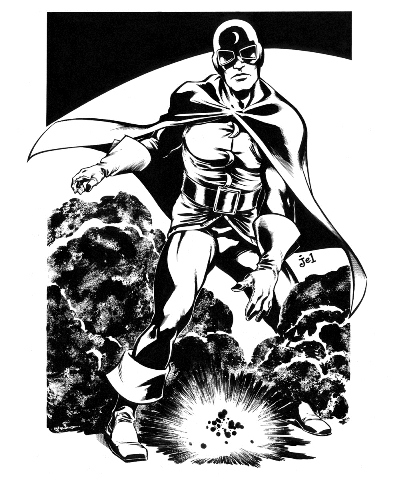
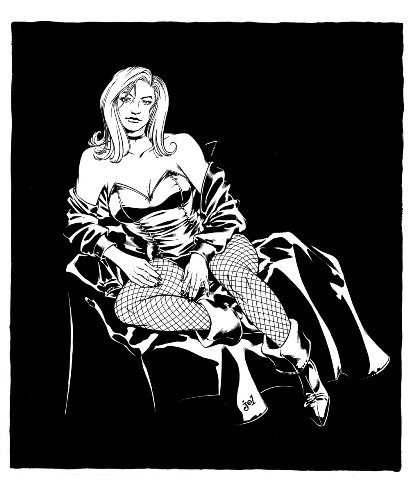
Both of the artworks we’re featuring today sprang from the hand of the same talented artist — James E. Lyle, who signs his work “jel” and is known to his friends as Doodle. I acquired both pieces in March 2005 from the same vendor, who if I recall correctly was selling them on Doodle’s behalf. Over the next several months, I commissioned three new pieces from Doodle directly, including two for my Common Elements theme. His work has many wonderful qualities that I enjoy — strong lines, expressive characters, exquisite costume detailing, and an old-school, retro feel that breathes and radiates the comics of my youth. He also uses shadows (or “spots blacks,” as they say in artist lingo) as effectively as anyone in the business, as you’ll see in a moment.

Black Canary, pencils and inks by James E. Lyle

Doodle titled this first item “Canary in a Coal Mine,” and it’s easy to see why. His juxtaposition of Black Canary against a solid black background make for a bold, arresting image, despite the relaxed posture of the subject. This piece has consistently ranked among the most-viewed items in my online gallery over the years.

For me, Lyle’s Canary reflects a humanity that we don’t often see in our superheroes. It reads to my eye as though Dinah Drake Lance has come home from a long, arduous night of fighting crime, and she wants nothing more than to just sit down and rest. She just walked through the door of her home and plopped down on the sofa. She doesn’t even have the strength left to completely remove her jacket. And yet, exhausted though she is, there’s a trace of a smile on Dinah’s lips as she reflects on the lives she’s saved and the evildoers she’s sent off to prison. It’s been a tough battle, but a job well done.

I also like that Doodle has given his Canary naturalistic proportions. Her figure is a bit fuller and softer than the typical mainstream comics artist would draw. She looks less like an idealized, male-power-fantasy caricature of a woman, and more like an actual woman. If there were a Black Canary in real life, she’d probably be closer to Lyle’s depiction than to that of whoever’s drawing her at DC this month.

Next, Doodle presents his take on Doctor Mid-Nite, a favorite hero of mine from comics’ Golden Age. In contrast to Black Canary, Mid-Nite finds himself in the heat of battle, facing down an unseen enemy. I think Doctor Mid-Nite’s original costume as seen here is one of the best superhero designs ever — the guy just looks like a superhero, and he also looks totally cool. (Credit Mid-Nite’s co-creator, artist Stanley Aschmeier — a.k.a. Stan Josephs — for his timeless style.)

Doctor Mid-Nite, pencils and inks by James E. Lyle

Lyle invests meticulous attention in the minute details of the good doctor’s outfit, taking care to get every crease and fold in Mid-Nite’s tunic, gloves, and boots exactly right. The smoke effect generated by Mid-Nite’s blackout bomb is also beautifully done. And, like his Black Canary, Doodle’s Doctor Mid-Nite is perfectly, realistically proportioned. He appears strong and sturdy, but his muscularity doesn’t brand him as a steroid junkie or a freak of nature.

I’ve always been fascinated by the concept of a blind superhero (which Doctor Mid-Nite is, for those not up on their comics lore). When I was a kid, Daredevil was one of my favorite characters. (I haven’t been able to stomach DD’s modern adventures since Frank Miller gave the character an unnecessarily antiheroic spin in the early ’80s, a trend that subsequent creators appear to have followed. But those Silver and Bronze Age Daredevil stories — including that early ’70s run where he’s partnered with the Black Widow — remain classics.)

Tangentially related: I was a major fan (come to think of it, perhaps the only fan) of CBS’s 1990s late-night TV drama Dark Justice, about a criminal court judge who moonlights as a vigilante, rounding up malfeasants who previously escaped punishment through loopholes in the legal system. The lead character in Dark Justice was not visually impaired, but he had a habitual quirk of telling his foes, “Justice may be blind, but it can see in the dark.” I always wanted to add, “So can Doctor Mid-Nite. And Daredevil.”

It’s been 20 years since that series last aired, but I still recall it vividly as a great concept. Someone should pick up the rights and resurrect it. (A bit of Dark Justice trivia: Although the show was set in an unnamed American metropolis, its first season was filmed in Barcelona, Spain, shortly before the 1992 Summer Olympics were held there. Part of the fun of watching those early episodes was trying to catch the instances when the production team failed in its efforts to make Barcelona look like, say, Los Angeles.)

But I digress.

Sometimes people ask me whether there’s a difference in my mind between the artworks I’ve commissioned and those I’ve purchased. To be frank, there usually is — I have a deeper, more visceral attachment to my commissions because they would not exist had I not hired an artist to create them. My theme commissions, especially, reflect my personal tastes and vision in a manner than no preexisting piece ever could. There are, however, some pieces I’ve picked up over the years that I absolutely love, as much as any I’ve commissioned, because they just speak to me in a special way, and at a unique level.

You’ve just seen two of them.

And that’s your Comic Art Friday.

Comic Art Friday: Beware all enterprises that require new clothes

June 10, 2011

So, yeah, I’m a little bit bummed that NBC didn’t pick up David E. Kelley’s Wonder Woman pilot as a series.

Adrianne Palicki, erstwhile Wonder Woman

As a WW fanatic of some 40 years’ seniority, I’d welcome any chance to see my favorite Amazon back on the airwaves. I thought Kelley’s concept — what I heard and saw of it, anyway — looked interesting, and Adrianne Palicki was a decent, if not perfect, casting choice for the title role.

But it was not to be.

Much of the buzz around the Kelley version of Wonder Woman revolved around the heroine’s redesigned costume. This conversation followed closely on the heels of the revamping of Diana’s classic togs that recently began appearing in her monthly comic book.

Why is it that when it comes to women, we always end up talking about clothes?

Wonder Woman alternate costume, pencils, inks, and design by Oliver Nome

Two months ago at WonderCon (no relation), artist Oliver Nome was displaying a series of concept drawings he’d developed featuring alternative costumes for everyone’s favorite Amazon. I liked this one so much that I purchased it from Oliver.

It’s a nice riff on the classic design — especially the eagle bustier — with a slick, armor-like twist. I’m not sure why a heroine boasting Diana’s powers needs a spear, but it sure looks cool, doesn’t it?

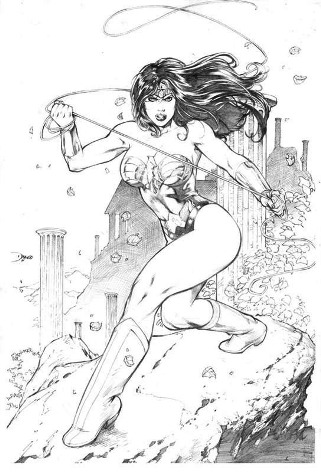
Then again, as this dazzling drawing by Diego Bernard reminds us…

Wonder Woman, pencils by comics artist Diego Bernard

It’s tough to improve on perfection.

And that’s your Comic Art Friday.

Comic Art Friday: The chauffeur’s daughters

March 4, 2011

I’ll be honest — sometimes, the only reason for a new Common Elements commission is that the idea made me grin from ear to ear when I thought of it.

Well, not literally from ear to ear in that Julia Roberts / Cameron Diaz sort of way. My mouth is not that enormous. More like from mid-cheek to mid-cheek.

First, the art. (As always, you can click the image for a better view.)

Sabrina the Teenage Witch and Fairchild, pencils and inks by comics artist Mike DeCarlo

Comics veteran Mike DeCarlo, who has drawn and/or inked everything from Spider-Man to The Simpsons during his quarter-century-plus in the industry, teams Sabrina, the Teenage Witch — star of comics, animation, and live-action TV, and responsible for extending the acting career of Melissa Joan Hart well beyond her teens (and, some might opine, beyond the limits of her talent) — with Caitlin Fairchild, leader of the youthful superhero team Gen13, who’s often known simply by her surname.

Next, the concept.

As an aficionado of old-school Hollywood, one of my favorite classic films is Sabrina. (That’s Billy Wilder’s 1954 original, starring Humphrey Bogart, William Holden, and a luminous Audrey Hepburn in the title role, not the tepid 1995 remake with Harrison Ford, Greg Kinnear, and Julia Ormond, directed by Sydney Pollack.)

Bogie and Holden portray two wealthy brothers — David, a good-for-nothing playboy (Holden), and Linus, who’s older and more serious (Bogart) — competing for the affections of a young woman (Hepburn) who happens to be the daughter of their family’s chauffeur. It’s sort of a reverse spin on Cyrano de Bergerac, with Linus working to sabotage the budding romance between his brother and the chauffeur’s daughter in order to score a huge business deal with the family of another woman, to whom David is engaged. And of course, Linus ends up falling in love with the girl himself. (Who wouldn’t? It’s Audrey Hepburn, for crying out loud.)

Okay, you’re thinking — that explains Sabrina. But what’s the Fairchild connection? If you’ve seen the movie, you know: the character Sabrina’s last name is Fairchild.

That makes me smile. Doesn’t it you?

And that’s your Comic Art Friday.

No Justice for the Maestro

February 22, 2011

I could hardly be more shocked and stunned than I was earlier today, when I read the news of the sudden death of Dwayne McDuffie.

Dwayne McDuffie leads an animation panel, WonderCon 2008

If the name is unfamiliar to you, then I’ll assume that you’re not a fan of either comic books or animation, or if you are, you don’t pay much attention to the names in the credits of either. McDuffie was a prolific writer and editor of comics who became an equally prolific writer, story editor, and producer of animation, primarily for television.

In the former realm, McDuffie created one of the most unique series in the history of comics: Damage Control, which spotlighted the exploits of a company that cleaned up cities after superhero fights. He also co-founded Milestone Media, an entire comics line that focused on bringing greater diversity to the medium, both on the page and behind the scenes. From Milestone’s publications came Static, the young electricity-wielding hero who later went on to star in the long-running and popular animated TV series, Static Shock.

McDuffie’s contributions to animation didn’t end with Static Shock. He served as story editor and producer on the Justice League franchise, as well as on the various iterations of Ben 10. He recently wrote the script for Warner/DC’s latest direct-to-DVD project, All-Star Superman, which debuted in stores — ironically enough — today.

As successful as he became in animation, McDuffie never completely abandoned printed comics. A few years ago, he wrote an outstanding miniseries for Marvel entitled Beyond!, and a well-regarded run on Fantastic Four. More recently, he breathed fresh life into DC’s tentpole series, Justice League of America.

Unlike many creators, McDuffie maintained a close connection to the readers and viewers who consumed his product. His personal website hosted a thriving online discussion forum, in which McDuffie himself (nicknamed by his fans “The Maestro”) actively participated. Never shy of expressing his opinions — and he had strong opinions about everything — McDuffie in correspondence was much like the characters whose adventures he wrote: witty, thoughtful, and more than a little tough. He gave no quarter, but he had a deft way of disagreeing vehemently with opponents without resorting to ad hominem attacks.

I had the privilege of meeting McDuffie briefly at WonderCon in 2008, following a panel featuring himself and several other top animation writers. (I took the above photo during that panel.) Although I didn’t muster the gumption to mention it to him in person, it was one of my career goals as a voice actor to snag a role in one of the series McDuffie wrote. As recently as a week ago, I’ve participated in workshops where McDuffie scripts served as the fodder for honing my acting chops. I deeply regret that I will never have the opportunity to work with him professionally.

McDuffie spoke and wrote much about the uphill struggle of being an African-American creator in a mainstream comics industry often frustratingly closed to diverse talents and storylines. His founding of Milestone Media represented his best effort at giving other people of color the opportunities that he, like few other creators of his background, had been afforded, and expanding the palette of characters about whom great comics tales could be spun. And yet, McDuffie would have been the first to correct anyone who referred to him as a “great black comics writer” — he was just a darned great writer, period.

A darned great writer, gone far too soon.

Dwayne McDuffie leaves behind his wife, his mother, a monumental legacy of work, and a numberless legion of colleagues and fans who appreciated his character as much as his creative genius. He was a singular talent in two discrete media, and successful in both.

He was just 49 years old — almost exactly two months younger than I. His birthday was yesterday.

Rest in peace, Maestro.

And don’t call me Shirley

November 29, 2010

When I heard last evening that Leslie Nielsen had died at the age of 84, I immediately thought — as I presume most people did — of the comedic roles he played during the last three decades of his acting career, beginning with Airplane! and continuing most notably with the TV series Police Squad! and the Naked Gun movies it spawned.

Often lost in that thought, however, is that Nielsen’s first comedy successes resulted from his not previously having been viewed as a comic actor. It’s a marvelous study in contrast — which is, after all, the very essence of comedy.

What made Airplane! funny was the absurdity of seeing actors whose screen images were stereotypically strait-laced — Nielsen, Lloyd Bridges, Robert Stack, Peter Graves, George Kennedy — doing and saying outlandish things. Think about the classic scene where Graves’s airline pilot makes homosexually suggestive remarks to a young boy: “Have you ever been in the cockpit of an airplane before? Have you ever seen a grown man naked? Have you ever been in a Turkish prison? Do you like movies about gladiators?” It’s shockingly funny, because at that point we mostly knew Peter Graves as the humorless secret agent Jim Phelps from Mission: Impossible. Did Graves ever utter a funny line in the entire run of that series? Did he ever even crack a smile? I don’t think so. Thus, when he makes these outrageous comments in Airplane!, it’s hilarious because, well, we didn’t know Peter Graves had that in him.

Now imagine, say, Will Ferrell in that same Peter Graves role. (Yes, I know Will Ferrell was in junior high school when Airplane! was made. Just go with me here.) It wouldn’t be as funny, because we expect outrageous comments from the mouth of Will Ferrell. The jokes would be the same, and Ferrell’s take on them might be more inherently humorous, but the impact of contrast would be lacking.

When Airplane! appeared, most people knew Leslie Nielsen — if indeed they knew him at all — as the sober-sided space captain in Forbidden Planet, or the equally somber ocean liner captain in The Poseidon Adventure, or the daring but dull Revolutionary War hero Francis Marion in the Disney miniseries The Swamp Fox. He was not an actor one expected to hear tossing off deadpan one-liners like the one in the headline of this post. Nielsen’s stiff-upper-lipped persona (as well as a previously untapped gift of timing) made him the perfect contrast for humor — a contrast he milked to great financial reward for the next 30 years.

Unfortunately — at least in my view — Nielsen didn’t know when to quit. In the aftermath of his first Naked Gun bonanza, he cranked out more than a dozen execrable films showcasing his newfound penchant for deadpan comedy, each of which proved more rancid than its predecessor. It’s one thing to find a fresh horse to ride; it’s entirely another to keep beating that horse long after it’s expired. Had Nielsen contented himself with the two movies that made his reputation, plus the TV series that inspired the second of those two movies, he’d be remembered as an unqualified comic genius. As it is, our fond memories of those noteworthy roles are muted by the likes of Repossessed, 2001: A Space Travesty, and Scary Movies 3 and 4.

If you like science fiction, and have never seen Forbidden Planet, you owe it to yourself to check it out on cable (it turns up periodically on the classic movie channels) or DVD. It’s one of the very few films from the bug-eyed monster era of sci-fi flicks that still holds up well today. (It’s more or less a retelling of Shakespeare’s The Tempest, in space opera dress.) Nielsen is effective in stolid action hero mode, Walter Pidgeon gnaws scenery as a brilliant but mad scientist, and Anne Francis — later the star of TV’s first female-lead detective series, Honey West — fills out a miniskirted space dress with aplomb.

Thanks for the good times, Mr. Nielsen. And remember… when you’re offered a choice between steak and fish for dinner, always choose the lasagna.

Comic Art Friday: My favorite changeling

September 24, 2010

It’s no secret that I have a thing for Isis.

Isis, pencils and inks by comics artist Gene Gonzales

For those of you who missed the 1970s, The Secrets of Isis was a live-action TV program that ran on CBS Saturday mornings from 1975 to 1977. Isis ran as half of a package with Shazam!, which featured the adventures of comics’ original Captain Marvel. (I say “original” because there have been several comic book heroes and heroines named Captain Marvel, spanning 70 years of comics history. But that’s a tale for another time.)

The basic premise of Isis was reiterated in the melodramatic narration that began every episode:

“O my Queen,” said the Royal Sorcerer to Hatshepsut, “with this amulet, you and your descendants are endowed by the goddess Isis with the powers of the animals and the elements. You will soar as the falcon soars… run with the speed of gazelles… and command the elements of sky and earth.”

Three thousand years later, a young science teacher dug up this lost treasure, and found she was heir to… the secrets of Isis!

And so, unknown to even her closest friends, Rick Mason and Cindy Lee, she became a dual person: Andrea Thomas, teacher… and Isis — dedicated foe of evil, defender of the weak, champion of truth and justice!

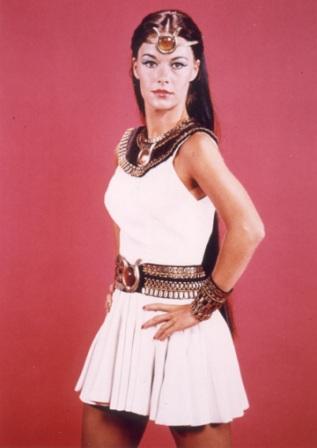
As highfalutin as all that sounds, the real attraction of The Secrets of Isis was its star, JoAnna Cameron, a charming actress who cut quite a fetching figure wearing Isis’s quasi-Egyptian miniskirt.

JoAnna Cameron as the mighty Isis

Cameron, who appeared in tons of commercials and guest-starred on several TV series and in telefilms throughout the ’70s, never had another role as prominent as Isis. By the end of the decade, she had left show business and moved on to other careers.

I’ve contributed in my own small way to keeping the legacy of Isis alive by commissioning several artworks featuring my favorite Saturday morning heroine. The drawing shown above, created by the talented and affable Gene Gonzales, is the most recent addition to my Isis gallery.

Ironically, Isis came into existence only because Filmation, the studio that produced both Shazam! and The Secrets of Isis, refused to pay DC Comics for the licensing rights to Mary Marvel, Captain Marvel’s sister and the character originally planned for the distaff half of the Shazam! TV hour.

Mary Marvel, pencils and inks by comics artist Gene Gonzales

Instead of shelling out the dough, Filmation created a new character based on the same general outline — a young woman who speaks a magical phrase (instead of “Shazam!” Andrea Thomas intoned, “O mighty Isis!”) and transforms into a superhero with powers derived from ancient mythology. DC ended up using Isis themselves, as the star of a short-lived comic series based on the TV show.

Isis, by the way, was the first female superhero to star in her own live-action program on American network television. All of the powered heroines who followed her to the small screen — from Wonder Woman and The Bionic Woman to Dark Angel and Witchblade — owe the Mighty Miniskirted One a debt of gratitude for kicking down the door.

And that’s your Comic Art Friday.

Through being Carl

April 20, 2010

I was surprised and saddened to read earlier today that Carl Macek passed away suddenly this past weekend.

To millions of anime (that’s Japanese animation, for the benefit of the uninitiated) fans, Macek gets credit — and, judging by several of the comments I’ve read at various online tributes, a considerable amount of abuse — for helping mainstream anime into American culture, through repackaging such series as Robotech for Western audiences. He also produced several of the English-language versions of Hayao Miyazaki’s films, including the classic My Neighbor Totoro.

My unbridled affection for Miyazaki aside, I’m not a rabid partisan of anime (or “Japanimation,” as we called it back in the day) produced for television. I grew up with such early examples of the genre as Gigantor and Speed Racer, but I always preferred the Western flavor of the animators’ art. Thus, it wasn’t his work in promoting anime that earned Carl Macek his pedestal in my mind’s hall of fame. Rather, it was one of his more obscure efforts, relatively speaking — his 1981 book, The Art of Heavy Metal, The Movie.

Regular visitors here may be aware that, in addition to this humble blog, I’m also the author of the Heavy Metal online reference page on Squidoo — one of my own more obscure efforts. So, Mr. Macek and I, although we diverged in our passion for (or indifference to, depending upon which of us you’re addressing) anime, shared a fondness for this strange little gem of an animated film that didn’t originate in Japan. (In fact, many people who are familiar with Heavy Metal don’t realize that the movie was a Canadian production, and that most of its segments were animated outside the United States.)

On the DVD release of Heavy Metal, Macek’s reading from his book serves as an audio commentary to the film. As a voice actor and narrator myself, I don’t find Macek’s dry delivery all that scintillating,  but he provided a number of interesting facts about the film that proved helpful when I compiled the Heavy Metal reference page. I consider myself forever in his debt, and I regret that we never had occasion to meet so that I could express my gratitude in person.

Thanks, Uncle Carl, wherever you are.

On television, everything dies

March 29, 2010

As evidence of the title of this post, I offer the following three exhibits.

Last Wednesday, Robert Culp died.

Robert Culp first became a TV star in the late 1950s as the lead in a Western series entitled Trackdown. Culp played a Texas Ranger whose job involved — as the more mentally nimble among you will already have surmised — tracking down criminals and bringing them to justice. Trackdown, which ran for two seasons, is probably less well remembered than the other Western series that spun off from it: Wanted: Dead or Alive, the show that launched Steve McQueen on his road to superstardom.

Forgettable though Trackdown was, Culp’s next series would be the stuff of TV legend. I Spy featured Culp as espionage agent Kelly Robinson, who masked his real occupation under the guise of a professional tennis player. Robinson’s fellow spy, Alexander “Scotty” Scott, played by Bill Cosby, masqueraded as Kelly’s personal trainer and coach. I Spy became the first network series to share top billing between Caucasian and African-American actors, and to portray a true partnership of peers between men of different races (even though the “I” of the show’s title was presumed to be Robinson — then again, We Spy wouldn’t have made as catchy a title).

Nearly two decades later, Culp returned to weekly TV on The Greatest American Hero, as the tough-as-nails FBI man who becomes the “handler” of a hapless superhero played by William Katt. More recently, Culp had a recurring role on the sitcom Everybody Loves Raymond, playing the father-in-law of Ray Romano’s put-upon sportswriter. In around all of the above acting roles, Culp also built a respectable career as a director and screenwriter.

Last Thursday, At the Movies — the long-running syndicated film review program — died. (Or was canceled, which is how shows die on TV.)

It’s fair to say that At the Movies had already died three deaths before Disney pulled the plug. It died first in 1999, when Gene Siskel, the Chicago Tribune critic who originally occupied the aisle seat opposite Roger Ebert of the Chicago Sun-Times, passed away from cancer. Richard Roeper — who, quite frankly, I never much cared for — replaced Siskel the following year.

The show died a second time in 2006, when Ebert’s health difficulties (originating with surgery to remove a cancerous salivary gland) escalated to the point that he could no longer appear on camera. An endless stream of guest hosts — some fine, several wretched — filled in the empty chair next to Roeper over the next couple of years.

(I will presume that most of my readers — savvy bunch that you are — already know that Ebert subsequently lost both the ability to speak and the ability to intake food and drink orally due to further complications from this surgery. Uncle Roger would want you to know, however, that he is alive and alert and continuing to write prolifically — as lead critic for the Sun-Times, on his own website, and on Twitter, where he posts with prodigious frequency.)

At the Movies suffered its third death in 2008, when Ben Mankiewicz, the Vanna White of the Turner Classic Movies cable channel, and Ben Lyons, an entertainment reporter for the E! channel whose primary qualification as a film reviewer was genetic (his father, Jeffrey Lyons — along with film historian Neal Gabler — replaced Siskel and Ebert on Sneak Previews, the PBS show S&E left in 1981 to start what evolved into At the Movies), took over for the medically unavailable Ebert and the dismissed Roeper. With the two Bens occupying the storied seats, At the Movies crashed and burned like nothing had since the Hindenburg. Disney realized its error after one grotesque season, ditching the Bens in favor of the perfectly acceptable A.O. Scott (from the New York Times) and Michael Phillips (from the Chicago Tribune), but the fatal damage had been done.

At the Movies will limp on for the remainder of this final season with Scott and Phillips at the helm. By rights, the show should have been laid mercifully to rest with poor Gene Siskel.

Finally, last Friday, 24 died.

When it exploded onto American TV in 2001, 24 was unlike anything viewers had seen before: A fictional 24-hour day that unfolded in real time, over the span of 24 hour-long episodes. (Well, “real time” in TV terms. Part of the fun was noting the many events that transpired with impossible swiftness; i.e., cross-Los Angeles car trips accomplished in 10 minutes.)

The show centered around the perfect hero for the New Millennium: Jack Bauer (played to teeth-gritting perfection by Kiefer Sutherland), a rule-bending intelligence agent employed by a super-secret federal antiterrorist unit. Bauer confronted national security crises and enemies of the state and beat, shot, tortured, and shouted them to death in the space of a single revolution of the planet. In that groundbreaking first season, Bauer saved the life of Senator David Palmer, who by Season Two had become the nation’s first African-American President — foreshadowing (and in the mind of more than one social scientist, helping to facilitate) the real-life election of Barack Obama to the White House by the end of the decade.

Jack Bauer has had seven more “really bad days” since Season One, the last of which is playing out Monday nights on FOX at this writing. It was difficult for many viewers — yours truly among them — to see how the show’s novel premise would survive repetition, but for the most part, 24 has worked. If you buy into the premise, are sufficiently forgiving to overlook continuity errors the size of Martian craters, and most importantly, get into Jack Bauer and his ever-changing supporting cast (the show’s cast turns over almost completely from one season to the next, with Bauer and tech wizard Chloe O’Brian –played by Mary Lynn Rajskub, who signed on in Season Three — the only consistent mainstays), then 24‘s seat-of-the-pants thrill-ride can prove addictive.

Now, as Jack has bellowed repeatedly (and to much-lampooned effect) over the years… “We’re running out of time!”

And so, indeed, it must be. Because on TV, everything dies eventually.

Except maybe The Simpsons.