Archive for the ‘Teleholics Anonymous’ category

Quizmasters!

November 10, 2009

Here’s proof that life sometimes winds around in bizarre directions that one never expected.

The game show fanatics in the room will recall that back in 2005, Jeopardy! mounted its Ultimate Tournament of Champions — or, as I like to refer to it, the Quest for Ken Jennings. 145 of us former Jeopardy! stalwarts were invited to participate in a mega-round-robin that played out over half a television season, for an opportunity to win major cash and reclaim a smidgen of (for some of us, anyway) long-faded glory. Brad Rutter, who had won a previous Jeopardy! super-tourney called Million Dollar Masters, plowed through the field, ultimately besting Mr. Jennings (no relation) and Jerome Vered in the finals to claim the two-million-dollar grand prize.

Shortly after the UTOC concluded, a group of Jeopardy! veterans from around the Bay Area — including your Uncle Swan — got together to play an evening of pub trivia at a Berkeley watering hole. We dubbed ourselves the Ruttersnipes, in Brad’s honor. Jon Carroll, the San Francisco Chronicle‘s human interest columnist, tagged along to document the event.

Now, four years later, I’m hosting a weekly game for the same quiz company.

I landed the gig via a serendipitous confluence of circumstances. As many of you know, a few months ago my wife KJ involuntarily retired from work on medical disability. Almost simultaneously, our daughter KM finished junior college and continued her studies at a state university. With our income shrinking and our expenses rising, I had my eyes open for opportunities to generate some additional revenue.

At the same time, Brainstormer, a San Francisco-based pub quiz company that runs trivia nights in taverns and restaurants around the country, was looking for someone to host the Tuesday night game at an establishment a mere stone’s throw from my house. (Assuming, of course, that you’re throwing your stones with a rocket launcher. A howitzer, at the very least.)

As Cinderella once said… put it all together and what have you got? Bibbidi bobbidi boo.

So, if you happen to be cruising through Sonoma County on a Tuesday evening, and experience a hankering to challenge your mental faculties (and perhaps nosh on a few freshly crafted tacos for a mere one dollar each), stop by The Cantina in downtown Santa Rosa around 8 p.m. We’ve got music, we’ve got laughter, we’ve got mind-bending trivia. Best of all, there’s no cover charge.

If the sleek, dashingly handsome quiz host looks familiar… I’m probably home with the creeping crud that night.

But if there’s a nerdy, middle-aged fat guy running the game, that’s me.
Comic Art Friday: Witches and warlocks

October 30, 2009

Tomorrow is Hallowe’en — All Hallows’ Eve, if you don’t want want to get lazy about it — which makes today Hallowe’ene’en.

I’m not sure that designation will catch on, but I thought you’d want to know.

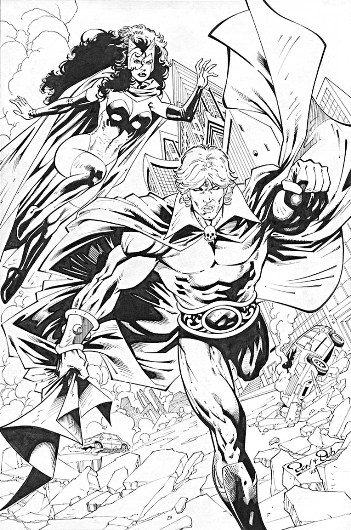
The Scarlet Witch and Adam Warlock, pencils by Ron Adrian, inks by Bob Almond

This being Hallowe’ene’en and all, what could be more appropriate than a Common Elements artwork featuring a witch and a warlock? Not just any witch and warlock, of course, but the Scarlet Witch and Adam Warlock — drawn here by the talented Brazilian penciler Ron Adrian and embellished by the man who puts the “king” in “inking,” Bob Almond.

The Scarlet Witch isn’t really a witch, of course, but a mutant with the power to alter probability. Nor is Adam Warlock really a warlock — that’s just his name. Much like Billy Warlock, who to the best of my knowledge is not an actual warlock either, just a soap opera actor.

Not being a real witch doesn’t make the Scarlet Witch any less cool. If anything, it makes her even more cool, because you have to be pretty cool to let people think you’re a witch when you’re really not. Sort of like Kristin Chenoweth, who, although famous for portraying a witch, is not an actual witch. Although she can sing an F above high C, and I’m fairly certain that you’d have to have supernatural powers to do that. So, she might be.

In similar fashion, not being an actual warlock doesn’t make Adam Warlock any less cool. Not being Billy Warlock, however, is pretty cool. Unless you’re Billy Warlock, in which case you’re stuck with it. Although Billy Warlock was married to Marcy Walker, which might have been kind of cool for a while. Then again, Marcy Walker has been married, like, five times, so it might not be all that cool after all.

A Common Elements commission starring the Scarlet Witch and Adam Warlock, however, is totally cool.

Even on Hallowe’ene’en.

And that’s your Comic Art Friday.

Not unique

October 29, 2009

I would have written about this before now, except that I didn’t know about it until today, when a member of an online forum that I frequent brought it to my attention.

A couple of weeks ago, I surrendered a distinction that I’ve held all by my lonesome for the past 21 years.

Since June 1988 — actually since March of that year, but the feat wasn’t official until June, when the programs aired — I have been the only African-American five-game champion in the history of Jeopardy! (If you’re arriving late to the party, you can read about my career as a game show trivia wizard by following the link. And yes, you nitpicker, technically I’m “biracial” — but if it’s good enough for the President of these United States, it’s absolutely good enough for me.)

As of two weeks ago Friday, a gentleman from Plano, Texas named Terry Linwood muscled his way into my formerly one-man fraternity.

Now, don’t get me wrong. I’m as thrilled as all get-out for Terry, who’s a fantastic Jeopardy! player. (I saw a couple of Terry’s games, but not his game five — which he won — or his game six — which he lost — and thus I wasn’t aware of his accomplishment.)

Still, I’m sure you’ll excuse me for feeling just a tiny bit less… remarkable today.

Had you asked me 21 years ago whether I thought my dubious accomplishment would stand the test of more than two decades’ time, I’d have imagined you daft. I mean, who’d have thought Jeopardy! would even be on the air after 26 seasons? And, given the number of contestants who grace the Sony Pictures Studios stage every year, you’d have supposed that a couple of dozen people, maybe, would have smashed in the door to my solitary club by now.

It’s a funny old world, sometimes.

Now I know how Snoopy felt in this classic Peanuts strip:

Peanuts

Congratulations to Terry Linwood on becoming Jeopardy!‘s latest five-time champ. I’ll be pulling for him in next year’s Tournament of Champions.

If he does well, I’ll even teach him the secret handshake.

Soup’s gone

October 22, 2009

So I come home tonight after a long day at the hospital with KJ, and the first thing I read on the news is that Soupy Sales died.

Go ahead, world… tear away another piece of my childhood.

Although I’m too young to have been around for his infamous kids’ shows from the 1950s and early 1960s — shame on you for thinking there’s nothing I’m too young to have been around for — Soupy was a big part of my nascent TV experience. Reruns of his mid-’60s variety show ran endlessly on Armed Forces Television, a staple of my military-brat youth.

More significantly, as a connoisseur of game shows, I watched Soupy on hundreds of episodes of programs like What’s My Line? (he was a regular panelist for seven seasons), Pyramid, To Tell the Truth, Match Game, and Hollywood Squares. In the ’70s, Soupy also hosted the juvenile version of the stunt game Almost Anything Goes, the forerunner of Nickelodeon’s Double Dare and its spinoffs.

Soupy’s legend in television was secured on New Year’s Day 1965, when as a gag he invited his young viewers to dig into their parents’ wallets and purses and mail him “those green pieces of paper with pictures of Presidents on them.” Contrary to popular belief, Sales wasn’t fired for this stunt — although he was suspended for a week — nor did his entreaty net a massive windfall. (Most of the mail submissions contained Monopoly money.) The incident, however, illustrates the unpredictable humor for which Soupy became famous, even when he was mostly known for entertaining kids.

Some years ago, TV comedy and comics writer Mark Evanier composed a detailed retrospective about Soupy’s career. In tonight’s blog post, Mark adds a few additional thoughts. Both articles are well worth a read.

Back when I was reviewing films for DVD Verdict, I penned a critique of a little-known “mockumentary” entitled …And God Spoke. It’s a pretty funny flick if you enjoy that Christopher Guest sort of thing, and one of its most hilarious bits is a cameo by Soupy Sales as himself, hired to portray Moses in a low-budget Biblical epic. Because if you couldn’t afford Charlton Heston, you’d definitely want the Soup Man.

Soupy Sales — whose birth name, incidentally, was Milton Supman — was 83. His two sons, Hunt and Tony Sales, are rock musicians who’ve worked as sidemen for such premier artists as David Bowie, Todd Rundgren, and Iggy Pop.

There. I didn’t mention pie once.

Comic Art Friday: Long tails, and ears for hats

September 11, 2009

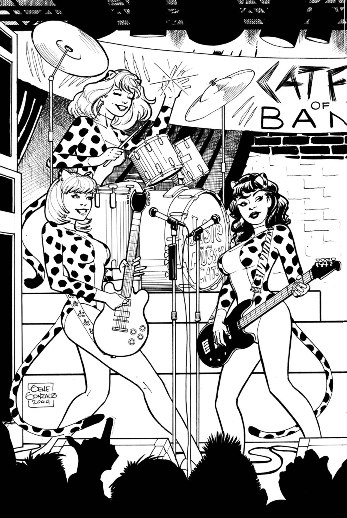
When last we convened for Comic Art Friday, we took our first look at a spectacular new addition to my Common Elements gallery — this super-sized six-character commission by Florida artist Gene Gonzales entitled “Catfight of the Bands.”

Catfight of the Bands, pencils and inks by comics artist Gene Gonzales

Today, let’s take a closer examination of the first of those two battling trios. (Never fear — we’ll catch up with the other three famous felines next Friday.)

From the preponderance of superhero art that appears here on Comic Art Friday, one might presume that comics in that genre were the only funnybooks I read during my formative years. Au contraire, mon frere. While superhero comics were — and still are — my core reads, as a kid I devoured every kind of comic book that I could find on the newsstands of the military bases where I grew up. I read sword and sorcery comics (I still read the current iterations of Conan and Red Sonja), horror comics (a particular pleasure in the early ’70s was the DC anthology Weird War Tales, which featured stories of the supernatural set on battlefields throughout history), Western comics (everything from Kid Colt, Outlaw to Bat Lash), military comics (you couldn’t call yourself a genuine service brat without reading Sad Sack), and juvenile comics (yes, friends, I read Casper the Friendly Ghost and Richie Rich, too).

And, I read Archie Comics. Heck, I loved Archie Comics. I’m man enough to admit that I read Betty and Veronica religiously back in the day.

My favorite Archie magazine? Josie and the Pussycats.

Josie and the Pussycats, pencils and inks by comics artist Gene Gonzales

Actually, I was reading the adventures of Josie and her friends before there was a Josie and the Pussycats. The perky redheaded teenager made her comics debut in 1963, as the star of the series She’s Josie. (Josie’s creator, longtime Archie artist Dan DeCarlo, named the character after his wife.) She’s Josie soon became just plain Josie, and centered on typical Archie-style teenage humor involving Josie and her high school pals, several of whom still costarred in the book when Josie decided to start her own rock band in 1969. (Not coincidentally, the Archie gang had exploded onto Saturday morning TV as a prefab pop group around the same time.)

When Josie (whose surname flip-flopped for years between Jones and James before settling on McCoy early in this current decade), her best friend Melody (also a Jones for many years, her last name became Valentine in the live-action Josie and the Pussycats movie a few years ago, and the comics followed suit), and their newest comrade Valerie (née Smith, later consistently Brown) donned their now-familiar leopard-spotted leotards and kitty-ear tiaras, the title of their comic took on the name of their newly formed act.

Thus legends are born.

Before long, Josie and the Pussycats had their own animated TV series. The show was eponymously titled for the first two years of its run (1970-72), then took a sci-fi turn and morphed into Josie and the Pussycats in Outer Space for another two seasons. Josie and the gang’s TV adventures borrowed heavily from the successful formula of Hanna-Barbera’s already popular Scooby-Doo, mostly involving the girls and their retinue solving comedic mysteries.

As did the Archies, Josie and the Pussycats — actually real-life session musicians using the band’s fictional identity — recorded several bubblegum pop singles in the early ’70s. Three then-unknown singers were “cast” as the singing voices of the Pussycats. The real-world “Melody” was a blonde named Cherie Moor (real name: Cheryl Jean Stoppelmoor), who came to greater fame later in the decade under her new stage name, Cheryl Ladd.

Ironically, most of the lead vocals on the Pussycats’ songs — including the familiar theme to the animated series — were performed by the singer cast as “Valerie,” Patrice Holloway, rather than by Cathy Dougher, who was “Josie.” Holloway almost didn’t the part, as Hanna-Barbera at first wanted to retool the Pussycats as an all-Caucasian trio. Music producer Danny Janssen, who assembled the real-life Pussycats and wrote several of their songs, refused to replace Holloway with a white performer. After several weeks of infighting, Hanna-Barbera agreed to restore Valerie to her original African-American heritage in the TV show, enabling Janssen to keep Holloway in the band. Valerie thus became the first black female character to appear regularly in an American animated TV show.

Three decades after their television debut, Josie and the Pussycats hit the live-action cinema. Rachael Leigh Cook portrayed Josie, Rosario Dawson played Valerie, and Tara Reid was typecast as the dizzy Melody. If you haven’t seen the movie… don’t. It’s 99 precious minutes of your life that you’ll never recoup. Trust me on this.

Josie and the Pussycats, blue pencil rough sketch by Gene Gonzales

Although I first hit on the idea to feature Josie and the girls opposite Catwoman and the two Black Cats a few years ago, it wasn’t until I saw Gene Gonzales’s rough sketch of the Pussycats on stage that I knew I’d found an artist with the appropriate sensibility to bring the concept to life. Thanks for allowing me to show off your inspiration, Gene!

Next week, we’ll wrap up our caterwauling by throwing the spotlight on the other half of this musical catfight.

Until then… that’s your Comic Art Friday.

From the Get Over It Department, Supermodel Division

September 7, 2009

Here’s a little celebrity news item from the Sydney Daily Telegraph:

Supermodel Elle Macpherson has revealed she fears that she looks old compared to her young TV co-stars as she has not had plastic surgery.

The supermodel is anxious about appearing on the new CW show The Beautiful Life because she hasn’t had plastic surgery.

The 46-year-old added that she is shocked at how she looks compared to her younger co-stars, including Mischa Barton and Sara Paxton.

Macpherson said: “Sometimes I really see that I’m the one that hasn’t done anything because I think people must think, ‘Oh my God, she looks old’.”

Let me see if I understand this correctly…

Elle Macpherson is worried that she looks old compared to Mischa Barton and Sara Paxton.

Mischa Barton is 23 years old. Sara Paxton is 21. Elle Macpherson is 46 — twice Ms. Barton’s age.

Here’s a breakthrough thought, Elle: If you’re chronologically qualified to be someone’s mother, it’s okay if you look older than that person. For a 46-year-old woman — which you are — you look just fine. Quit worrying, already.

This illustrates the stupidity of Western culture’s perceptions of beauty. A 46-year-old woman should not think she should look like a 23-year-old. Or a 21-year-old. Or anything other than a 46-year-old. Because it should be okay for each of us to be what we are, and not what someone  half our age is, or what we ourselves used to be two decades ago.

This also illustrates one reason why plastic surgeons and pharmaceutical companies are rich, and half the people in Hollywood look like circus freaks.

Embrace the real, people.

When I’m Elle Macpherson’s age, I hope I look as good as she does.

Hmm? I’m what?

Never mind.

Iron Goofy, Incredible Duck, and the Amazing Spider-Mouse

August 31, 2009

This may be the biggest pop culture business story of the decade: The Walt Disney Company is buying Marvel Entertainment for $4 billion.

Already, the fanboys — and, to be fair, the occasional fangirl — are burning up the ‘Net with their prediction of what will happen when the House of Ideas collides with the House of Mouse.

The truth is simple: We’ll see.

Disney is now, and pretty much has been throughout recent memory, all about licensing. There’s no question that the reason they want Marvel isn’t because they crave a niche in the rapidly shrinking world of comics publishing. Heck, Disney can’t be bothered to publish comic books starring the characters they already own — they summarily dumped the last vestige of this connection, the hugely popular Disney Adventures magazine, a while back, with hardly a fare-thee-well — much less floppies about people running around in brightly colored underwear.

What intrigues Disney’s beancounters is the tremendous stable of familiar characters that Marvel represents — characters ripe for exploitation on toys, T-shirts, and oodles of memorabilia. A quick stroll around Anaheim’s Disneyland Resort will clue you in to how thoroughly and aggressively the Mouse House has co-opted the characters from their last mega-acquisition, Pixar Animation Studios. The mind boggles at the fun Disney will have — and the kajillions they’ll profit — marketing Spidey, Wolverine, and the rest of the Merry Marvel Marching Society.

What does it all mean for Marvel in terms of its comics line? Who knows? Comics are a dying industry. Movies and video games, on the other hand, have never been hotter, and Marvel offers a veritable cornucopia of product to churn through. I don’t know how much longer comics will last, regardless of who holds the reigns. With Disney pulling the strings, however, it seems likely that Marvel’s signature superheroes will plow ahead in one form or another for the foreseeable future, and perhaps beyond.

As for the worriers who believe that suddenly Marvel’s going to get all family-friendly because Disney takes over: (a) I’m not sure that would be an awful thing if it happened, and (b) remember, this is the company whose ABC Television Network brings you Desperate Housewives and Grey’s Anatomy.

In the words of the immortal Stan Lee…

Excelsior!

Tick… tick… tick…

August 19, 2009

I awakened this morning to the news about Don Hewitt, the pioneering newsman who passed away today at the age of 86.

Although most of Hewitt’s obituaries will lead with the fact that he created 60 Minutes — the show that continues to define investigative reporting, for better or worse — that’s really just the tip of Hewitt’s iceberg of influence. From his days as a CBS News producer in the earliest days of network television, Hewitt was a pivotal figure in shaping broadcast journalism as we know it — not merely the way the news is presented on TV, but how we think about the news we receive via that medium.

Back in the days when I thought I wanted to be a broadcast journalist — somewhere at the bottom of my underwear drawer lies a university degree that attests to that long-evaporated ambition — Don Hewitt was one of my heroes. It’s been sad in recent years to see the quagmire that TV journalism has become in this era of TMZ and FOX News. I’m sure that Hewitt looked at a lot of what passes for news these days — even on the network for which he toiled for more than five decades — and just shook his head in disbelief.

That’s not to say that Hewitt himself was above stunt journalism. Like much else in TV news, he pretty much invented it. Hewitt’s genius was in understanding that to cut through on the “cool” medium of television — if I can get all Marshall McLuhan for just a moment — news stories needed to be direct, personal, and in the viewer’s face. Certainly, the confrontational style of 60 Minutes reflected that.

Thanks, Don, for all the great stories.

The prince of darkness

August 18, 2009

Generally speaking, when I write about celebrity deaths in this space — and as regulars here know, I do that quite frequently — I attempt to find something positive to say about the decedent. Heck, I was even nice to William F. Buckley, a man with whom I would likely have disagreed about the benefits of oxygen.

Today, Robert Novak is dead.

I got nothing.

My path in life never crossed Novak’s, but I spent countless hours in his electronic presence by way of the many talk programs on which the archconservative commentator appeared. I can’t say how much of Novak’s on-camera persona was genuine and how much was an act, but by most accounts, he presented the same dour, bulldog face in everyday affairs that he showed on The McLaughlin Group or The Capital Gang. Novak seemed to be one of those jerky people who revel in their jerkiness, and in making other people feel small and uncomfortable.

I don’t find much laudable in people like that.

Although he broke numerous Washington stories over his lengthy career, Novak will be forever remembered as the journalist who, in a fit of politically motivated pique, broke the cover of CIA operative Valerie Plame Wilson. Some considered that act tantamount to treason. I’m not sure I’d go quite that far — treason, like racism, is not an accusation to be hurled lightly — but it was without doubt a stupid and reprehensible act that lowered Novak even in the eyes of many conservatives who had previously lionized him.

For some of us, it simply proved that Novak was exactly what we’d always thought him to be. I’ll let you fill in that blank for yourself, loath as I am to speak ill of the newly departed.

Jon Friedman of MarketWatch expressed it as well as I could:

To me, [Novak] was, as a journalist, a shameful bully. He demonstrated the worst instincts of a professional pundit.

It was always an impression I had about him. I suspected that if the highly paranoid and divisive Richard Nixon had actually been a newspaperman, he would have resembled Novak.

Early in his career, a colleague hung the moniker “Prince of Darkness” on Novak, because of his aggressively pessimistic disposition. Novak enjoyed that image, and even used the nickname as the title of his 2007 autobiography.

Now it’s dark for sure.

The walking, talking, I-don’t-care man

August 17, 2009

It’s Monday, and here’s a bunch of things that I just can’t bring myself to give a rip about.

  • Jon, Kate, their eight, or their dates.
  • Soccer.
  • KISS selling its new album at Walmart.
  • Whether Walmart is spelled Walmart or Wal-Mart.
  • The BART non-strike.
  • Michael Vick’s future in the NFL.
  • Project Runway.
  • Any opinion expressed on talk radio.
  • Whether Gwyneth Paltrow likes Scarlett Johannson.
  • The Time Traveler’s Wife.
  • Tom DeLay appearing on Dancing with the Stars.
  • Brett Favre.
  • Alyssa Milano’s wedding.
  • Big Brother.
  • Vegetarianism.
  • Veganism.
  • Antidisestablishmentarianism.
  • Isms in general.
  • Any opinion expressed on FOX News.
  • Madonna’s biceps.
  • Lady Gaga.
  • The Chrome OS.
  • Burger King.

I could probably come up with a few more. But I just don’t care.