Comic Art Friday: This is not a blonde joke

Posted August 21, 2009 by swanshadow
Categories: Comic Art Friday

Growing up, I read so many comics that my memories of specific stories and issues — and where I was when I read them — run together. A handful of landmark issues stand out for me, however. One such issue was Ms. Marvel #1.

Ms. Marvel, pencils by comics artist MC Wyman

I was already a fan of the Marvel Comics version of Captain Marvel — a completely different character from the Captain Marvel of whom you’re probably thinking if you’re not a major comics geek — when his distaff surrogate first appeared. What drew me to Ms. Marvel, though, was the fact that she was the first Marvel heroine with A-level superpowers.

Essentially, Carol Danvers (who’d actually been a popular Marvel supporting character for several years before she gained superpowers) was both of DC’s signature heroines, Wonder Woman (the powerful and wise mother figure) and Supergirl (the powerful but cute blonde), rolled into one.

"Danvers Dolls," a Common Elements commission by Christopher Rich-McKelvey

The similarities between Supergirl and Ms. Marvel didn’t end with their strength, invulnerability, disdain for gravity, connection to a prototypical male hero, or flaxen tresses. Supergirl’s civilian identity at one point in her complex history was also Danvers — she used the first name Linda — which couldn’t possibly have been a coincidence, though the facts remain shrouded in mystery.

One other factor that Ms. Marvel and Supergirl have in common is that I collect images of both of them. (You can browse my Supergirl collection here and here, and my Ms. Marvel collection here and here.)

Supergirl, pencils by comics artist Christopher Rich-McKelvey

The Ms. Marvel pinup above was drawn by MC Wyman, one of Marvel’s best artists throughout the 1990s. Both the Supergirl solo drawing and the Common Elements commission pairing these two heroines come from the pencil of Christopher Rich-McKelvey, owner of Bald Guy Studios and creator of the independent comic Footman 15.

I don’t often have two artworks featuring the same character by the same artist in my collection, but I’m particularly fond of Supergirl’s costume from the mid-’70s, as seen in the solo pic here. So is Chris, apparently.

And that’s your Comic Art Friday.

Tick… tick… tick…

Posted August 19, 2009 by swanshadow
Categories: Celebritiana, Dead People Got No Reason to Live, Ripped From the Headlines, Teleholics Anonymous

I awakened this morning to the news about Don Hewitt, the pioneering newsman who passed away today at the age of 86.

Although most of Hewitt’s obituaries will lead with the fact that he created 60 Minutes — the show that continues to define investigative reporting, for better or worse — that’s really just the tip of Hewitt’s iceberg of influence. From his days as a CBS News producer in the earliest days of network television, Hewitt was a pivotal figure in shaping broadcast journalism as we know it — not merely the way the news is presented on TV, but how we think about the news we receive via that medium.

Back in the days when I thought I wanted to be a broadcast journalist — somewhere at the bottom of my underwear drawer lies a university degree that attests to that long-evaporated ambition — Don Hewitt was one of my heroes. It’s been sad in recent years to see the quagmire that TV journalism has become in this era of TMZ and FOX News. I’m sure that Hewitt looked at a lot of what passes for news these days — even on the network for which he toiled for more than five decades — and just shook his head in disbelief.

That’s not to say that Hewitt himself was above stunt journalism. Like much else in TV news, he pretty much invented it. Hewitt’s genius was in understanding that to cut through on the “cool” medium of television — if I can get all Marshall McLuhan for just a moment — news stories needed to be direct, personal, and in the viewer’s face. Certainly, the confrontational style of 60 Minutes reflected that.

Thanks, Don, for all the great stories.

The prince of darkness

Posted August 18, 2009 by swanshadow
Categories: Celebritiana, Dead People Got No Reason to Live, Ripped From the Headlines, Teleholics Anonymous, The Body Politic

Generally speaking, when I write about celebrity deaths in this space — and as regulars here know, I do that quite frequently — I attempt to find something positive to say about the decedent. Heck, I was even nice to William F. Buckley, a man with whom I would likely have disagreed about the benefits of oxygen.

Today, Robert Novak is dead.

I got nothing.

My path in life never crossed Novak’s, but I spent countless hours in his electronic presence by way of the many talk programs on which the archconservative commentator appeared. I can’t say how much of Novak’s on-camera persona was genuine and how much was an act, but by most accounts, he presented the same dour, bulldog face in everyday affairs that he showed on The McLaughlin Group or The Capital Gang. Novak seemed to be one of those jerky people who revel in their jerkiness, and in making other people feel small and uncomfortable.

I don’t find much laudable in people like that.

Although he broke numerous Washington stories over his lengthy career, Novak will be forever remembered as the journalist who, in a fit of politically motivated pique, broke the cover of CIA operative Valerie Plame Wilson. Some considered that act tantamount to treason. I’m not sure I’d go quite that far — treason, like racism, is not an accusation to be hurled lightly — but it was without doubt a stupid and reprehensible act that lowered Novak even in the eyes of many conservatives who had previously lionized him.

For some of us, it simply proved that Novak was exactly what we’d always thought him to be. I’ll let you fill in that blank for yourself, loath as I am to speak ill of the newly departed.

Jon Friedman of MarketWatch expressed it as well as I could:

To me, [Novak] was, as a journalist, a shameful bully. He demonstrated the worst instincts of a professional pundit.

It was always an impression I had about him. I suspected that if the highly paranoid and divisive Richard Nixon had actually been a newspaperman, he would have resembled Novak.

Early in his career, a colleague hung the moniker “Prince of Darkness” on Novak, because of his aggressively pessimistic disposition. Novak enjoyed that image, and even used the nickname as the title of his 2007 autobiography.

Now it’s dark for sure.

The walking, talking, I-don’t-care man

Posted August 17, 2009 by swanshadow
Categories: Aimless Riffing, Celebritiana, Cinemania, Listology, Ripped From the Headlines, Taking Umbrage, Teleholics Anonymous

It’s Monday, and here’s a bunch of things that I just can’t bring myself to give a rip about.

  • Jon, Kate, their eight, or their dates.
  • Soccer.
  • KISS selling its new album at Walmart.
  • Whether Walmart is spelled Walmart or Wal-Mart.
  • The BART non-strike.
  • Michael Vick’s future in the NFL.
  • Project Runway.
  • Any opinion expressed on talk radio.
  • Whether Gwyneth Paltrow likes Scarlett Johannson.
  • The Time Traveler’s Wife.
  • Tom DeLay appearing on Dancing with the Stars.
  • Brett Favre.
  • Alyssa Milano’s wedding.
  • Big Brother.
  • Vegetarianism.
  • Veganism.
  • Antidisestablishmentarianism.
  • Isms in general.
  • Any opinion expressed on FOX News.
  • Madonna’s biceps.
  • Lady Gaga.
  • The Chrome OS.
  • Burger King.

I could probably come up with a few more. But I just don’t care.

Supergirl takes flight

Posted August 14, 2009 by swanshadow
Categories: Comic Art Friday, SwanStuff

The nest is about to get empty at Casa de Swan. Our daughter KM — our only offspring — departs for college this weekend.

As regular readers know, KM graduated from the local community college in May. She’s about to continue her education at California State University, Chico, and we’re moving the last of her belongings — and KM herself — there tomorrow. Chico is only about a three-hour drive from here, but I’m sure that it will seem like a galaxy away. For a while, at any rate.

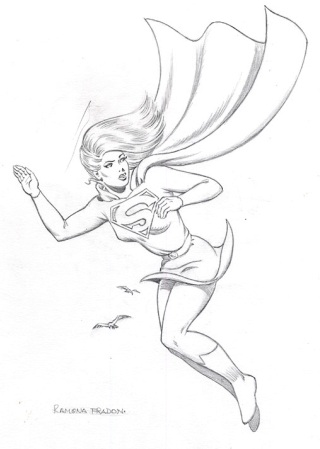
So, today’s Comic Art Friday is dedicated to my Supergirl — a nickname I hung on KM during her high school days, when one of her favorite articles of clothing was a pink hooded sweatshirt emblazoned with the Kryptonian crest. It also helps that her given name is, by sheer coincidence, similar to Supergirl’s, who came into the universe as Kara Zor-El.

Supergirl, pencils by comics artist Ramona Fradon

The charming drawing above comes from the pencil of Ramona Fradon, one of the first and most prominent female artists in the comic book industry. Ramona is best known in comics circles for her lengthy run drawing the Aquaman feature in Adventure Comics and World’s Finest (1951-1963). She co-created (with writer Robert Bernstein) Aquaman’s youthful sidekick Aqualad in 1960. Later, she  introduced (with writer Bob Haney) the seriocomic Metamorpho the Element Man, a hero who continues to command a cult following among fans to this day.

Ms. Fradon left comics during the mid-’60s, devoting the next several years to her family. She returned to the industry in 1972 and worked on various titles for both DC (Plastic Man, Freedom Fighters, Super Friends) and Marvel (most notably, The Claws of the Cat). In 1980, Ramona picked up a prestigious new assignment, as the artist of the daily newspaper strip Brenda Starr. She would draw the intrepid reporter’s adventures for the next 15 years.

Comics artists Ramona Fradon and Scott Shaw!, WonderCon 2006

I enjoyed the privilege of meeting Ramona Fradon at WonderCon a few years ago, and hearing her discuss her groundbreaking career in comics. She was remarkably candid both about the industry and her place in it. I was surprised to learn that she didn’t really enjoy drawing superhero violence, which explained why she gravitated toward characters whose stories focused less on fistfights (such as Aquaman), and those that veered into comedy (i.e., Metamorpho, Plastic Man).

In 2006, Ramona Fradon became only the second woman inducted (after longtime Marvel artist Marie Severin) into the Will Eisner Awards’ Comic Book Hall of Fame — an honor well deserved, and long overdue.

Comics artists Ramona Fradon and Scott Shaw!, WonderCon 2006

Ms. Fradon’s career demonstrates that, given the opportunity, talent and determination always find their reward — even against such obstacles as the sexism rampant in comics publishing during the ’50s and ’60s (and, to a sad yet significant degree, to this day).

It’s a lesson that I hope my daughter will remember as she finds her path through life. I’m going to miss my Supergirl.

And that’s your Comic Art Friday.

My name’s Paul, and that’s between y’all

Posted August 13, 2009 by swanshadow
Categories: Celebritiana, Dead People Got No Reason to Live, Ripped From the Headlines, Soundtrack of My Life

Musician and technological innovator Les Paul died today, at the ripe old age of 94.

It’s sometimes said of people who’ve recently passed away — I’m sure I’ve written it in reference to dozens of folks — that it would be impossible to overestimate their influence. When it comes to the art of music and the industry of recording, there might well be no one of whom the saying is more true.

Les Paul — whose original name was Lester Polfuss, and you can see why he changed it — made modern popular music possible when he created the solid-body electric guitar. Just try to imagine what rock, pop, jazz, or country would sound like without that instrument. You can’t, because they wouldn’t exist — at least, not in anything approaching the forms to which we’re accustomed.

It’s also important to note that Paul was a brilliant player of the instrument he invented. He not only produced the tool, but also developed a sizable lexicon of technique for its use.

If that one innovation was all that Paul contributed to music, we’d still be hailing him today. But wait… there’s more! (I’ve always wanted to do that.)

Paul also created multitrack recording. Which is to say that he’s responsible for the entire recording industry as we know it today — not just musical recordings, but pretty much everything we hear on television or in film. Whenever you hear an artist singing or speaking over a separately recorded instrumental track, or layered instrumentals or vocals, or any kind of recording that necessitated multiple sources being combined into a single signal — again, just about all of the recorded sound you hear anywhere — you have Les Paul to thank for both the idea and the execution.

For live performances, he invented the Les Paulverizer, the first electronic device for in-the-moment sound-on-sound production (or live looping, as it’s often called). With this system — the inner workings of which Paul never publicized, and which he continually upgraded for over 50 years — Paul could transform a solo performer (himself, for instance) or a duo (himself and then-wife and collaborator Mary Ford) into an entire ensemble, all from a control box attached to his guitar. (Or so it appeared — Paul confessed in later years that the on-stage control mechanism was nothing more than a prop.)

No wonder they called the man “the Edison of music.” That might even be giving Edison a little too much credit.

Until shortly before his death, Les Paul was still playing his music live every Monday night at a New York City jazz club. I doubt I’ll live to be 90-plus, but on the off chance, I hope I’m still doing things I love.

Les Paul is dead, may he rest in peace. But his legend, like the sounds from his multitrack recording equipment, will just keep going and going.

What’s Up With That? #80: Video killed the RadioShack

Posted August 11, 2009 by swanshadow
Categories: Aimless Riffing, Ripped From the Headlines, What's Up With That?, Wonderful World of Advertising

My long-ago former employer RadioShack (to illustrate how long ago it was that I worked for them, the name was still two discrete words back then) is rebranding itself as “The Shack.”

Aside from the potential conflicts with other businesses (the Joe’s Crab Shack restaurant chain comes immediately to mind) and celebrities (namely, a certain NBA center who recently joined the Cleveland Cavaliers), this seems like a silly idea to me. I get the fact that “radio” is an old-school communications medium that few in the iPod generation listen to anymore, but the whole notion of a company giving itself a pithy, street-sounding nickname is ridiculous.

Knowing, however, the lemming mentality of American corporations, I find myself wondering whether — if RadioShack… I mean… The Shack’s experiment proves successful — we’ll be seeing any of the following:

  • The Soft
  • The Buy
  • The Gamble
  • The Bucks
  • The Mart
  • The Get
  • The Motors
  • The Cola
  • The Cast

I’d come up with a few more, but I need to visit The Room.

Roller coaster Monday

Posted August 10, 2009 by swanshadow
Categories: Aimless Riffing, My Home Town, Ripped From the Headlines

As I type, 24 people are trapped on the Invertigo roller coaster at California’s Great America, a theme park in Santa Clara.

Let’s see…

Suspended four stories off the ground…

On a roller coaster…

With no foot supports…

Or protection from the blazing sun…

On a 100-degree day in August.

This sounds like a dreadful way to begin one’s week.

I’m reminded of a similar incident here several years ago, when a bunch of tourists were stalled on a coaster at what was then Marine World (it’s now called Six Flags Discovery Kingdom) in Vallejo. In that circumstance, the coaster was a corkscrew model, and several of the passengers were trapped in upside-down or sideways positions.

Not that this will be any comfort to the guests-slash-victims at Great America.

I drive past Great America every Tuesday night on my way home from chorus rehearsal. If these poor people are still hanging there when I cruise by tomorrow, I’ll report back.

Comic Art Friday: Chicks dig the longbow

Posted August 7, 2009 by swanshadow
Categories: Comic Art Friday

As we noted in a previous Comic Art Friday, archery would appear, on the face of things, to be a poor choice of expertise for a superhero.

Supervillains, after all, tend to be in-your-face types. It seems unlikely that when, say, Dr. Doom is punching you in the face with his armored fists that he will respond politely to your request that he step back about ten yards so that you have room to shoot him with an arrow.

Despite this apparent disadvantage, archers have formed an essential subset of superherodom since its beginnings. In fact, the first masked crimefighter in comics was an archer — The Arrow, who debuted just three months after Superman kick-started the genre in 1938. He was followed in short order by such bow-slinging stalwarts as Golden Arrow, the Spider (not the pulp hero of the same name, but the star of the comic series entitled Alias the Spider), and perhaps the best-known of the bunch, Green Arrow, who stands as one of only five superheroes from the Golden Age of comics to be published continuously from that day to this. (The others are the DC “trinity” of Superman, Batman, and Wonder Woman, plus their Justice League comrade Aquaman — because who doesn’t love a guy who can talk to fish?)

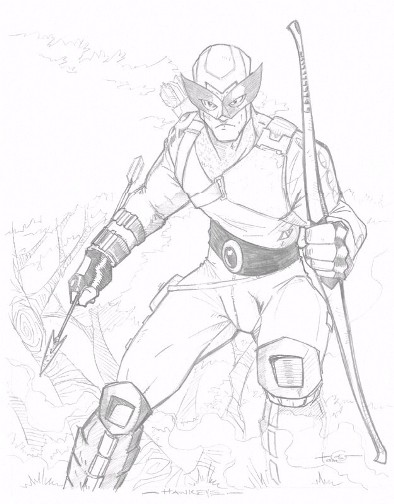
Never one to miss a trend, longtime Marvel Comics editor-in-chief Stan Lee thought, “Hey, we should have one of those archer types, too.” So, in 1964, with the aid of artist Don Heck, Stan the Man created Clint Barton, a.k.a. Hawkeye.

Hawkeye, pencils by comics artist Thomas Hodges

Like the other archer superheroes who preceded him, Hawkeye possessed no paranormal abilities. He was simply a talented fellow who knew how to bend a bow with the best of them. Hawkeye did, however, bring new wrinkles to the party — a surly demeanor and an iconoclastic attitude. (Green Arrow, whose debut predated Hawkeye’s by more than two decades, would later adopt similar personality traits.)

Hawkeye became a member of the second generation of the Avengers, Marvel’s front-line super-team. When founding members Iron Man, Thor, Ant-Man and the Wasp simultaneously took leaves of absence, Captain America pulled together a ragtag bunch of Grade B heroes to replace them. Cap’s new Avengers included the Scarlet Witch, her speedster brother Quicksilver, and our man Hawkeye.

In an interesting twist, Clint Barton gave up his bow and arrows for a while to become Goliath, one of numerous identities assumed over the years by Henry Pym, originally known as Ant-Man. Clint used Henry’s infamous Pym Particles to grow himself to giant size. His stint as a super-sized superhero was short-lived (no pun intended), and Clint soon resumed his Hawkeye guise and weaponry.

Hawkeye and Lady Rawhide, pencils and inks by comics artist Ernie Chan

Today, Clint has yet another fighting code name — Ronin — and he’s back in the ranks of the Avengers. The Hawkeye identity continues on, however. It’s now being used by a young woman named Kate Bishop, who carries on Clint’s bow-bending tradition as a member of the Young Avengers.

And that’s your Comic Art Friday.

Life is not a John Hughes movie

Posted August 6, 2009 by swanshadow
Categories: Celebritiana, Cinemania, Dead People Got No Reason to Live, Disney, Listology, Ripped From the Headlines

I just saw the bulletin that movie maven John Hughes died today, of an apparent heart attack.

How great a loss this news is to the cinematic community depends somewhat on your tastes. It also depends, to a certain degree, on your age, as Hughes — one of Hollywood’s most active and popular producer/directors throughout the 1980s — helmed his last film in 1991. Hughes retired to his native Upper Midwest in the ’90s, and has been entirely absent from the entertainment scene for the past decade.

But when the man was working, he was money in the bank.

I first discovered Hughes long before he got into the movie business, when he was a staff writer and editor for National Lampoon magazine in the 1970s. Hughes was my favorite Lampoon scribe, contributing infinite belly-laughs to those halcyon times when I sported considerably less belly. I still have, buried in a filing cabinet somewhere, a copy of the Sunday newspaper parody that he and PJ O’Rourke cowrote in 1978. It was one of the funniest things my adolescent brain had ever read at the time. I’ll have to dig it out and see whether the sophomoric humor holds up.

Hughes soon segued from publishing to film, scripting the comedy hits Mr. Mom and National Lampoon‘s Vacation in 1983. The following year, he made his directorial debut with the movie that made Molly Ringwald a superstar: Sixteen Candles. For the next several years, Hughes could do no wrong — he wrote and directed such classics as The Breakfast Club, Weird Science, Ferris Bueller’s Day Off (my personal favorite), Planes, Trains & Automobiles, and Uncle Buck.

When Hughes wasn’t directing his own scripts, he was penning screenplays to be lensed by his army of protégés — Pretty in Pink (directed by Howard Deutsch), Some Kind of Wonderful (Deutsch again), National Lampoon‘s Christmas Vacation (Jeremiah Chechik), Home Alone (Chris Columbus) and its two theatrical sequels (Columbus redux, then Raja Gosnell), Career Opportunities (Bryan Gordon), Beethoven (Brian Levant), Dennis the Menace (Nick Castle), and the live-action remakes of 101 Dalmatians (Stephen Herek) and Flubber (Les Mayfield).

If you added up the combined box office from all of the above flicks, you could pretty much erase the national deficit.

The critics didn’t always embrace Hughes’s works, especially in his latter period from Home Alone forward. (In fairness to those critics, they were right about the stuff Hughes churned out during the 1990s.) His name became synonymous with teen angst, the Brat Pack, and mawkish sentimentality. For abut 15 years, though, the public devoured almost everything on which the Hughes name (and his nom de plume Edmond Dantes) appeared.

I never knew why Hughes left the business in the late ’90s. I don’t know whether he lost creative focus, got tired of the ridicule from film snobs, or just decided to take his mega-millions and go home. But when one’s name becomes the brand for an entire genre of cinema — if you say “John Hughes film” to anyone who knows movies, they know exactly what you mean — he or she has accomplished something. Like it or not, Hughes’s legacy is more than secure.

In memoriam, we present Uncle Swan’s Top Seven John Hughes Films, in ascending order of greatness.

7. Nate and Hayes. The third Hughes screenplay produced in 1983, and the only one to bomb at the box office, it’s Hughes’s most atypical effort — a pirate movie starring Tommy Lee Jones. It’s largely forgotten today, but if you enjoy Disney’s Pirates of the Caribbean trilogy, it’s well worth seeking out. Directed by the otherwise obscure Ferdinand Fairfax.

6. Weird Science. Best remembered for its bombshell starring turn by Kelly LeBrock (the future Mrs. Steven Seagal) and its quirky theme song by Oingo Boingo, this bizarre fantasy also features solid work by young actors Anthony Michael Hall — a Hughes staple — and Ilan Mitchell-Smith. Any movie in which Bill Paxton turns into a humongous pile of excrement — literally! — is worth seeing once.

5.The Breakfast Club. The quintessential Brat Pack flick. The acting is worse than you remember — Emilio Estevez, Molly Ringwald, and Ally Sheedy are dreadful here, and Judd Nelson is… well… Judd Nelson. But the screenplay, while overwrought, is effective, and the lesser roles are excellently performed (especially the underrated Hall — again — and Paul Gleason). Besides, it’s an icon of the Me Decade.

4. National Lampoon‘s Vacation. Still hilarious after all these years. Right now, I’m betting that you can quote a dozen lines from this movie. Docked one place on the list for making Chevy Chase think he’s funnier than he is. (Has Chevy ever made a non-Vacation comedy that was even remotely good?)

3. Some Kind of Wonderful. The best Hughes film not directed by Hughes is also one of the strongest, most realistic teen pictures in Hollywood history. It also boasts the solid cast that The Breakfast Club desperately needed. Can you imagine Eric Stoltz as Andrew, Lea Thompson as Claire, Mary Stuart Masterson as Crazy Freak Girl, and Elias Koteas as Bender? Now that would have been some kind of wonderful.

2. Planes, Trains & Automobiles. Hughes’s most adult comedy, and his only one centered around two fully realized and believable adult characters. It’s one of the few films in which Steve Martin plays straight man to a superior comedian. John Candy finally got a starring role worthy of his talents. A Thanksgiving weekend staple at Casa de Swan.

1. Ferris Bueller’s Day Off. The best teenage comedy ever made — period — and among the finest film comedies of all time. About as flawless an example of the genre as could be constructed, while managing to be touching and thoughtful at the same time. Matthew Broderick creates one of the truly great comic heroes, and Jeffrey Jones matches him note for note as one of the great comic villains.

As Ferris Bueller once said, “Life moves pretty fast. If you don’t stop and look around once in a while, you could miss it.” John Hughes, dead at 59, proves the truth of those words.